Polymarket Cuts Crypto Taker Delay From 250ms to 50ms
Polymarket reduced its crypto-market taker delay from 250ms to 50ms. Here is what changed for fills, trading bots, makers, and copy traders.

PolyBot Team
Updated August 24, 2026
Reported from the linked primary sources and reviewed by the PolyBot team. AI assisted with copy editing.
Polymarket has cut the taker delay on its crypto markets from 250 milliseconds to 50 milliseconds.
The change was scheduled for August 17, 2026 at 11:00 UTC. In the official announcement, Polymarket Developers said it would watch liquidity and market quality after the rollout and adjust if needed.
That is a fivefold reduction. It matters most in short-duration crypto markets, where the underlying price and the order book can both move several times inside a quarter of a second.
It does not, by itself, guarantee a fill in 50ms.
The update in one table
| Before | From August 17, 2026 | |
|---|---|---|
| Crypto-market taker delay | 250ms | 50ms |
| Reduction | — | 80% |
| Affected orders | Taker orders on configured crypto markets | Same scope in Polymarket's announcement |
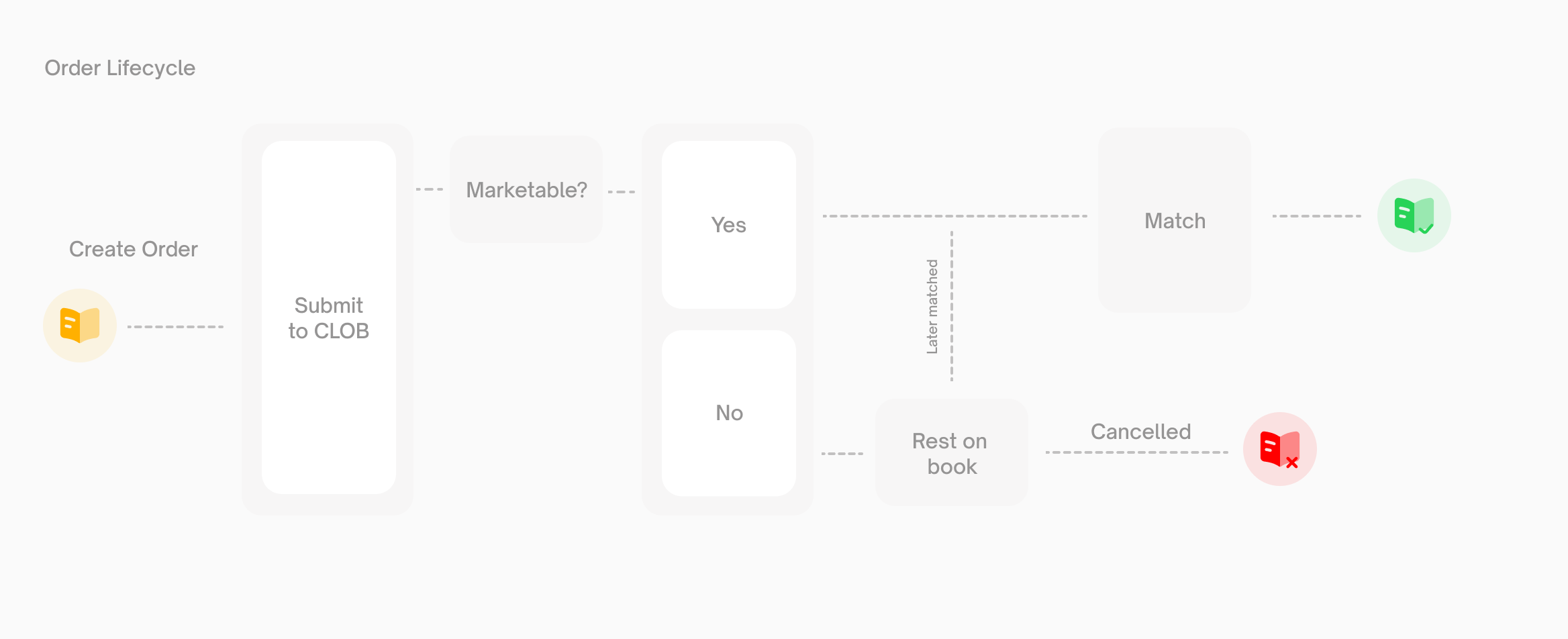
A taker order removes liquidity that is already resting on the book. A marketable buy crosses the best ask; a marketable sell crosses the best bid. Polymarket implements these as limit orders priced to execute immediately, rather than as a separate onchain “market order.”
If an order does not cross the spread, it is a maker order and can rest on the book. The 50ms announcement is about the taker path, not every order sent to the CLOB.
Why Polymarket had a taker delay
The delay gives resting quotes a short protection window when fast external markets move.
This is especially relevant for five- and fifteen-minute crypto markets. A market maker may be quoting a BTC outcome while watching a faster spot feed elsewhere. If BTC jumps, the Polymarket quote can become stale before it is replaced.
In June, Polymarket changed the behavior inside the then-250ms window. Its CLOB maintenance notice says a delayed taker order remains pending, reserves balance, rejects duplicates, and cannot be cancelled until the delay completes. The order is checked again before matching.
The new 50ms setting shortens that protected window. It does not remove the order checks around balance, allowance, market state, price, or available liquidity.
What 50ms changes for traders
The clearest benefit is less intentional waiting before a marketable crypto order can match. In a fast book, 200ms is enough time for a quote to disappear or for the best price to move.
But the end-to-end result still includes your own connection, request handling, the matching engine, and the book available when matching happens. A 50ms taker delay is not the same as a 50ms round trip, and it is not a promise that the displayed size will still be there.
For a manual trader, the change should make a fast crypto order feel less stale. It should not change the basic checks:
- look at the spread before crossing it
- keep a worst acceptable price
- expect partial or missed fills when depth is thin
- confirm the terminal order status before retrying
The distinction between FAK, FOK, GTC, and GTD still matters. Our Polymarket order types guide covers those execution rules without treating speed as a substitute for price control.
What it changes for bots and makers
For taker bots, 50ms reduces one fixed part of the latency budget. That may improve fill quality when a strategy reacts to a fresh crypto price or a book imbalance.
It also makes weak assumptions show up faster. A backtest that treats the displayed best ask as guaranteed, ignores fees, or assumes unlimited size is still unrealistic. Polymarket's current fee schedule applies taker fees to crypto markets, while makers pay no maker fee and can receive rebates.
For makers, the shorter window means less time to pull a stale quote before an incoming taker can match it. Quoting systems need current market data, disciplined inventory limits, and a cancellation path that does not assume a delayed taker can be withdrawn once it is pending.
An independent study of Polymarket's five-minute crypto microstructure measured the previous 250ms delay as a meaningful part of the old execution environment. Its results predate the 50ms change, so they are useful as a baseline, not proof of how strategies perform now.
What it means for copy trading
Copy trading has at least two separate delays: observing the source wallet and submitting the follower order. Polymarket's change only reduces the exchange-side taker hold on configured crypto markets.
It does not eliminate detection delay, network time, price movement after the leader's fill, slippage limits, or insufficient depth. A copied trade can still be late even when the exchange's own wait is shorter.
The practical response is to measure actual follower fills against source fills. Faster is useful only if the copied price remains acceptable. The same principle applies to self-hosted systems: the self-hosted bot comparison explains why infrastructure control and operational burden need to be evaluated together.
One documentation caveat
As of August 24, Polymarket's order lifecycle documentation still describes a 250ms crypto taker delay, even though the later developer announcement scheduled the move to 50ms.
That mismatch is worth stating plainly. The announcement is the newest first-party source for the number; the documentation remains the better source for the surrounding order lifecycle. Developers should check both—and verify the behavior of the specific market they trade—rather than building around a number copied from an old article.
The headline is simple: 250ms became 50ms for Polymarket's configured crypto taker flow. The trading lesson is less dramatic. Faster matching helps, but price, liquidity, fees, and final order status still decide whether the trade was good.
Polymarket Order Types Explained: FOK, FAK, GTC, GTD, Market, and Limit Orders
A practical guide to Polymarket order types for Telegram traders: market orders, limit orders, FOK, FAK, GTC, GTD, post-only errors, tick size, slippage, and failed orders.
Execution / 10 min
Polymarket Copy Trading: How It Works and How to Start From Telegram
Learn how Polymarket copy trading works, how to choose wallets, configure filters, control slippage, size positions, and manage risk from Telegram with PolyBot.
Copy Trading / 13 min