Polymarket Copy Trading: How It Works and How to Start From Telegram
Learn how Polymarket copy trading works, how to choose wallets, configure filters, control slippage, size positions, and manage risk from Telegram with PolyBot.

PolyBot Team
Updated August 22, 2026
Maintained by the PolyBot product team with AI-assisted editing. Examples explain workflow and risk; they are not return claims or financial advice.
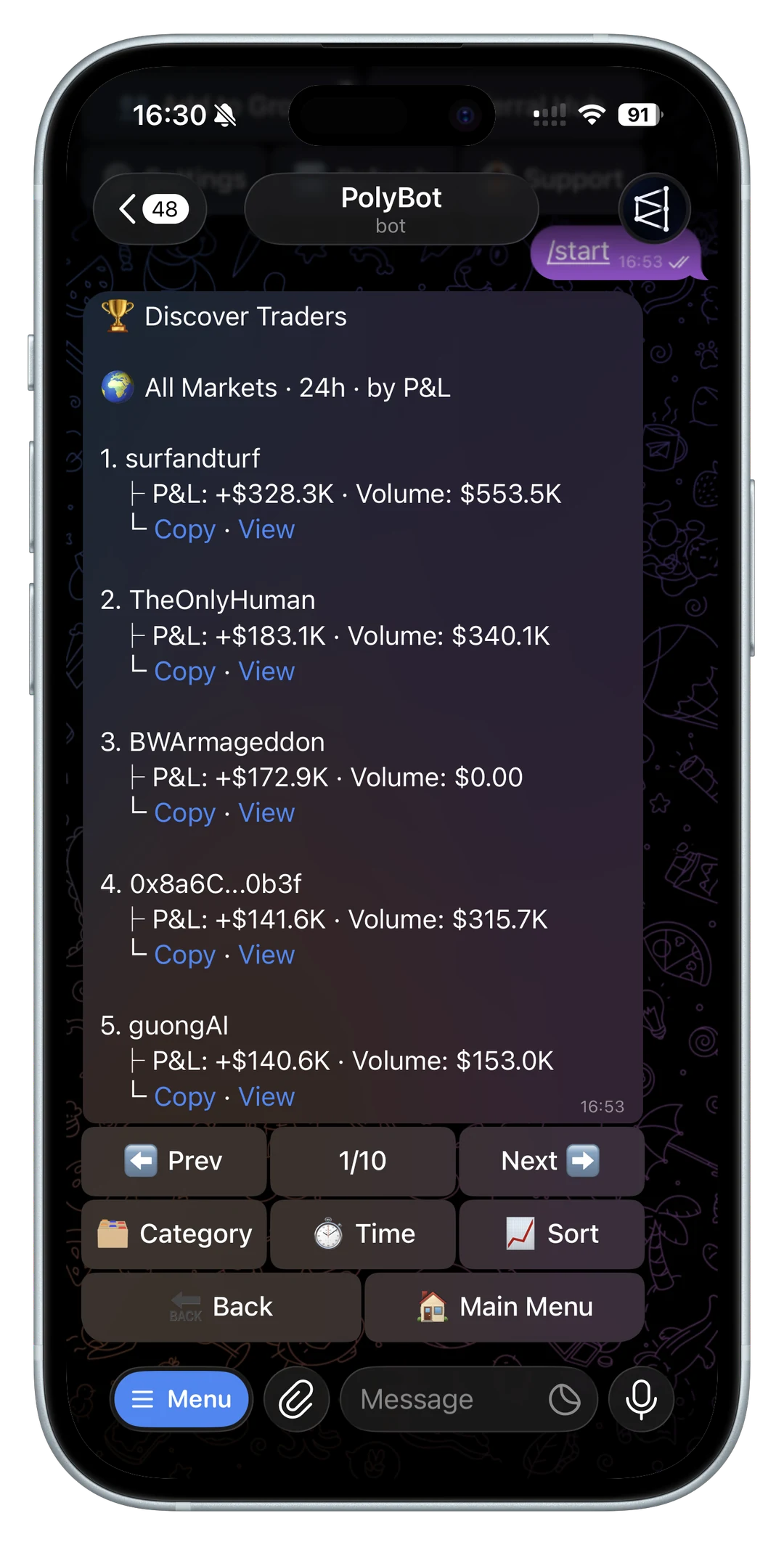
Polymarket copy trading is the process of following another trader's public market activity and mirroring selected trades into your own account.
The simple version sounds almost automatic: find a profitable wallet, copy it, and let the trader's edge work for you. The real version is more demanding. You still need to decide which wallet is worth copying, which markets are copyable, how much to size, how much slippage to allow, what to do when the copied trade moves against you, and when to stop.
That is why PolyBot treats copy trading as a controlled workflow, not a passive income button. The goal is to help you analyze wallets, shape copy rules around your own bankroll, and manage copied positions from Telegram without losing sight of the risk.
This guide explains how Polymarket copy trading works, how to start from Telegram, and how to avoid the mistakes that make copied trades perform worse than the source wallet.
What is Polymarket copy trading?
Polymarket copy trading means using another trader's activity as a signal for your own prediction market trades.
Instead of manually browsing markets, reading every order book, and deciding from scratch, you can follow a wallet that already trades Polymarket. When that wallet buys or sells, your setup can attempt to place a related trade for your own account, subject to the rules you choose.
The important phrase is "subject to the rules you choose." A good copy setup is not just "copy everything." It should answer questions like:
- Which wallets am I willing to copy?
- Which market categories should be included?
- What is the maximum size per copied trade?
- What is the maximum exposure per market?
- How much worse can my fill be than the leader's entry?
- Should I copy buys, sells, or both?
- What happens if the leader exits?
- What stop-loss, take-profit, or alert rules sit around the position?
Prediction markets make copy trading interesting because public wallet behavior can be studied. You can look for repeatable edge, category specialization, timing, sizing discipline, and consistency. But public history does not guarantee future performance. It only gives you better evidence before you decide what to copy.
If you are still learning the research side, start with the smart money copy trading playbook and the Polymarket wallet analyzer guide.
How Polymarket copy trading differs from crypto copy trading
Most copy trading content is written for crypto perpetuals, centralized exchanges, or vault-style systems. Polymarket is different.
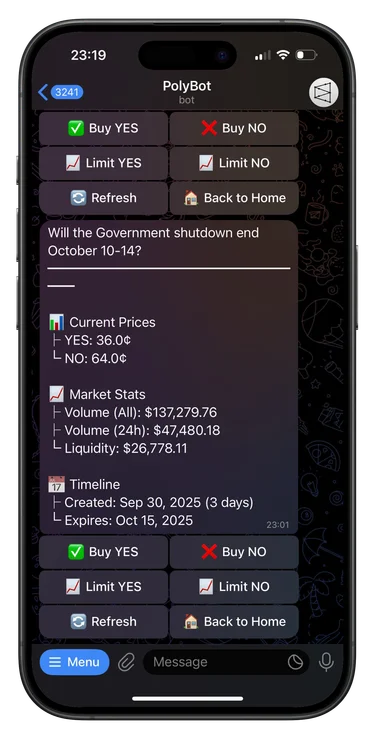
On Polymarket, traders buy and sell shares in event outcomes. A YES share priced at 40 cents is not the same thing as a leveraged BTC long. The trade has a market question, resolution rules, a deadline, liquidity constraints, and binary outcome risk. That changes how copy trading should be evaluated.
The biggest differences are:
- Market wording matters. You are copying exposure to a specific event question, not just a ticker.
- Liquidity is uneven. Large markets may absorb follower demand cleanly, while niche markets can move after one source trade.
- Category edge is common. A trader may be excellent in politics, weather, sports, or crypto up/down markets and weak elsewhere.
- Timing can dominate. A fast-news wallet may win because it enters before the market reprices, which can be hard to copy after delay.
- Position management matters. Some traders win by exiting early, scaling out, or managing baskets of related outcomes.
- Bankroll fit matters. A strategy that works for a six-figure wallet may not work if you can only copy one leg of a broader position set.
That is why a Polymarket copy trading bot should give you filters, caps, slippage controls, and visibility into copied results. Blind mirroring is fragile.
How copy trading works in PolyBot
PolyBot is built around a Telegram-first Polymarket workflow. The idea is to keep research, copy settings, alerts, execution, and portfolio review close to the place where traders already watch signals.
A practical PolyBot copy trading workflow looks like this:
- Find a wallet or trader worth reviewing.
- Analyze the wallet with the PolyBot wallet analyzer.
- Decide what kind of edge the wallet appears to have.
- Configure copy filters, sizing, caps, and slippage.
- Add risk controls such as stop-loss, take-profit, trailing stops, or alerts.
- Start with small exposure.
- Review copied fills against the source wallet.
- Pause, narrow, or stop the setup when the evidence gets weaker.
PolyBot is not trying to make every wallet look copyable. A useful copy trading workflow should reject weak setups. Sometimes the correct result of wallet analysis is "watch only," "copy only one category," or "do not copy this wallet at your size."
For the broader product surface, read the Telegram trading bot for Polymarket guide.
Step 1: Build a wallet shortlist
Do not start by copying the top wallet you see on a leaderboard.
Leaderboards are useful for discovery, but they can hide important context. A wallet may rank well because of one large win, because it traded a category that is no longer active, or because it uses sizes you cannot reasonably mirror. Another wallet may look less impressive but have a cleaner, more repeatable strategy.
When building a shortlist, look for:
- meaningful realized PnL across more than one market
- enough trades to reduce pure luck as the explanation
- recent activity
- clear market specialization
- consistent position sizing
- entries that occur in markets with enough liquidity
- exits that can be monitored or copied
- behavior that still makes sense at your bankroll size
Also look for reasons not to copy. If a wallet trades mostly thin markets, wins from one unresolved position, or enters before public information is widely available, it may be interesting to study but hard to copy.
The best source wallets are not always the loudest ones. They are the wallets whose behavior can be understood, filtered, and repeated with your own constraints.
Step 2: Analyze the wallet before copying
Before you activate copy trading, answer one question: is this wallet's edge copyable for me?
The PolyBot Polymarket wallet analyzer is built for this step. It helps review wallet behavior before capital goes live, including performance, category mix, sizing patterns, and copy risk.
Useful wallet analysis questions include:
- Is profit broad or concentrated in one market?
- Does the wallet have a real category edge?
- Does win rate hold up after looking at average win and average loss?
- Are large trades better than small trades?
- Does the wallet trade markets that still have liquidity after its entry?
- How often does the wallet exit manually before resolution?
- Would a follower get similar prices or much worse prices?
- Does the strategy require copying every related leg?
Raw PnL is only the start. A wallet can be profitable and still be a poor copy target. The job of analysis is to separate "good trader" from "good trader for my copy setup."
Step 3: Identify the type of edge
Different wallets win for different reasons. Your settings should match the edge you are trying to copy.
Expertise edge
Some traders win because they understand a category better than the crowd. That might be politics, sports, crypto, macro, weather, entertainment, or another market type.
For expertise wallets, category filters matter. If the wallet is strongest in one area, copying every unrelated market can dilute the edge.
Strategy edge
Some traders win because they repeat a specific setup across many markets. The edge might come from basket construction, price ranges, market timing, or consistent risk/reward.
For strategy wallets, you need to know whether the strategy requires full coverage. If the wallet enters five related markets and you only copy one, you may not be copying the actual strategy.
Information edge
Some traders win because they react quickly to new information. These wallets can be valuable, but they are also the most sensitive to execution delay.
For information-speed wallets, you need to pay close attention to slippage and fill quality. If the source wallet buys at 34 cents and followers get filled at 47 cents, the copied trade may no longer be the same opportunity.
Sizing edge
Some traders reveal their conviction through size. Their small trades may be noise while their large trades carry more signal.
For sizing-edge wallets, a minimum source trade threshold can be useful. You may decide to copy only when the leader's trade is large enough to suggest conviction.
Step 4: Configure copy filters
Filters are what turn copy trading from blind mirroring into a controlled setup.
Useful filters include:
- market category filters
- minimum source trade size
- maximum copied trade size
- price or odds range
- buy-only or sell-only mode
- per-market exposure cap
- daily copied volume cap
- maximum active copied positions
- slippage limit
- pause rules after repeated failed or poor fills
The narrower setup is often the stronger setup. If a wallet is strongest in NBA markets, copy NBA. If a wallet only performs well on high-conviction entries, copy above a size threshold. If a wallet's edge is thin, use strict slippage or do not copy it.
For a tool-selection checklist, read the best Polymarket copy trading bot checklist.
Step 5: Size around your own bankroll
Never copy another wallet's dollar size just because the source wallet can afford it.
Source-wallet size reflects that trader's bankroll, risk tolerance, and portfolio context. Your copy size should reflect yours.
A practical sizing framework:
- Start with a small fixed amount per copied trade.
- Cap exposure per market.
- Cap total daily copied volume.
- Avoid copying multiple correlated wallets at full size.
- Increase only after reviewing enough copied fills.
- Reduce size when markets are thin or execution gaps are large.
Copy trading should make your process more disciplined, not transfer someone else's risk profile into your account.
This is especially important in prediction markets because outcomes can go to zero. A position that looks small for the source wallet may be oversized for you.
Step 6: Control slippage and execution quality
Slippage is the gap between the source wallet's trade and your copied fill.
In liquid markets, that gap may be small. In thin or fast-moving markets, it can decide whether the copied trade still has positive expected value.
Watch for:
- source wallet entry price
- copied entry price
- time between source trade and copy attempt
- filled size versus requested size
- skipped trades and skip reasons
- market spread at the time of copy
- category where slippage is worst
Not every skipped trade is bad. Sometimes a skip means your rules protected you from a worse entry. A good review process distinguishes missed opportunity from avoided bad fill.
For a deeper explanation, read why execution speed matters in prediction market copy trading.
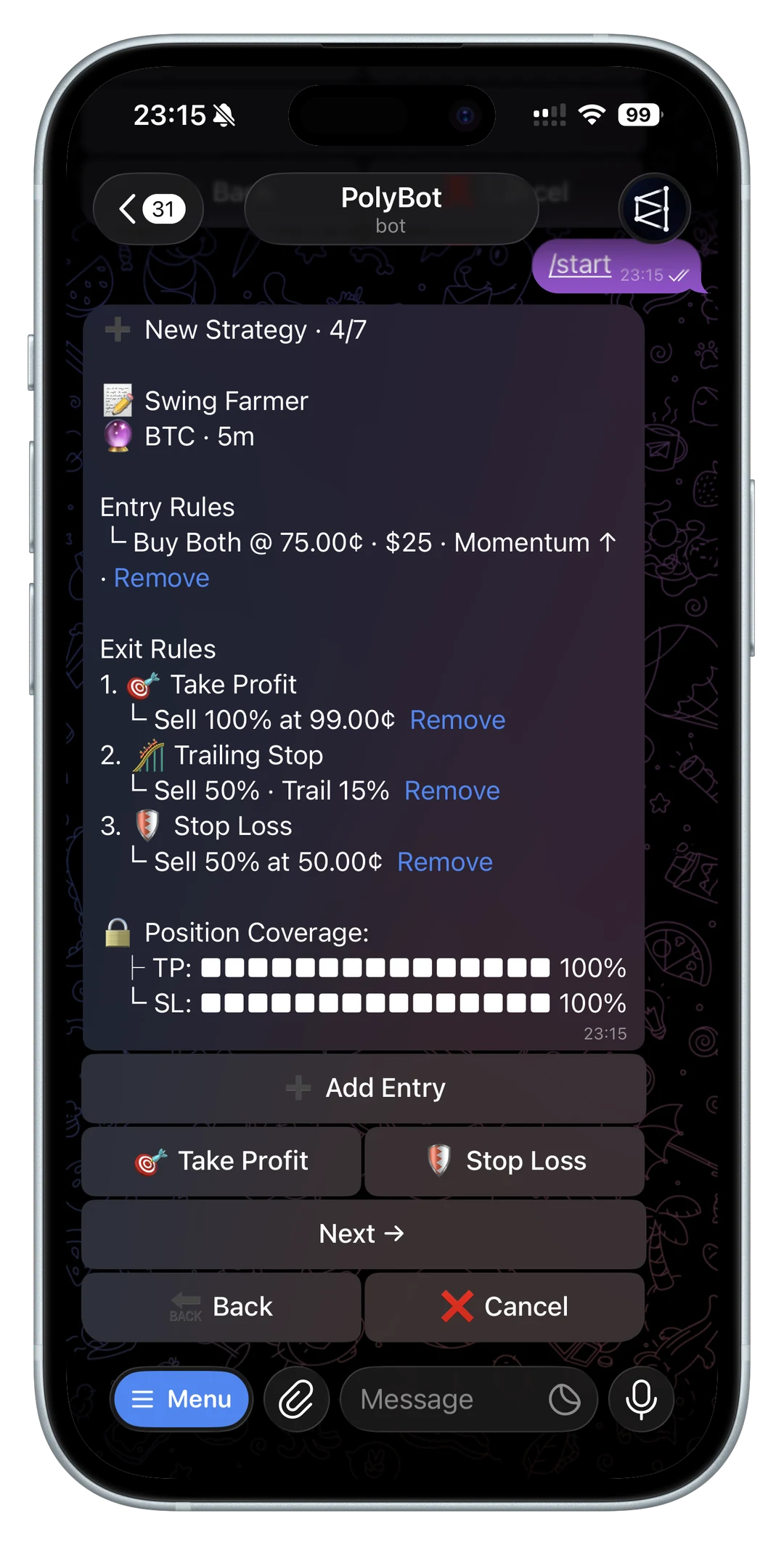
Step 7: Add exit logic
Many copy setups focus only on entries. That is a mistake.
Before copying, decide how positions should be managed after entry:
- Should the copied position close when the leader exits?
- Should you use a stop-loss if the trade moves against you?
- Should you take profit at a fixed return?
- Should you use alerts instead of automatic exits?
- Should partial exits be allowed?
- Should copy trading pause after a drawdown?
PolyBot combines copy trading with automated strategy controls, so entries and risk rules can live in the same Telegram workflow. For position monitoring and exit workflows, read the Polymarket portfolio and orders guide.
Exit logic is not about making copy trading safe. It is about deciding what risk you are willing to keep and what risk should trigger action.
Step 8: Monitor copied performance
A copied wallet is not a permanent asset. Edge can decay.
After activation, review:
- copied PnL
- source-wallet PnL
- fill quality
- skipped trades
- missed exits
- category performance
- drawdowns
- changes in source-wallet behavior
- copied exposure by market
If copied performance diverges from the source wallet, diagnose why before adding more size. The issue may be poor fills, a category mismatch, a wallet whose edge has faded, or a strategy that is not suitable for your balance.
Make one change at a time. If you adjust size, category filters, slippage, and exits all at once, you will not know which change helped.
Fees, custody, and safety
Copy trading math should include costs and custody.
Before funding any bot or copy trading workflow, understand:
- who controls the wallet
- how deposits and withdrawals work
- what fees apply to trades
- whether gas is sponsored or paid by the user
- whether private keys or signer permissions are explained clearly
- how to pause copy trading
- how to recover access if Telegram access changes
PolyBot is built around a Safe wallet flow and Telegram-first controls. Still, users should verify official links before funding any Telegram bot. Start with official PolyBot links and fake bot safety, then review the fees, custody, gas, and safety checklist.
Be skeptical of any copy trading claim that implies guaranteed profit, risk-free automation, or no need to understand the market.
Common Polymarket copy trading mistakes
Avoid these patterns:
- copying the top leaderboard wallet without analysis
- copying every market from a specialist wallet
- using the source wallet's dollar size instead of your own sizing rules
- ignoring slippage because the source wallet is profitable
- copying thin markets with too much size
- treating one lucky copied win as proof the setup works
- failing to monitor exits
- leaving copy trading active after the source wallet changes behavior
- using a bot without verifying custody, fees, and official links
Most bad copy trading setups fail for boring reasons: weak wallet selection, poor sizing, loose slippage, or no review loop.
A practical beginner workflow
If you are starting from zero, keep the first setup narrow.
- Pick one wallet.
- Analyze it with the wallet analyzer.
- Identify the edge you are trying to copy.
- Choose one market category.
- Use small fixed sizing.
- Set a per-market cap and daily cap.
- Keep slippage conservative.
- Add alerts for copied fills, skips, and exits.
- Review after enough trades to see a pattern.
- Expand only if copied results match the reason you chose the wallet.
Is PolyBot the right Polymarket copy trading bot?
PolyBot is designed for traders who want Polymarket copy trading inside a broader Telegram trading workflow.
That matters if you want:
- wallet analysis before copying
- copy filters and sizing controls
- Telegram alerts and portfolio review
- market and limit order workflows
- automated exits and strategy controls
- Safe wallet control
- one place to trade, monitor, and adjust settings
For product context, read the PolyBot review checklist, the Telegram trading bot guide, and the comparison hub.
Polymarket copy trading questions
Can you copy trade on Polymarket?
Yes, but the quality of the setup matters. A practical copy trading workflow should analyze wallets, filter markets, control sizing, limit slippage, and monitor copied positions instead of blindly mirroring every trade.
What is the best wallet to copy on Polymarket?
There is no universal best wallet. A good wallet for copy trading has repeatable behavior, enough history, a clear category or strategy edge, copyable liquidity, and sizing that can be adapted to your bankroll.
Should beginners use Polymarket copy trading?
Beginners should learn manual market review first, then test copy trading with small size and strict caps. Copy trading can reduce research load, but it does not remove market risk, liquidity risk, or the need to understand what is being copied.
How much should I allocate to a copied wallet?
Start small and cap exposure. The right amount depends on your bankroll, the wallet's trade frequency, liquidity, slippage, and drawdown behavior. Do not copy the source wallet's dollar size unless your bankroll and risk tolerance actually match.
What makes Telegram useful for copy trading?
Telegram is useful when it reduces friction between signals, alerts, settings, order review, and portfolio monitoring. For Polymarket traders who already watch markets in Telegram, keeping copy controls close to alerts can make the workflow easier to manage.
Build a copy process, not a blind mirror
The best Polymarket copy trading setup is not the one that copies the most trades. It is the one that copies the right trades under rules you understand.
Use wallet analysis before copying, configure filters around the actual edge, size around your own bankroll, monitor slippage, and keep exit rules visible. That is how copy trading becomes a repeatable process instead of a leaderboard bet.
Not investment advice. Prediction markets are risky, copy trading can lose money, and public wallet history does not guarantee future performance.
Best Polymarket Copy Trading Bot? Use This Checklist Before You Pick One
Compare Polymarket copy trading bots by execution, wallet analysis, copy filters, risk controls, custody, fees, and Telegram workflow before you trust a setup.
Copy Trading / 13 min
Follow Smart Money: The Playbook for Copy Trading in Prediction Markets
Copy trading is more than mirroring. Learn how to find traders with real edge and configure setups that preserve it in prediction markets.
Trading Playbook / 7 min