Polymarket Wallet Analyzer Guide: PnL, Win Rate, Sizing, and Copy Risk
A practical guide to analyzing a Polymarket wallet before copying it: PnL, win rate, category edge, trade sizing, timing, liquidity, and copy-trading risk.

PolyBot Team
Updated June 2, 2026
A Polymarket wallet analyzer should answer one question before anything else: is this wallet's edge real enough, repeatable enough, and copyable enough to matter?
Raw PnL is not enough. A wallet can make a large profit from one market, get lucky on a low-sample run, or trade in a way that is impossible to copy after price movement. To evaluate a trader properly, you need to look at behavior, market selection, sizing, timing, and liquidity.
This guide explains what to check before you copy a wallet on Polymarket.
You can run the same process with the free PolyBot Polymarket wallet analyzer. If you are starting from a public profile rather than a raw address, convert the profile into a wallet-level review before you copy. If you need candidates first, start with PolyBot smart wallets. For the broader end-to-end workflow, read the Polymarket copy trading guide.
If your first step is simply finding or checking an address, read the Polymarket wallet lookup guide before interpreting positions, activity, and profile data.
If the wallet appears to profit from related-market baskets or arbitrage, read the Polymarket arbitrage guide before assuming the behavior is copyable.
If the wallet came from a large-trade notification, read the Polymarket whale alerts and wallet tracker guide before assuming the alert is copyable.
If you are still building the shortlist, use the best Polymarket traders to copy guide before spending time on deeper wallet analysis.
If the wallet came from a ranking page, the Polymarket leaderboard guide explains why category, period, PnL, and volume need separate review.
If you use AI to summarize wallet behavior or classify trader style, read the Polymarket AI trading bot guide before treating a model explanation as proof of edge.
Quick answer: what should a Polymarket wallet analyzer show?
A good Polymarket wallet analyzer should turn public wallet activity into a copy-trading decision, not just display a profit number.
At minimum, it should show:
- realized and unrealized PnL context
- win rate with average win and average loss
- market categories where the wallet performs best
- trade-size distribution and conviction patterns
- timing, speed, and whether entries are still copyable
- liquidity, spread, and slippage risk for followers
- recent behavior changes, drawdown, and sample size
- recommended copy settings or reasons not to copy
Official Polymarket docs are useful background because wallet analysis depends on the same market, order, and trade data used by the trading system. Use the Polymarket API overview, CLOB trading docs, and Polymarket fee docs when comparing wallet-analyzer claims against the underlying data.
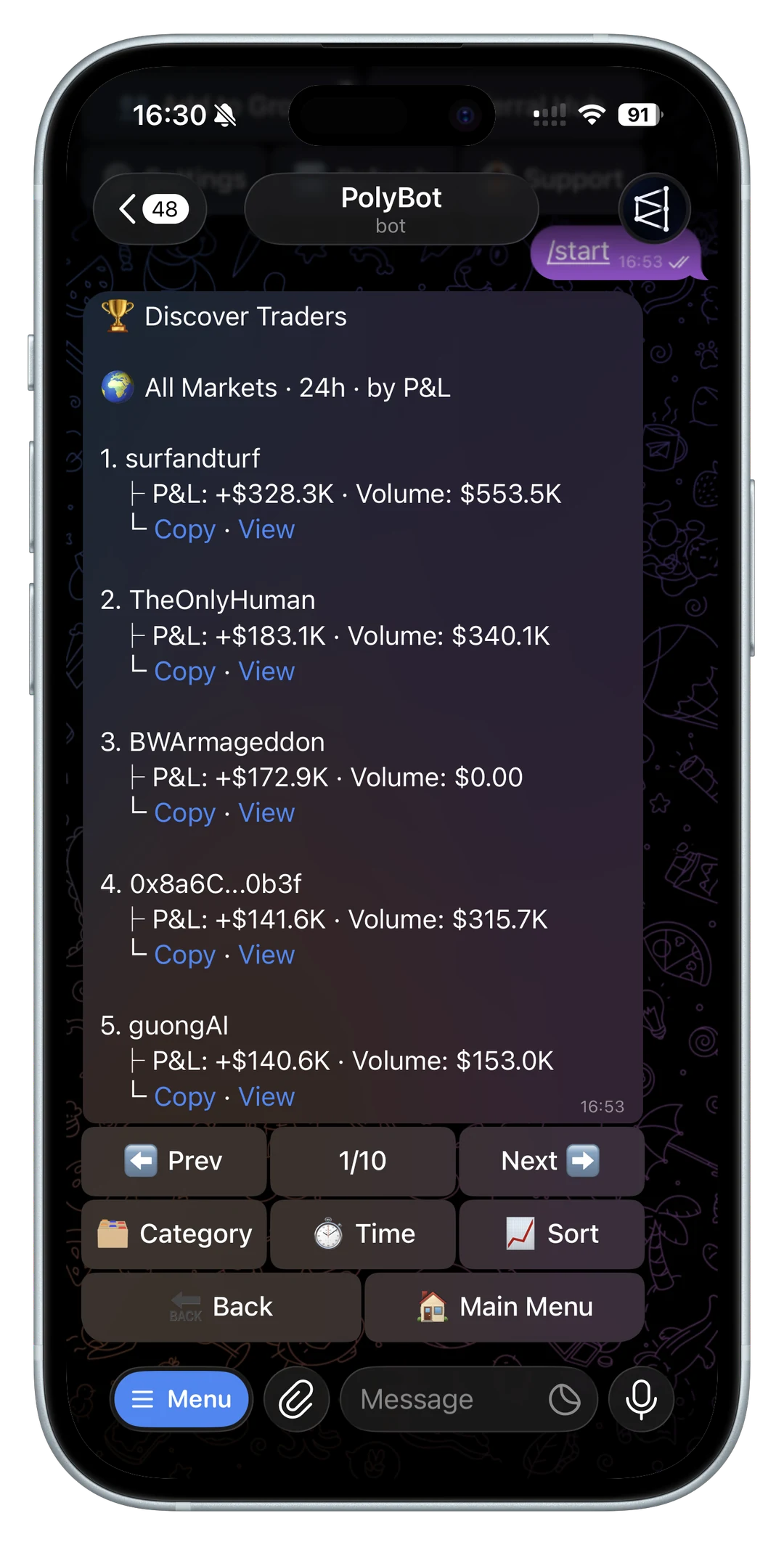
Wallet analyzer vs wallet tracker vs leaderboard
These tools overlap, but they answer different questions.
| Tool | Best question | Risk if used alone |
|---|---|---|
| Wallet tracker | What did this wallet do recently? | recent activity can look important even when it is not profitable or repeatable |
| Whale alert | Did a large trade just happen? | the alert may arrive after price, liquidity, or spread already changed |
| Leaderboard | Which traders rank highly by PnL, volume, or category? | rank can hide one-off wins, stale performance, or uncopyable size |
| Wallet analyzer | Is this wallet's behavior repeatable and copyable for my account? | analysis can still be wrong if sample size is small or market conditions change |
The best workflow uses all four in order: discover wallets, track activity, analyze behavior, then configure copy trading only if the evidence survives slippage, fees, and bankroll checks.
Start with PnL, but do not stop there
PnL tells you whether the wallet made money. It does not tell you why.
Useful PnL questions:
- Was the profit earned across many markets or concentrated in one event?
- Did the wallet win steadily, or did one trade create most of the result?
- Is the PnL recent, or did the wallet stop trading months ago?
- Does the wallet keep profits after losses, or does it give back gains quickly?
The goal is to separate persistent behavior from a lucky highlight. A wallet that made $50,000 once may be less useful than a wallet that repeatedly compounds smaller edges across a category.
If you are comparing wallet performance against your own account, first separate realized and unrealized results with the Polymarket PnL tracker guide.
If the wallet came from a shared profit screenshot or Telegram result image, read the Polymarket PnL card guide before treating that screenshot as evidence of repeatable edge.
For wallet-level recordkeeping, pair that with the Polymarket trade history guide so fills, activity, positions, and redeems are reviewed separately.
Read win rate in context
Win rate is one of the most misunderstood copy trading metrics.
A high win rate can be weak if the wallet wins small and loses big. A lower win rate can be strong if the wallet sizes well and wins larger than it loses. Prediction markets also have binary outcomes, changing liquidity, and markets that can be partially traded before resolution, so win rate alone misses a lot.
Win rate needs context. When reviewing win rate, compare it with:
- average position size
- realized profit per win
- realized loss per loss
- average entry price
- whether the trader exits early or waits for resolution
- the market categories being traded
If a wallet wins often by buying near-certain outcomes at 96 cents, the win rate may look excellent while returns are small. If another wallet takes selective 35 to 55 cent entries with strong thesis quality, its win rate may be lower but more valuable.
Look for category edge
Many strong Polymarket traders are specialists. They may understand one market type deeply and perform poorly elsewhere.
Category analysis helps answer:
- Does the wallet win in politics but lose in sports?
- Does it only understand crypto up/down markets?
- Does it perform better in breaking-news markets or slower information markets?
- Is it trading categories you understand enough to monitor?
For politics-heavy wallets, read the Polymarket politics and election trading bot guide before turning category edge into a copy subscription.
This matters for copy trading because you do not have to copy everything. If the wallet's edge is concentrated in one category, your setup should usually reflect that. It also explains why raw rankings can mislead before treating a ranked wallet as copy-ready.
The smart money copy trading playbook explains this in more detail.
Study sizing behavior
Sizing tells you what the trader believes, not just what they clicked.
Check whether the wallet:
- sizes up only on high-conviction trades
- sprays many small speculative positions
- doubles down after losses
- uses consistent sizing across market types
- enters with one order or scales into a position
A wallet that has strong selection and disciplined sizing is usually easier to copy than one that swings randomly. If large trades are much better than small trades, a minimum copied trade threshold may help isolate the useful signal.
Check whether the edge is copyable
Some profitable wallets are hard to copy.
Examples:
- They trade thin markets where the next order moves the price.
- They react to news before most systems can mirror them.
- They enter at prices that disappear quickly.
- They exit manually in ways that are hard to follow.
- Their profit comes from full basket coverage, but your budget is too small to copy every leg.
This is why a wallet analyzer should lead into copy settings, not just show a score. A trader can be skilled and still be a poor copy target for your specific capital, latency, or risk rules.
Use timing to identify the type of edge
Timing often reveals the trader's edge.
If a wallet repeatedly enters before public news is widely processed, the edge may be information speed. If it buys mispriced outcomes across similar markets, the edge may be strategy. If it is consistently right in one subject area, the edge may be expertise.
Those types require different copy settings:
- information-speed wallets need fast execution and sensible slippage limits
- strategy wallets need full coverage and careful sizing
- expertise wallets need category filters
- conviction wallets may need minimum trade size filters
This is the difference between copying a wallet and copying the part of the wallet that actually works.
Watch liquidity and slippage
Prediction market liquidity is not uniform. A trade that looks profitable on the leader wallet may be much weaker for followers if the order book is thin.
The Polymarket liquidity, spreads, and slippage guide explains how to judge order-book depth before treating a wallet's historical fill as copyable.
For the fee and cost side of the same copyability question, read the Polymarket trading costs guide.
Before copying, ask:
- How much volume does the wallet usually trade?
- Are entries in liquid markets or small niche markets?
- How far would the price move if your order followed?
- Does the wallet's average edge survive bot fees and worse fills?
For timing-sensitive wallets, read why execution speed matters in prediction market copy trading.
Convert analysis into settings
The final step is turning analysis into a copy setup.
Examples:
- Category specialist: copy only the categories where the wallet has edge.
- High-conviction trader: copy trades above a minimum size.
- Thin-margin strategy: use strict slippage or avoid copying.
- Full-basket strategy: lower sizing so you can copy the whole structure.
- Fast-news wallet: prioritize execution speed and simple settings.
PolyBot's wallet analyzer is designed to make this practical. Paste a wallet, profile URL, or username into the analyzer, review the edge profile, and use the recommended copy-trading setup as a starting point.
For the full control surface, read the Polymarket copy trading settings guide before turning analysis into a live subscription.
A simple pre-copy checklist
Before you turn on copy trading, make sure you can answer:
- What market categories does this wallet actually win in?
- Is the PnL broad or concentrated?
- Is the win rate supported by profitable sizing?
- Are the entries liquid enough to copy?
- What slippage would make the setup no longer worth it?
- What budget is needed to copy the strategy properly?
- What stop-loss, take-profit, or alert rules should sit around the setup?
If those answers are unclear, keep analyzing. A wallet analyzer is most useful when it prevents a bad copy relationship before it starts.
For sizing the actual allocation, read the Polymarket copy trading bankroll and drawdown guide.
For follower results that are mostly skips, read the Polymarket copy trading skipped trades guide before assuming the analyzed wallet is uncopyable.
Wallet analyzer questions traders ask first
What should a Polymarket wallet analyzer show?
A useful analyzer should show more than headline PnL. It should help you inspect realized performance, open exposure, win rate context, trade sizing, category mix, timing, liquidity, and whether the wallet's behavior is copyable.
Is high PnL enough to copy a wallet?
No. High PnL can come from one outlier market, a large bankroll, or entries that followers cannot copy at the same price. Treat PnL as a starting point, then check repeatability and execution quality.
Can wallet analysis predict future results?
No. Wallet analysis can reveal behavior and risk patterns, but it cannot prove that an edge will continue. Use it to avoid weak copy targets and to set conservative filters, not to assume future profit.
Not investment advice. Prediction markets are risky, and copy trading can lose money even when the original wallet remains profitable.
Polymarket Whale Alerts and Wallet Tracking: Use Large Trades Without Blind Copying
How to use Polymarket whale alerts and wallet tracking responsibly: big trade alerts, wallet analysis, copy-trading filters, liquidity checks, and Telegram workflow.
Wallet Analysis / 12 min
Polymarket Leaderboard Guide: PnL, Volume, Wallet Rankings, and Copy Trading Risk
How to read a Polymarket leaderboard before copy trading: PnL, volume, time windows, category rankings, wallet activity, liquidity, and when top traders are not copyable.
Wallet Analysis / 10 min