Polymarket Leaderboard Guide: PnL, Volume, Wallet Rankings, and Copy Trading Risk
How to read a Polymarket leaderboard before copy trading: PnL, volume, time windows, category rankings, wallet activity, liquidity, and when top traders are not copyable.

PolyBot Team
Updated August 22, 2026
Maintained by the PolyBot product team with AI-assisted editing. The ranking framework is editorial guidance, not a performance promise.
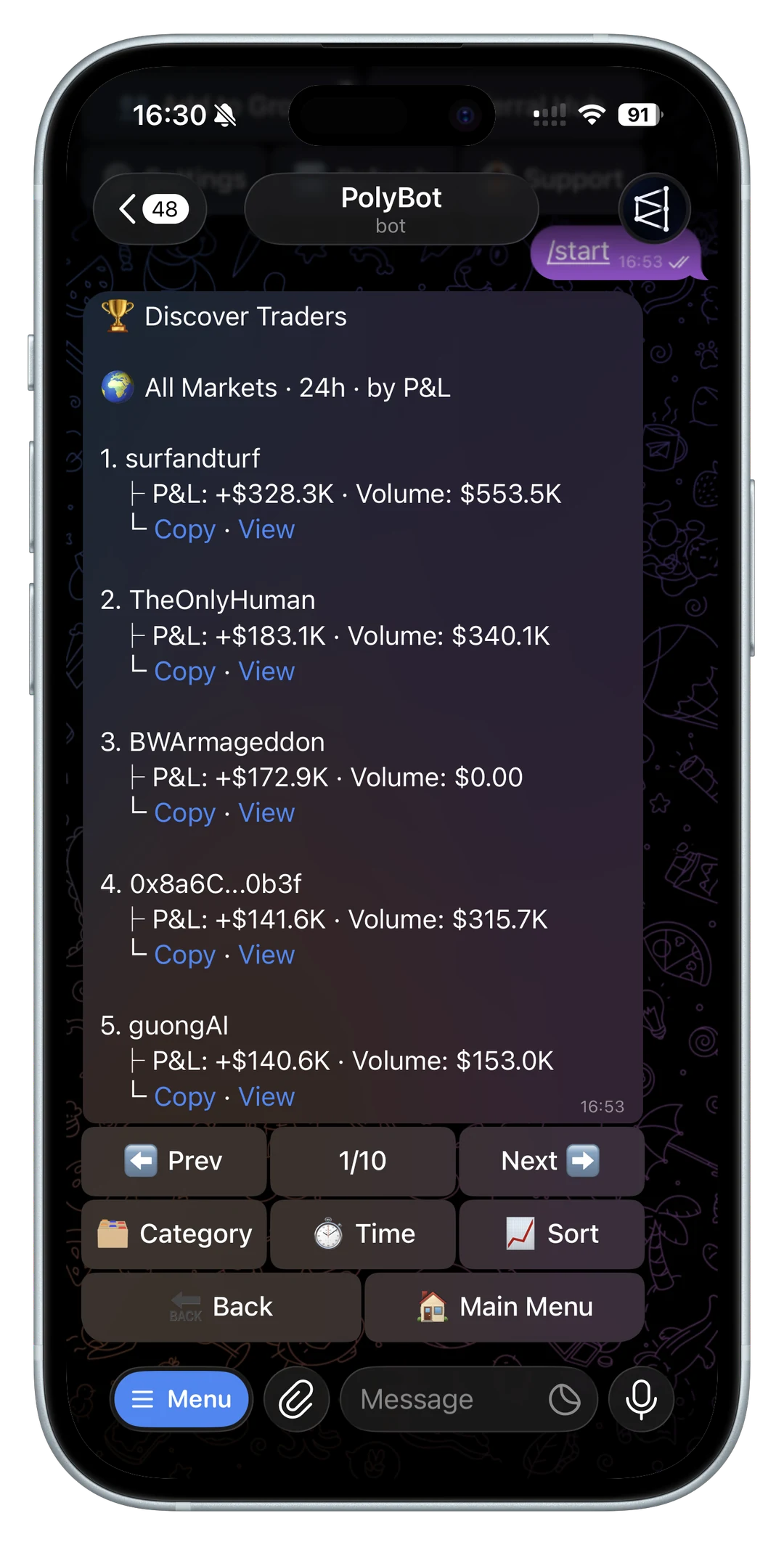
A Polymarket leaderboard is a discovery tool, not a copy-trading plan.
If your goal is to move from leaderboard discovery to an actionable shortlist, open the live top Polymarket traders ranked for copyability. It adds copy margin, sample quality, suggested capital, and risk flags to the raw ranking question covered in this guide.
It can help you find active wallets, profitable traders, category specialists, and high-volume accounts worth analyzing. But a rank by itself does not tell you whether the trader is still active, whether the PnL came from one market, whether the strategy is liquid enough to copy, or whether a smaller bankroll can survive the same swings.
Polymarket's public API documentation includes a trader leaderboard endpoint with rank, wallet, username, volume, PnL, profile image, X username, and verified badge fields. It also supports category, time period, and ordering parameters. That is useful data, but the trader still needs a second layer of review before you mirror anything.
Use this guide when you are reading a leaderboard and trying to decide which wallets deserve deeper analysis in the Polymarket wallet analyzer.
When a leaderboard gives you only an address or profile, use the Polymarket wallet lookup guide to connect that ranking to positions, activity, and profile context.
What a Polymarket leaderboard actually tells you
A leaderboard usually answers a narrow question: who ranks highest by a selected metric over a selected time window.
Depending on the tool or endpoint, the ranking may expose:
- trader rank
- wallet address or profile
- username
- PnL
- trading volume
- category
- time period
- verified badge or social profile
- pagination for more traders
The official Polymarket leaderboard API supports category filters such as overall, politics, sports, crypto, culture, weather, economics, tech, and finance. It also supports time periods such as day, week, month, and all time, plus ordering by PnL or volume.
That means "top trader" is not one universal thing. A trader can be top by all-time PnL and weak recently. Another can be top by daily volume but not profitable. Another can be strong in weather and irrelevant for politics.
PnL rank is not the same as copy quality
PnL is the number most people notice first. It is also the number most likely to be overused.
High PnL can mean:
- repeatable edge across many markets
- one very large winning market
- a large bankroll taking larger swings
- mark-to-market gains on unresolved positions
- a strategy that worked in one event cycle
- a trader who was early before liquidity improved
Only the first case is obviously useful for copy trading. The rest need more context.
Before treating PnL as a signal, ask:
- Is the PnL realized, unrealized, or mixed?
- Did one market create most of it?
- Is the trader still active?
- Are recent trades profitable too?
- Did the trader use size you can reasonably copy?
- Would a follower have entered near the same price?
Volume rank can hide very different behavior
Volume tells you how much a wallet traded. It does not tell you whether the trading was good.
A high-volume wallet can be:
- a disciplined active trader
- a market maker or automation-heavy account
- a trader churning in and out of positions
- a large bankroll spreading exposure across many events
- a wallet that trades frequently but keeps thin margins
Volume matters because it can show activity and liquidity tolerance. But for copy trading, high volume can also be a warning. If the trader's edge depends on speed, size, rebates, or market-making behavior, a follower may not be able to reproduce it.
Use volume as a reason to inspect a wallet, not as a reason to copy it.
Time windows change the interpretation
The same wallet can look different across day, week, month, and all-time rankings.
Short windows are useful for current activity. They can show who is trading now and which categories are moving. But they are noisy. One lucky market can dominate a daily or weekly ranking.
Long windows can show durable performance. But they may include old trades, old market regimes, or an abandoned strategy.
A better review compares multiple windows:
- All time: did the wallet ever create meaningful profit?
- Month: is the edge still active?
- Week: is the trader currently engaged?
- Day: is there a live catalyst or temporary spike?
If a wallet only ranks well in one short window, wait for more evidence. If it ranks well all time but has no recent activity, watch instead of copying.
Category leaderboards are more useful than overall rankings
Overall rankings can mix unrelated skills. A trader who wins in sports may be useless in crypto. A politics specialist may have no edge in weather. A high-volume account may appear strong overall because it trades everything.
Category leaderboards help isolate the question that matters:
Which trader appears strong in the market type I actually want to follow?
When reviewing category rankings, check:
- whether the trader has repeated wins in the category
- whether recent trades still match the same category
- whether losses came from outside the specialty
- whether the category is liquid enough for your size
- whether you understand the market type well enough to monitor exits
This connects directly to copy settings. If the edge is category-specific, use category filters instead of copying the whole wallet.
Verified badges and usernames are identity signals, not trading proof
A username, social profile, or verified badge can help you avoid confusing one wallet with another. It does not prove the wallet is worth copying.
Identity context is useful when:
- you need to confirm the same trader across tools
- you want to avoid copying an impersonator
- the trader's public commentary explains their market focus
- a group shares a trader card and you need to verify the wallet
But identity does not replace trade review. The wallet still needs PnL context, category analysis, sizing review, activity checks, and liquidity review.
For official-link and fake-bot safety, use the official PolyBot links checklist before funding or clicking bot links from a shared ranking page.
Use activity history to explain the leaderboard number
A leaderboard number is a summary. Activity history is the evidence underneath it.
Polymarket's user activity documentation includes records with fields such as wallet, timestamp, market, side, size, USDC size, price, outcome, and activity type. Activity types include trades, splits, merges, redeems, rewards, conversions, maker rebates, and referral rewards.
That matters because two traders can show similar PnL for different reasons. One may have clean buys and sells. Another may have rewards, redeems, partial exits, or a few unresolved positions driving the current value.
Before copying a ranked wallet, inspect:
- recent buys and sells
- prices paid
- position sizes
- markets traded
- categories
- resolved versus unresolved markets
- redeem activity
- whether the trader exits or mostly holds
- whether PnL is supported by many trades or one event
Treat activity, fills, positions, and accounting snapshots as separate evidence. A trade list alone does not prove realized profit or current exposure.
Convert a leaderboard into a wallet shortlist
A strong leaderboard workflow should reduce the number of wallets you study, not tell you who to copy immediately.
Use this shortlist process:
- Pick the category that matches your strategy.
- Compare multiple time windows.
- Remove wallets with stale activity.
- Remove wallets where one event explains most of the result.
- Remove wallets whose trade sizes are impossible for your bankroll.
- Keep wallets with repeat behavior and recent entries.
- Analyze the remaining wallets before subscribing.
The best Polymarket traders to copy guide goes deeper on turning that shortlist into a copy-trading decision.
Check copyability before copying a top wallet
Copyability is the difference between "this trader made money" and "I can reasonably follow this trader."
A top wallet may be hard to copy when:
- the market is thin
- the spread is wide
- the trader enters before the market moves
- the wallet uses large orders that shift price
- the trader scales in many times
- the strategy needs every related leg
- sells matter as much as buys
- the follower account has a smaller bankroll
For copied trades, entry price matters. If the leader bought at 34 cents and your copied order fills at 42 cents, the position is not equivalent. Your downside, upside, and exit threshold changed.
Read the liquidity, spread, and slippage guide before assuming a leaderboard wallet can be copied cleanly.
How PolyBot fits into leaderboard research
PolyBot's copy-trading flow is designed to turn a wallet into a controlled subscription, not a blind mirror.
After a leaderboard gives you candidates, use PolyBot workflows to:
- analyze the wallet
- pick fixed or proportional sizing
- set daily caps
- filter by price range
- control slippage tolerance
- apply trade size limits
- add per-outcome limits
- filter categories
- review skipped trades
- monitor copied performance
PolyBot's official Copy Trading Guide describes leaderboard discovery, direct wallet entry, group trader cards, subscriptions, sizing, filters, skip reasons, and performance views.
For the setting-by-setting setup, read the Polymarket copy trading settings guide.
A simple leaderboard review checklist
Before copying a ranked trader, answer these questions:
- What ranking did I use: PnL, volume, category, or time window?
- Is the wallet currently active?
- Did the PnL come from many markets or one event?
- Is the trader strong in a category I want to copy?
- Are recent trades still in that category?
- Are entry prices liquid enough for followers?
- Are the trader's order sizes compatible with my bankroll?
- Does the wallet exit positions in a way I can follow?
- What slippage would make the copy no longer worthwhile?
- What daily cap and max-per-trade limit should protect the setup?
If you cannot answer those questions, do not turn the leaderboard rank into an automated subscription yet.
Polymarket leaderboard questions
What does a Polymarket leaderboard rank?
A leaderboard can rank traders by metrics such as PnL or volume, often across a category and time window. The exact interpretation depends on the selected metric, period, category, and data source.
Is the top Polymarket trader the best wallet to copy?
Not automatically. The top-ranked trader may have one large win, old performance, a larger bankroll, or entries that followers cannot copy at similar prices.
Should I sort by PnL or volume?
Use PnL to find profit candidates and volume to find active traders, but treat both as discovery filters. Neither metric replaces wallet analysis, liquidity review, and sizing rules.
Why can copied results differ from a leaderboard wallet?
Copied results can differ because of slower entry, worse fill prices, slippage limits, skipped trades, daily caps, different sizing, category filters, and different exits.
What should I do after finding a ranked wallet?
Run the wallet through the Polymarket wallet analyzer, review category edge and copyability, then configure conservative copy settings before increasing exposure.
Not investment advice. Leaderboard data can be noisy, stale, incomplete, or hard to copy. Prediction-market trading and copy trading can lose money.
Polymarket Cuts Crypto Taker Delay From 250ms to 50ms
Polymarket reduced its crypto-market taker delay from 250ms to 50ms. Here is what changed for fills, trading bots, makers, and copy traders.
Execution / 5 min
Polymarket Copy Trading: How It Works and How to Start From Telegram
Learn how Polymarket copy trading works, how to choose wallets, configure filters, control slippage, size positions, and manage risk from Telegram with PolyBot.
Copy Trading / 13 min