Polymarket Copy Trading Settings: Sizing, Slippage, Caps, and Filters
How to configure Polymarket copy trading settings before mirroring a wallet: fixed vs proportional sizing, slippage, daily caps, price filters, category filters, stop losses, skip reasons, and performance review.

PolyBot Team
Updated June 1, 2026
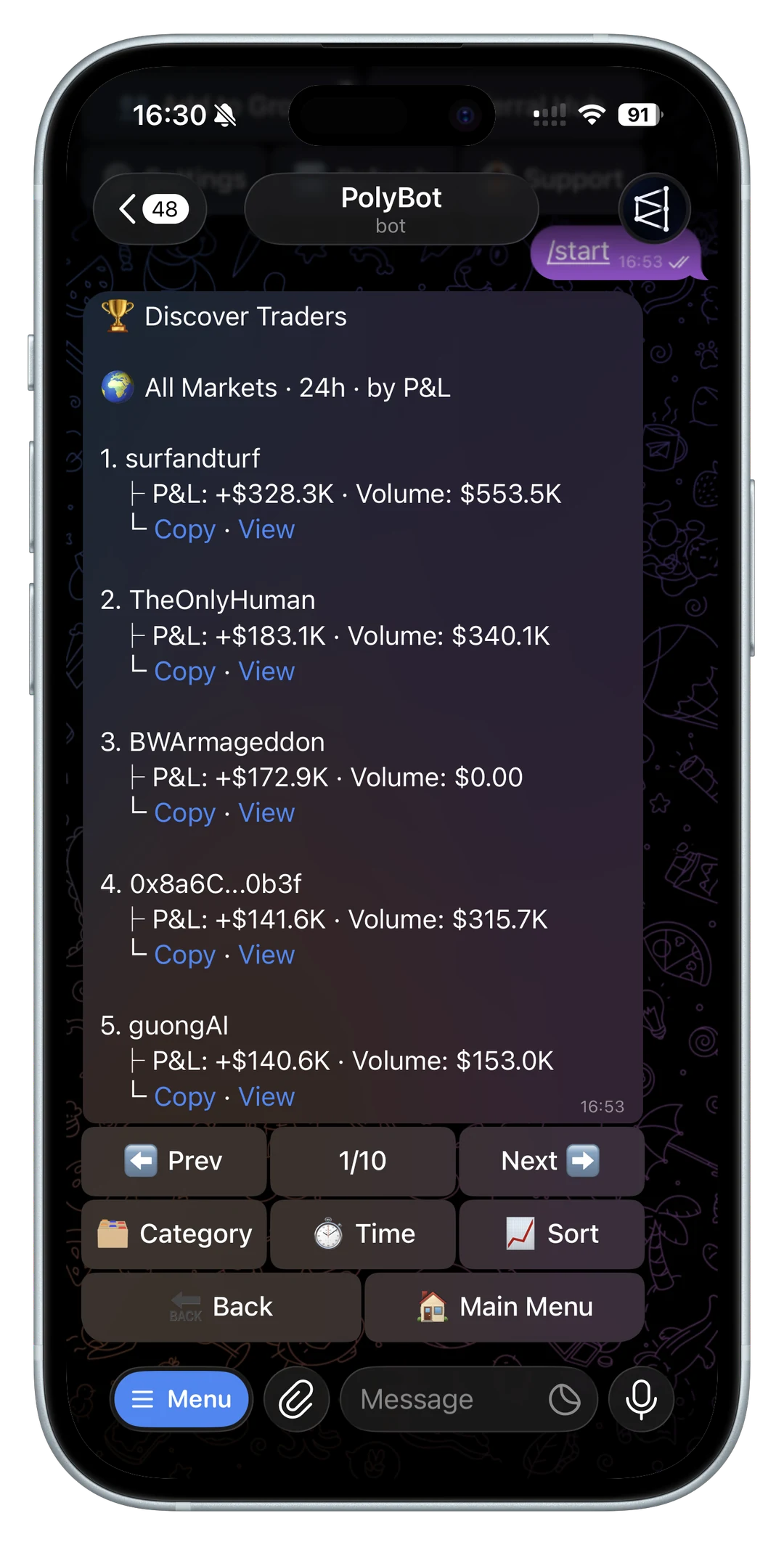
Copy trading is not one setting. A serious Polymarket copy setup is a stack of decisions: who to follow, how much to copy, which prices to accept, which markets to skip, when to pause, and how to review whether the copied result still matches the leader's edge.
That is why copy-trading settings matter as much as the trader you choose. A strong wallet can become a weak copy target if your sizing is wrong, your slippage is too loose, your category filters are missing, or your daily cap lets one busy leader use more balance than you planned.
PolyBot's official Copy Trading Guide describes subscriptions, sizing modes, daily caps, price range filters, slippage tolerance, advanced limits, copy modes, skip reasons, and performance views. This guide turns those controls into a practical setup checklist for Polymarket traders.
Before you configure any subscription, run the trader through the Polymarket wallet analyzer, then use these settings to copy only the behavior you actually want.
If you use alerts to monitor copied positions after entry, read the Polymarket price alerts bot guide so target-price notifications support copy settings instead of replacing caps, filters, and slippage limits.
If copied trades are already creating open exposure, use the Polymarket portfolio tracker bot guide to review positions by leader, market, PnL, open orders, and risk concentration.
If you have not picked the trader yet, start with the best Polymarket traders to copy guide, then come back here to configure the subscription.
If the trader came from a ranking page, use the Polymarket leaderboard guide to check the period, category, PnL, and volume context before setting copy rules.
If the trader came from a pasted address, use the Polymarket wallet lookup guide to verify positions, activity, and profile context before configuring the subscription.
If the trader came from a shared PnL screenshot, read the Polymarket PnL card guide before setting size, caps, or slippage around a single highlighted result.
If the leader uses related-market or arbitrage-style baskets, read the Polymarket arbitrage guide before copying only one visible leg.
If a copied setup depends on immediate execution versus resting limit behavior, read the Polymarket maker vs taker guide before loosening slippage or price filters.
For the broader sizing framework across manual trades and copied positions, read the Polymarket position sizing guide.
Start with the subscription, not the wallet hype
A copy-trading subscription is the configuration for one followed trader. It is where you decide what gets mirrored and what gets blocked.
Do not create a subscription just because a wallet has a large profit number. First answer:
- What category or market type explains the edge?
- Does the trader win with many small entries or a few high-conviction trades?
- Does the trader need fast execution to preserve the edge?
- Is the leader's size much larger than yours?
- Are their entries still copyable after slippage and fees?
- Do they sell positions in a way you want mirrored?
The how to copy trade on Polymarket from Telegram guide covers the full pre-copy workflow. This page focuses on the settings after you already have a candidate trader.
Fixed sizing vs proportional sizing
Sizing is the first real decision because it decides how much capital each copied trade can use.
Fixed sizing
Fixed sizing means each copied buy uses the same dollar amount, regardless of the leader's trade size.
Use fixed sizing when:
- you are testing a new leader
- your bankroll is much smaller than the leader's
- you want predictable exposure per copied trade
- the leader's sizing is noisy or too aggressive
- you do not yet trust the wallet enough to scale with conviction
Example: you set a fixed amount of $10. If the leader buys $75 or $750, your copied buy stays at $10.
The benefit is control. The drawback is that fixed sizing ignores the leader's conviction. If the trader only sizes up on their best ideas, fixed sizing may flatten the signal.
Proportional sizing
Proportional sizing copies a percentage or multiplier of the leader's size.
Use proportional sizing when:
- the leader sizes trades with discipline
- large leader trades are meaningfully better than small leader trades
- your balance can handle the variance
- the wallet's strategy depends on relative sizing
- you have enough tracked evidence from this leader
Example: at 0.10x, a leader's $500 buy becomes your $50 buy. At 0.50x, it becomes your $250 buy.
The benefit is signal preservation. The risk is that a large leader trade can become too large for your own bankroll. If you use proportional sizing, pair it with max-per-trade, max-per-outcome, and daily caps.
For the bankroll math behind this decision, read the Polymarket copy trading bankroll and drawdown guide.
Daily cap is your first circuit breaker
A daily cap limits how much one subscription can spend in a day. This matters because a high-volume leader can fire many trades before you check Telegram again.
Set a daily cap before increasing size. A practical starting point is to decide the maximum amount you would be comfortable losing or locking into copied positions from that leader in a single day, then set the cap below that number.
Daily caps are especially important when:
- the leader trades live sports or fast crypto markets
- the leader averages into positions repeatedly
- you follow multiple traders at once
- you use proportional sizing
- you cannot watch every notification
For sports-specific copy risk, read the Polymarket sports trading bot guide before widening category filters around live games.
If the daily cap is hit often, that does not automatically mean the setup is bad. It means the leader is more active than your current allocation allows. Review performance before raising it.
Price range filters protect you from bad odds
Polymarket prices carry implied probability. Copying every price can expose you to very different risk profiles.
A price range filter lets you define which outcome prices are copyable. For example, a 20 to 80 cent range avoids very low-probability long shots and very high-probability low-upside entries.
Use tighter price ranges when:
- the leader takes many speculative positions
- you only want mid-range opportunities
- you want to avoid 95 cent almost-certain buys with little upside
- you want to avoid 3 cent long shots with high variance
Use wider ranges only when the leader's edge actually lives near the extremes. Some traders specialize in long-shot mispricings or late-stage markets, but those setups need more evidence.
Price filters are not about making a trade safe. They are about preventing a copied setup from buying a kind of risk you did not mean to own.
Slippage decides whether you copy the same trade
Slippage is the difference between the leader's fill and your copied fill.
If a leader buys YES at 41 cents and your order fills at 48 cents, you did not copy the same expected value. You bought a later version of the trade at a worse price.
Tight slippage protects price quality but can cause more skipped trades. Loose slippage improves fill rate but can copy bad prices. Unlimited slippage should be treated carefully because it prioritizes execution over price discipline.
Use stricter slippage when:
- the leader's edge is thin
- the market is illiquid
- the market has a wide spread
- the leader usually buys early and waits
- you would rather skip than chase
Use looser slippage only when:
- the market moves quickly
- the leader's edge can survive worse fills
- missing the trade is worse than accepting drift
- you have evidence that filled copies still perform
For the execution mechanics, read why execution speed matters in prediction market copy trading, the liquidity, spreads, and slippage guide, and the Polymarket slippage tolerance guide. Fast execution helps, but settings still decide whether a fill is worth taking.
Trade size limits stop one order from dominating the setup
Advanced copy settings should include minimum and maximum copied trade sizes.
A minimum trade size can filter out low-conviction leader noise. If a leader's small test buys usually do not matter, a minimum threshold can keep your subscription cleaner.
A maximum trade size protects your account from outsized leader bets. This is essential if the leader has a much larger bankroll than you or occasionally presses very large positions.
Useful questions:
- What is the largest copied trade I am comfortable with?
- Are the leader's largest trades actually better than their normal trades?
- Should small leader trades be skipped as noise?
- Would one copied order make the rest of my portfolio too concentrated?
Trade size limits are not only risk controls. They are signal filters.
Per-outcome limits prevent repeated overexposure
Some leaders average into the same outcome many times. That can be sensible for them and still wrong for you.
Per-outcome limits control repeated exposure to one position. Depending on the setup, you may want to allow only one purchase per token, cap the number of buys per outcome, or cap the total amount copied into that outcome.
Use per-outcome limits when:
- the leader averages down aggressively
- a single market can consume too much balance
- you want exposure to the trader's ideas, not every scale-in
- you follow multiple leaders who may all buy the same outcome
Without per-outcome limits, copy trading can quietly become concentration trading.
Category filters copy the edge, not the entire wallet
Many strong Polymarket traders are specialists. A wallet can be excellent in NBA markets and weak in politics. Another can be strong in crypto up/down markets and mediocre everywhere else.
If the leader specializes in elections or campaign news, read the Polymarket politics and election trading bot guide before widening politics category filters.
If the leader specializes in BTC, ETH, SOL, or other up/down markets, read the Polymarket crypto trading bot guide before widening crypto category filters.
Category filters let you copy only the market types where the leader's edge is most likely to repeat.
Use category filters when:
- wallet analysis shows clear category concentration
- the leader trades markets you do not understand
- you want to avoid categories with different volatility or liquidity
- the trader's best results come from one niche
- you are building several subscriptions for the same leader
This is where the Polymarket wallet analyzer guide connects directly to copy settings. Analysis should become filters, not just a score.
Max expiry keeps the timeline manageable
Max expiry filters can skip markets that resolve too far in the future.
This matters because long-dated positions use capital differently from short-window trades. A trader may buy a market that takes weeks or months to resolve. If your copy setup is intended for short-cycle opportunities, that copied position can lock up balance and distort performance review.
Use max expiry when:
- you only want short-duration trades
- your balance is small
- you need faster feedback on copied performance
- the leader mixes short and long horizon markets
- you do not want dormant positions sitting in the portfolio
Long-dated markets are not bad by default. They just need to match your intended strategy.
Buy-only and counter-trade modes need extra care
Most users think of copy trading as mirroring both buys and sells. But copy modes can change that behavior.
Buy-only mode copies buys but skips sells. That can be useful if you want the leader's entries but prefer to manage exits yourself. The risk is obvious: if you ignore exits, your copied portfolio can drift away from the leader's actual result.
Counter-trade mode buys the opposite side. Treat this as an advanced mode. It only makes sense if you have strong evidence that a leader is consistently wrong in a way that can be faded after fees, slippage, and liquidity.
Before using either mode, decide:
- Who owns the exit decision?
- How will open positions be reviewed?
- What happens if the leader exits quickly?
- Do you need stop losses or alerts around copied positions?
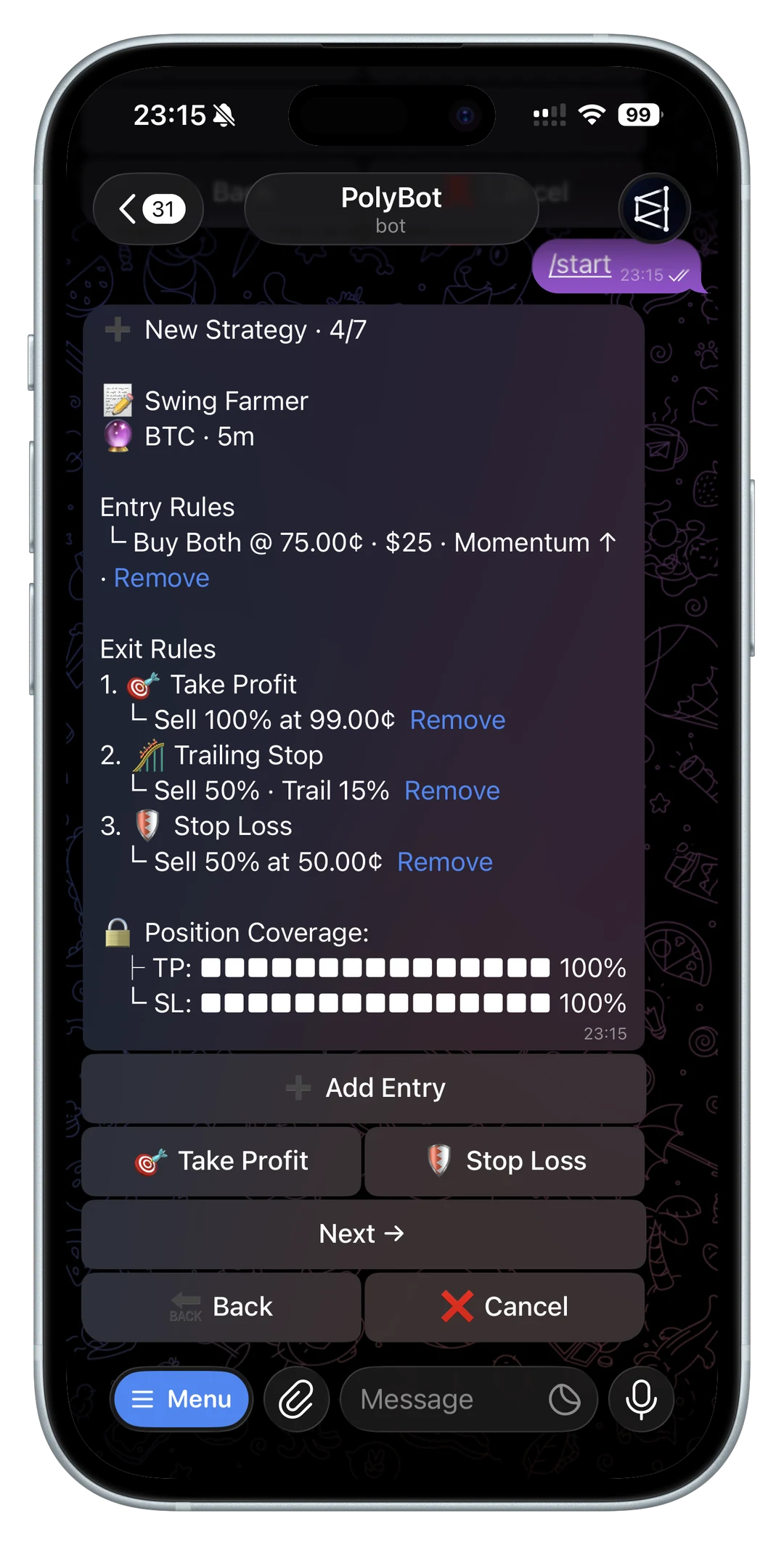
For exit planning, read the stop-loss and take-profit Telegram bot guide.
Stop losses on copied positions are not automatic protection
A stop loss can help limit downside, but it does not guarantee a fill or a specific exit price. Prediction markets can move quickly, spreads can widen, and liquidity can disappear.
Use stop losses when:
- copied trades may move while you are away
- you do not want to rely only on the leader's exit
- your bankroll cannot absorb large drawdowns
- you are testing a volatile leader
Avoid treating stop losses as a substitute for good filters. A bad subscription with a stop loss is still a bad subscription.
If a copied wallet often adds to the same market or exits in pieces, read the Polymarket scale-in and scale-out guide before mirroring that behavior with your own bankroll.
Skip reasons tell you whether settings match the leader
Skipped trades are useful data. They show where your rules refused to copy.
For a focused troubleshooting workflow, read the Polymarket copy trading skipped trades guide before loosening slippage, caps, price filters, or category filters.
Common skip reasons include:
- daily cap reached
- slippage too high
- price outside range
- insufficient pUSD tradable balance
- no shares to sell
- purchase or amount limit reached
- category filtered
- expiry too far
- leader trade below minimum
A high skip rate is not always bad. It can mean your filters are doing their job. But if every high-quality leader trade is skipped, your setup may be too tight or misaligned with the wallet's style.
Review skip reasons weekly. They are often more useful than raw copied PnL because they explain what your settings are actually doing.
Activity and performance review should change settings
After a subscription is live, do not only watch wins and losses. Watch the relationship between the leader's trades and your copied trades.
Review:
- fill quality compared with the leader
- copied PnL by category
- skipped trades by reason
- whether fixed or proportional sizing is behaving better
- whether copied sells match your position size
- drawdown during high-volume days
- open exposure by market and outcome
If the copied result is worse than the leader result, look for the cause before increasing size. The problem may be slippage, category drift, overexposure, stale exits, or a leader whose edge has faded.
For the cost side of copied fills, read the Polymarket trading costs guide before loosening slippage or raising caps.
A conservative setup for a new leader
For a new trader, start with a narrow setup:
- Run the trader through the wallet analyzer.
- Pick one category or market type where the wallet shows edge.
- Use fixed sizing while testing.
- Set a small daily cap.
- Use a mid-range price filter.
- Add a max copied trade size.
- Set slippage tight enough to avoid chasing.
- Review skipped trades and copied PnL before scaling.
Only widen the setup after the data supports it. The safest-looking wallet on a leaderboard can still be a poor fit for your capital, latency, and goals.
Copy trading settings FAQ
Should I use fixed or proportional copy trading?
Use fixed sizing when testing, when your bankroll is smaller than the leader's, or when you want predictable exposure. Use proportional sizing only after you trust the leader's sizing behavior and have caps to prevent outsized copied trades.
What slippage should I use for Polymarket copy trading?
There is no universal setting. Tight slippage protects price quality but skips more trades. Loose slippage fills more trades but can erase the leader's edge. Start stricter for thin or slow markets and loosen only when missed trades are clearly worse than worse fills.
Why are my copied trades skipped?
Common reasons include daily cap, slippage, price range, balance, amount limits, category filters, max expiry, or leader minimum size. A skipped trade is a signal to review whether your filters are too strict or the leader is not a good fit.
Should I copy every category a profitable wallet trades?
Usually no. Many wallets have edge in one category and noise elsewhere. Category filters help copy the part of the wallet that analysis supports.
Settings are the difference between copying and mirroring blindly
The goal is not to copy everything a wallet does. The goal is to copy the behavior that survives your own size, speed, balance, risk limits, and market preferences.
Start with wallet analysis, translate the edge into filters, keep caps small, and let performance data decide whether to widen the subscription.
Not investment advice. Copy trading can lose money, and automation can fail or skip trades during fast or illiquid markets. Verify current product behavior in official docs before funding or increasing size.
Polymarket Copy Trading Skipped Trades Guide: Slippage, Caps, Filters, Balance, and Fixes
Why copied Polymarket trades can skip in a Telegram bot: slippage, daily caps, balance, price filters, category filters, minimum size, no shares to sell, liquidity, and how to review fixes.
Copy Trading / 11 min
Polymarket Copy Trading: How It Works and How to Start From Telegram
Learn how Polymarket copy trading works, how to choose wallets, configure filters, control slippage, size positions, and manage risk from Telegram with PolyBot.
Copy Trading / 13 min