Polymarket Price Alerts Bot Guide: Targets, Price Moves, Watchlists, and Safer Orders
How to use a Polymarket price alerts bot from Telegram: target prices, price-change alerts, watchlists, volume context, order-book checks, limit orders, and risk controls.

PolyBot Team
Updated June 1, 2026
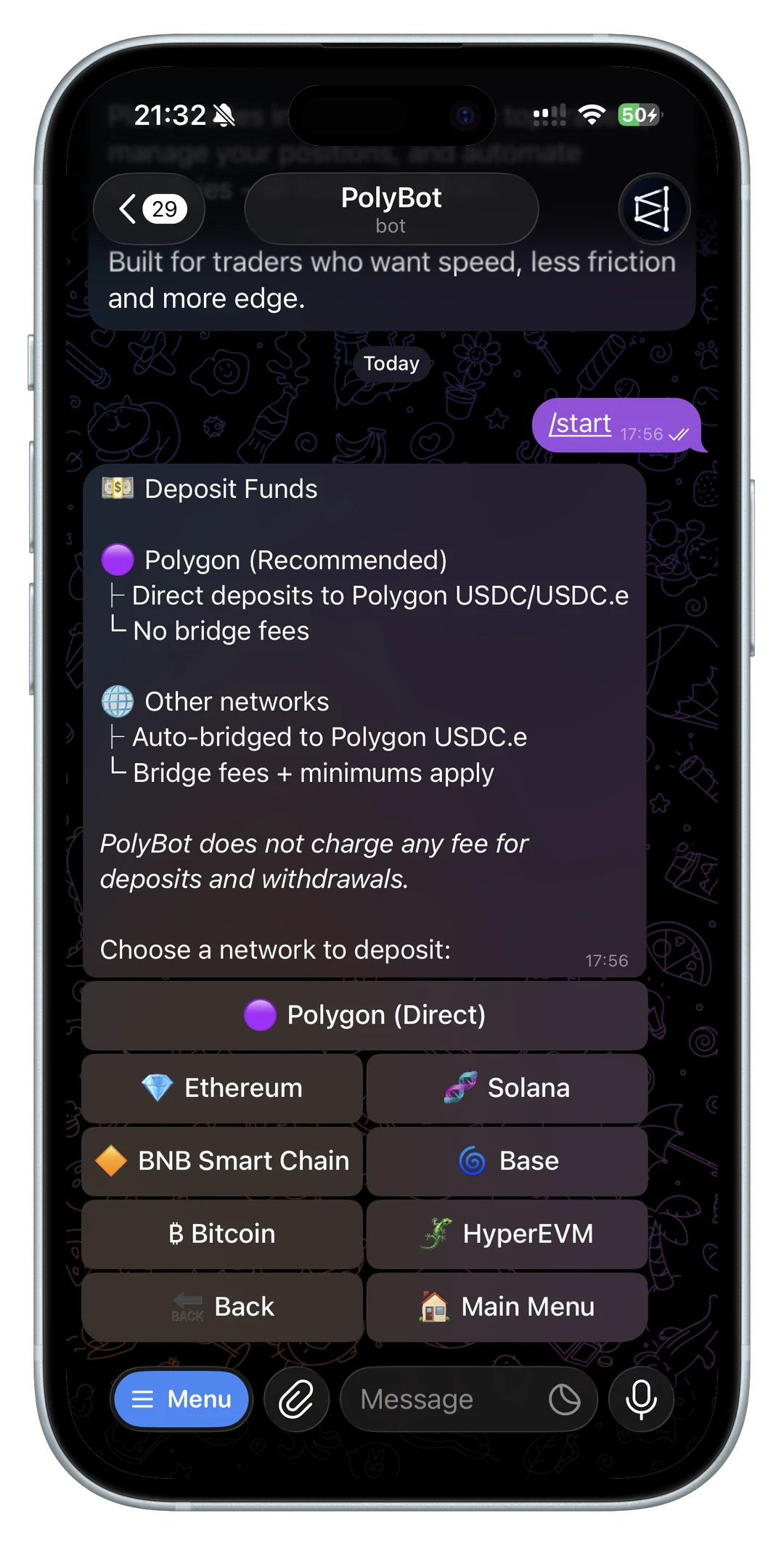
A Polymarket price alerts bot is useful when it brings you back to a market at the right time without pressuring you to trade too quickly.
Price alerts solve a simple problem: you cannot watch every market all day. A target price, price-change alert, or watchlist notification can tell you when a market deserves another look. But the alert is only the start of the decision. A market can hit your target and still be a bad trade if the spread widened, liquidity disappeared, the event changed, or the price already moved past the useful level.
This guide explains how to use Polymarket price alerts from Telegram: target prices, price-change alerts, watchlists, thresholds, volume context, wallet context, order-book checks, limit orders, mobile notifications, and risk controls.
If you want the wider alert surface first, read the Polymarket Telegram alerts and watchlists guide. If price alerts are part of a broader notification setup, use the Polymarket notification bot guide. If the alert is one signal among several, pair this with the Polymarket trading signals bot guide.
If alerts are attached to open positions, open orders, exits, copied trades, or redeemable markets, use the Polymarket portfolio tracker bot guide so each alert routes to current account review.
If the next action after an alert is an immediate order, read the Polymarket market orders from Telegram guide before market buying or selling from the notification. If the alert could become either a resting order or an immediate fill, use the Polymarket maker vs taker guide before choosing execution style.
Price alerts are review triggers
A price alert should answer one question:
Should I review this market now?
It should not answer:
Should I market buy immediately?
That distinction matters. A target price can be hit for several reasons:
- a real event changed the probability
- liquidity thinned and one trade moved the display price
- the spread widened
- a related market moved first
- a whale trade consumed the best depth
- the market is noisy and bouncing inside a range
- the target was set too close to normal volatility
The alert tells you a condition fired. It does not prove that the market is still tradeable at a good price.
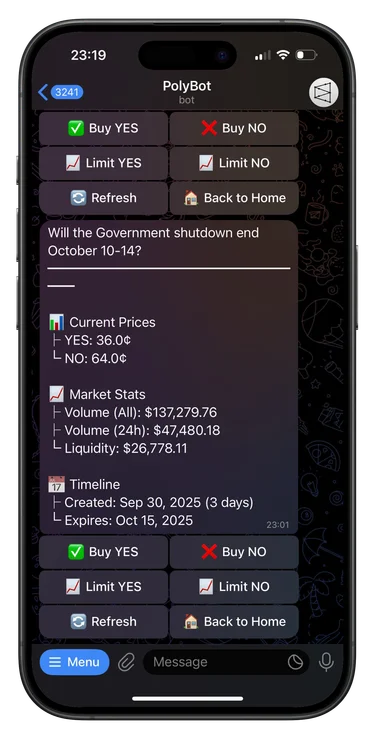
Target price alerts versus price-change alerts
There are two common price-alert workflows.
A target price alert fires when a market reaches a specific level you chose.
A price-change alert fires when a market moves enough to deserve attention.
They solve different jobs.
Use a target price alert when you already know a level that matters. For example, you may want to review YES if it falls to 38 cents or NO if it rises above 60 cents.
Use a price-change alert when you want to know that something changed even if you did not know the exact level in advance.
Target alerts are better for prepared decisions. Price-change alerts are better for discovery.
Do not use them the same way. A prepared target can sometimes become a limit order. A price-change alert usually needs more investigation before any order.
Define the decision before setting the alert
Before setting a Polymarket price alert, write down what the alert means.
Useful fields include:
- market
- outcome side
- target price
- reason the target matters
- acceptable spread
- minimum visible depth
- planned size
- next action if the alert fires
- reason to ignore the alert
The "reason to ignore" is important.
Examples:
- Ignore if the spread is wider than the planned edge.
- Ignore if the market moved because of unverified news.
- Ignore if the price already crossed past the useful range.
- Ignore if a related market has better liquidity.
- Ignore if the position would exceed the daily risk budget.
If you cannot define the next action, the alert may be too vague.
Price alerts and watchlists work together
A watchlist stores markets you care about.
A price alert tells you when one market on that list changes enough to review.
The best workflow uses both. Watchlists prevent random discovery from becoming scattered. Alerts prevent watched markets from requiring constant manual refreshes.
Use watchlists for:
- markets you understand but are not ready to trade
- markets where the current spread is too wide
- markets waiting on news
- markets tied to related outcomes
- positions you already own
- markets where you want a better entry
- markets where you want to review an exit
Use price alerts inside those watchlists when you know the next review level.
For broader watchlist discipline, use the Polymarket Telegram alerts and watchlists guide.
Price alerts are not limit orders
A price alert and a limit order are different tools.
A price alert notifies you.
A limit order expresses a price you are willing to trade.
If you already know the exact market, side, size, price, and order duration, a Polymarket limit order can be cleaner than waiting for a notification and then rushing.
Use a price alert when:
- you want to review context before trading
- the news source matters
- the order-book depth may change
- the decision depends on related markets
- you may decide to do nothing
Use a limit order when:
- the acceptable price is already known
- missing the trade is acceptable
- you do not need another manual review
- the order size is bounded
- you are comfortable with the order resting
Many bad trades happen when a trader treats an alert like a limit order but submits a rushed market order after the notification.
Check the order book after every alert
The order book decides whether a price alert is tradeable.
Before acting, check:
- best bid
- best ask
- spread
- depth near the intended price
- likely fill price for your size
- whether your order would move the price
- whether the displayed alert price is still available
- whether a partial fill would be acceptable
This is especially important in thin prediction markets. A market can briefly touch the alert level and then lose liquidity. The alert may be accurate, but your order may still fill worse than expected.
Use the Polymarket order book guide and Polymarket liquidity, spread, and slippage guide before trading from price alerts with meaningful size.
Price-change alerts need source review
A price-change alert tells you something moved.
The next question is why.
Common causes include:
- breaking news
- sports updates
- crypto price moves
- election polls
- court rulings
- whale trades
- low-liquidity jumps
- group-driven attention
- unrelated market confusion
Do not assume the move is valid because it fired an alert.
After a price-change alert, review:
- source of the move
- whether the source is confirmed
- whether the market wording matches the event
- whether the market source differs from the news source
- whether the price already moved too far
- whether liquidity improved or disappeared
- whether related markets moved in the same direction
For news-driven moves, read the Polymarket news trading bot guide. For volume-driven moves, read the Polymarket volume alerts bot guide. Before turning the alert into a market order, use the Polymarket slippage tolerance guide to decide whether the new price is still acceptable.
Avoid alert thresholds that create noise
Too many alerts make every notification feel less important.
If your price alert bot is noisy, the usual problem is not Telegram. It is threshold design.
Weak thresholds include:
- tiny moves on volatile markets
- alerts on markets you do not understand
- alerts on low-liquidity markets
- duplicate alerts across related markets
- target levels with no planned action
- price-change alerts during normal back-and-forth trading
Better thresholds are tied to decisions:
- review if YES returns to a planned entry zone
- review if a position moves near a stop level
- review if a market breaks above a thesis invalidation level
- review if a related market diverges enough to compare
- review if a high-liquidity market moves after confirmed news
Alert quality matters more than alert count.
Mobile price alerts need extra discipline
Most price alerts arrive on a phone.
That is convenient. It is also dangerous.
On mobile, a good alert should route you to review before order placement:
- market title
- outcome side
- target or move that fired
- current bid and ask
- spread
- available actions
- portfolio or existing position context
- open orders if any
If the alert only says "price hit," slow down before tapping into a trade. Open the market card, check the book, and confirm whether the alert still matters.
Use the Polymarket mobile trading bot guide and the Polymarket notification bot guide for phone-first workflows.
Price alerts for exits
Price alerts are not only for entries.
They can also support exits.
Use exit alerts when:
- a position is approaching a target profit level
- a position is approaching a stop review level
- a market is close to thesis invalidation
- a related market suggests the current price is stale
- liquidity improves enough to consider selling
- a resolved or near-resolved market needs review
An exit alert is not the same as a stop loss. It tells you to review. A stop-loss rule attempts an exit according to configured behavior.
For automatic or semi-automatic exits, read the Polymarket stop loss and take profit guide. For manual exits, read how to sell a Polymarket position.
Price alerts for copy trading
Copy trading can also benefit from price alerts.
A copied wallet may enter a market before you understand it. A price alert can help you monitor copied exposure, review whether the position still fits, or decide whether to pause a setup after large movement.
Useful copy-related price alerts include:
- leader position moves against you
- copied position reaches an exit review level
- market price moves far from the leader fill
- liquidity gets too thin for a safe sell
- a related market moves differently
- a copied trade skips because price moved too far
Price alerts should not replace copy settings. The copy setup still needs caps, filters, slippage, and pause controls.
Use the Polymarket copy trading settings guide and Polymarket copy trading skipped trades guide before using alerts to manage copied positions.
A practical price-alert workflow
A practical Polymarket price-alert workflow can look like this:
- Add a market to a watchlist because it fits a category you understand.
- Set a target price or price-change threshold with a clear reason.
- Wait for the alert instead of refreshing constantly.
- When the alert fires, open the market card.
- Check source, wording, bid, ask, spread, and depth.
- Decide whether this is watchlist only, limit order, market order, exit review, copy adjustment, or no trade.
- Record whether the alert helped after the trade or skip.
- Remove alerts that repeatedly create no useful action.
This keeps alerts in their proper role: attention first, execution second.
Polymarket price alerts checklist
Before trading from a Polymarket price alert, answer:
- What market and outcome triggered the alert?
- Was this a target alert or a price-change alert?
- Why did this level matter?
- Is the alert price still available?
- What are the current bid and ask?
- How wide is the spread?
- Is there enough depth for my size?
- Did news, volume, or a whale trade cause the move?
- Does the market wording still match the thesis?
- Is a limit order better than a market order?
- Is this an entry, exit, watchlist, or no-trade decision?
- Will this trade exceed my risk limits?
If those answers are unclear, the alert has done its job: it brought the market back to review. It does not need to become a trade.
Common questions about Polymarket price alerts
What is a Polymarket price alerts bot?
A Polymarket price alerts bot is a Telegram workflow that notifies you when a market reaches a target price or moves enough to review. It helps you return to markets without refreshing constantly.
Are price alerts the same as limit orders?
No. A price alert sends a notification. A limit order places a resting order at a price you choose. Use alerts when you want review before acting. Use limit orders when the exact price, size, and side are already defined.
Should I market buy when a price alert fires?
Only after checking the current bid, ask, spread, depth, market wording, and reason for the move. Many alerts are better handled with a limit order, watchlist update, or no trade.
Are price-change alerts useful for news trading?
They can be useful, but they are not source verification. A price-change alert should send you to news, market wording, and liquidity review before any order.
How do I reduce noisy price alerts?
Use wider thresholds, fewer categories, higher-liquidity markets, clearer target levels, and delete alerts that repeatedly fire without producing a useful decision.
Price alerts should reduce refreshing, not increase rushing
The best Polymarket price alerts bot makes trading calmer.
It lets you define the levels that matter, wait for a useful prompt, and return to the market with enough context to decide. It should connect to watchlists, order-book checks, limit orders, exits, copy settings, and portfolio review.
Use alerts to create attention. Use the trading plan to decide what happens next.
Not investment advice, legal advice, tax advice, or security advice. Prediction markets are risky, price alerts can fire late or during thin liquidity, and every order still needs current market review before execution.
Polymarket Telegram Alerts and Watchlists: Price Targets, Whale Moves, and Noise Control
How to use Polymarket Telegram alerts and watchlists without chasing noise: price targets, large trade alerts, copied-wallet signals, group links, limit orders, and safety checks.
Telegram Trading / 11 min
Polymarket Market Scanner Bot Guide: Find Markets, Alerts, Liquidity, Wallet Signals, and Risk
How to evaluate a Polymarket market scanner bot workflow: search, trending markets, volume, price alerts, whale alerts, wallet signals, liquidity, order books, and risk controls.
Telegram Trading / 12 min