Polymarket Limit Orders From Telegram: Price Control and Order Management
Learn how Polymarket limit orders work in a Telegram bot: limit buys, limit sells, GTC orders, stale orders, cancellations, partial fills, and when market orders are safer.

PolyBot Team
Updated June 1, 2026
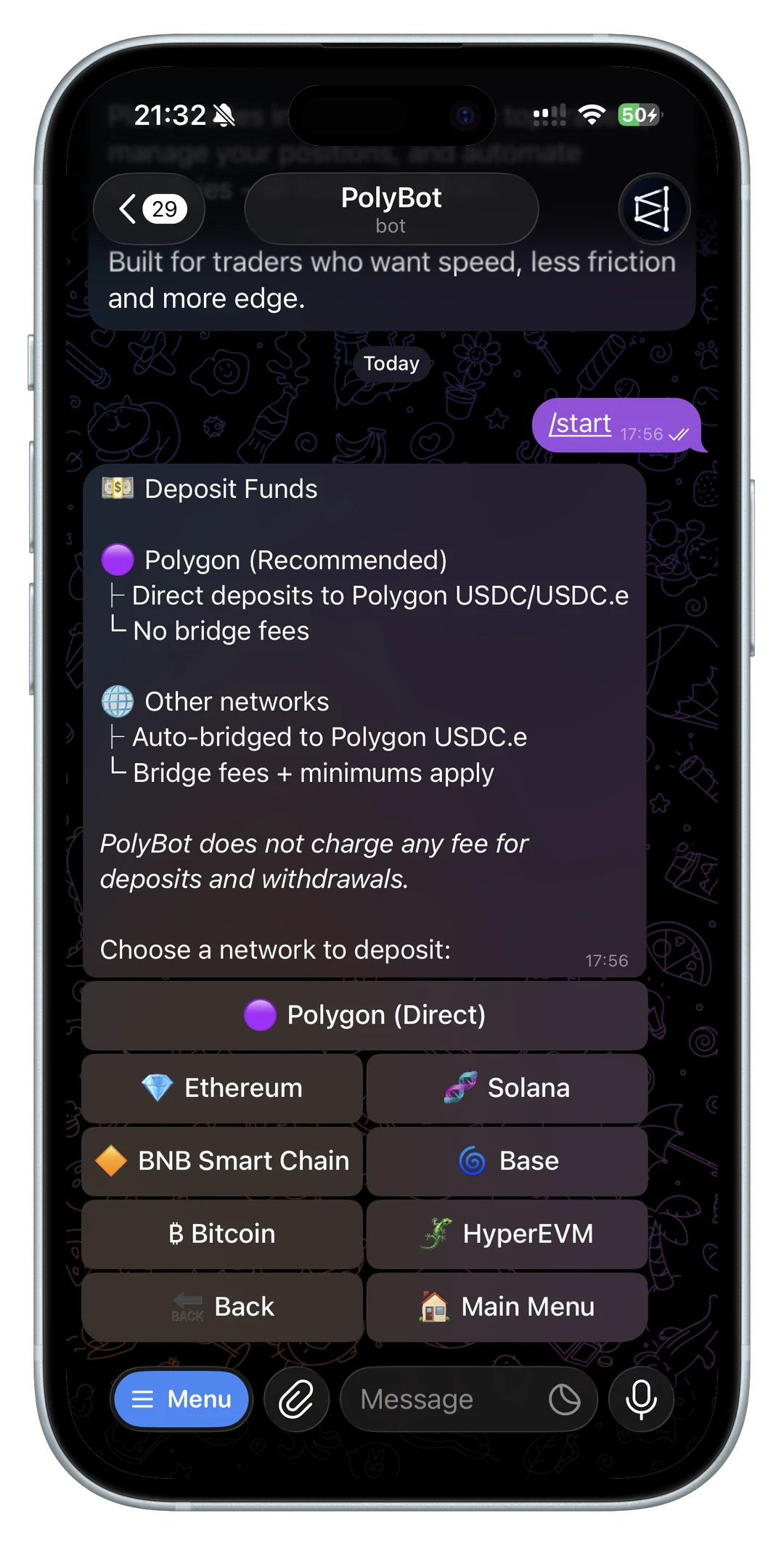
Limit orders are one of the most useful controls in a Polymarket Telegram workflow.
Fast execution matters, but speed without price discipline can produce bad fills. A limit order lets you define the price you are willing to accept before the market moves again. It can help you avoid chasing a price, manage exits, and keep a trading plan visible inside Telegram.
PolyBot's official Trading Guide documents limit buys, limit sells, and order management from Telegram. Polymarket's own order docs explain the underlying order-type model: GTC and GTD are limit order types, while FOK and FAK are market-style order types that execute immediately against resting liquidity.
If you are comparing normal limit orders with maker-style automation, read the Polymarket maker vs taker guide and Polymarket market making bot guide before assuming every resting order is a market-making strategy.
If you are comparing limit orders with fast sniper-style entries, read the Polymarket sniper bot guide before choosing speed over price control.
If you are deciding whether immediate execution is worth crossing the spread, read the Polymarket market orders from Telegram guide before choosing market order over limit order.
If you are deciding whether to set a notification first or leave a resting order immediately, read the Polymarket price alerts bot guide before turning every target price into an order.
If the limit order is already resting, track it with the Polymarket portfolio tracker bot guide so stale orders, partial fills, PnL, and open exposure stay visible. For cancellation decisions, read the Polymarket open orders and cancel orders guide.
If only part of a limit buy or limit sell fills, read the Polymarket partial fills guide before deciding whether to leave the remainder open, cancel it, or complete the position another way.
If the order is still open and you are not sure why it has not matched, use the Polymarket limit order not filled guide before changing the price or retrying.
If the limit price itself is rejected, use the Polymarket tick size guide before manually editing decimals.
This guide explains the trader-level workflow, not API implementation.
What a limit order does
A limit order sets your price condition.
For a buy, the limit price is the maximum price you are willing to pay. For a sell, it is the minimum price you are willing to accept.
That gives you price control, but not fill certainty. The market may never trade at your price, or it may only fill part of your size. A limit order is useful because it lets you define a plan before the market becomes emotional.
If you are deciding between an immediate exit and a target-price exit, read how to sell a Polymarket position.
Use it when:
- the spread is wide
- liquidity is thin
- you have a target entry price
- you want to sell only above a target
- the market is moving too quickly to trust a market order
- you need to avoid overpaying after a Telegram alert
For target-price notifications before a limit order, read Polymarket price alerts in Telegram.
For the broader manual workflow, read how to buy, sell, and close Polymarket positions from Telegram.
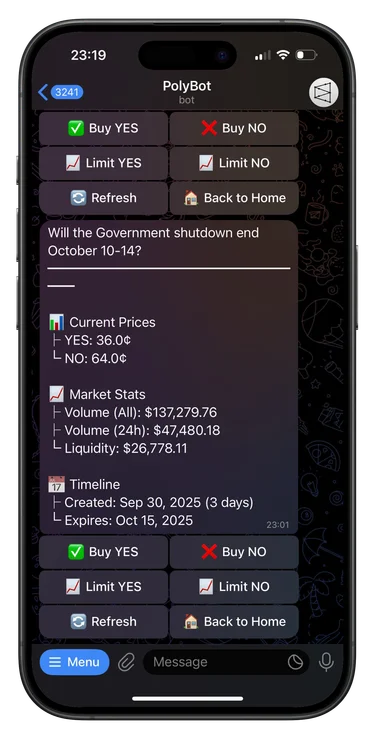
Limit orders are different from market orders
A market order prioritizes immediate execution. A limit order prioritizes price.
That tradeoff matters:
- market order: more likely to fill now, but can fill worse than expected
- limit order: protects your price, but may not fill
Polymarket's order docs explain that market-style orders execute immediately against resting liquidity, often using fill-or-kill or fill-and-kill behavior. Limit orders can rest on the book until they fill, expire, or are cancelled depending on the order type. The Polymarket order types guide explains FOK, FAK, GTC, and GTD in trader terms.
In a Telegram bot, the user-facing question is simpler: do you need the trade now, or do you need a specific price?
How a limit buy works in PolyBot
In PolyBot's documented flow, a limit buy starts from a market view.
The practical steps are:
- Open a binary market in Telegram.
- Choose a limit action for YES or NO.
- Enter the limit price in cents.
- Enter the USD amount to spend.
- Review outcome, price, amount, approximate shares, and total cost.
- Confirm the order.
PolyBot's docs describe these as GTC orders. That means the order can remain open until it fills or is cancelled. Because of that, users need to review open orders regularly.
Do not set a limit price randomly. Set it based on the price where the market still makes sense for your thesis.
How a limit sell works
A limit sell starts from a position you already hold.
Use it when you want to exit only if the market reaches a target price. That can be useful for planned take-profit behavior or for reducing exposure without taking the current bid.
Before placing a limit sell, check:
- how many shares you own
- current bid and ask
- target exit price
- likely time window
- whether partial fills are acceptable
- whether the market may resolve before the order fills
If you want rule-based exits rather than a simple resting order, read stop loss, take profit, and trailing stops on Polymarket.
If you are using several limit prices to build or reduce one position, read the Polymarket scale-in and scale-out guide before placing laddered entries.
Stale orders are the main risk
Limit orders can protect price, but they can also become stale.
A once-good order can become bad after:
- breaking news changes the market
- liquidity disappears
- the market nears resolution
- your thesis changes
- another open order changes your available balance
- you forget the order exists
This is why order management matters as much as order placement. In PolyBot, the documented /orders flow shows open limit-order count, order details, fill status, and cancellation actions.
For fast-entry workflows where a stale order is not the right tool, read the Polymarket sniper bot guide.
The Polymarket portfolio and orders guide explains how open limit orders, active stop-loss rules, PnL, and redeemable positions fit into the same review workflow.
Read Polymarket Telegram bot commands for how order views fit into the broader command workflow.
If an exit preset placed the order, review the applied preset too. The exit presets guide explains why deleting a preset template is not the same thing as cancelling existing orders.
When a market order may be safer
Limit orders are not always better.
A market-style order may fit better when:
- the spread is tight
- the market is highly liquid
- the price edge is still acceptable
- missing the fill is worse than paying the spread
- the market will move before a resting order is likely to fill
The point is not to always avoid market orders. The point is to choose intentionally.
Read Polymarket liquidity, spreads, and slippage before deciding. If the decision is whether to widen price drift or switch to a limit order, use the Polymarket slippage tolerance guide.
For the book-level reason a limit order may rest, cross, partially fill, or miss, read the Polymarket order book guide.
Why open orders can affect balance
Open limit orders can reserve or commit funds.
That means your visible balance and your available balance may differ. A trader can have funds in the wallet but less available for a new order if other limit orders are open.
If an order fails because of balance or allowance, check:
- open limit orders
- copied trades that reserved balance
- pending cancellations
- partial fills
- dust positions
- recent deposits or withdrawals
The Polymarket order failed guide covers those errors in more detail.
A simple limit-order checklist
Before placing a Polymarket limit order from Telegram, confirm:
- market question and outcome side
- current YES and NO prices
- bid/ask spread
- limit price
- size
- whether partial fills are acceptable
- how long the thesis remains valid
- how you will review and cancel the order
- whether a market order would actually fit better
For multi-outcome event structures, also read Polymarket negative-risk markets in Telegram before placing resting orders.
After placing it, check /orders or the relevant order-management view. Do not leave old orders unattended.
Use limit orders for discipline, not complexity
Limit orders are not only for advanced traders. They are a discipline tool.
They force one good habit: decide the price before you trade. In a fast Telegram workflow, that can be the difference between acting on a plan and chasing a moving market.
Use market orders when immediate execution is genuinely more important than price. Use limit orders when price control matters. Review open orders often enough that they do not outlive the idea that created them.
Not investment advice. Limit orders do not guarantee fills, and prediction market liquidity can change quickly.
Polymarket Open Orders and Cancel Orders in Telegram: Limit Orders, Balance, and Risk
How to manage Polymarket open orders from Telegram: cancel stale limit orders, review reserved balance, partial fills, stop rules, failed orders, and portfolio risk.
Execution / 11 min
How to Sell a Polymarket Position: Market Sells, Limit Sells, Stop Losses, and Redeems
A practical guide to closing Polymarket positions from Telegram: market sells, limit sells, partial exits, stop losses, take profits, open orders, liquidity, PnL, redeeming winners, and withdrawals.
Execution / 10 min