Polymarket Telegram Alerts and Watchlists: Price Targets, Whale Moves, and Noise Control
How to use Polymarket Telegram alerts and watchlists without chasing noise: price targets, large trade alerts, copied-wallet signals, group links, limit orders, and safety checks.
PolyBot Team
Updated June 2, 2026
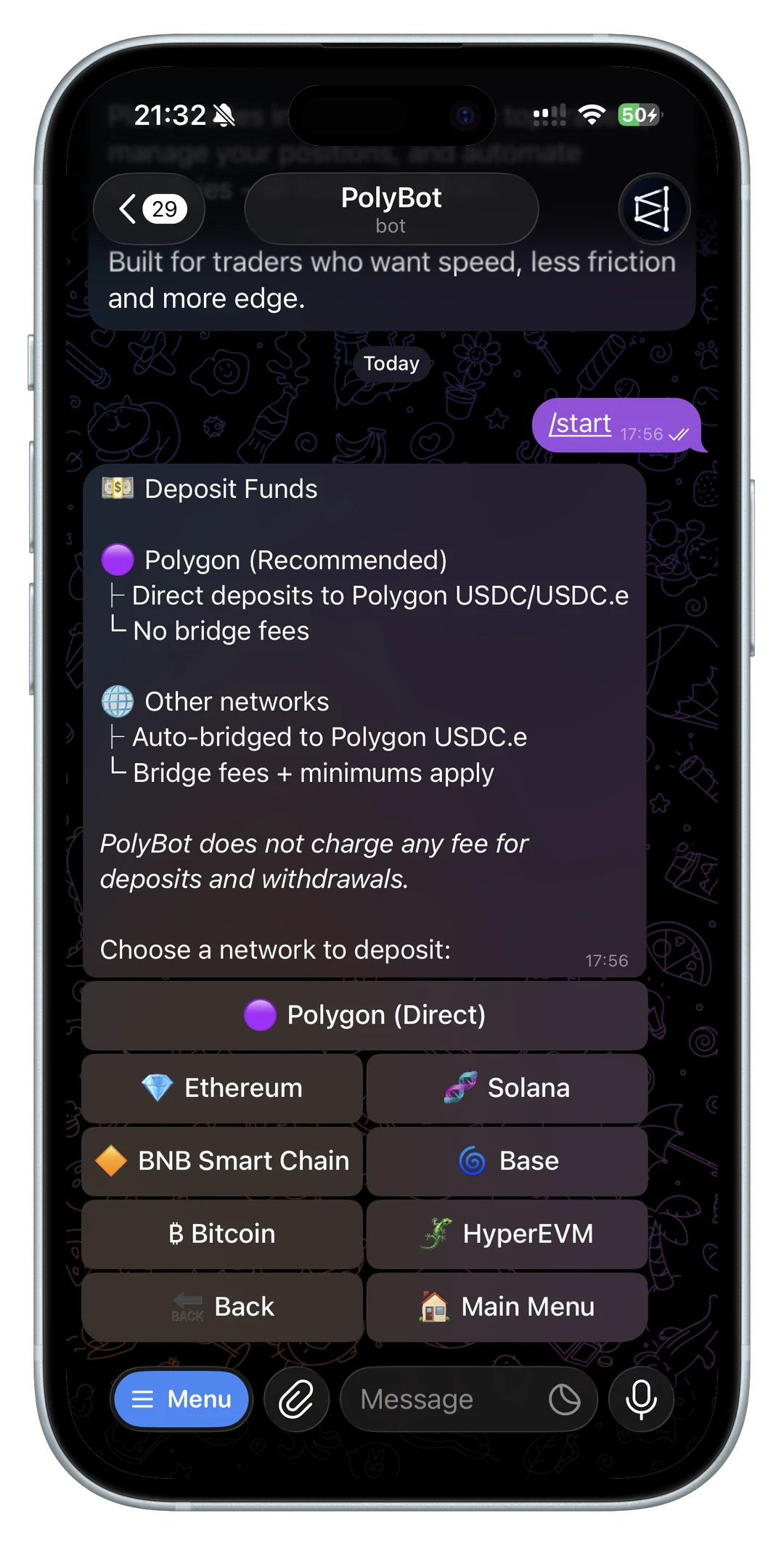
Polymarket alerts are useful only when they improve the next decision.
A Telegram alert can help you stop refreshing markets all day, catch a price target, notice a large wallet move, or return to a position that needs attention. The same alert can also push you into a rushed trade if it is too noisy, too vague, or disconnected from order controls.
This guide explains how to use Polymarket Telegram alerts and watchlists as a trading workflow, not as a signal to click every notification.
If your main need is target prices, price-change thresholds, and deciding when alerts should become limit orders, read the Polymarket price alerts bot guide.
If you want the broader notification layer across price alerts, wallet updates, copied trades, order failures, portfolio reminders, and redemptions, read the Polymarket notification bot guide.
If an alert leads to a shared profit screenshot or group result post, read the Polymarket PnL card guide before treating the image as realized profit or copyable edge.
For the broader signals workflow, read the Polymarket trading signals bot guide before turning alerts, wallet moves, or group messages into trades.
If alerts are part of a discovery system, use the Polymarket market scanner bot guide to separate scan results, watchlist items, alerts, and orders.
If an alert is triggered by breaking news, headlines, or a fast event update, use the Polymarket news trading bot guide to verify the source, market wording, spread, and liquidity before acting.
If the alert is based on volume, trending markets, or sudden price movement, use the Polymarket volume alerts bot guide to decide whether it belongs in a watchlist, limit order, or no-trade path.
If the alert should become an immediate buy or sell, read the Polymarket market orders from Telegram guide before crossing the spread from the notification.
If most alerts reach you on a phone, read the Polymarket mobile trading bot guide before letting notification speed drive order decisions.
PolyBot's public docs describe market alerts for price targets and large trade notifications as part of its Telegram-native automation surface. The practical question is how those alerts fit with market review, limit orders, copy trading, portfolio checks, and group discovery.
When comparing real-time alert tools, also check the underlying market and trade data claims against official Polymarket references such as the API overview and CLOB trading docs.
Quick answer: what makes a good Polymarket Telegram alert?
A good Polymarket Telegram alert should be fast enough to matter, specific enough to review, and quiet enough that traders do not ignore it.
Useful alerts include:
- the market and outcome side
- the trigger that fired
- current price or price movement
- spread or liquidity context when available
- wallet or whale context when the alert is activity-based
- a clear next action path: review, watchlist, limit order, copy setting, or no trade
Bad alerts create urgency without context. Good alerts reduce screen time and bring you back only when a market, wallet, or position needs a decision.
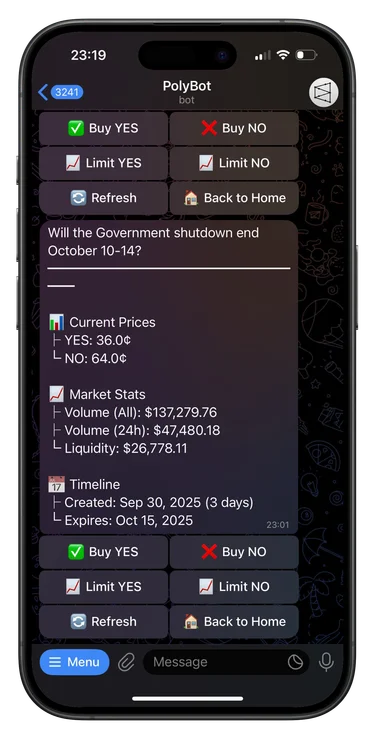
What a useful alert should include
| Alert type | Useful fields | Bad pattern |
|---|---|---|
| Price target | market, side, target, current price, planned action | "price moved" with no level or outcome |
| Price change | move size, previous price, current price, time window | constant noise on tiny moves |
| Whale alert | wallet, trade size, market, side, price impact | big-trade hype with no liquidity context |
| Copied-wallet alert | source wallet, copied fill, skip/fail reason, slippage | "copy failed" with no reason |
| Portfolio alert | position, order state, redeem status, next review action | generic account update with no trade context |
For real-time alerts, speed and cooldowns matter together. A notification that arrives quickly but fires too often becomes background noise. A useful Telegram workflow should let traders keep high-signal alerts on while reducing duplicate, tiny, or stale notifications.
Alerts, watchlists, and orders are different tools
Start by separating three ideas:
- A watchlist is a set of markets or wallets you want to monitor.
- An alert is a notification that something changed.
- An order is an instruction to trade.
Mixing those up is where many traders get hurt.
Adding a market to a watchlist does not mean it is worth trading now. Receiving an alert does not mean the price is good. Placing a limit order is not the same as asking to be notified. A good Telegram workflow keeps those states separate so you can monitor first, review second, and trade only when the setup still makes sense.
For broader execution context, read Polymarket Telegram bot vs web trading. For price-control details, read Polymarket limit orders from Telegram.
The main types of Polymarket alerts
Different alert types answer different questions.
Price target alerts
A price target alert tells you when a market reaches a level you care about.
Use this when:
- you like a market but not the current price
- you want to revisit a YES or NO outcome near a specific probability
- you are waiting for a better entry
- you are watching a position approach an exit zone
- you want to avoid staring at the order book
The key is to decide your action before the alert fires. If YES reaches 42 cents, are you reviewing the spread, placing a limit buy, reducing a position, or doing nothing unless liquidity improves?
An alert without a planned action becomes noise.
If an alert sends you searching for the right market, use the Polymarket market search in Telegram guide to check liquidity, expiry, and outcome wording before trading.
Large trade and whale alerts
Large trade alerts can be useful because public wallet activity can reveal conviction, hedging, or fast reaction to news. They can also mislead.
A big wallet may have:
- a different bankroll
- a different time horizon
- better information
- worse execution than it appears
- an existing hedge in another market
- a private reason that does not apply to you
Treat whale alerts as research prompts. Before copying or following a large move, read the Polymarket whale alerts and wallet tracker guide, use the Polymarket wallet analyzer, then read the wallet analyzer guide and how to copy trade on Polymarket from Telegram.
Copied-wallet alerts
Copy trading creates a second class of alerts: copied fills, skipped trades, failed orders, and wallet activity that may need review.
These alerts should answer:
- Which wallet traded?
- Which market and outcome changed?
- Did your copy fill, partially fill, skip, or fail?
- Was the copied price close enough to the source trade?
- Did the trade hit your size, odds, or daily-cap rules?
- Do you need to pause, tighten filters, or change sizing?
Copy trading is not set-and-forget. Alerts are the feedback loop that tells you whether the copy setup is behaving as expected.
For the control checklist, read best Polymarket copy trading bot checklist.
Portfolio, order, and redemption alerts
Post-trade alerts matter as much as entry alerts.
You may need to know when:
- a market order filled
- a limit order partially filled
- an order failed
- a stop-loss rule triggered
- a market resolved
- a position can be redeemed
- an automated strategy acted
- an open order became stale
These are operational alerts. They are less exciting than whale alerts, but they help prevent forgotten exposure.
If the alert came from an automated strategy, read the Polymarket Auto Trader bot guide before deciding whether to widen, pause, or delete the rule.
Read Polymarket portfolio and orders in Telegram for the post-trade workflow. For resolved positions, read Polymarket auto-claim and redeem winnings.
Group and link alerts
Telegram groups can create informal alerts even when no formal alert rule exists.
A market link, market card, trader card, or group discussion can pull attention to a market quickly. That is useful for discovery, but it can also make urgency feel like conviction.
When a group message points to a market:
- verify the exact market question
- check the outcome side
- review current price and spread
- open the trade in DM, not from pressure in the group
- avoid support DMs or fake bot links after group activity
For group-specific behavior, read Polymarket Telegram group trading.
What to check before acting on an alert
Use the same checklist every time an alert fires.
1. What changed?
Identify the trigger.
Was it a price level, a large trade, a copied wallet, a market link, a portfolio event, or a resolved position?
If the alert does not clearly explain why it fired, it is hard to use safely.
2. Is the market still tradeable?
Before placing an order, check:
- whether the market is still open
- current YES and NO prices
- bid/ask spread
- available liquidity
- time until resolution
- whether the rules match the alert headline
Markets can move between the alert and your action. A price target may be gone by the time you open the card.
3. Does the alert imply review or execution?
Most alerts should imply review.
Execution needs a separate decision:
- market order if speed matters and spread is acceptable
- limit order if price discipline matters
- stop-loss or preset if it is an exit rule
- no trade if the alert only tells you something changed
If you are not sure, use a limit order or do nothing. Missing a trade is usually cheaper than reacting to every notification.
4. Is the alert still inside your risk plan?
Check whether the trade would violate:
- maximum position size
- daily loss limit
- copied-wallet cap
- market exposure cap
- category concentration
- slippage tolerance
- unresolved open orders
Alerts should operate inside risk controls, not override them.
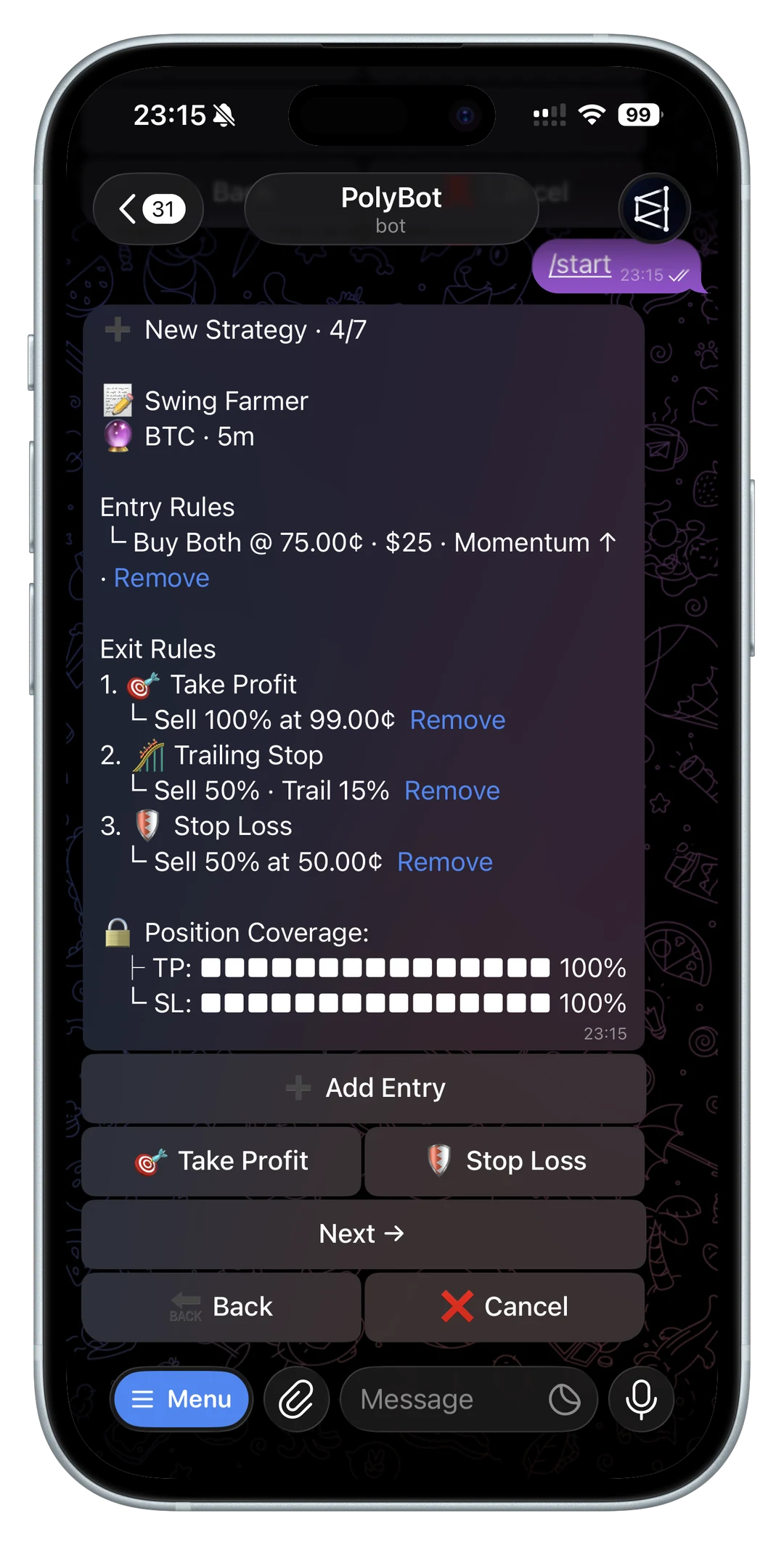
How alerts fit into a Telegram trading workflow
A disciplined Telegram workflow looks like this:
- Watch the market, wallet, or group topic.
- Receive a clear alert when something relevant changes.
- Open the market or wallet context inside Telegram.
- Review price, liquidity, position state, and risk.
- Choose market order, limit order, copy adjustment, stop-loss, or no action.
- Review the result in portfolio, orders, or recent activity.
PolyBot is built around keeping those steps close together: alerts, market cards, copy trading, portfolio review, orders, and settings live inside the Telegram flow instead of being split across many tools.
If the alert is for a live game or league market, read the Polymarket sports trading bot guide before treating every sports notification as an entry.
If the alert is for BTC, ETH, SOL, or another fast crypto move, read the Polymarket crypto trading bot guide before treating the notification as an entry.
If the alert is for a poll, campaign headline, or election-night market, read the Polymarket politics and election trading bot guide before treating the notification as a trade signal.
For navigation, keep the Polymarket Telegram bot commands guide nearby.
When to use an alert instead of a limit order
Use an alert when you want to decide later.
Examples:
- "Tell me if this market reaches 45 cents, then I will inspect liquidity."
- "Tell me if a large wallet enters, then I will analyze the wallet."
- "Tell me when a copied trade fails, then I will review settings."
Use a limit order when you already know the price and size you are willing to trade.
Examples:
- "Buy YES only if I can get 38 cents or better."
- "Sell half my position at 62 cents."
- "Rest a price-controlled order instead of chasing the alert."
Use a stop-loss or preset when the rule is attached to an existing position and you want automated exit behavior.
Use an auto-trader strategy when the entry and exit rules are both defined. The Polymarket Auto Trader bot guide explains that broader workflow.
The limit order guide and portfolio/orders guide explain those differences in more detail.
Watchlists should reduce noise, not create a second feed
A watchlist is useful only if it stays small enough to monitor.
Good watchlist candidates:
- markets where you already understand the resolution criteria
- positions you hold
- markets linked to an upcoming event
- wallets you have analyzed
- categories where you have an edge
- markets where you are waiting for a specific price
Poor watchlist candidates:
- every trending market
- every whale trade
- markets you do not understand
- old positions with no action plan
- categories you never trade
If every market is on the watchlist, the watchlist is just another feed.
Noise control rules for Polymarket alerts
Use these rules to keep alerts useful:
- Set alerts only when you know what decision they support.
- Prefer fewer, higher-quality alerts over constant notifications.
- Separate price alerts from trade execution.
- Do not copy whale alerts without wallet analysis.
- Review liquidity before market buying from an alert.
- Use limit orders when the target price matters.
- Use portfolio and order alerts to clean up stale exposure.
- Turn off alerts that repeatedly produce no action.
This matters on Telegram because notification speed creates pressure. The goal is not to be notified about everything. The goal is to notice the few changes that deserve review.
Alert safety and fake bot checks
Alerts create link-clicking behavior, so safety matters.
Before opening a bot or funding a wallet from an alert path:
- start from official PolyBot links
- verify the Telegram username
- ignore unsolicited support DMs
- never share a seed phrase or private key
- do not trust copied bot names or fake referral pages
- open sensitive wallet actions from known official surfaces
Read official PolyBot links and fake bot safety before using any bot link from a random DM, ad, or group message.
Common questions about Polymarket alerts
Are Polymarket Telegram alerts trade signals?
No. An alert is a prompt to review. It may tell you that a market moved, a wallet traded, or an order changed state, but the trade decision still depends on price, liquidity, market rules, sizing, and risk.
Are whale alerts enough for copy trading?
No. Whale alerts can help you discover wallets, but copy trading requires more context: wallet PnL quality, category edge, trade size, timing, liquidity, and exit behavior. Use the Polymarket wallet analyzer before copying a wallet.
Should I use a price alert or a limit order?
Use a price alert when you want to review later. Use a limit order when you already know the price, side, and size you are willing to trade. Use stop-loss or preset tools when the rule belongs to an existing position.
What makes an alert too noisy?
An alert is too noisy when it repeatedly fires without leading to a clear review or action. Tighten thresholds, remove markets you do not understand, reduce wallet coverage, and keep only the alerts that support your process.
Alerts should make trading calmer
The best Polymarket Telegram alerts make trading calmer, not more frantic.
They help you stop refreshing, notice meaningful changes, and return to the right market or wallet with enough context to decide. They should connect to market review, limit orders, copy settings, portfolio checks, and safety habits.
Use alerts to create attention. Use your trading plan to decide what happens next.
Not investment advice. Prediction markets are risky, and alerts can still arrive late, mislead, or point to markets that are no longer attractive by the time you review them.
Polymarket Price Alerts Bot Guide: Targets, Price Moves, Watchlists, and Safer Orders
How to use a Polymarket price alerts bot from Telegram: target prices, price-change alerts, watchlists, volume context, order-book checks, limit orders, and risk controls.
Telegram Trading / 11 min
Polymarket Notification Bot Guide: Telegram Alerts, Wallet Updates, Orders, and Noise Control
How to use a Polymarket notification bot from Telegram: price alerts, whale alerts, wallet updates, copied trades, portfolio reminders, order failures, redemptions, and noise control.
Telegram Trading / 12 min