Polymarket News Trading Bot Guide: Breaking News Alerts, Verification, Liquidity, and Risk
How to use a Polymarket news trading bot workflow from Telegram: breaking news alerts, source verification, market search, watchlists, liquidity checks, fast execution, limit orders, and risk controls.

PolyBot Team
Updated June 1, 2026
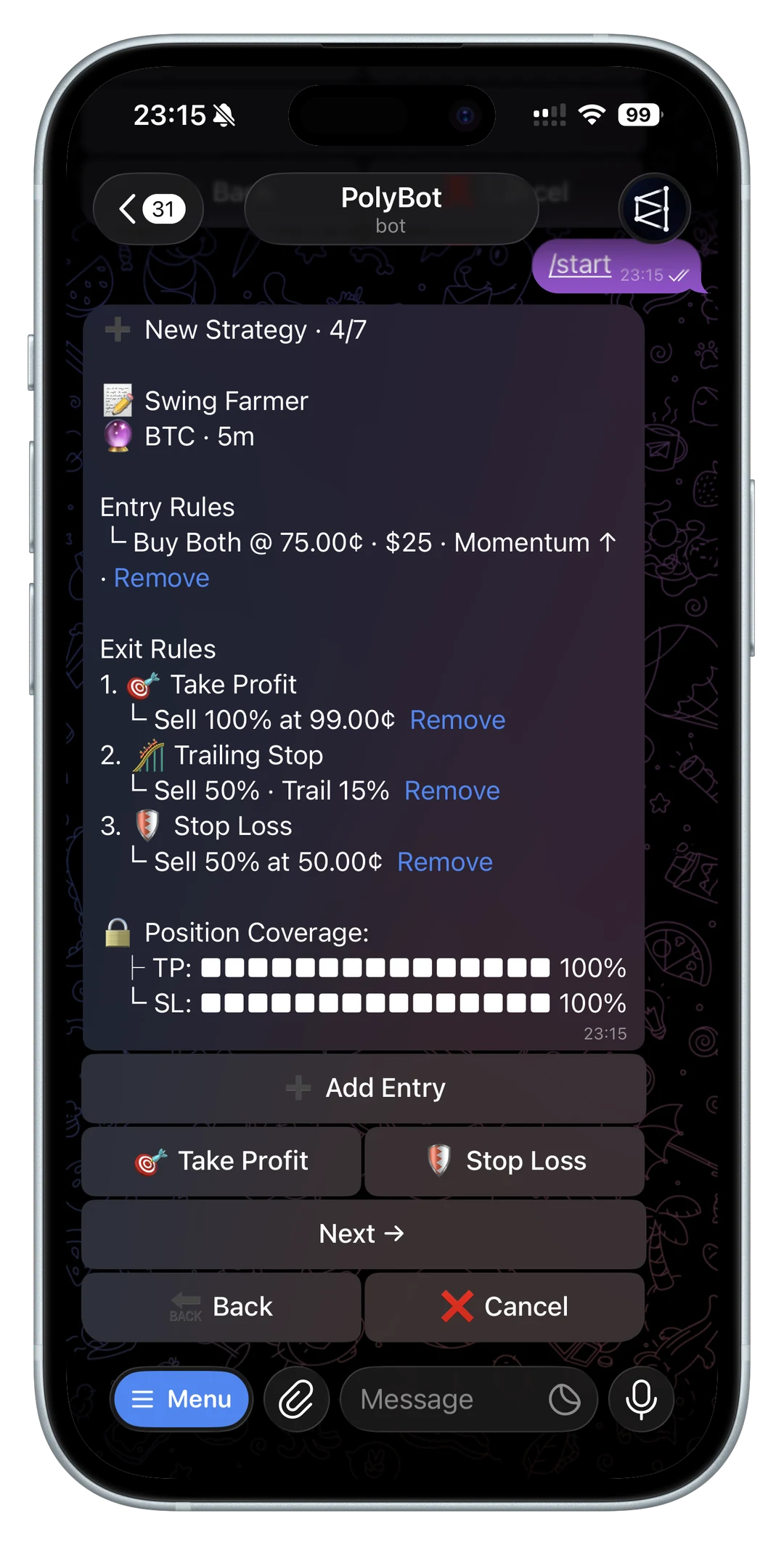
A Polymarket news trading bot is useful only when it helps you move from a headline to a verified market workflow.
Breaking news can move prediction markets quickly. A poll drops, a court ruling appears, a sports injury is reported, a crypto candle breaks a level, a public figure makes an announcement, or a group chat shares a market link. The mistake is treating the first notification as the trade.
News trading on Polymarket needs more than speed. It needs source checks, market wording, resolution rules, current bid and ask, visible liquidity, order controls, and risk limits. Telegram can make that workflow faster, but it should not remove the review.
This guide explains how to use a Polymarket news trading bot workflow from Telegram: breaking news alerts, search, scanners, watchlists, price alerts, whale signals, fast execution, limit orders, category checklists, and when no trade is the right action.
If those alerts are part of a larger Telegram notification setup, use the Polymarket notification bot guide to separate news alerts from wallet updates, copied trades, order failures, portfolio reminders, and redemptions.
If the news workflow uses price targets or price-change thresholds, use the Polymarket price alerts bot guide to decide when an alert should stay review-only.
If you use AI to summarize headlines or rank news-driven markets, read the Polymarket AI trading bot guide before treating a summary as source verification.
If you want the product overview first, start with the Telegram trading bot for Polymarket. If you already use alerts and scanners, pair this guide with the Polymarket trading signals bot guide, the Polymarket market scanner bot guide, and the Polymarket Telegram alerts and watchlists guide.
If the news shows up first as volume, trending activity, or a market-mover alert, use the Polymarket volume alerts bot guide to decide whether the move is still tradeable.
News trading is not headline trading
The headline is only the beginning.
A prediction market resolves according to the market question and resolution rules, not according to the fastest post, the first screenshot, or the loudest group message. Two markets can react to the same story and still have different outcomes, deadlines, sources, and risk.
Before trading from a news alert, separate three things:
- the real-world event
- the market wording
- the current executable price
Those are different. A story can be true while the market does not resolve the way you assume. A market can be correctly worded while the price already moved. A trade can be directionally right and still be a bad fill if the spread is wide.
For the resolution layer, read the Polymarket resolution rules guide. For price and probability basics, read Polymarket odds and prices explained.
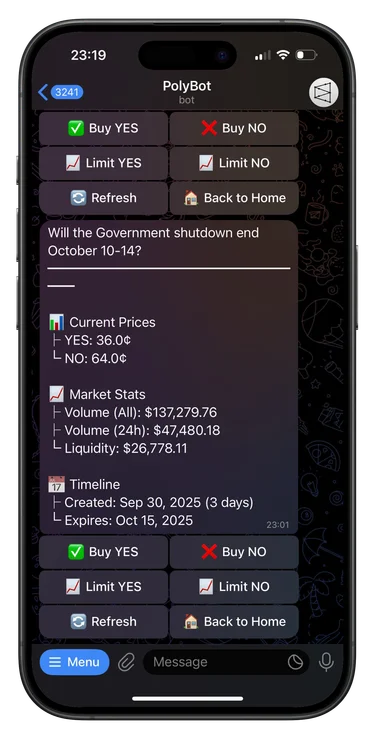
What a news trading bot should do
A useful news trading bot should reduce the time between discovery and review.
It should help you:
- find markets related to a news topic
- receive alerts when a watched market moves
- inspect the current market card
- check YES and NO prices
- review bid, ask, spread, and depth
- open related markets
- compare the headline with the market rules
- choose market order, limit order, alert, watchlist, or no trade
- review fills, open orders, and position exposure after entry
The bot should not make every news item feel urgent.
The best workflow is:
- News appears.
- Search or scanner finds the relevant market.
- Market wording and rules are checked.
- Price, spread, and liquidity are reviewed.
- The trader chooses an action.
- The result is reviewed after the order or alert.
That is slower than blind clicking, but it is faster than switching between many disconnected tools.
News alert, signal, and order are different
News-driven trading breaks when traders collapse three states into one.
A news alert says something happened.
A trading signal says the event may matter for a market.
An order commits capital at specific terms.
The same headline can lead to different actions:
- add a market to a watchlist
- set a price alert
- place a limit order
- reduce an existing position
- inspect a whale wallet
- wait for confirmation
- do nothing because the move is already priced
For signal discipline, use the Polymarket trading signals bot guide. For alert setup and noise control, use the Polymarket Telegram alerts and watchlists guide.
Start with market search
Most news workflows begin with a topic, not a market link.
Search is useful when:
- a headline mentions an event and you need to know whether a market exists
- a group chat discusses a story without sharing the exact market
- several related markets may fit the same topic
- you need to compare wording across outcomes
- you want to avoid trading the wrong contract
Search terms can include:
- person name
- team or league
- country or election
- event name
- company or asset
- policy topic
- "will"
- "by"
- "before"
- "today"
- "this week"
After search, do not trade from the result title alone. Open the market, check the outcome side, read the wording, inspect expiry, and review current liquidity.
For the detailed search workflow, read the Polymarket market search in Telegram guide.
Use scanners for discovery, not confirmation
Scanners can surface markets that are moving after news.
Trending markets, volume lists, price-change alerts, category filters, and large-trade notifications can all tell you where attention is gathering. That is useful because news can hit many markets at once.
It is also dangerous because the scanner usually finds the market after some traders have already reacted.
Before acting on a scanner result, ask:
- Did the price already move?
- Did the spread widen?
- Did volume improve or only spike briefly?
- Is the market still open?
- Is there enough depth for my size?
- Is this the primary market or a related market?
- Are traders reacting to confirmed news or a rumor?
- Would a limit order be better than immediate execution?
Use the Polymarket market scanner bot guide to keep scanner output in the discovery layer instead of turning every moving market into an order.
Verify the source before the trade
Fast news can be wrong, incomplete, or stale.
Before treating a headline as tradeable, check:
- whether the source is official, primary, or secondary
- whether the report is confirmed or only rumored
- whether the market rules name a specific source
- whether the headline matches the exact market question
- whether the update affects the outcome directly or indirectly
- whether the deadline in the market still matters
- whether other related markets moved in the same direction
This matters most when the event is ambiguous. A court headline may not settle a politics market. A team report may not settle a sports market. A crypto move may matter only for a short time window. A public statement may not match the resolution source.
The source check should happen before size increases.
If the headline makes you want to add to an existing position, use the Polymarket scale-in and scale-out guide before increasing exposure.
Market wording is the contract
News traders often see the event first and the contract second. That is backwards.
The market question decides what is being traded.
Check:
- YES versus NO side
- exact event definition
- deadline
- resolution source
- edge cases
- whether the market uses an official announcement
- whether the title is shorthand for a more detailed rule
- whether related markets have different wording
For politics, that can mean the difference between a candidate winning an election, winning a nomination, being inaugurated, appearing in a debate, or receiving an endorsement.
For sports, that can mean the difference between a team winning, a player starting, an injury report, a stat line, or a league decision.
For crypto up/down markets, that can mean the difference between a price at a specific time, a range, a daily candle, or a short window.
The headline can point you to the market. The market wording tells you what you own.
Liquidity is the news trader's filter
News markets can look obvious and still be hard to trade well.
After a major update, makers may pull quotes, spreads can widen, and visible depth can disappear. The displayed price may not be the price you can get for your size.
Before placing a news-driven order, check:
- best bid
- best ask
- spread
- visible depth near your size
- recent movement
- whether your order would walk the book
- whether the market is still refreshing
- whether a smaller order is more appropriate
- whether a limit order should replace a market order
This is the point where many news trades fail. The idea may be correct, but the fill can be wrong.
For execution checks, read Polymarket liquidity, spread, and slippage, the Polymarket slippage tolerance guide, and the Polymarket order book guide.
Fast execution needs a prebuilt plan
Speed matters most when the decision has already been prepared.
A fast Telegram workflow can help when:
- the market is already known
- the acceptable price is already defined
- the source is already trusted
- the market wording has already been checked
- the order size fits visible depth
- the trader knows whether to use market or limit
It is risky when the alert is the first time you have seen the market.
A fast button is not a substitute for:
- reading the rules
- checking the side
- checking spread
- checking size
- checking whether the move already happened
If your news workflow depends on quick links, price alerts, or group messages, read the Polymarket sniper bot guide. For mobile workflows, use the Polymarket mobile trading bot guide.
Limit orders are often better than chasing
News traders often assume the fastest order is the best order.
That is not always true.
A limit order can be the right action when:
- the price moved before you arrived
- the spread widened after the alert
- you only want the trade at a defined level
- your size would move the book
- the market is volatile
- you would rather miss than overpay
Use alerts and scanners to find the setup. Use a limit order to express the price you are actually willing to pay.
For the order-control layer, read Polymarket limit orders from Telegram and Polymarket order types: FOK, FAK, GTC, and GTD.
Whale alerts can confirm attention, not edge
Large wallet activity often appears around news.
That can be useful because a whale alert may show that a market is active, that a trader reacted quickly, or that liquidity changed. It does not prove the wallet is right, and it does not prove that your entry price is still good.
Before following a whale after news, check:
- whether the wallet entered before the price moved
- whether the trade consumed the best liquidity
- whether the wallet is hedged in another market
- whether the wallet has a category edge
- whether your size can enter without worse slippage
- whether the market still matches the original thesis
Use the Polymarket whale alerts and wallet tracker guide, then inspect the wallet with the Polymarket wallet analyzer.
Category-specific news workflows
Different news categories need different checks.
Politics and elections
Politics news often requires source and wording discipline.
Check:
- whether the market resolves on official results, certification, a named source, or another rule
- whether a poll is relevant to settlement or only price discovery
- whether the update is confirmed
- whether a court ruling or announcement has follow-up conditions
- whether related candidate markets moved together
- whether eligibility and jurisdiction rules apply
Use the Polymarket politics and election trading bot guide before treating every politics headline as final.
Sports and live games
Sports news can move markets before a trader finishes reading.
Check:
- lineup confirmation
- injury status
- score and clock
- weather
- league source
- whether the market is pre-game, live, or post-event
- whether the price changed faster than liquidity
Use the Polymarket sports trading bot guide for live-market execution checks.
Crypto and short-window markets
Crypto news and price movement can decay quickly.
Check:
- market window
- asset and exchange reference
- current price path
- time remaining
- volatility
- spread
- whether the move already completed
- whether a limit order is safer
Use the Polymarket crypto trading bot guide for BTC, ETH, SOL, and up/down markets.
Related and multi-market events
Some news affects several markets at once.
Before trading one market, check whether another related market has a cleaner expression of the idea, better liquidity, or different wording.
Use the Polymarket arbitrage and related-markets guide when the news affects several outcomes at the same time.
Risk controls for news trading
News trading needs smaller defaults than slow research trades.
Useful controls include:
- maximum position size
- per-market cap
- daily loss limit
- category cap
- slippage tolerance
- limit-order preference after wide spreads
- pause button for automation
- copied-wallet caps
- no-trade rule for unverified headlines
- post-trade review of fills
The point is not to remove risk. The point is to avoid letting urgency override the plan.
For sizing and exposure rules, read the Polymarket position sizing and risk management guide.
A practical Telegram news trading workflow
A disciplined workflow looks like this:
- A headline, alert, wallet move, or group link appears.
- Search finds the relevant market or related markets.
- The market card is opened in Telegram.
- The trader checks wording, rules, expiry, and side.
- The trader checks bid, ask, spread, and depth.
- The trader compares the current price with the thesis.
- The trader chooses no trade, alert, watchlist, limit order, market order, or copy adjustment.
- The trader reviews the fill or open order afterward.
That is the difference between a news trading workflow and a news reaction habit.
When no trade is the best action
Some news should not produce a trade.
Skip when:
- the source is unclear
- the market wording does not match the headline
- the price already moved too far
- the spread is too wide
- liquidity is thin
- the market is close to resolution but still ambiguous
- the order would exceed your risk plan
- you do not understand the category
- you are only reacting because the alert feels urgent
No trade is an action. In news-driven markets, it is often the most important one.
News trading checklist
Before placing a news-driven Polymarket order, answer:
- What exactly happened?
- Is the source credible?
- Which market expresses this event?
- Does the market wording match the headline?
- What source or rule resolves the market?
- Is the market still open?
- What are the current bid and ask?
- How wide is the spread?
- How much depth exists for my size?
- Has the market already repriced?
- Should this be an alert, limit order, market order, or no trade?
- What is my maximum loss if I am wrong?
If any answer is unclear, slow the workflow down.
FAQ
What is a Polymarket news trading bot?
A Polymarket news trading bot is a Telegram workflow that helps traders find markets related to breaking news, receive alerts, inspect market cards, review liquidity, and place controlled orders. The useful version supports review. It does not blindly trade every headline.
Should I market buy after a breaking news alert?
Only if the market wording, source, price, spread, liquidity, and size still fit your plan. Many breaking-news moves are already priced by the time an alert arrives, so a limit order or no trade can be better.
Are whale alerts good news signals?
Whale alerts can show that a market is active, but they do not prove the trade is still good. A large wallet may have entered earlier, moved the book, hedged elsewhere, or used a risk profile you cannot copy.
What is the safest first step after a headline?
Search for the exact market, read the wording and resolution rules, then check bid, ask, spread, and depth. If the setup still makes sense, choose the order type. If not, set an alert or skip.
Bottom line
A Polymarket news trading bot should make market review faster, not judgment weaker.
The strongest setup is not "headline to market order." It is headline to search, search to market review, review to liquidity check, and only then to alert, limit order, market order, copy adjustment, or no trade.
For the full workflow map, read the prediction market trading bot guide, then use the Polymarket trading signals bot guide, market scanner guide, and alerts guide to build a news workflow that does not trade every notification.
Polymarket Trading Signals Bot Guide: Alerts, Wallet Signals, Copy Trading, and Safer Telegram Execution
How to use Polymarket trading signals from Telegram without blindly chasing alerts: price targets, price-change alerts, big trades, wallet signals, copy trading, liquidity checks, and execution rules.
Telegram Trading / 11 min
Polymarket Market Scanner Bot Guide: Find Markets, Alerts, Liquidity, Wallet Signals, and Risk
How to evaluate a Polymarket market scanner bot workflow: search, trending markets, volume, price alerts, whale alerts, wallet signals, liquidity, order books, and risk controls.
Telegram Trading / 12 min