Prediction Market Trading Bot Guide: Copy Trading, Alerts, Automation, and Risk Controls
How to evaluate a prediction market trading bot for Polymarket-style markets: copy trading, wallet analysis, alerts, automation, execution speed, order types, custody, fees, and risk controls.

PolyBot Team
Updated June 1, 2026
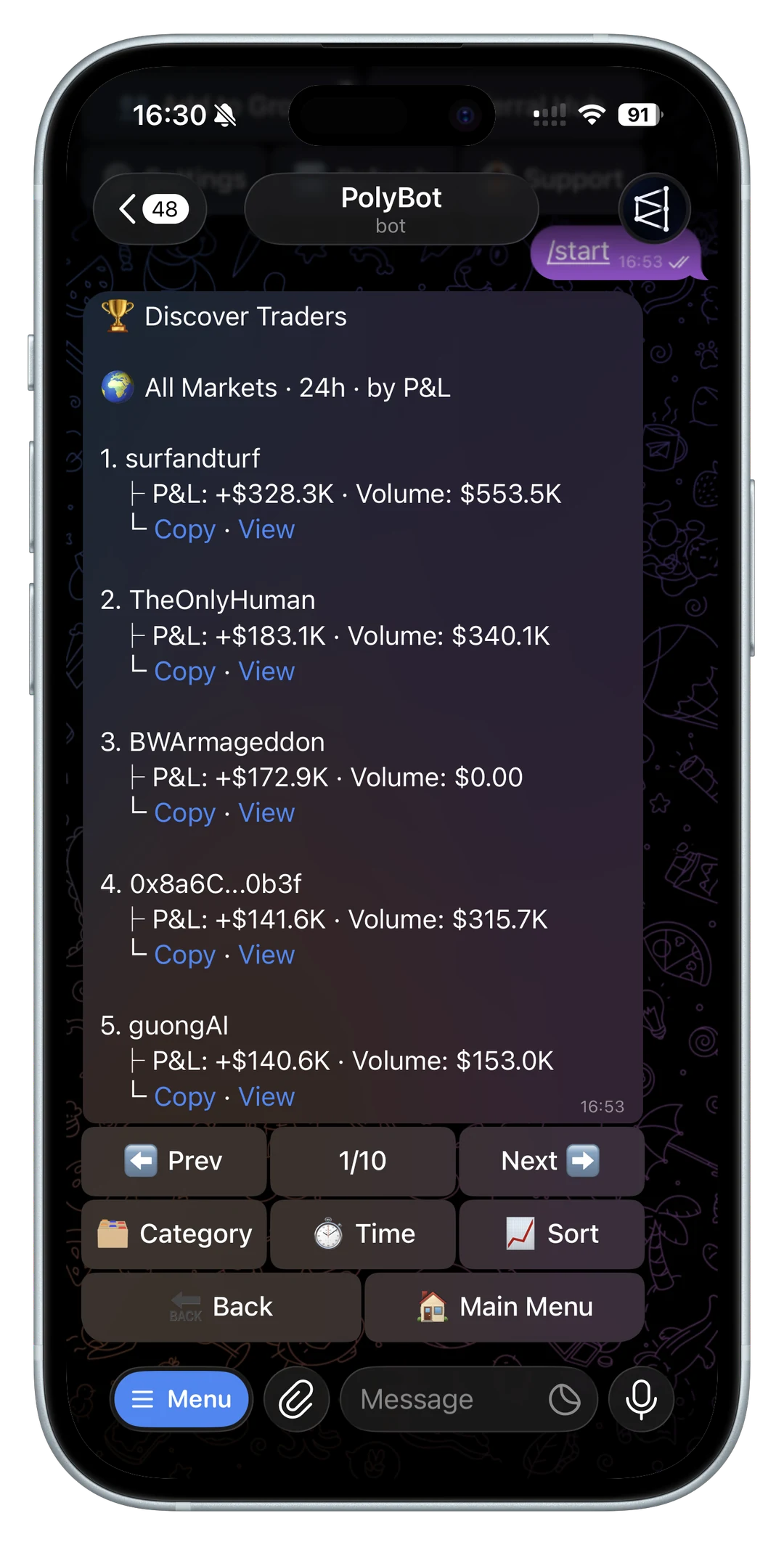
A prediction market trading bot is useful only when it helps a trader make better decisions before capital moves.
The weak version of a bot is simple: take a signal, click faster, and hope the price is still good. The stronger version connects market search, wallet analysis, alerts, execution, order controls, risk limits, and post-trade review into one workflow.
That distinction matters on Polymarket-style markets because every trade is tied to liquidity, spread, timing, resolution rules, and the exact price you receive. A bot can improve speed and consistency, but it can also repeat bad rules faster if the setup is loose.
This guide explains how to evaluate a prediction market trading bot across copy trading, alerts, automated strategies, manual execution, API trading, wallet safety, fees, and risk controls. If you want the PolyBot product overview first, start with the Telegram trading bot for Polymarket. If you are choosing between tools, use the Polymarket Telegram bot alternatives guide after this checklist.
If the product claims AI-assisted trading, use the Polymarket AI trading bot guide to separate research summaries, signal ranking, explicit automation rules, and live order placement.
If your main need is discovery rather than execution, read the Polymarket market scanner bot guide to connect search, volume, alerts, whale moves, liquidity, and watchlists.
If the workflow starts from headlines or breaking events, read the Polymarket news trading bot guide before using speed, scanners, or alerts as an execution trigger.
If the workflow starts from market movers, volume spikes, or trending lists, read the Polymarket volume alerts bot guide before letting attention substitute for price review.
If you are evaluating post-trade account management, use the Polymarket portfolio tracker bot guide to check positions, PnL, orders, alerts, copy exposure, and redemptions.
What a prediction market bot should actually do
A trading bot should not only place orders.
For prediction markets, a serious bot should help answer:
- Which market am I trading?
- What outcome am I buying or selling?
- What price is acceptable?
- How much can this trade use?
- What happens if the order only partially fills?
- What happens if the price moves before execution?
- How do I exit?
- How do I know whether the strategy is still working?
- How do I stop automation quickly?
That is why a useful bot workflow is usually a stack:
- market search
- odds and order-book review
- wallet or signal analysis
- order execution
- slippage control
- stop-loss and take-profit rules
- alerts
- trade history and PnL review
- wallet safety and withdrawal clarity
If a bot only advertises speed, treat that as incomplete. Speed matters, but price quality, liquidity, and risk rules decide whether the faster action was worth taking.
Prediction markets are not normal chart trading
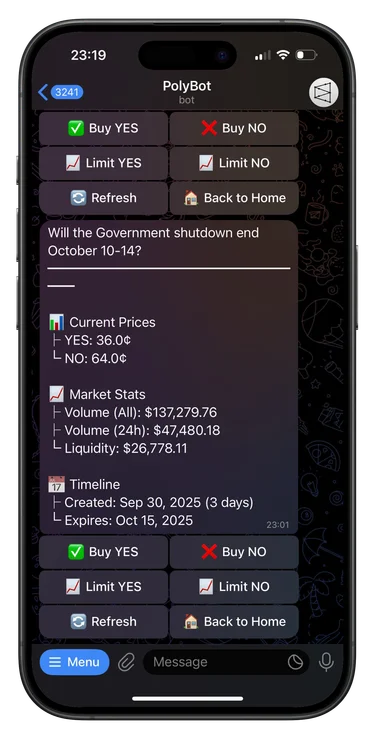
Prediction markets use outcome shares. Prices usually behave like implied probabilities, but the trade still happens through an order book with bids, asks, depth, and spread.
That creates a few bot-specific constraints:
- A 5 cent worse fill can materially change expected value.
- Some markets are liquid at one size and thin at another.
- A headline can move prices before an order lands.
- Resolution language can matter as much as price action.
- A winning thesis can still be hard to exit if liquidity disappears.
- Long-dated markets lock capital differently from short-window markets.
Before using any bot, understand the basics in the Polymarket odds and prices guide, then review the Polymarket order book guide. Those two concepts explain why a prediction market bot needs controls beyond a buy button.
Workflow 1: fast manual execution
Fast manual execution is the simplest bot workflow. You find a market, receive a link or alert, review the price, and place the order from Telegram or another interface.
This is useful when:
- you already understand the market
- the setup needs a quick reaction
- you want final confirmation before every order
- you are trading smaller size
- you do not want automation running unattended
The risk is rushed execution. A bot can make it easy to enter before checking liquidity, spread, resolution rules, or whether the price already moved.
For this workflow, pair the Polymarket sniper bot guide with the liquidity, spread, and slippage guide. The goal is not to click first. The goal is to avoid paying a bad price because the workflow is faster than your review process.
Workflow 2: copy trading
Copy trading uses another wallet as the signal. When that wallet buys or sells, your setup can mirror the action according to your rules.
This can work well when the followed trader has repeatable edge and the copied fills are still close enough to the leader's fills. It breaks down when a wallet looks good on a leaderboard but is not actually copyable after timing, slippage, size, and market selection.
A prediction market copy trading bot should support:
- wallet analysis before subscription
- fixed and proportional sizing
- daily caps
- price range filters
- category filters
- slippage tolerance
- max-per-market or max-per-outcome exposure
- skip reasons
- performance review by followed trader
Start with the best Polymarket traders to copy guide, then use the Polymarket copy trading settings guide to decide how much of that wallet you actually want to mirror. If you are comparing products, the best Polymarket copy trading bot checklist is the more specific buyer's guide.
Workflow 3: alerts and watchlists
Alerts are not automation by themselves. They are decision support.
Good alerts can tell you when:
- a price crosses a threshold
- a watched wallet trades
- a market becomes active
- an order fills or fails
- a position moves sharply
- a market resolves
- winnings are ready to redeem
The benefit is focus. Instead of refreshing pages, you define the conditions that deserve attention.
The danger is alert overload. If every small movement becomes a notification, the bot trains you to react without enough context. A good alert setup should have priority levels, quiet periods, and clear reasons why the notification exists.
Use the Polymarket Telegram alerts and watchlists guide for the alert workflow. If the signal comes from wallets rather than prices, read the Polymarket whale alerts and wallet tracker guide before blindly copying large trades.
Workflow 4: automated strategies
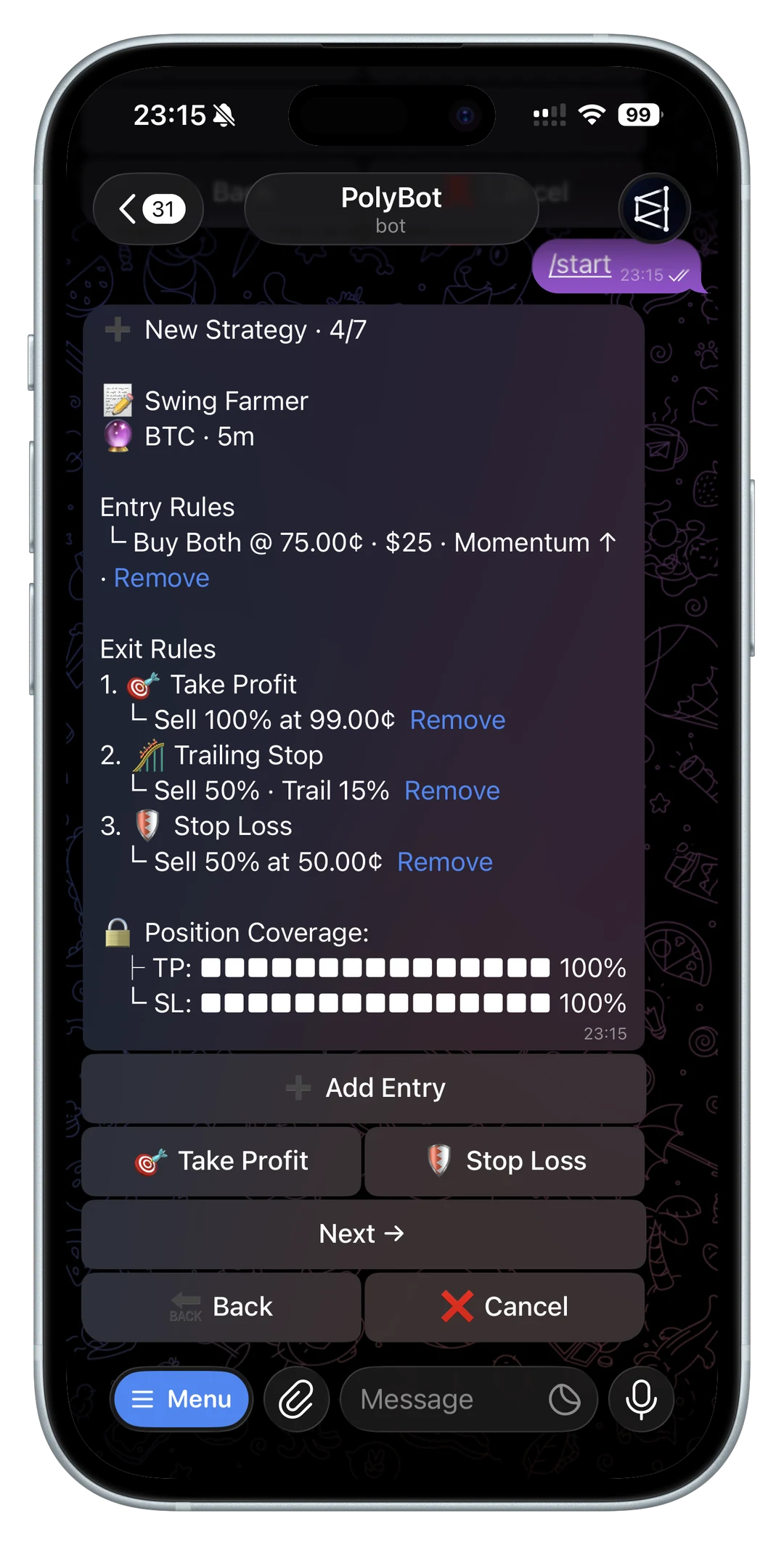
Automated strategies are rules that can execute without a manual click each time.
That can be useful for defined setups, such as short-window crypto markets, price-triggered entries, take-profit exits, stop-loss exits, trailing stops, and repeated strategy templates.
Automation should define:
- market scope
- entry condition
- amount per entry
- slippage limit
- entry window
- maximum attempts
- take-profit rule
- stop-loss rule
- trailing-stop behavior
- pause condition
- review cadence
If those pieces are missing, the bot is not running a strategy. It is running a vague instruction.
Use the Polymarket auto trader bot guide for the full automation checklist. For crypto-specific setups, read the crypto trading bot guide and trading strategies for crypto up/down markets.
Workflow 5: API and self-hosted bots
Some traders prefer direct API or self-hosted trading bots. That can make sense for technical teams that want custom logic, direct CLOB integration, private infrastructure, and full control over execution.
But self-hosting increases operational responsibility.
Before choosing that path, ask:
- Who stores credentials?
- How are API keys scoped?
- How are failed orders retried?
- How are duplicate orders prevented?
- How are partial fills handled?
- How is slippage enforced?
- How are logs monitored?
- How are secrets rotated?
- How does the bot stop during a bad market condition?
For a technical overview, read the Polymarket API trading bot and CLOB guide. For the tradeoff between managed Telegram workflows and custom infrastructure, read self-hosted Polymarket bot vs Telegram bot.
Execution controls matter more than marketing claims
The most important execution question is not whether the bot can place an order. It is whether the bot can avoid placing the wrong order.
Look for:
- market orders with slippage limits
- limit orders for price control
- clear behavior for FOK, FAK, GTC, and GTD orders
- partial-fill visibility
- order failure reasons
- open-order management
- position and balance updates
If you do not understand the order type, do not automate it.
Use the Polymarket order types guide, limit orders guide, and order failed error codes guide to check whether the bot explains the execution path clearly enough.
Risk controls should exist before the first trade
A prediction market trading bot should make it easy to define what should not happen.
Useful risk controls include:
- max amount per trade
- max amount per market
- max exposure per outcome
- daily budget caps
- stop-loss rules
- take-profit rules
- trailing stops
- slippage limits
- category filters
- expiry filters
- pause buttons
- alerting after failures or repeated skips
Risk controls do not make trading safe. They make the limits explicit.
For sizing and exposure, use the Polymarket position sizing guide. For exits, use the stop-loss and take-profit guide. For copy-specific drawdown planning, use the copy trading bankroll guide.
Wallet safety and custody are part of the bot
Any bot that trades with real funds needs a clear wallet model.
Before funding, verify:
- which wallet is used
- who can sign transactions
- whether you can withdraw when you want
- whether you can export or recover wallet access
- what permissions are requested
- how 2FA or withdrawal protection works
- whether fake bots or impersonators are easy to avoid
Do not treat custody as a secondary detail. A bot with good execution and unclear wallet control is still not ready for serious use.
Read the Polymarket Telegram bot fees, custody, gas, and safety checklist, API keys and wallet permissions guide, 2FA security guide, and official PolyBot links guide before trusting a bot link.
Fees, gas, spread, and slippage change the result
Bot performance should be evaluated after costs.
A copied wallet may be profitable before fees and worse fills. A strategy may look good at the trigger price but weak after spread and slippage. A small trade may be too small to justify the operational overhead.
Review:
- bot fees
- network and withdrawal costs
- spread paid on entry
- slippage versus expected price
- failed-order opportunity cost
- partial-fill behavior
- redemption and settlement flow
Use the Polymarket trading costs guide for the full cost stack and the auto-claim and redeem guide for the post-resolution workflow.
How to choose the right bot workflow
Choose based on the work you actually need.
If you are new, start with manual Telegram trading, market search, small size, and clear alerts.
If you want to follow traders, use wallet analysis first, then copy with tight caps and skip reasons.
If you trade fast-moving markets, focus on execution speed, slippage, and order-book depth.
If you want automation, start with one narrow strategy and review every fill before increasing size.
If you are technical, direct API access may fit, but only if you are prepared to own monitoring, credential security, and failure handling.
The how to choose a Telegram trading bot for Polymarket guide covers the broader product checklist. This page is the prediction-market-specific version: start from liquidity, resolution, wallets, risk controls, and execution evidence.
Final checklist
Before trusting a prediction market trading bot, confirm:
- You can search and inspect markets before trading.
- The bot explains odds, order book, spread, and slippage.
- You can use price controls, not only market buys.
- Copy trading has filters, caps, and skip reasons.
- Alerts are actionable and not just noisy.
- Automation has entry, exit, pause, and review rules.
- Wallet custody and permissions are documented.
- Fees and post-trade costs are visible.
- Failed orders and partial fills are easy to review.
- You can stop the bot quickly.
A bot is not good because it removes thinking. It is good when it makes the right checks easier to repeat.
Not investment advice, legal advice, tax advice, or security advice. Prediction markets are risky, eligibility rules vary, and automated trading can lose money. Always verify current product docs and live market conditions before funding or trading.
Polymarket Telegram Bot for Beginners: What to Check Before Your First Trade
A beginner checklist for using a Polymarket Telegram bot: official links, wallet funding, order types, copy trading, alerts, and risk controls.
Trading Guide / 11 min
How to Choose a Telegram Trading Bot for Polymarket
Comparing Telegram trading bots for Polymarket? Focus on execution speed, order controls, automation, custody, and docs — not generic lists.
Trading Guide / 10 min