Polymarket Auto Trader Bot Guide: Automated Strategies, Triggers, Exits, Alerts, and Risk Controls
How to evaluate a Polymarket auto trader bot workflow: automated strategies, trigger prices, momentum entries, take profit, stop loss, trailing stops, slippage, alerts, sizing, and pause rules.

PolyBot Team
Updated June 1, 2026
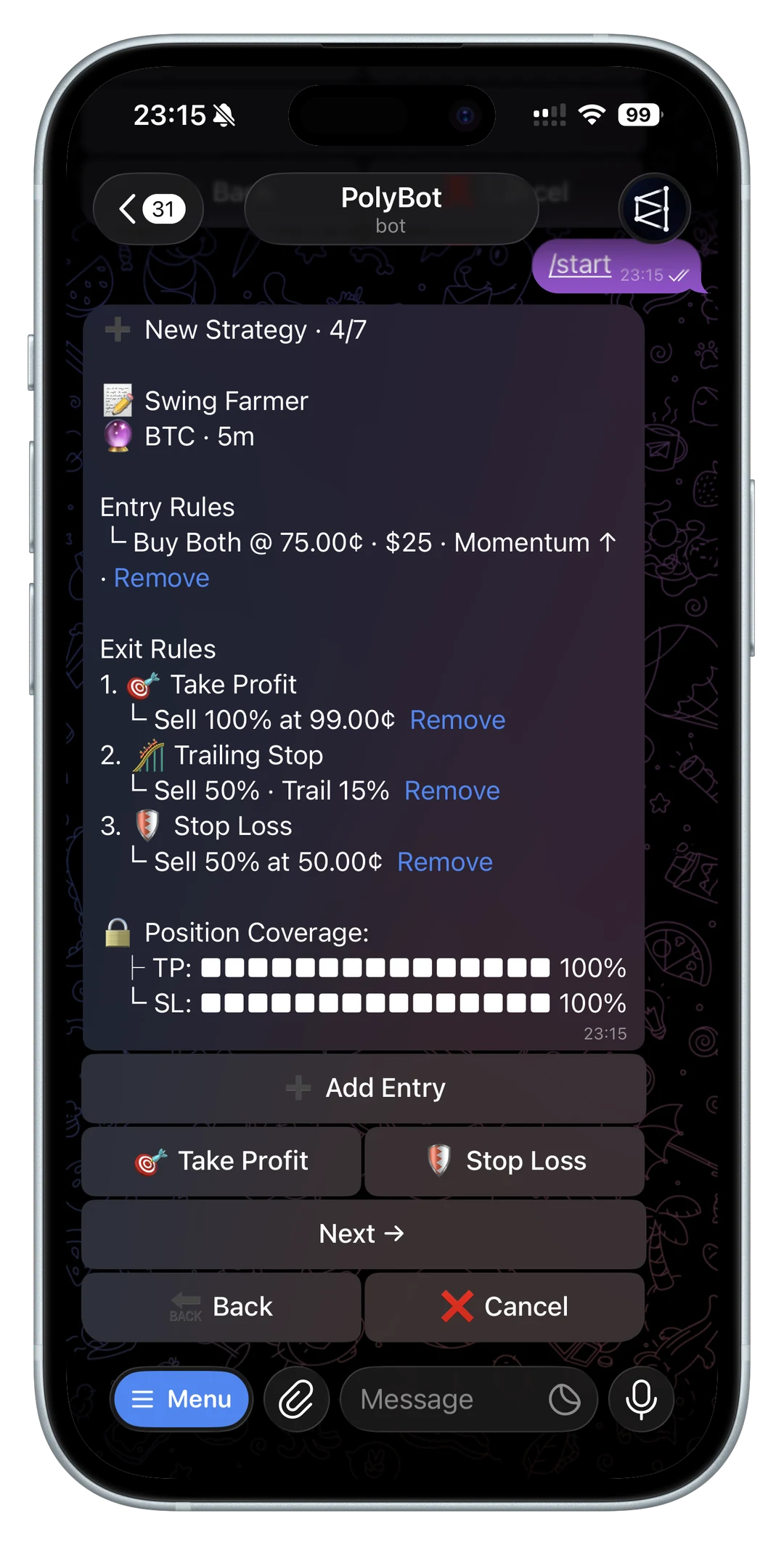
A Polymarket auto trader bot is useful only when the strategy is clear before automation starts.
Automation should not be a shortcut around market review. It should be a way to run a defined setup consistently: what markets to watch, when to enter, how much to buy, when to exit, when to skip, and when to pause.
This guide explains how to evaluate automated Polymarket trading from Telegram: strategy scope, trigger prices, momentum entries, entry windows, take-profit rules, stop-loss rules, trailing stops, slippage, sizing, alerts, monitoring, and the difference between strategy automation, copy trading, and fast manual execution.
If you are evaluating model-assisted automation, read the Polymarket AI trading bot guide before letting AI output influence entries, exits, sizing, or risk rules.
If you are still choosing the broader bot workflow, read the prediction market trading bot guide before deciding whether you need alerts, copy trading, fast manual execution, API trading, or full automation.
If you want the product overview first, start with the Telegram trading bot for Polymarket. If you want the crypto-specific version, read this with trading strategies for crypto up/down markets.
What an auto trader should automate
An auto trader should automate rules, not guesses.
Good automation candidates have:
- a specific market type
- a clear entry condition
- a fixed or bounded trade size
- a defined exit plan
- slippage limits
- enough liquidity for the expected size
- a pause condition
- a way to review fills, skips, and failures
Weak automation candidates sound like:
- "Buy if it looks strong"
- "Follow every move"
- "Trade whatever is trending"
- "Copy every wallet that wins"
- "Retry until it fills"
- "Use bigger size after a loss"
Automation makes good rules more consistent. It also makes bad rules repeat faster.
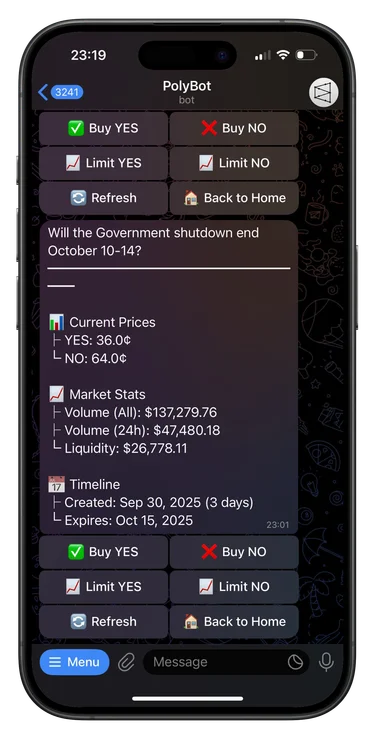
Strategy automation versus alerts versus copy trading
These are different workflows.
Strategy automation means you define the rule yourself. The bot watches for conditions and executes when the setup appears.
Alerts mean the bot notifies you that something happened. You still decide what to do.
Copy trading means another wallet's activity becomes the input. Your settings decide what gets mirrored or skipped.
Fast manual execution means you react to a link, alert, or wallet move and choose the order yourself.
Do not mix those without thinking. A price alert is not an entry rule. A copied wallet is not a strategy unless you understand why the wallet trades. A sniper workflow is not the same as automated strategy logic.
For adjacent workflows, use the Polymarket trading signals bot guide, how to copy trade on Polymarket from Telegram, and the Polymarket sniper bot guide.
Start with strategy scope
PolyBot's Trading Strategies docs describe Auto Trader as a way to build custom trading logic inside PolyBot. The user defines what to trade, when to enter, and when to exit.
The current documented strategy scope focuses on crypto up/down markets, with assets such as BTC, ETH, SOL, XRP, BNB, DOGE, HYPE, and all-crypto selection, plus timeframes such as 5m, 15m, 1h, 4h, and 24h.
That scope matters because short-window markets behave differently from long-duration event markets.
Before creating a strategy, decide:
- asset
- timeframe
- outcome side
- trade amount
- entry condition
- exit condition
- allowed entry window
- slippage tolerance
- execution mode
- pause rule
If the scope is too broad, the strategy becomes hard to interpret. Start narrow enough that each fill teaches something.
Entry rules define the reason to buy
An entry rule is the condition that opens a position.
Common entry inputs include:
- outcome side
- trigger mode
- trigger price
- momentum direction
- order amount
- entry window
A useful entry rule should be testable. After it fires, you should be able to answer: did this entry happen for the reason I intended?
If the answer is no, the rule is too vague.
Good entry examples:
- Buy BTC Up when price hits 42 cents inside a defined window.
- Buy ETH Down after a momentum move with a fixed dollar amount.
- Enter only after the first 30 seconds of a 5-minute market.
- Stop allowing new entries in the final minute.
Bad entry examples:
- Buy anything trending.
- Buy all crypto timeframes at once.
- Enter after every alert.
- Keep entering until a loss recovers.
For fast-entry workflows that are manual rather than rule-based, read the Polymarket sniper bot guide.
Exit rules are part of the strategy, not an afterthought
An auto trader without exit rules is only half automated.
PolyBot's strategy docs describe take-profit, stop-loss, and trailing-stop exits. Preset docs also describe reusable exit rules that can sell portions of a position when targets are hit.
The exit plan should answer:
- Where should profits be taken?
- How much should sell at each target?
- Where is the loss invalidation point?
- Should the stop be fixed or trailing?
- What happens if liquidity is thin?
- Should the strategy pause after repeated bad exits?
Take-profit rules help reduce hesitation. Stop-loss rules help avoid unmanaged downside. Trailing stops can follow upside and exit after a reversal.
None of those guarantee the final fill. They still depend on market liquidity, order type, and speed.
Use the Polymarket stop-loss and take-profit guide before relying on exits, and use the Polymarket limit orders guide when price control matters.
Slippage is where automation meets the order book
A trigger is not the same as a fill.
PolyBot's strategy docs describe slippage tolerance as the tradeoff between price discipline and fill reliability. Tight slippage can protect price but skip more trades. Loose slippage can improve fill rate but accept worse prices.
The right setting depends on the strategy.
Use tighter slippage when:
- the edge is small
- liquidity is thin
- the market is slower
- worse fills destroy the setup
- missed entries are acceptable
Consider looser slippage only when:
- the expected move is large enough
- the market moves quickly
- missing the exit is worse than accepting drift
- size is small enough for the book
- you are monitoring results closely
For the execution layer, read Polymarket liquidity, spread, and slippage and the Polymarket order book guide.
Entry windows reduce bad timing
Short-window markets have phases.
The open can be chaotic. The middle can be more stable. The close can be thin, volatile, or too late for a good risk-reward setup.
Entry windows let a strategy decide when new entries are allowed. That is different from exits, which still need to work after a position is open.
Ask:
- Should the strategy wait after the market opens?
- Should entries stop before the final minute?
- Does the same rule work on 5m and 1h markets?
- Does the rule behave differently on BTC versus smaller assets?
- What happens if the entry never appears?
If you do not know, narrow the strategy.
Once versus multiple execution
A strategy that enters once per market is easier to evaluate.
Multiple execution mode can be useful when a repeatable setup appears more than once, but it also increases risk. Re-entry after a closed position can turn a disciplined setup into overtrading if the gates are too loose.
Before using multiple execution, define:
- cooldown after close
- minimum price change before re-entry
- maximum entries per market
- maximum capital per market
- when the strategy should pause
- whether the previous exit was clean
Multiple mode should be earned by data, not enabled because a market feels active.
Size automation around risk, not excitement
Automation makes sizing mistakes easier to repeat.
Before activating a strategy, set:
- dollar amount per entry
- maximum per market
- maximum per outcome
- daily cap
- maximum number of active strategies
- maximum total exposure in one category
- stop condition after repeated losses or skips
For bankroll controls, read the Polymarket position sizing guide and the copy trading bankroll guide. Even if you are not copying a wallet, the same exposure logic applies.
If several automated entries behave like a ladder, read the Polymarket scale-in and scale-out guide before letting multiple rules add exposure to the same market.
Alerts still matter after automation
Automation should not be invisible.
Useful notifications include:
- entry fired
- entry skipped
- partial fill
- failed order
- take profit triggered
- stop loss triggered
- trailing stop updated or triggered
- strategy paused
- strategy performance changed
- position resolved
- winnings are redeemable
Alerts are the review loop. They tell you whether the automation is behaving the way the strategy intended.
Use the Polymarket Telegram alerts guide, order failed guide, and auto-claim guide to keep post-trade automation visible.
Monitoring decides whether to keep the strategy
A strategy should not run forever just because it exists.
Review:
- number of trades
- win rate
- realized PnL
- unrealized exposure
- average entry price
- average exit price
- skipped entries
- failed orders
- slippage versus trigger
- behavior by asset and timeframe
- whether losses cluster in one market condition
If the strategy only works in one asset, narrow the scope. If it fails near market close, adjust entry windows. If exits miss too often, review slippage and liquidity. If performance changes after a market regime shifts, pause before changing size.
When not to use an auto trader
Manual review is better when:
- the market wording is complex
- the resolution source is unclear
- the edge depends on interpreting news
- liquidity is thin
- the strategy has not been tested
- size is too large for visible depth
- the setup needs a full basket of related markets
- you do not know the exit plan
- you cannot monitor failures
Automation is not a substitute for understanding the market.
For related-market strategies, read the Polymarket arbitrage guide before automating only one leg. For developer-built automation, read the Polymarket API trading bot guide.
Auto trader checklist
Before turning on a Polymarket auto trader bot, answer:
- What exact market type is in scope?
- What entry condition starts the trade?
- What order size should each entry use?
- What slippage is acceptable?
- What entry window is allowed?
- Is this once per market or multiple execution?
- What take-profit rule applies?
- What stop-loss or trailing-stop rule applies?
- What happens after a skipped or failed order?
- What is the max exposure per market, outcome, and day?
- What alert tells me the strategy needs review?
- What condition pauses the strategy?
If the checklist is incomplete, keep the workflow alert-only or manual until the rule is clearer.
Polymarket auto trader questions
What is a Polymarket auto trader bot?
It is a workflow that runs defined trading rules automatically. In PolyBot, Trading Strategies let users define scope, entry rules, exit rules, slippage, execution mode, entry windows, monitoring, and pause or resume behavior.
Is auto trading the same as copy trading?
No. Auto trading runs rules you define. Copy trading follows another wallet through settings such as sizing, filters, slippage, caps, and copy mode.
Do trigger prices guarantee fills?
No. A trigger starts the action, but the final fill depends on liquidity, spread, market movement, order behavior, and slippage tolerance.
Should beginners use automated strategies?
Beginners should start narrow or use alerts first. Automation is safer after the trader understands market wording, order types, liquidity, sizing, and exits.
What is the safest first automated strategy?
The safest first strategy is usually narrow: one asset, one timeframe, one entry rule, small size, a take-profit rule, a stop-loss rule, conservative caps, and active monitoring.
Not investment advice, financial advice, legal advice, or trading advice. Automated trading can lose money, and every strategy should be tested, monitored, and paused when market behavior changes.
Polymarket AI Trading Bot Guide: Signals, Wallet Analysis, Automation, and Risk Controls
How to evaluate a Polymarket AI trading bot workflow: market discovery, news summaries, wallet analysis, signals, automated rules, API safety, order-book checks, and risk controls.
Automation / 12 min
Polymarket Copy Trading: How It Works and How to Start From Telegram
Learn how Polymarket copy trading works, how to choose wallets, configure filters, control slippage, size positions, and manage risk from Telegram with PolyBot.
Copy Trading / 13 min