Polymarket Stop Loss and Take Profit in Telegram: Exit Rules, Presets, and Trailing Stops
How Polymarket stop-loss, take-profit, trailing-stop, and exit preset workflows should work in a Telegram bot: triggers, partial exits, liquidity risk, copy trading, and stale-order review.

PolyBot Team
Updated August 22, 2026
Maintained by the PolyBot product team with AI-assisted editing. Risk controls reduce manual work but do not guarantee execution or outcomes.
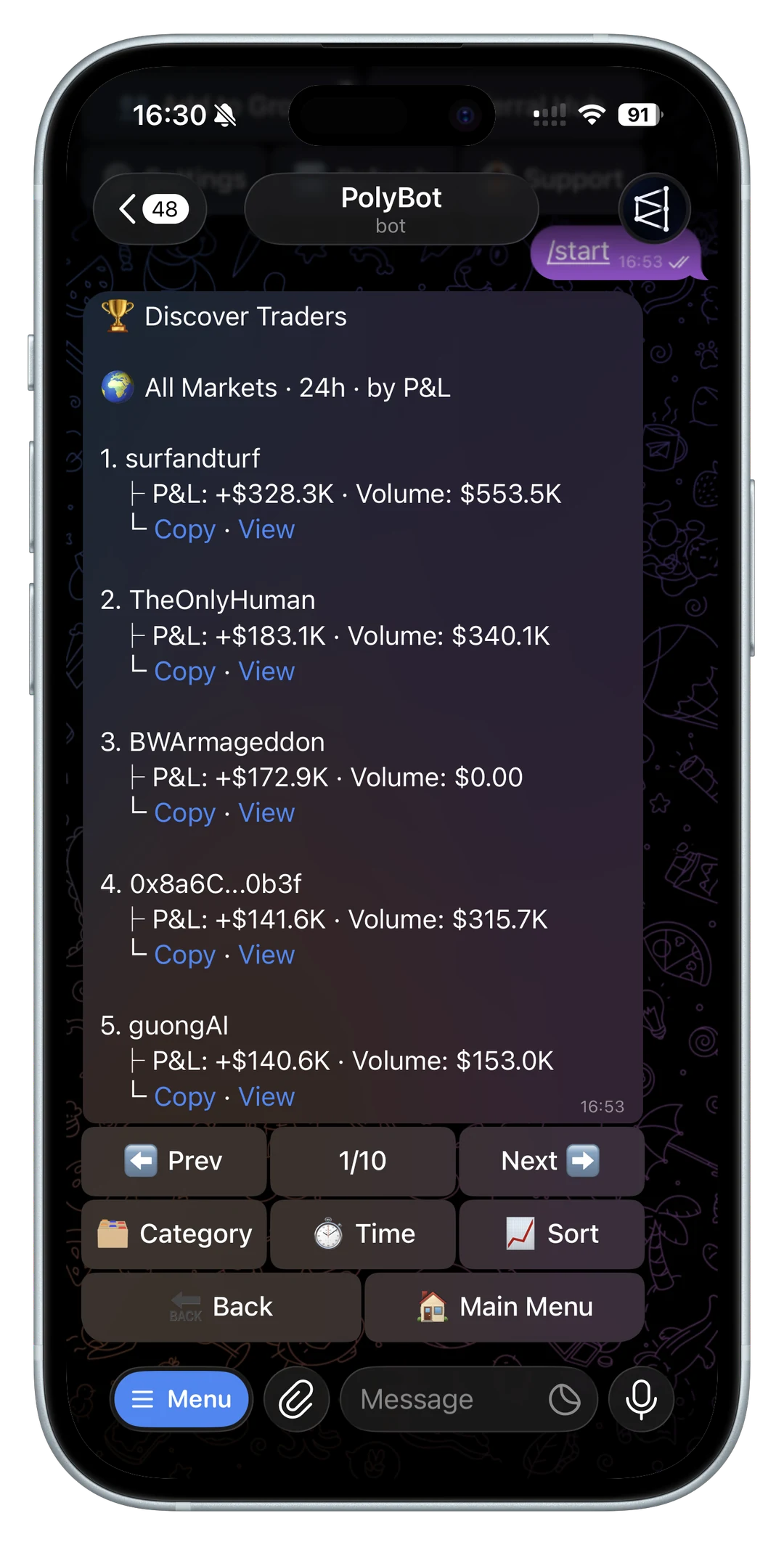
Stop-loss and take-profit tools are not magic protection. They are rules that help you decide what should happen after a Polymarket position moves.
That distinction matters. Prediction markets can move quickly, liquidity can disappear, and a triggered exit still depends on available order-book depth. A stop loss can reduce unmanaged downside, but it cannot guarantee the exact exit price. A take-profit rule can lock in gains, but it can also close a position before the market fully plays out.
Before relying on exit rules, make sure the entry size is sane. Set a bankroll limit and a maximum exposure per market first; a stop loss should never be used to justify an oversized entry.
The value of a Telegram trading bot is that the exit rule can live near the trade: market card, position, alert, portfolio, and order review all stay in the same workflow.
For the notification layer around triggered stops, submitted exits, partial fills, failed exits, and remaining exposure, read the Polymarket notification bot guide.
If exit rules need to be reviewed next to open positions, PnL, open orders, and copied exposure, use the Polymarket portfolio tracker bot guide.
If a triggered exit reduces only part of the position, use the Polymarket partial fills guide before assuming the stop loss or take-profit rule fully closed exposure.
PolyBot's official Portfolio & Orders Guide, Trading Guide, and What Is PolyBot page describe stop losses, presets, portfolio/order management, and strategy exits as part of its Telegram-native Polymarket workflow. This guide explains how to think about those exits before you turn them on.
The three exit jobs
Most Polymarket exits fit into one of three jobs.
Stop loss
A stop loss is a downside rule.
It asks: if this position moves against me, where should the bot try to reduce or close exposure?
Use a stop loss when:
- you already know the maximum downside move you are willing to tolerate
- you cannot watch the market continuously
- the market can reprice quickly
- a copied wallet or automated strategy could open positions while you are away
- you want a defined review point instead of emotional panic selling
In a prediction market, the trigger can usually be expressed as a price level or percentage move from entry. The important part is that the rule should match the market's liquidity and time horizon.
Take profit
A take-profit rule is an upside rule.
It asks: if this position moves in my favor, where should the bot try to lock in gains?
Use take profit when:
- the market may reverse after a fast move
- your thesis has a clear target price
- you want to sell only part of the position
- you are trading short-window markets
- you want a plan before the green PnL makes you hesitate
Take profit is not only about greed control. It also helps turn an open position into a defined trade plan.
Trailing stop
A trailing stop follows a winning position and exits only after a reversal.
Instead of choosing one fixed exit price, you choose a trail distance. If the market moves up, the high-water mark moves with it. If the market pulls back by the trail amount, the exit can trigger.
Use trailing stops when:
- you want to let a winner run
- you still want a defined giveback limit
- the market can trend after news
- you do not know the exact take-profit level in advance
Trailing stops are useful, but they can be too sensitive in choppy markets. A tight trail can close a good position because of normal noise.
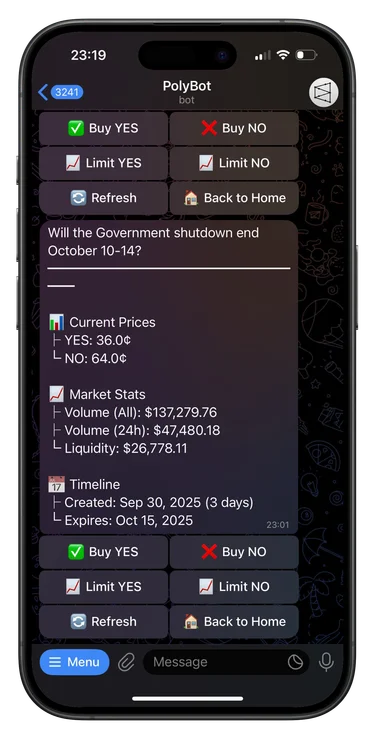
Stop loss is not the same as a limit sell
A limit sell and a stop loss can both close a position, but they answer different questions.
- Limit sell: sell only if the market reaches my target price.
- Stop loss: try to sell if the market breaks my risk level.
- Take profit: try to sell after a favorable move.
- Trailing stop: try to sell after a winner reverses by a defined amount.
Limit sells are price-control orders. Stop losses and take-profit rules are risk or plan rules. That difference matters because the user should review them in different mental buckets.
For the broader market-sell, limit-sell, redeem, and withdrawal distinction, read how to sell a Polymarket position.
For resting price-control orders, read Polymarket limit orders from Telegram. For post-entry review, read Polymarket portfolio and orders in Telegram.
What an exit preset does
An exit preset is a reusable exit plan.
Instead of deciding stop loss and take profit from scratch every time, a preset lets you save a pattern such as:
- take profit at +25%, sell 50%
- take profit at +50%, sell the rest
- stop loss at -15%, sell 100%
- trailing stop at 5%, sell remaining shares after a reversal
Presets are useful because many traders repeat the same style of trade. A crypto up/down scalp, a long-horizon political market, and a copied-wallet position may need different exits. Saving those templates reduces setup time and lowers the chance that a fast entry has no exit plan.
The risk is applying a preset to the wrong market. A tight stop that makes sense on a short-window trade may be wrong for a slow market. A take-profit rule that works in liquid markets may fail or fill poorly when liquidity is thin.
Auto-apply presets need extra discipline
Auto-apply means a default exit preset can attach to new positions automatically.
That can be useful if your default risk plan is well tested. It is risky if you turn it on just because it feels safer.
Before using auto-apply, check:
- Does this preset fit the market type I trade most?
- Does it fit my usual position size?
- Does the stop distance respect normal price noise?
- Does the take-profit level have enough likely liquidity?
- Do I know where active preset exits appear?
- Can I cancel or revise the rule quickly?
Auto-apply should not hide exit logic. It should make a deliberate exit plan easier to repeat.
For settings-level context, read Polymarket Telegram bot settings.
Partial exits reduce all-or-nothing thinking
Not every exit has to sell 100% of a position.
Partial exits can help when:
- you want to take some profit but keep upside
- you want to reduce downside without fully closing
- the position is large relative to available liquidity
- the market is moving but still unresolved
- you are copy trading and want gentler risk control
For example, a trader might sell 50% at the first take-profit level, leave 25% for a later target, and protect the remaining 25% with a trailing stop. Another trader might use a stop loss that sells only half because the market is volatile and they still want some exposure.
The goal is not to make the setup complicated. The goal is to match the exit to the position.
Liquidity decides whether exits work cleanly
Every exit rule eventually meets the order book.
Before relying on a stop loss or take-profit setup, understand:
- how wide the spread usually is
- whether enough shares are available near the trigger
- whether your position is large for the market
- whether the market moves in jumps
- whether resolution is close
- whether partial fills are possible
If the market gaps through your trigger, the exit may happen at a worse price than expected. If liquidity disappears, the order may only partially fill or fail. This is not unique to Telegram; it is how thin prediction markets behave.
Read why execution speed matters in prediction market copy trading for the liquidity, spread, and slippage side.
Stop-loss rules for copy trading
Copy trading needs exits because copied wallets do not trade for your exact constraints.
A source wallet may:
- have more capital
- accept a larger drawdown
- exit manually later
- hedge in another market
- tolerate wider slippage
- trade a category you do not understand
That means your copy setup may need its own stop loss, take-profit rule, or trailing stop. You are not only copying a wallet. You are adapting that wallet to your bankroll, latency, and risk tolerance.
Before copying, use the Polymarket wallet analyzer, then read how to copy trade on Polymarket from Telegram.
Stop-loss rules for automated strategies
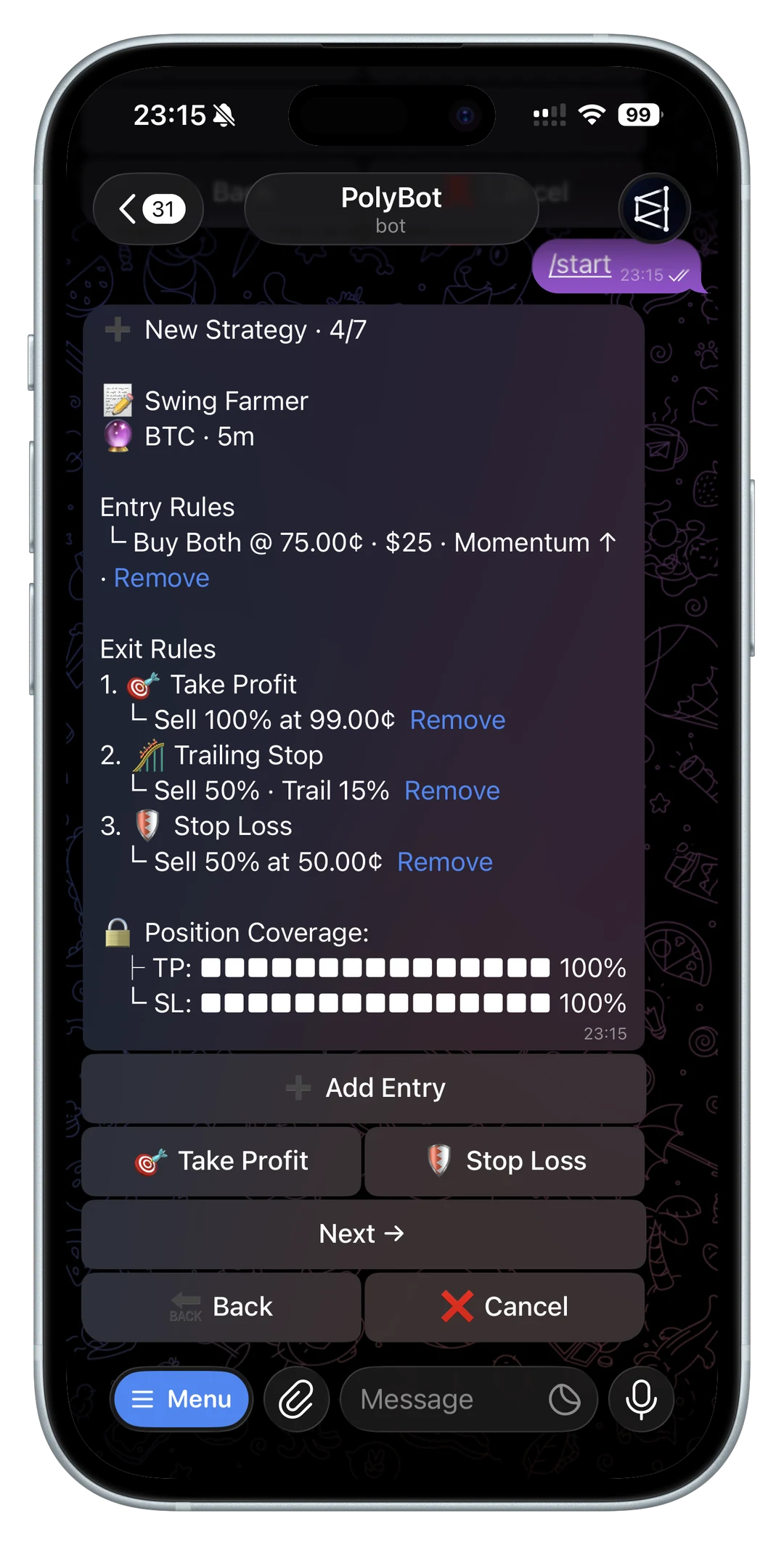
Automated strategies should define exits before entries.
For short-window markets, that means:
- entry trigger
- trade size
- stop loss
- take profit
- trailing stop if relevant
- entry window
- slippage limit
- maximum exposure
If the strategy can enter without an exit, it can create unmanaged exposure while you are away. If the exit rules are too tight, it can churn. If the rules are too loose, the automation may hold a bad position longer than you would manually.
How to review active exit rules
After placing a stop loss, take profit, trailing stop, or preset, review it like an open order.
Check:
- which market it applies to
- which outcome side it protects
- current position size
- trigger price or percentage
- sell percentage
- whether multiple exits overlap
- whether a limit order already exists
- whether the rule should be cancelled after the thesis changes
The most dangerous exit rule is the one you forget exists. Old rules can fire after the reason for the trade has changed.
A simple exit checklist
Before adding a stop loss or take profit to a Polymarket position, answer:
- What is the market question?
- Which outcome do I hold?
- What is my average entry price?
- What price invalidates the trade?
- What price makes partial profit-taking reasonable?
- How much should sell at each trigger?
- Is there enough liquidity for that exit?
- Does this rule overlap another order?
- Will I remember to review it later?
If you cannot answer those questions, the exit rule may create false confidence.
Common mistakes
Avoid these patterns:
- setting the same stop loss on every market
- using a stop loss in a market with very thin liquidity
- treating a stop as a guaranteed exit price
- taking profit too early because the preset is too tight
- leaving old exit rules after the thesis changes
- using auto-apply before testing a preset manually
- adding exits without checking open limit orders
- copying a wallet without adapting exits to your own bankroll
The fix is usually simpler than the mistake: smaller size, clearer trigger, wider review window, and fewer overlapping rules.
FAQ
Does Polymarket have stop losses?
Polymarket itself is an order-book market. Stop-loss behavior usually comes from a tool or bot that monitors prices and submits an exit when a trigger is reached. PolyBot exposes stop-loss and preset workflows inside Telegram.
Can a stop loss guarantee my exit price?
No. A stop loss can trigger an exit attempt, but the final fill depends on liquidity, spread, market speed, and order behavior. In fast or thin markets, the fill can be worse than expected or incomplete.
Is take profit better than a limit sell?
They solve different problems. A limit sell is a resting order at a target price. A take-profit rule is part of a broader exit plan and may be packaged with stop-loss or trailing-stop behavior.
Should every copied trade have a stop loss?
Not automatically. Some copied wallets trade markets where tight stops are harmful. But every copied setup should have a risk plan: size caps, slippage limits, category filters, pause rules, and exit logic where appropriate.
Exits should make fast trading safer to review
The best exit rules make your plan visible before the trade becomes emotional.
Use stop losses to define downside, take profits to define upside, trailing stops to manage winners, and presets to repeat tested logic. Then review active rules the same way you review open orders.
Not investment advice. Prediction markets are risky, and stop-loss, take-profit, and trailing-stop tools do not guarantee profit or prevent loss.
Polymarket Cuts Crypto Taker Delay From 250ms to 50ms
Polymarket reduced its crypto-market taker delay from 250ms to 50ms. Here is what changed for fills, trading bots, makers, and copy traders.
Execution / 5 min
Polymarket Copy Trading: How It Works and How to Start From Telegram
Learn how Polymarket copy trading works, how to choose wallets, configure filters, control slippage, size positions, and manage risk from Telegram with PolyBot.
Copy Trading / 13 min