Polymarket Odds and Prices Explained: YES/NO Shares, Probability, and Payouts
A practical guide to Polymarket odds: how YES/NO prices map to probability, why bid/ask matters, how shares pay out, what position value means, and how Telegram traders should read market cards.

PolyBot Team
Updated June 1, 2026
Polymarket odds are prices.
That is the first idea every trader needs to understand. A YES share trading near 60 cents is not just a button price. It is the market's current implied probability, shaped by buyers and sellers in the order book. If the outcome wins, the winning side redeems at $1 per share. If it loses, that side is worth $0.
This sounds simple, but many mistakes come from reading the displayed price too casually. The price you see, the price you can buy at, the price you can sell at, and the final payout are related but not identical.
Polymarket's official Prices & Orderbook documentation explains that shares are priced between $0 and $1 and that prices represent implied probability. The Positions & Tokens documentation explains YES/NO outcome tokens, $1 redemption for the winning side, current position value, and selling before resolution. PolyBot's Trading Guide shows how these concepts appear in Telegram trading flows.
For the official outcome, dispute, and post-resolution workflow behind those payouts, read the Polymarket resolution rules guide.
For the live bid, ask, spread, depth, and fill-price mechanics behind the displayed number, read the Polymarket order book guide.
This guide turns those mechanics into a practical checklist for reading Polymarket prices from Telegram.
Price means implied probability
In a simple binary market, the price is easiest to read as a probability estimate.
Examples:
- 25 cents means roughly a 25% implied chance
- 50 cents means roughly a 50% implied chance
- 75 cents means roughly a 75% implied chance
That does not mean the market is guaranteed to be right. It means traders are currently willing to buy and sell around that probability. If new information arrives, the price can move quickly.
The useful question is not "is 60 cents high or low?" The useful question is: "Do I believe the true probability is meaningfully higher or lower than the executable price?"
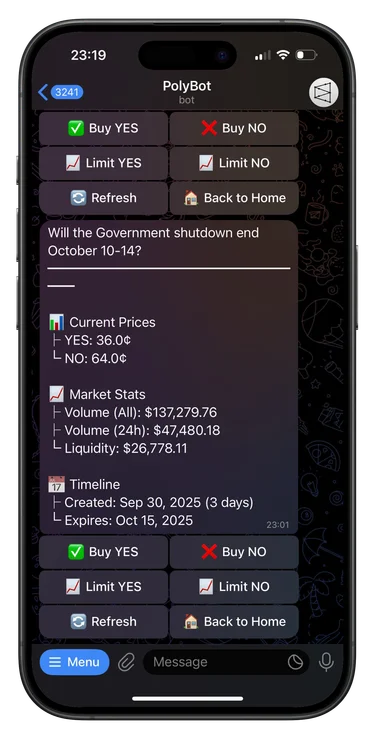
YES and NO shares are outcome tokens
Polymarket positions are outcome tokens.
In a standard binary market, there are two sides:
- YES wins if the event happens
- NO wins if the event does not happen
If you buy YES, you hold YES outcome tokens. If YES wins, those tokens redeem for $1 each. If YES loses, they redeem for $0. NO works the same way in the opposite direction.
This is why position size is measured in shares. Buying $60 of YES at 60 cents gives you about 100 YES shares before fees and execution effects. If YES later wins, those 100 winning shares redeem around $100. If YES loses, they are worth $0.
The important part: the payout is tied to the number of winning shares, not to the dollar amount you originally clicked.
For the difference between payout and net result after fees, spread, and slippage, read the Polymarket trading costs guide.
Payout is different from profit
Payout and profit are not the same.
If you buy 100 YES shares at 40 cents, you spend about $40. If YES resolves as the winner, those 100 shares redeem for $100. The payout is $100, while the gross profit is about $60 before any relevant fees, spread, or execution costs.
If you buy 100 YES shares at 80 cents, you spend about $80. If YES wins, the payout is still $100, but the gross profit is about $20.
Same winning payout. Different risk and return.
This is why higher-probability trades can still have lower upside. A 92-cent market may look safe, but it risks most of the purchase amount to make a smaller gain. A 20-cent market can return more if it wins, but it is priced as a lower-probability outcome.
Displayed price is not always your executable price
Polymarket's docs explain that the displayed price is normally the midpoint between the best bid and best ask. If the bid-ask spread is wide, the last traded price can be shown instead.
That distinction matters.
Suppose YES has:
- best bid: 34 cents
- best ask: 40 cents
- midpoint: 37 cents
The displayed price may look like 37 cents, but a market buy usually pays near the ask, and a market sell usually receives near the bid. In this example, you may pay 40 cents to buy immediately or receive 34 cents to sell immediately.
That gap is the spread. It is one reason a market can look fair on the card but still be expensive to trade immediately.
For the execution side, read the Polymarket liquidity, spread, and slippage guide.
The order book sets the live trade
Prices are not set by Polymarket itself. They emerge from supply and demand in the order book.
The order book has:
- bids: prices buyers are willing to pay
- asks: prices sellers are willing to accept
- spread: the gap between best bid and best ask
- depth: how much size exists at each price level
When you buy immediately, you are usually taking from the ask side. When you sell immediately, you are usually taking from the bid side. If your order is large relative to visible depth, it can fill across worse prices.
That is why "the market is 60 cents" is incomplete. Better questions are:
- Can I buy at 60 cents or only at 63 cents?
- Can I sell at 60 cents or only at 56 cents?
- How much size is available near that price?
- Has the book moved since the card loaded?
- Would a limit order be more honest about my target price?
Market orders and limit orders read price differently
A market-style order prioritizes immediate execution. A limit order prioritizes price.
For a market buy, the practical question is: what ask liquidity can I take now?
For a market sell, the practical question is: what bid liquidity can I receive now?
For a limit buy, the question is: what is the highest price I am willing to pay?
For a limit sell, the question is: what is the lowest price I am willing to receive?
Those are not just interface choices. They are different ways of expressing your price belief. If your thesis only has a few cents of edge, a sloppy market order can erase it.
The Polymarket order types guide explains market-style FOK/FAK behavior and resting GTC/GTD limit orders in more detail.
Position value is mark-to-market
Position value is the number of shares multiplied by the current market price.
If you hold 100 YES shares and YES is trading at 75 cents, the current position value is about $75.
That does not mean you have realized $75. It means the position is currently valued around that price. If the bid side is thinner than the displayed price suggests, your actual exit may be lower. If the market resolves in your favor, the winning shares redeem at $1 each. If it resolves against you, they redeem at $0.
This is why open-position PnL should be treated as a live estimate, not final profit. For the difference between realized, unrealized, and total PnL, read the Polymarket PnL tracker guide.
Selling before resolution locks a different outcome
You do not have to hold until resolution.
If you buy YES at 40 cents and later sell at 70 cents, you can realize a gain before the event concludes. If you buy at 70 cents and later sell at 40 cents, you can cut exposure before a full loss.
Selling before resolution converts market price movement into a realized exit. Holding until resolution converts the final event outcome into a redeem or loss.
Use selling when:
- the market is still tradeable
- your thesis changed
- you want to reduce risk
- you want to lock in partial profit
- liquidity is available at an acceptable bid
Use redeem after resolution when:
- your outcome won
- the position is redeemable
- you want the payout back in tradable balance
For exit mechanics, read how to sell a Polymarket position. For settlement cleanup, read the auto-claim and redeem guide.
YES and NO are not always a beginner shortcut
In a simple binary market, YES and NO are straightforward.
In multi-outcome events, wording and structure can get more complicated. A market may be part of a larger event where outcomes are related. In those cases, reading only one price can be misleading.
Before trading, check:
- exact question wording
- whether the market is binary or part of a multi-outcome event
- resolution source
- expiry
- which side you are buying
- what would make that side win
- what happens to related outcomes
For multi-outcome event structure, read the Polymarket negative-risk markets guide.
Copy trading adds a price gap
Copy trading does not automatically give you the leader's odds.
If a leader buys YES at 41 cents and you fill at 48 cents, you are not taking the same risk-reward profile. You copied the market and side, but your entry price is different.
Review copied trades by comparing:
- leader entry price
- follower entry price
- spread at follower execution
- fill size
- skipped trades
- exit price
- realized or unrealized PnL
Price filters and slippage settings exist because this gap matters. The copy trading settings guide explains how odds ranges, slippage, caps, and side filters shape copied exposure.
A Telegram market-card checklist
Before acting on a market card in Telegram, check:
- What is the exact question?
- Which side is YES and which side is NO?
- Is the displayed price a midpoint, last trade, bid, or ask context?
- What price would I pay to buy now?
- What price would I receive to sell now?
- How wide is the spread?
- How much size is available near my price?
- What is the payout if my side wins?
- What is the loss if my side loses?
- Can I exit before resolution?
- Would a limit order fit better than a market order?
- Is the market simple binary or part of a multi-outcome event?
The goal is not to make every trade slow. It is to make fast actions preserve the price reason for the trade.
The bottom line
Polymarket odds are useful because they are tradable probabilities, but they need to be read carefully.
The displayed price is a signal, not always your executable price. YES and NO shares pay out based on resolution, but open positions move with current market prices. Bid/ask spread, order-book depth, slippage, and resolution state all affect what a trade is actually worth.
If you remember one rule, make it this: do not ask only "what are the odds?" Ask "what price can I actually trade, what payout am I taking, and what happens if I need to exit?"
Not investment advice. Prediction markets are risky, prices can move quickly, and any trade should be verified against current market data and official product behavior before execution.
Polymarket Resolution Rules: Payouts, Disputes, Redeems, and What Happens After a Market Ends
A practical guide to Polymarket resolution rules, UMA proposals and disputes, winning-share payouts, redeem timing, market wording, and how Telegram traders should review settled positions.
Trading Guide / 10 min
Polymarket Arbitrage Guide: Related Markets, Negative Risk, Order Books, and Bot Risk
How to evaluate Polymarket arbitrage before trading or automating it: related markets, negative-risk events, order-book depth, fees, slippage, timing, and execution risk.
Trading Guide / 10 min