Polymarket Order Types Explained: FOK, FAK, GTC, GTD, Market, and Limit Orders
A practical guide to Polymarket order types for Telegram traders: market orders, limit orders, FOK, FAK, GTC, GTD, post-only errors, tick size, slippage, and failed orders.

PolyBot Team
Updated August 22, 2026
Maintained by the PolyBot product team with AI-assisted editing. Order behavior was reviewed against the linked official documentation.
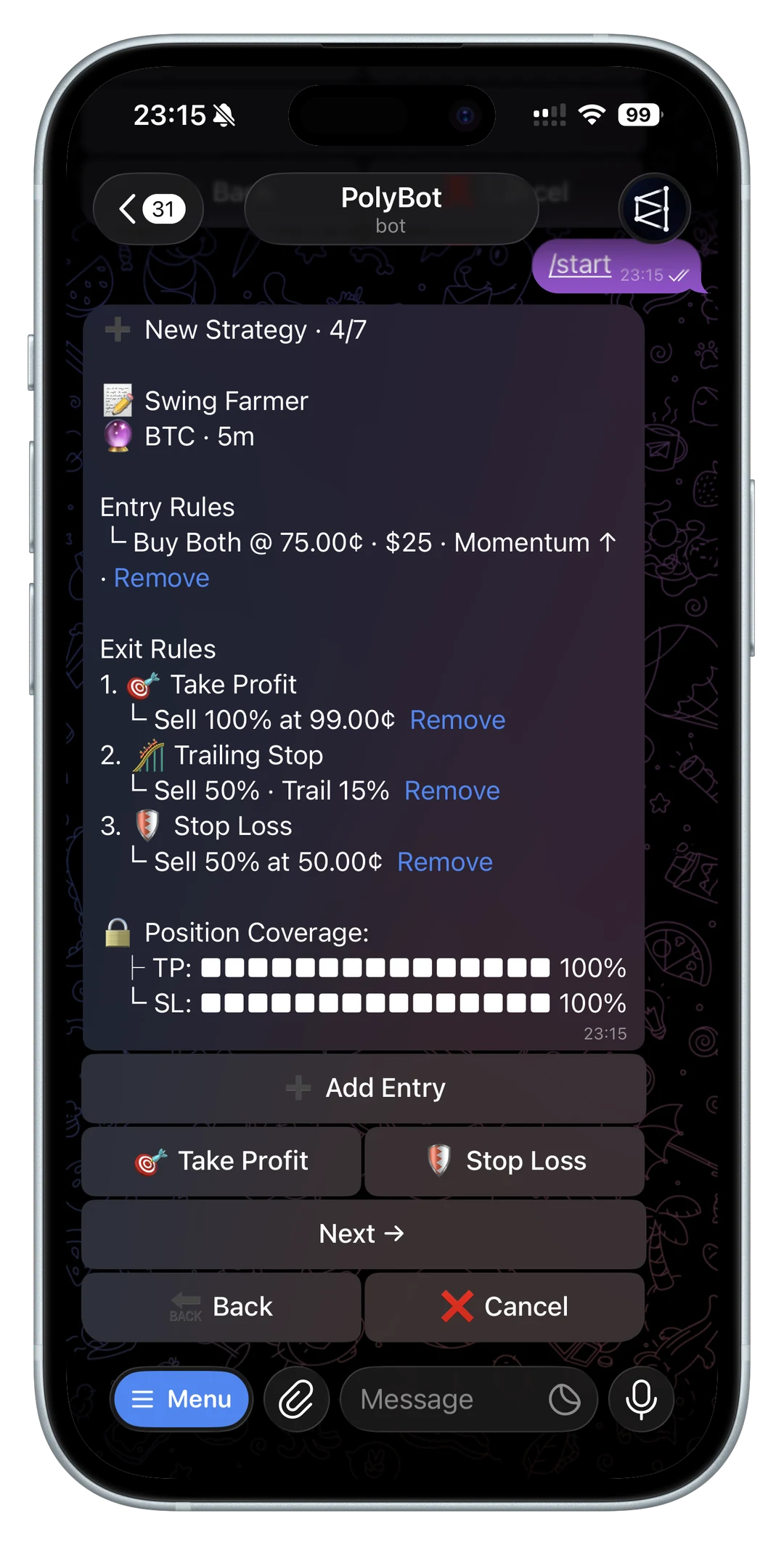
Order types decide what happens after you press confirm.
For Polymarket traders using Telegram, the button may look simple: buy, sell, market, limit, confirm. Under the surface, the order type decides whether the order rests on the book, fills immediately, partially fills, expires, or fails.
PolyBot's official Trading Guide documents market buys, sells, limit buys, limit sells, and order management from Telegram. Polymarket's official create order documentation explains the underlying order types: GTC, GTD, FOK, and FAK. This guide translates those terms into trader decisions.
The simple version
Most traders can start with this mental model:
- Market order: prioritize execution now.
- Limit order: prioritize price control.
- GTC: a limit order that can rest until filled or cancelled.
- GTD: a limit order that can rest until a specific expiration time.
- FOK: a market-style order that must fully fill immediately or cancel.
- FAK: a market-style order that fills available size immediately and cancels the rest.
That is the user-facing difference. The important part is choosing the behavior that matches the trade.
If you need the position now and the spread is acceptable, a market-style order can fit. If price matters more than speed, a limit order is usually the safer expression.
For direct CLOB automation, read the Polymarket API trading bot guide before assuming market, limit, FOK, or FAK behavior is handled safely by code.
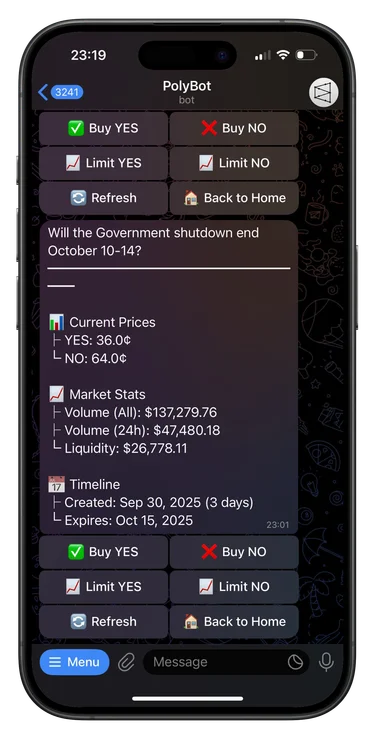
Market orders on Polymarket
A market order is built for immediacy.
Polymarket's docs explain that market-style behavior is implemented by submitting an order with a marketable price against resting liquidity. The price acts as a worst-price limit, which means it is part of slippage protection rather than a guarantee that the final fill will happen exactly at that displayed price.
Trader translation:
- a market buy tries to spend against available asks
- a market sell tries to sell into available bids
- the book can change between display and execution
- the order can fail if protection limits or liquidity do not support the trade
For exit-specific decisions, read how to sell a Polymarket position.
Market orders are useful when:
- speed matters
- the spread is tight
- the market is liquid
- the order is small relative to visible depth
- missing the trade is worse than paying the spread
They are risky when:
- the market is thin
- the spread is wide
- the price has already moved
- your order size is large
- you are reacting emotionally to an alert
For the underlying YES/NO price and payout model, read Polymarket odds and prices explained.
Limit orders on Polymarket
A limit order sets the price you are willing to accept.
For a buy, the limit price is the maximum price you are willing to pay. For a sell, it is the minimum price you are willing to receive.
Limit orders are useful when:
- you want a specific entry price
- the spread is wide
- a market order would cross too much spread
- you can tolerate waiting
- you want a planned exit
- the market is moving too quickly to trust immediate execution
The tradeoff is fill certainty. A limit order can protect price and still never fill. It can also fill partially, or remain open long after the thesis has changed.
GTC: Good-Til-Cancelled
GTC means good-til-cancelled.
In practical terms, a GTC limit order can remain live until it fills or is cancelled. PolyBot's docs describe limit buys and limit sells as GTC orders in the Telegram flow.
GTC fits when:
- you want to rest at a target price
- you are willing to wait for the market to come to you
- the thesis remains valid over time
- you will review open orders regularly
The risk is stale exposure. A GTC order that made sense this morning can be wrong after news, injury updates, market resolution changes, or a price move in related markets.
GTD: Good-Til-Date
GTD means good-til-date.
This is also a limit-order style, but with an expiration time. It is useful when the order should exist only for a defined window.
GTD fits when:
- the trade idea is time-sensitive
- the market has a known upcoming event
- you do not want the order to survive after a news window
- you want a target price but not an indefinite resting order
For a trader, the key question is simple: if the order does not fill by a certain time, should it still exist?
If the answer is no, an expiring order type is conceptually cleaner than a forgotten resting order. In Telegram product flows, check the current order-management screen and docs before assuming expiration controls are exposed in the exact place you expect.
FOK: Fill-Or-Kill
FOK means fill-or-kill.
The order must fill immediately and entirely, or it cancels. That makes it an all-or-nothing market-style behavior.
FOK fits when:
- you need the full size or no trade
- partial exposure would be worse than no exposure
- liquidity appears deep enough for the whole order
- you want to avoid ending with a small partial fill
FOK can fail even when a market has a visible price. The displayed quote may not have enough size, the book may move, or your worst-price limit may prevent execution.
That failure can be useful. It tells you the current book did not support the order under the requested rules.
FAK: Fill-And-Kill
FAK means fill-and-kill.
The order fills what is available immediately and cancels the rest. This allows partial fills.
FAK fits when:
- you want immediate execution
- partial exposure is acceptable
- you do not want the unfilled remainder to rest
- you prefer a smaller fill over no fill
FAK is common in fast markets because it avoids leaving leftover orders behind. But partial fills need review. If you asked for $100 of exposure and got only $18, the result may be much smaller than the trade you intended.
Post-only behavior
Post-only behavior is for maker-style orders that should rest on the book instead of taking liquidity immediately.
If a post-only order would cross the book and match right away, it can be rejected. That is not necessarily a broken order. It means the requested behavior conflicts with current prices.
Use post-only behavior only when:
- you specifically want to add liquidity
- you do not want immediate taker execution
- the price is set away from the opposite side of the book
- you understand why the order might be rejected
For most Telegram traders, the practical lesson is simpler: if an order fails because it would cross the book, recheck the bid, ask, and order type before retrying.
Tick size and price precision
Every market has valid price increments.
Polymarket's docs explain that order prices must conform to a market's tick size. If a market uses a 0.01 tick, prices like 0.42 and 0.43 are valid. If a market supports finer ticks, additional decimal precision may be allowed.
A custom limit price can fail if it does not match the market's tick size.
Before retrying a price error:
- check current tick size
- round to a valid price increment
- avoid manual decimal edits that create invalid precision
- refresh the market before resubmitting
Negative-risk markets and order options
Some Polymarket events are negative-risk or multi-outcome structures.
Polymarket's order docs say multi-outcome events use the Neg Risk CTF Exchange and require the negative-risk option when orders are submitted programmatically. For a Telegram trader, the important part is not the implementation detail; it is recognizing that the event structure can affect approvals, outcomes, and order behavior.
Before trading a multi-outcome event, confirm:
- exact event
- exact outcome
- whether only one outcome can win
- whether older wallet approvals are still completing
- whether related outcomes affect your thesis
The Polymarket negative-risk markets guide covers that workflow.
Which order type should a beginner use?
Beginners should not think in acronyms first.
Think in intent:
-
Need speed and accept price movement? Use a market-style workflow.
-
Need price discipline and can wait? Use a limit workflow.
-
Need all size or no trade? FOK-style behavior fits that intent.
-
Accept partial fill but no leftover order? FAK-style behavior fits that intent.
-
Want an order to rest until cancelled? GTC-style behavior fits that intent.
-
Want an order to expire after a window? GTD-style behavior fits that intent.
Then check whether the Telegram product flow exposes that exact control directly or abstracts it behind simpler market and limit actions.
A practical order-type checklist
Before confirming a trade, ask:
- Do I need speed or price control?
- Is partial fill acceptable?
- Is the spread reasonable?
- Is there enough visible liquidity for my size?
- Am I placing a buy or sell?
- Would this order rest after submission?
- Could it become stale?
- Is the price valid for the market tick size?
- Is the market standard or negative-risk?
- How will I verify the result afterward?
If you cannot answer those questions, reduce size, use a limit order, or wait.
FAQ
What is the difference between FOK and FAK on Polymarket?
FOK must fill immediately and entirely or cancel. FAK fills available liquidity immediately and cancels the unfilled remainder.
What is the difference between GTC and GTD?
GTC can rest until filled or cancelled. GTD can rest only until a specified expiration time.
Is a Polymarket market order guaranteed to fill?
No. It depends on available liquidity, worst-price protection, size, and order type. A visible market price does not guarantee your requested size can fill.
Why did my limit order not fill?
Should I use market orders or limit orders from Telegram?
Use market orders when immediate execution matters and the spread is acceptable. Use limit orders when price discipline matters more than immediate fill certainty.
Order type is risk control
Order type is not just implementation language. It is risk control.
The same market idea can produce different results depending on whether you cross the spread now, rest at a limit price, demand a full fill, accept a partial fill, or leave an order open.
Telegram can make order placement faster. The trader still has to choose the behavior that matches the situation.
Not investment advice. Prediction markets are risky, and order behavior can change the final trade materially.
Polymarket Cuts Crypto Taker Delay From 250ms to 50ms
Polymarket reduced its crypto-market taker delay from 250ms to 50ms. Here is what changed for fills, trading bots, makers, and copy traders.
Execution / 5 min
Polymarket Copy Trading: How It Works and How to Start From Telegram
Learn how Polymarket copy trading works, how to choose wallets, configure filters, control slippage, size positions, and manage risk from Telegram with PolyBot.
Copy Trading / 13 min