Polymarket Sniper Bot Guide: Fast Telegram Execution, Alerts, Links, Liquidity, and Risk Controls
How to evaluate a Polymarket sniper bot or fast execution workflow: paste-to-trade links, alerts, wallet moves, market orders, limit orders, slippage, liquidity, settings, and risk controls.

PolyBot Team
Updated June 1, 2026
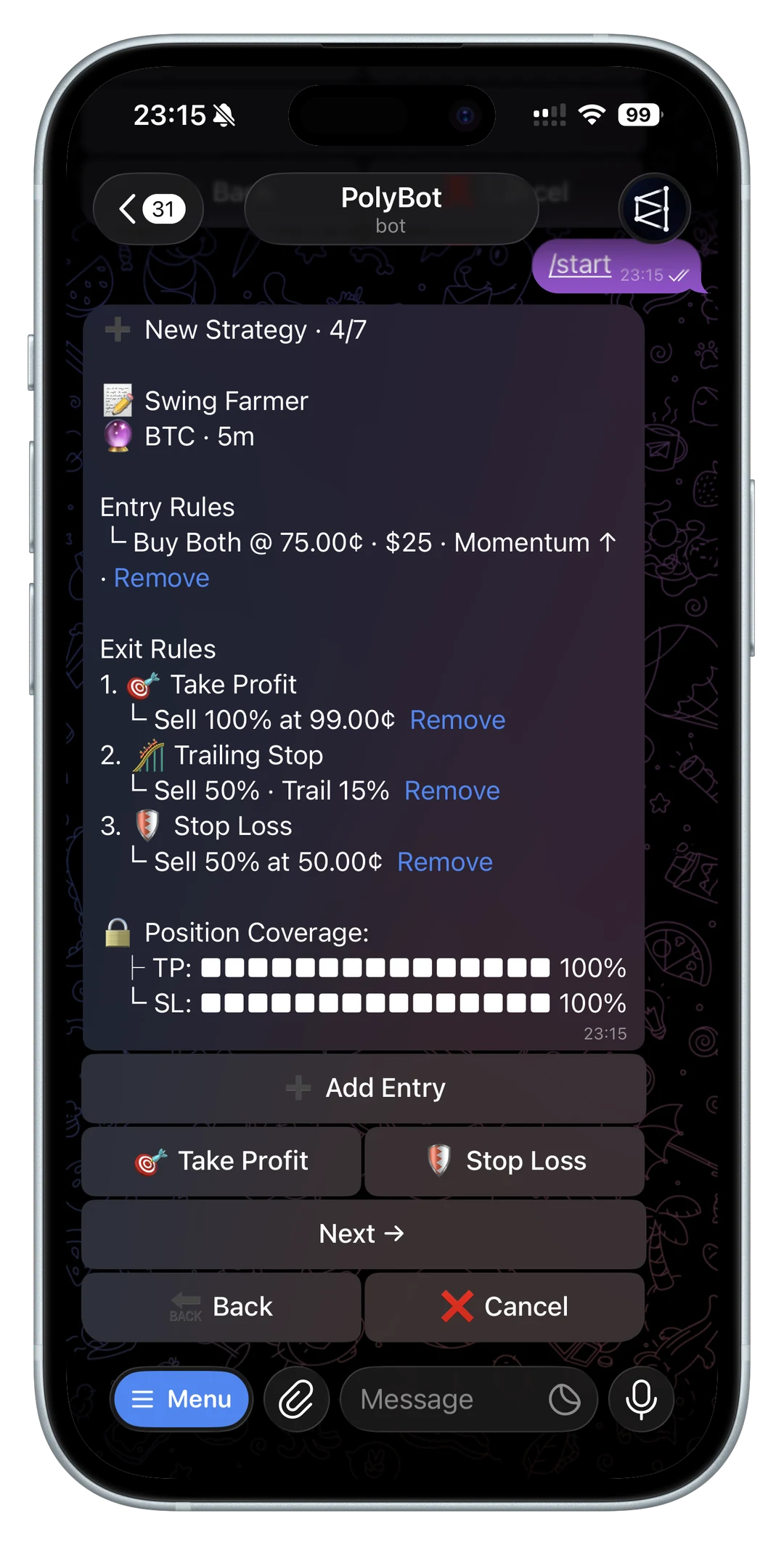
A Polymarket sniper bot is only useful when speed supports a decision you already understand.
Fast execution can help when a market link, price alert, wallet move, or breaking-news signal needs quick review. It can also make mistakes more expensive. In prediction markets, the displayed price can change, liquidity can disappear, and a rushed market order can fill worse than expected.
This guide explains how to evaluate a Polymarket sniper workflow from Telegram: paste-to-trade links, alerts, wallet signals, market orders, limit orders, order-book checks, slippage, failed orders, settings, and when speed should become alert-only or limit-order discipline.
For the broader decision tree around bots, alerts, copy trading, API trading, and automation, read the prediction market trading bot guide.
If your fast-entry workflow starts from scanners, trending markets, or wallet alerts, read the Polymarket market scanner bot guide before turning every discovery result into a sniper trade.
If the fast-entry workflow starts from a target price or price-change notification, use the Polymarket price alerts bot guide before treating speed as more important than price review.
If most fast entries happen from your phone, read the Polymarket mobile trading bot guide before treating mobile speed as a substitute for order review.
If you want the broader product overview first, start with the Telegram trading bot for Polymarket. If your workflow starts from alerts or wallet moves, read this with the Polymarket trading signals bot guide.
If the fast-entry setup starts from breaking news or headlines, use the Polymarket news trading bot guide before turning speed into a market order.
If the fast-entry action is an immediate buy or sell, use the Polymarket market orders from Telegram guide to check spread, depth, slippage, and partial-fill behavior first.
If the fast-entry setup starts from volume spikes, trending markets, or price-change alerts, use the Polymarket volume alerts bot guide before treating the move as an entry.
If the entry and exit rules are defined ahead of time, read the Polymarket Auto Trader bot guide before treating every fast entry as a manual sniper trade.
What traders mean by sniper bot
In Polymarket trading, "sniper bot" usually means a workflow designed to shorten the distance between a signal and an order.
That signal can be:
- a Polymarket link shared in Telegram
- a price target alert
- a large trade alert
- a watched wallet entering a position
- a group chat surfacing a market
- a breaking-news headline
- a market search result
- a fast crypto up/down move
- a live sports market repricing
The useful version is not blind automation. It is fast review plus controlled execution.
The dangerous version is a button that turns every notification into a market order.
Speed is a feature only after review
Speed helps when the trade already has a plan.
Before using a fast execution workflow, the trader should know:
- which market is being traded
- which outcome is intended
- what price is acceptable
- how much size fits the order book
- whether a market order or limit order fits
- what slippage is acceptable
- what should happen if the order fails
- what exit plan applies after entry
If those answers are unclear, the correct action is usually no trade, an alert, a watchlist entry, or a limit order.
For the general speed tradeoff, read why execution speed matters in prediction-market copy trading.
Paste-to-trade is the cleanest sniper workflow
The simplest fast workflow starts with a Polymarket URL.
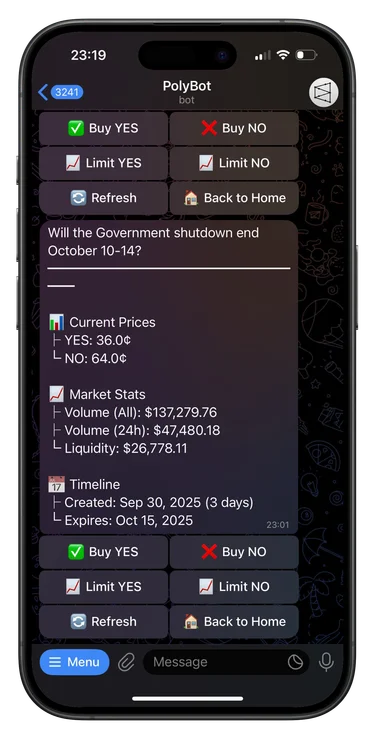
PolyBot's Trading Guide describes paste-to-trade: paste a Polymarket URL in Telegram, open the market view, review prices and stats, then choose an action from inline buttons.
That is useful because the trader does not need to rebuild the market manually after receiving a link.
Use paste-to-trade when:
- someone sends a market link
- a group chat discusses a specific market
- you found the market in the web app but want Telegram execution
- a watchlist or alert points back to a market
- you need to review the market on mobile quickly
The important word is review. A pasted link should open the market card; it should not remove the need to check wording, side, bid, ask, spread, depth, and expiry.
For discovery when you do not have a URL yet, use the Polymarket market search in Telegram guide.
Market orders are fast but not price guarantees
A market-style workflow prioritizes immediate execution against available liquidity.
That can fit when:
- the market is liquid enough
- the spread is acceptable
- size is small relative to depth
- timing matters more than exact price
- the trader has already reviewed the market
It can be wrong when:
- the spread is wide
- depth is thin
- the signal is stale
- the market just moved
- a large group is chasing the same side
- the trade needs a strict entry price
For order mechanics, read Polymarket order types: FOK, FAK, GTC, and GTD. For the practical tradeoff between immediate taking and resting liquidity, read the Polymarket maker vs taker guide.
Limit orders are sniper discipline
Many traders think sniper means "buy as fast as possible."
Often the better sniper action is a limit order.
A limit order lets the trader define the maximum buy price or minimum sell price. That can be better than chasing after a notification because it keeps price discipline inside the fast workflow.
Use a limit order when:
- the current ask is too high
- the spread widened after the alert
- the market is thin
- the signal is useful but the price already moved
- you want the trade only at a specific level
- you would rather miss than overpay
For this workflow, read Polymarket limit orders from Telegram.
Order book first, button second
The order book decides whether a fast order is realistic.
Before acting fast, check:
- best bid
- best ask
- spread
- visible depth
- recent movement
- whether your size consumes multiple levels
- whether the displayed midpoint is far from executable price
A market can look attractive at a displayed price and still be expensive to buy immediately. The midpoint is not the fill.
Use the Polymarket order book guide and the liquidity, spread, and slippage guide before increasing fast-order size.
Alerts can feed a sniper workflow
PolyBot's Market Alerts docs describe price target alerts, price-change alerts, and big-trade alerts.
Those alerts can feed a fast workflow, but the alert is not the trade.
Examples:
- Price target alert: review whether the target price is still available.
- Price-change alert: review whether the move is real or already over.
- Big-trade alert: review whether the whale moved the book before you follow.
- Copied-wallet alert: review whether your copy settings still fit the leader.
Use Polymarket Telegram alerts and watchlists for alert setup and the Polymarket trading signals bot guide for deciding whether a signal deserves action.
Wallet sniping versus copy trading
Some traders use sniper workflows around wallet activity: a strong wallet enters, and the follower wants to react quickly.
That can overlap with copy trading, but it is not the same thing.
Manual wallet sniping means:
- a wallet activity signal appears
- the trader reviews the market and price
- the trader chooses whether to follow
- the trader controls each order manually
Copy trading means:
- a subscription is configured in advance
- sizing, filters, slippage, and caps decide what copies
- the follower reviews skipped trades, fills, and performance afterward
Manual sniping gives more discretion. Copy trading gives more automation. Both can fail if the wallet's edge depends on entries that cannot be copied after delay and slippage.
Use how to copy trade on Polymarket from Telegram, Polymarket copy trading settings, and the Polymarket whale alerts guide before following wallet signals with size.
Fast categories need different rules
Not every market type rewards speed the same way.
Crypto up/down markets can move inside seconds. A price that looked acceptable when the alert fired may be gone before the order lands.
Live sports markets can reprice around goals, injuries, fouls, weather, clock, and lineup information.
Politics and election markets can move around polling, campaign news, court decisions, and resolution wording, but many trades still require slower source review.
Fast-news and breaking-event markets can be the most tempting for sniper behavior, but they also create the highest risk of trading incomplete information.
Use category-specific checks:
- Polymarket crypto trading bot guide
- Polymarket sports trading bot guide
- Polymarket politics and election trading bot guide
Settings matter before speed modes
A fast workflow should start with conservative settings.
Review:
- quick-buy amounts
- default order size
- slippage tolerance
- copy-trading caps
- daily caps
- category filters
- price filters
- stop-loss and take-profit defaults
- notification volume
- two-factor authentication
Small fast orders can be useful while learning. Large fast defaults can make one mistaken tap expensive.
Use the Polymarket Telegram bot settings guide before changing speed-related defaults.
What to do when a fast order fails
A failed order is not always a bug.
It can mean:
- the book moved
- no liquidity matched the order
- the market stopped accepting orders
- size was below the minimum
- balance or allowance was unavailable
- price precision was invalid
- the order crossed a post-only rule
- the market had already resolved or paused
Do not retry blindly. Reopen the market card, refresh the book, and decide whether the original reason for the trade still exists.
If the fast order failed because the custom price had invalid precision, use the Polymarket tick size guide before increasing speed or size.
For automated strategies, repeated failures should usually trigger a review or pause rule. The Polymarket Auto Trader bot guide explains that monitoring loop.
For troubleshooting, read the Polymarket order failed guide.
When a sniper bot is the wrong tool
A fast execution workflow is not always the best workflow.
Use slower review when:
- the market wording is complex
- the resolution source is unclear
- the trade depends on interpreting news
- liquidity is thin
- the spread is wide
- the position needs a full basket
- the trade would be too large for your bankroll
- you are following a wallet you have not analyzed
- you do not know the exit plan
Speed can preserve an edge. It can also preserve a mistake before you notice it.
Sniper workflow checklist
Before using a Polymarket sniper bot or fast execution workflow, answer:
- What signal started this action?
- Is the market link or search result the correct market?
- Which outcome am I trading?
- What bid, ask, spread, and depth are visible now?
- Is my size small enough for the book?
- Do I need speed or price control?
- Would a limit order be better than a market order?
- What slippage is acceptable?
- What happens if the order fails or partially fills?
- What is my exit plan?
- Is this market type too fast for manual review?
- Should this be alert-only until I collect more data?
If the checklist is unclear, slow down.
Polymarket sniper bot questions
What is a Polymarket sniper bot?
It is a fast execution workflow for reacting to market links, alerts, wallet activity, or price moves. The useful version still includes market review, order-book checks, slippage limits, and risk controls.
Is a sniper bot better than copy trading?
Not always. Sniping is usually manual and signal-driven. Copy trading follows a configured wallet automatically or semi-automatically. The better workflow depends on whether the edge is a market signal, a wallet signal, or a repeatable setup.
Should I use market orders for sniper trades?
Only when speed matters, the spread is acceptable, and depth supports your size. If price matters more than immediacy, a limit order is usually safer.
Can alerts act as sniper signals?
Yes, alerts can point you to markets that deserve fast review. They should not automatically become trades unless rules, size, price, slippage, and exits are already defined.
What is the main risk of fast execution?
The main risk is executing a stale or incomplete assumption before checking liquidity, market wording, order type, and price. Fast execution can make a good workflow better, but it can also make bad habits faster.
Not investment advice, financial advice, legal advice, or trading advice. Prediction-market trading can lose money, and fast execution does not guarantee fills, profit, or price quality.
Polymarket Market Scanner Bot Guide: Find Markets, Alerts, Liquidity, Wallet Signals, and Risk
How to evaluate a Polymarket market scanner bot workflow: search, trending markets, volume, price alerts, whale alerts, wallet signals, liquidity, order books, and risk controls.
Telegram Trading / 12 min
Polymarket Market Search in Telegram: Find Markets, Check Liquidity, and Trade Safely
How to use Polymarket market search inside Telegram: /search, /polybot group search, volume, trending, category, live, up/down markets, liquidity checks, paste-to-trade, and safe order review.
Telegram Trading / 11 min