Polymarket Crypto Trading Bot Guide: BTC, ETH, SOL, Up/Down Markets, and Telegram Automation
How to evaluate a Polymarket crypto trading bot workflow for BTC, ETH, SOL, and up/down markets: short windows, trigger prices, alerts, copy trading, fees, slippage, and Telegram risk checks.
PolyBot Team
Updated June 1, 2026
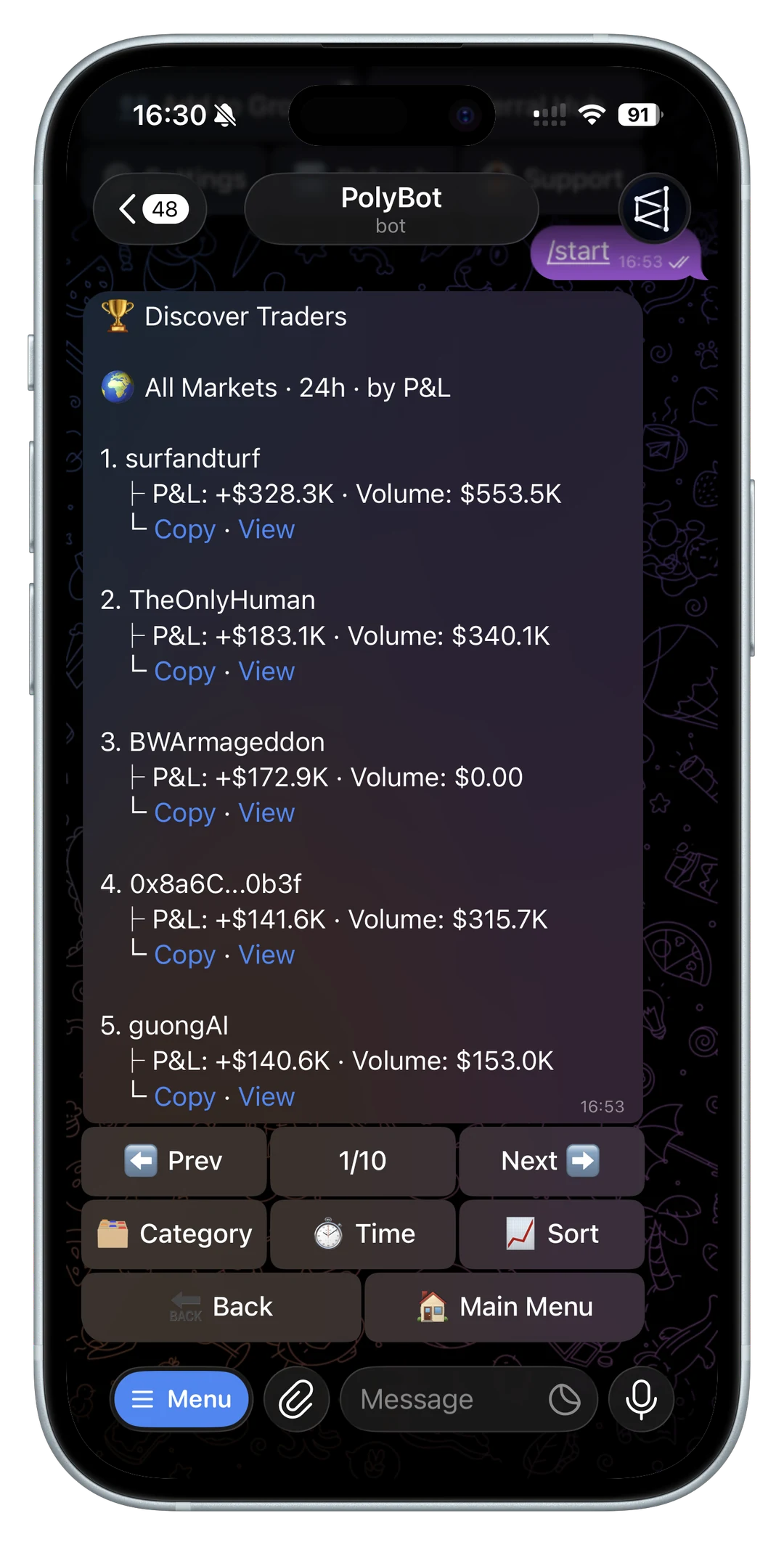
A Polymarket crypto trading bot is useful only if it improves timing without removing discipline.
Crypto markets can move before a trader finishes opening a chart. Short-window up/down markets compress that problem even further: BTC, ETH, SOL, and other assets can reprice inside seconds, while spreads and liquidity change at the same time. Telegram automation can help, but it should not turn every price move into an automatic trade.
If the crypto setup starts from a macro headline, exchange update, liquidation event, or fast price move, use the Polymarket news trading bot guide with this page before chasing the first alert.
This guide explains how to evaluate a crypto trading workflow for Polymarket: up/down market search, trigger prices, alerts, strategy rules, copy trading, fees, slippage, and when a manual Telegram order is safer than automation.
If you discover BTC, ETH, SOL, or other up/down markets through scanners, alerts, or volume lists, read the Polymarket market scanner bot guide before automating entries.
If you want the product overview first, start with the Telegram trading bot guide. If you already know you want strategy rules, read this with trading strategies for crypto up/down markets.
What a crypto up/down market is
Crypto up/down markets are short-duration prediction markets about whether an asset will finish up or down over a defined window.
The common trader question is simple:
- Will BTC be up or down?
- Will ETH be up or down?
- Will SOL be up or down?
- Which direction wins by the end of the window?
The execution question is harder:
- What is the current YES or NO price?
- How much time remains?
- Is the order book still deep enough?
- Did the price already move?
- Is the spread too wide?
- Would a limit order, alert, or strategy rule fit better?
Polymarket prices are tradable probabilities, not fixed sportsbook-style odds. For the price and payout model, read Polymarket odds and prices explained.
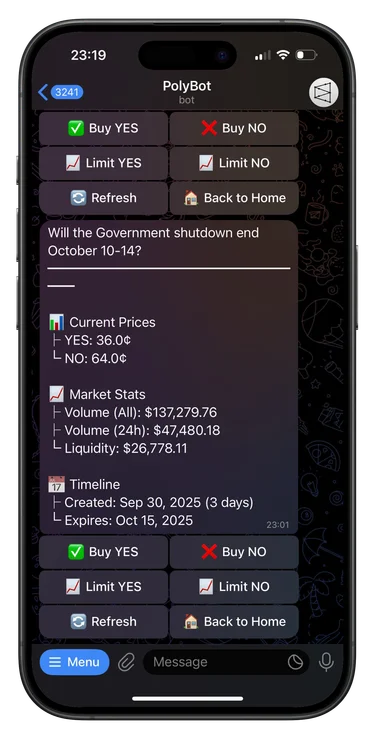
Use up/down search intentionally
PolyBot's market search docs describe Up or Down as a browse mode for short-duration crypto prediction markets. The docs mention 5-minute and 15-minute windows, and the Trading Strategies docs describe crypto strategy scope across assets and timeframes.
Use up/down search when you specifically want fast crypto direction markets. Do not confuse it with longer-duration crypto event markets such as ETF approvals, end-of-year price targets, or protocol announcements.
Before opening a trade, check:
- asset
- timeframe
- market start and end
- outcome side
- current price
- liquidity
- bid and ask
- expiry
- whether the market card is fresh
Use the Polymarket market search guide for the discovery flow.
Short windows change the risk
A 5-minute crypto market is not just a smaller version of a weekly market.
Short windows create specific execution risks:
- the entry can become stale quickly
- a few seconds can change the price
- spreads can widen near the open or close
- liquidity can disappear after a fast move
- stop losses can fill worse than expected
- late entries can have poor risk-reward
- old links can point to finished markets
That does not mean short-window markets should never be traded. It means the workflow needs to match the pace.
For many traders, the safest first step is not automation. It is alerting and manual review until the trader understands how the market behaves.
Strategy rules are for repeated setups
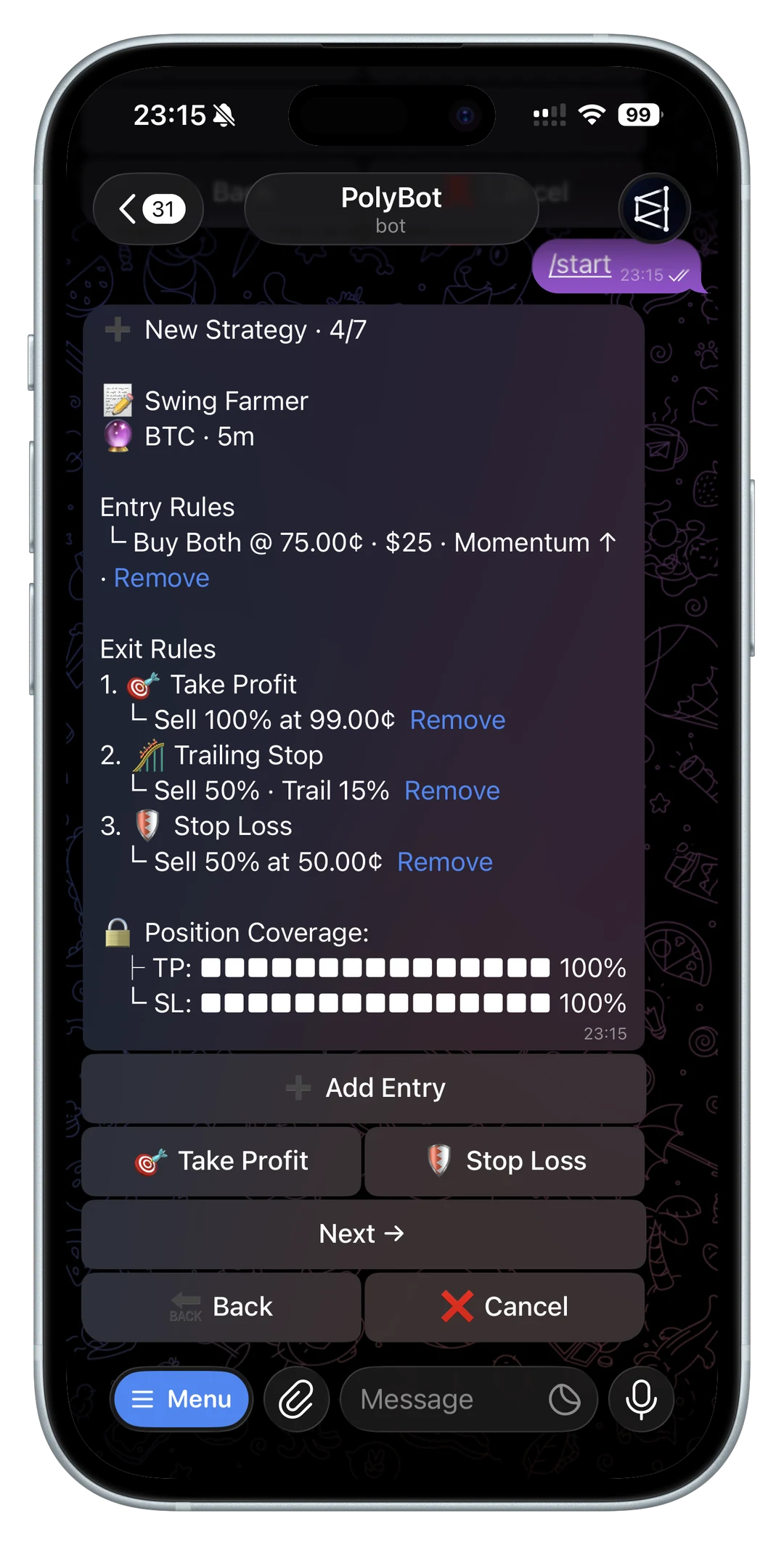
PolyBot's Trading Strategies docs describe a custom trading bot inside PolyBot. The user defines what to trade, when to enter, and when to exit; PolyBot runs those rules automatically when conditions are met.
The documented strategy scope covers crypto up/down markets with assets such as BTC, ETH, SOL, XRP, BNB, DOGE, HYPE, and all-crypto selection, plus timeframes such as 5m, 15m, 1h, 4h, and 24h.
That makes sense when the setup is repeatable.
Good candidates for strategy rules:
- a clear trigger price
- a clear asset and timeframe
- fixed entry amount
- defined take-profit rule
- defined stop-loss rule
- slippage tolerance
- entry window
- pause rule after bad behavior
Bad candidates:
- vague "buy if it feels strong"
- no exit plan
- no idea how the market resolves
- no liquidity check
- settings copied from someone else without testing
- all assets and all windows enabled before learning one setup
For the setup mechanics, use trading strategies for crypto up/down markets.
Trigger price is not fill price
A trigger is the condition that starts an action. A fill is the executed trade.
Those are not always identical.
In a fast crypto market, the price can move between trigger detection and order execution. The order book can also change while the bot is submitting the trade.
Before using triggers, understand:
- trigger side
- trigger price
- slippage tolerance
- order size
- current depth
- whether partial fills are acceptable
- whether missed entries are better than bad fills
PolyBot's strategy docs describe slippage tolerance as the tradeoff between price discipline and fill reliability. Tight slippage can protect price but skip trades. Loose slippage can increase fills but produce worse prices.
For the execution layer, read Polymarket liquidity, spread, and slippage.
Entry windows matter
Short-duration markets have phases.
The open can be chaotic because liquidity is still forming. The middle can be more stable. The close can become thin or volatile because there is less time to recover from a bad entry.
PolyBot's strategy docs describe entry windows that control when a strategy is allowed to enter after the market starts and before it ends. That is useful because a setup may only make sense during a stable part of the market.
Ask:
- Should entries wait after market open?
- Should entries stop before the final minute?
- Does this setup work on 5m markets or only longer windows?
- Does the strategy behave differently on BTC versus smaller assets?
- What happens if no entry appears inside the window?
If you do not know the answer, keep the strategy narrow.
Alerts can be safer than automation
Not every crypto setup needs automatic execution.
Alerts are useful when:
- you want to inspect the order book before trading
- you want a price target but not an automatic order
- you are still learning a market type
- liquidity changes too quickly for your current rules
- you want a human check before entering size
- the market is news-driven rather than pattern-driven
PolyBot's Market Alerts docs describe price target alerts, price-change alerts, and big-trade alerts. For crypto traders, those alerts can be a useful middle ground between staring at charts and letting a bot trade every move.
For alert discipline, read Polymarket Telegram alerts and watchlists.
Copy trading crypto wallets
Some wallets specialize in crypto up/down markets. That can be useful because short-window crypto trading is skill-specific. It can also be hard to copy because entry timing matters.
Before copying a crypto wallet, check:
- which assets it trades
- which timeframes it trades
- average entry price
- whether trades are preplanned or reactive
- how often it exits before resolution
- whether copied fills stay close to source fills
- whether the wallet wins after fees and slippage
- whether liquidity can support your copied size
- whether losses cluster during volatile periods
If the source wallet trades 5-minute BTC markets, a delayed copy may not resemble the source trade at all.
For copy setup, read how to copy trade on Polymarket from Telegram and Polymarket copy trading settings.
Crypto fees and costs are not only protocol fees
Polymarket's fee docs list crypto as a fee-enabled category with taker fees and maker rebates in the current table. Fees are determined per market at match time, and makers are not charged protocol fees in the current docs.
That is only one cost layer.
Crypto traders also need to account for:
- spread
- slippage
- bot or tool fees
- bad fills from late entries
- missed exits
- partial fills
- stale links
- failed orders
- opportunity cost from reserved capital
For cost review, read Polymarket trading costs. If you are deciding whether a crypto setup should take liquidity immediately or rest on the book, use the Polymarket maker vs taker guide.
When manual Telegram trading is better
Manual trading can be better when the trade depends on context that is hard to encode.
Use manual review when:
- the move is news-driven
- liquidity is thin
- spreads are wide
- you are testing a new setup
- the strategy has not earned trust
- you want to inspect market wording
- you need to adjust size in the moment
Use automation when the rules are clear, repeated, and monitored.
The goal is not to automate everything. The goal is to automate only the part of the workflow that is already defined well enough to survive speed.
Crypto trading checklist
Before trading BTC, ETH, SOL, or another crypto up/down market from Telegram, answer:
- Which asset and timeframe am I trading?
- Is this an up/down market or a longer-duration crypto event?
- How much time remains?
- What are the current bid, ask, spread, and depth?
- Is my trigger price still relevant?
- What slippage tolerance fits the setup?
- Should the trade be automatic, alert-only, or manual?
- What is the stop-loss or exit plan?
- What happens if the entry partially fills?
- What costs apply after fees, spread, slippage, and tool fee?
- If copying a wallet, is the source fill still copyable?
- When should the strategy pause?
If the setup cannot answer those questions, keep size small or stay out.
Polymarket crypto trading bot questions
Can I automate crypto up/down markets on Polymarket?
PolyBot's Trading Strategies docs describe custom strategy rules for crypto up/down markets, including asset/timeframe scope, entry rules, exit rules, slippage, execution mode, entry windows, and monitoring.
Which assets can a crypto strategy target?
PolyBot's current strategy docs list assets including all crypto, BTC, ETH, SOL, XRP, BNB, DOGE, and HYPE, with timeframes including 5m, 15m, 1h, 4h, and 24h.
Is an alert safer than an automatic crypto strategy?
Sometimes. Alerts can be safer while you are still learning a setup, because they notify you without placing an order. Automation fits better after rules are clear and tested.
Do trigger prices guarantee fills?
No. Trigger prices start an action, but actual fills depend on order-book liquidity, spread, slippage tolerance, market movement, and execution timing.
Can I copy trade crypto up/down wallets?
Yes, but copied crypto trades can decay quickly. Compare copied fill price against the source wallet, use category and price filters, and watch skipped, failed, or delayed fills.
Not investment advice, legal advice, or security advice. Crypto prediction markets can move quickly, automation can lose money, and every trade should be checked against current official docs and live market conditions before execution.
Polymarket Copy Trading: How It Works and How to Start From Telegram
Learn how Polymarket copy trading works, how to choose wallets, configure filters, control slippage, size positions, and manage risk from Telegram with PolyBot.
Copy Trading / 13 min
Best Polymarket Traders to Copy: How to Find Wallets With Real Edge
How to find and evaluate the best Polymarket traders to copy: leaderboard filters, wallet PnL, win rate, sizing behavior, category edge, liquidity, copyability, and risk controls.
Copy Trading / 10 min