Polymarket Market Scanner Bot Guide: Find Markets, Alerts, Liquidity, Wallet Signals, and Risk
How to evaluate a Polymarket market scanner bot workflow: search, trending markets, volume, price alerts, whale alerts, wallet signals, liquidity, order books, and risk controls.

PolyBot Team
Updated June 1, 2026
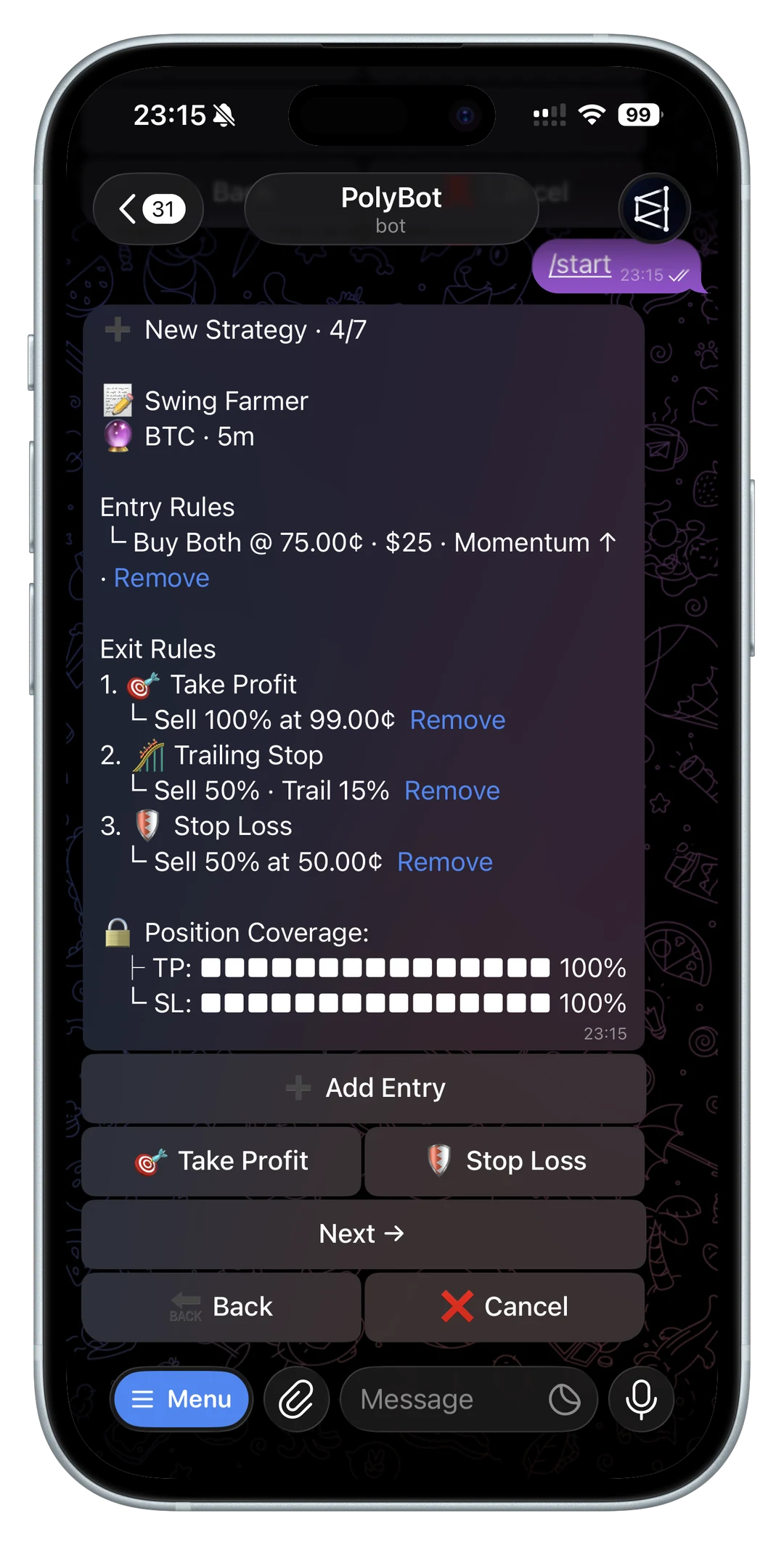
A Polymarket market scanner bot is useful only when it helps you find better markets without turning every result into a rushed trade.
The scanner workflow sounds simple: surface active markets, notify the trader when something changes, and make it easy to act. The hard part is deciding which scan results deserve attention, which should become alerts, which are only research, and which are too thin or noisy to trade.
This guide explains how to evaluate a Polymarket market scanner workflow from Telegram: search, volume, trending markets, categories, price alerts, whale alerts, wallet signals, liquidity, order-book checks, execution controls, and risk limits.
If you want the broader product framework first, read the prediction market trading bot guide. If you want the exact search mechanics, use the Polymarket market search in Telegram guide with this page.
If scanner results are coming from headlines, rumors, or fast event updates, pair this with the Polymarket news trading bot guide before treating a moving market as an entry.
If your scanner workflow is mainly about volume, trending markets, or price-change alerts, use the Polymarket volume alerts bot guide to keep attention signals separate from trade execution.
If scanner output feeds Telegram notifications, pair it with the Polymarket notification bot guide so market alerts, wallet updates, order status, and portfolio reminders stay separated.
If a scanner result is interesting but not ready to trade, use the Polymarket price alerts bot guide to turn it into a target-price or price-change review instead of a rushed order.
If a scanner result looks ready for immediate execution, use the Polymarket market orders from Telegram guide before using a market buy on the first active result.
If scanner output is being summarized or ranked by AI, use the Polymarket AI trading bot guide before turning model-ranked markets into automated orders.
What a market scanner should do
A scanner should help you notice markets worth reviewing. It should not replace the review.
Good scanner workflows can answer:
- What markets are active right now?
- Which categories are moving?
- Which markets have enough volume to inspect?
- Which prices crossed levels I care about?
- Which large wallets traded?
- Which markets are too illiquid for my size?
- Which signals are repeated noise?
- Which markets need a limit order instead of a market order?
- Which alerts should become watchlist items rather than trades?
That means a useful scanner sits between discovery and execution. It should connect search, watchlists, alerts, wallet tracking, and order-book review before any order is placed.
Scanner result versus trade signal
The most important distinction is this:
- A scanner result says, "Look here."
- A trade signal says, "This setup may be worth acting on."
- An order says, "Commit capital at these terms."
Those are different states.
A trending market can be active and still be a bad trade. A whale alert can point to a smart wallet and still arrive too late. A price target can fire at the level you wanted while the spread is too wide to enter cleanly.
For signal discipline, read the Polymarket trading signals bot guide. A market scanner should feed that decision process, not bypass it.
Start with market search
Search is the base layer of scanner work.
Use search when:
- you know the topic but not the exact market
- a group mentions an event without a link
- a news item makes you wonder whether a market exists
- you want to compare similar markets
- you need to check wording before acting on an alert
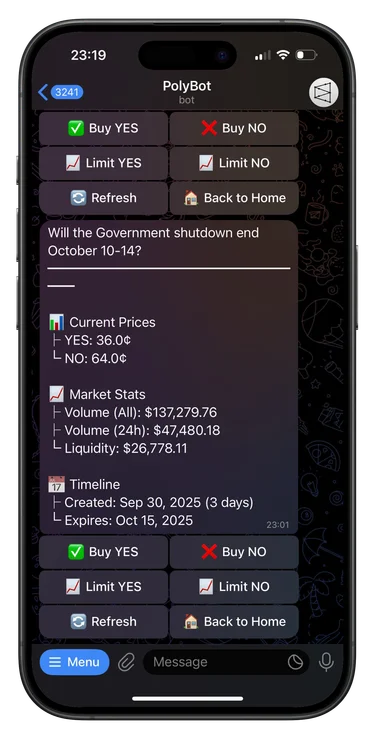
The search result should expose enough context to slow you down in the right places: market title, outcome side, price, volume, expiry, and a path to inspect liquidity.
If a search result is ambiguous, do not trade from the title alone. Open the market, read the wording, and check the resolution rules. The Polymarket resolution rules guide is the right follow-up when wording or source matters.
Use volume and trending views carefully
Volume and trending lists are useful because they show where attention is concentrated.
High-volume markets can have:
- more active price discovery
- tighter spreads
- more recent order-book updates
- easier exits
- more public context
But high volume is not the same as edge. A market can be crowded because everyone is reacting to the same headline. A trending market can already price in the news before you see it. A hot category can attract traders who chase movement without checking the fill.
Use volume and trending scans to build a shortlist. Then filter that shortlist by:
- market wording
- time remaining
- spread width
- depth near your intended size
- whether the move already happened
- whether the category is one you understand
- whether a limit order is safer
For price and probability basics, read the Polymarket odds and prices guide. For executable depth, read the Polymarket order book guide.
Add price alerts after review
A good scanner does not require you to refresh every market. Once a market passes initial review, alerts can bring it back when the price reaches a level worth checking.
Use price alerts when:
- the market is interesting but the current price is wrong
- you want a better entry
- you want to revisit an exit area
- a spread is too wide now but may improve later
- you want to avoid watching the same page all day
The alert should include a planned action. For example:
- If YES trades near 42 cents, check the spread and place a limit order only if depth is enough.
- If NO breaks 60 cents, review whether the original thesis changed.
- If a position reaches a take-profit zone, inspect liquidity before selling.
An alert without a plan becomes noise. Use the Polymarket Telegram alerts and watchlists guide before turning scanner output into a notification stream.
Whale alerts are scanner inputs, not commands
Large trades can help a scanner find markets that deserve attention.
A whale alert may tell you:
- a large wallet is taking a position
- a market is repricing quickly
- a category is active
- a trader worth studying appeared
- liquidity may be shifting
But the alert does not tell you whether to copy the trade.
Large wallets can move the book, trade as part of a hedge, tolerate drawdowns you cannot, or enter before the alert reaches you. If you chase after the move, you may buy a worse version of the trade.
Use the Polymarket whale alerts and wallet tracker guide for wallet-signal review, then use the Polymarket wallet analyzer before adding a trader to a copy list.
Category scanners need category rules
Different Polymarket categories behave differently.
Sports markets can reprice during live games. Crypto up/down markets can move inside very short windows. Politics and election markets can turn on wording, polls, deadlines, court rulings, or certification rules. Related-market and negative-risk setups can require checking several outcomes together.
Do not use the same scanner rule everywhere.
For category-specific review:
- use the Polymarket sports trading bot guide for live-game markets
- use the Polymarket crypto trading bot guide for BTC, ETH, SOL, and up/down markets
- use the Polymarket politics and election trading bot guide for campaign and election markets
- use the Polymarket arbitrage guide for related-market scans
The scanner should help route a market to the right checklist.
Liquidity is the scanner filter most traders skip
The most common scanner mistake is treating a visible price as an executable price.
Before acting on a scan result, check:
- bid and ask
- spread
- depth at your intended size
- recent volume
- whether the market has enough sellers or buyers
- whether a market order would walk the book
- whether a smaller test order is more sensible
- whether a limit order should replace a market order
This matters more in prediction markets than many traders expect. A 6 cent spread can erase the value of a signal. A whale trade can consume the best liquidity before followers arrive. A low-volume market can look attractive until you try to exit.
Use the Polymarket liquidity, spread, and slippage guide and the Polymarket slippage tolerance guide before increasing size from scanner-driven ideas.
Scanner to sniper is a risky jump
Some traders use scanners to feed fast-entry workflows. That can be useful when the market is liquid, the thesis is already defined, and the order path is controlled.
It is risky when:
- the scanner result is new to you
- the price already moved
- the market wording is unfamiliar
- depth is thin
- the alert came from a group message
- you are using market orders by default
- the trade size is larger than normal
Fast execution should be the last mile after review, not the first response to every scan.
If your scanner feeds fast manual entries, read the Polymarket sniper bot guide. If price control matters more than immediacy, read the Polymarket limit orders guide.
Scanner to copy trading needs wallet evidence
A scanner may reveal a wallet worth studying. That still does not mean the wallet is worth copying.
Before creating a copy subscription, check:
- realized PnL
- category concentration
- average trade size
- copyability after delay and slippage
- whether the wallet uses related markets
- whether wins came from one lucky market
- whether the trader exits cleanly
- whether your bankroll can handle the same variance
For this path, read the best Polymarket traders to copy guide, then the Polymarket copy trading settings guide. Scanner discovery should become wallet research before it becomes automation.
Scanner to automation needs strict rules
Scanner output can also feed strategy automation, but only if the rules are clear.
Do not automate:
- "trade anything trending"
- "buy every large-wallet move"
- "enter every market that spikes"
- "chase all price alerts"
- "increase size after missed trades"
Automation needs a defined market type, entry condition, size, slippage tolerance, exit plan, pause rule, and review loop.
The Polymarket auto trader bot guide explains how entry windows, take-profit, stop-loss, trailing stops, slippage, and monitoring fit together. If scanner output can become either a resting quote or an immediate order, the Polymarket maker vs taker guide helps separate discovery from execution style. A scanner can help find candidates. It should not create vague automatic trading rules.
How to evaluate a scanner bot
Before trusting a Polymarket market scanner bot, ask:
- Does it show market wording clearly?
- Does it show volume and liquidity context?
- Can alerts be filtered by market, wallet, category, or price?
- Can noisy alerts be paused?
- Does it connect to order-book review before execution?
- Does it separate watchlist, alert, and order states?
- Does it support limit orders when market orders are unsafe?
- Does it explain failed orders and skipped trades?
- Does it route whale activity into wallet analysis?
- Does it make it easy to stop or reduce automation?
If the scanner only produces more notifications, it is not enough. A good scanner reduces missed opportunities without creating more low-quality decisions.
Practical scanner workflow
A disciplined workflow looks like this:
- Scan by topic, volume, category, alert, or wallet activity.
- Open the market and confirm wording, outcome side, and expiry.
- Check price, spread, and order-book depth.
- Decide whether the market belongs on a watchlist, alert, copy list, or trade shortlist.
- Use a limit order when price control matters.
- Use smaller size when liquidity is uncertain.
- Review fills, skips, and failed orders after acting.
- Remove noisy markets and wallets from the scanner.
That workflow is slower than blindly reacting, but it is much closer to how scanner tools should be used with real capital.
Not investment advice, legal advice, tax advice, or security advice. Prediction markets are risky, eligibility rules vary, and alerts or scanner results can be stale, noisy, or wrong by the time you act. Always verify market wording, liquidity, wallet safety, and current product docs before trading.
Polymarket Notification Bot Guide: Telegram Alerts, Wallet Updates, Orders, and Noise Control
How to use a Polymarket notification bot from Telegram: price alerts, whale alerts, wallet updates, copied trades, portfolio reminders, order failures, redemptions, and noise control.
Telegram Trading / 12 min
Polymarket Market Search in Telegram: Find Markets, Check Liquidity, and Trade Safely
How to use Polymarket market search inside Telegram: /search, /polybot group search, volume, trending, category, live, up/down markets, liquidity checks, paste-to-trade, and safe order review.
Telegram Trading / 11 min