Polymarket Notification Bot Guide: Telegram Alerts, Wallet Updates, Orders, and Noise Control
How to use a Polymarket notification bot from Telegram: price alerts, whale alerts, wallet updates, copied trades, portfolio reminders, order failures, redemptions, and noise control.
PolyBot Team
Updated June 1, 2026
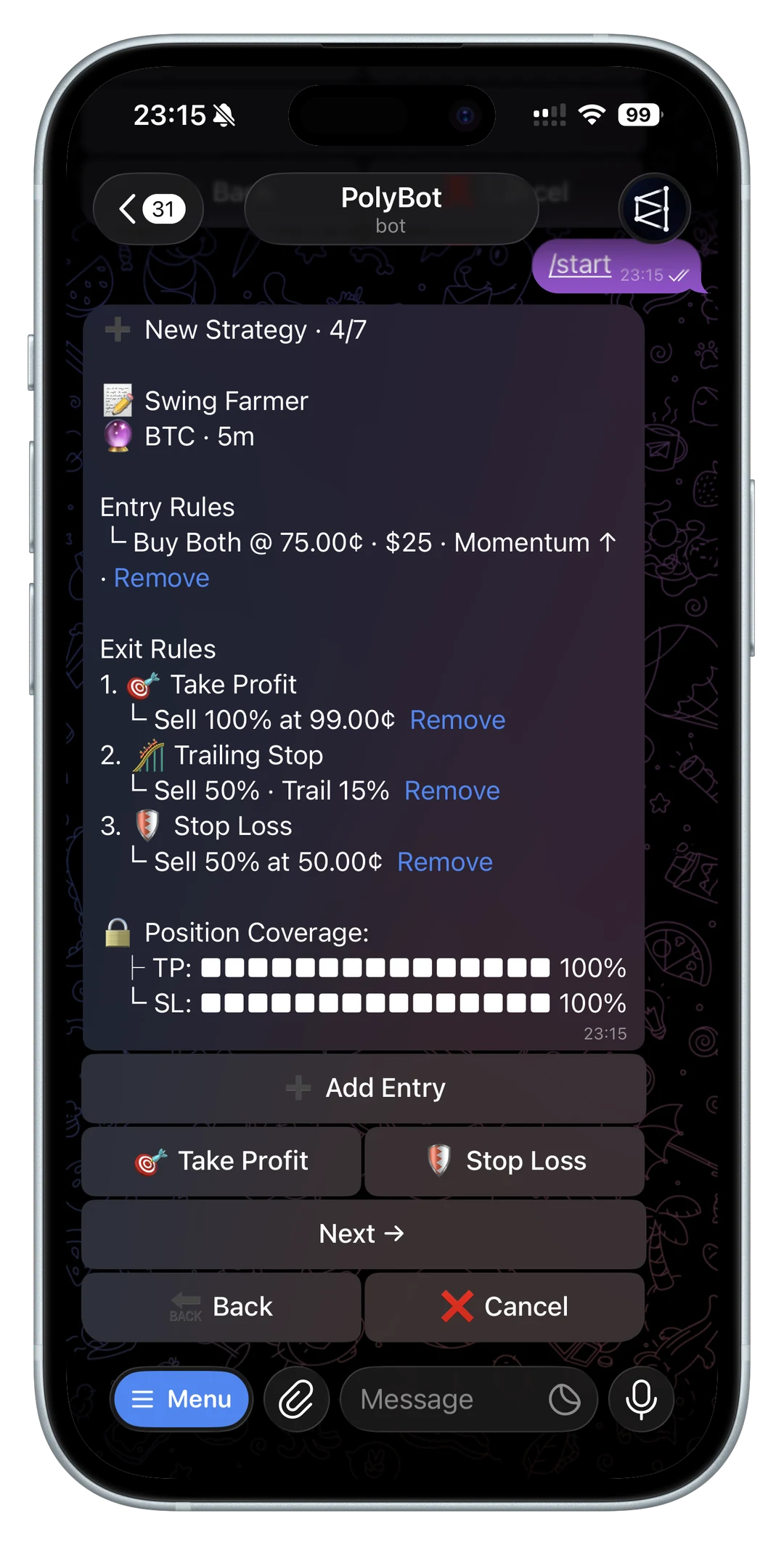
A Polymarket notification bot is useful when it tells you what changed and what to review next.
It is not useful when every notification feels like a command to trade.
Prediction markets move through prices, liquidity, news, wallet activity, copied-trader updates, open orders, resolved positions, and account state. A Telegram notification can help you react faster, but the real value is routing attention to the right checklist: market wording, bid and ask, spread, depth, size, order type, wallet context, open exposure, or settlement status.
This guide explains how to build a practical Polymarket notification workflow from Telegram: price alerts, price-change alerts, volume alerts, whale alerts, wallet updates, copied trades, portfolio reminders, open-order updates, failed-order messages, skipped copied trades, redemptions, and noise control.
If the notification is specifically about target prices, price-change alerts, or when to use alerts instead of limit orders, read the Polymarket price alerts bot guide.
If notifications should roll up into current positions, PnL, open orders, copied exposure, and redeemable winnings, read the Polymarket portfolio tracker bot guide.
If the notification leads to a shared profit image, read the Polymarket PnL card guide so the card stays tied to realized status, liquidity, and portfolio context.
If the notification says an order partially filled, read the Polymarket partial fills guide before treating the order as either fully filled or fully failed.
If a notification is pushing you toward an immediate buy or sell, use the Polymarket market orders from Telegram guide before treating the alert as an execution instruction.
If you want the alert-only layer, read the Polymarket Telegram alerts and watchlists guide. If notifications are part of a broader signal workflow, use the Polymarket trading signals bot guide. If you want the full bot map first, start with the prediction market trading bot guide.
If notifications are summarized or prioritized by AI, use the Polymarket AI trading bot guide to keep model triage separate from live trading authority.
A notification is a routing tool
The best notification does not answer every question. It tells you which question to ask next.
A price-target notification asks: is this price still attractive after checking the current bid, ask, spread, and market wording?
A whale notification asks: is this wallet worth analyzing, and did the trade move the book before I saw it?
A copied-trade notification asks: did my copy fill at a reasonable price, skip for a good reason, or create exposure that needs review?
A portfolio notification asks: is an open position, stale order, stop rule, or resolved market waiting for action?
If the notification does not point to a review path, it is noise. The goal is not to receive more updates. The goal is to receive the updates that reduce missed decisions and stale risk.
The main Polymarket notification types
Useful Polymarket Telegram notifications usually fall into six groups:
- market notifications
- wallet notifications
- copy-trading notifications
- order notifications
- portfolio notifications
- safety and account notifications
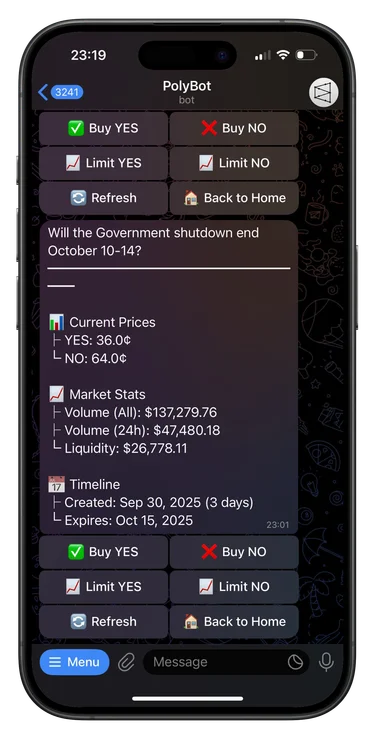
Market notifications include price targets, price changes, trending markets, volume spikes, and market-mover updates. They are discovery and review prompts.
Wallet notifications include whale alerts, followed-wallet trades, large positions, and trader activity. They are research prompts.
Copy-trading notifications include copied fills, skipped copied trades, subscription state, daily-cap events, and leader activity. They are automation-review prompts.
Order notifications include fills, partial fills, cancellations, open orders, rejected orders, and failed orders. They are execution prompts.
For deciding what to do after an open-order or cancellation notification, read the Polymarket open orders and cancel orders guide.
Portfolio notifications include open exposure, PnL changes, stop-loss or take-profit triggers, resolved markets, redeemable winnings, and stale positions. They are risk and maintenance prompts.
Safety notifications include login-sensitive actions, wallet changes, withdrawal checks, 2FA prompts, fake-link warnings, and official-link verification. They are protection prompts.
Treat these as separate workflows. A whale alert should not behave like a fill confirmation. A stop-loss trigger should not behave like a market-discovery alert. A redeemable winnings update should not compete with breaking-news noise.
Price alerts need a decision attached
A price alert is useful only when you know why that price matters.
Before setting a Polymarket price alert, define:
- market
- outcome side
- target price
- reason the target matters
- acceptable spread
- maximum size
- next action if the alert fires
The next action may be "review only." That is valid.
For example, a trader may want a notification if YES returns to 38 cents, but only trade if the spread remains tight and the market wording still matches the thesis. If the alert fires after the spread widens or the source changes, the correct action may be no trade.
If you already know the exact price, side, size, and time-in-force you are willing to accept, a Polymarket limit order may be better than a notification. If you only want to be pulled back into review, a notification is cleaner.
Price-change notifications are not proof of edge
A price-change notification says a market moved.
It does not say the current price is good.
Price-change notifications can help with:
- breaking news
- sports injuries or lineup updates
- election polls or court rulings
- crypto up/down markets
- markets that suddenly wake up
- positions that move toward a risk threshold
But the first question after a price-change notification is not "buy or sell?" It is "why did this move?"
Review:
- cause of the move
- source quality
- current bid and ask
- spread after the move
- visible depth
- whether the move already completed
- whether the market resolves the way the headline implies
For this layer, use the Polymarket news trading bot guide and the Polymarket volume alerts bot guide before turning movement into an order.
Volume and trending notifications are discovery prompts
Volume and trending notifications help you notice where attention is moving.
That is valuable, but attention can be late.
A trending market can be:
- genuinely newly active
- already repriced
- temporarily noisy
- thin but exciting
- related to a better market elsewhere
- driven by social pressure instead of fresh information
A good notification workflow should make it easy to open the market card, inspect liquidity, compare related markets, and decide whether the right action is watchlist, price alert, limit order, market order, or no trade.
For the discovery layer, use the Polymarket market scanner bot guide. For related markets and multi-outcome risk, use the Polymarket arbitrage and related-markets guide.
Whale notifications need wallet context
A whale notification can be useful when it points to a wallet, market, or trade size worth reviewing.
It can also be dangerous because large trades can move the book before you see them.
Before acting on a whale notification, check:
- wallet address or profile
- trader history
- category concentration
- market side
- trade size
- fill price if available
- current bid and ask
- spread after the whale trade
- whether the whale may be hedging or closing
- whether the wallet's size makes sense for your account
Do not copy a large trade only because it is large. The trade may be part of a portfolio you cannot see from one notification.
Use the Polymarket whale alerts and wallet tracker guide, then inspect the wallet with the Polymarket wallet analyzer before turning a whale notification into a copy-trading candidate.
Copied-trade notifications should separate fills from skips
Copy trading needs clear notifications because the leader's action and your copied action are not always the same.
A useful copied-trade notification should tell you:
- which wallet or subscription triggered it
- market and outcome
- leader action
- copied size
- copied price
- fill or skip state
- skip reason if skipped
- current exposure after the event
If the copy filled, review whether the copied price is still close enough to the leader's price. If the copy skipped, review whether the skip protected you or blocked a trade you wanted.
Common skipped-copy notifications include:
- slippage too high
- daily cap reached
- insufficient balance
- copied amount below minimum order size
- market outside category filter
- price outside allowed range
- no shares to sell
- market liquidity disappeared
For the setup layer, read the Polymarket copy trading settings guide. For skip diagnosis, use the Polymarket copy trading skipped trades guide.
Order notifications are execution evidence
Order notifications should be treated as records, not just confirmations.
After a Polymarket order notification, check:
- order type
- side
- amount
- expected price
- actual fill price
- partial-fill state
- remaining open order
- cancellation state
- error text if rejected
- resulting position
This matters because a trader may think the order is done when only part of it filled. Or a limit order may remain open after the original idea is stale. Or a failed market order may be retried without understanding why it failed.
If the notification says the order failed, save the exact message. Do not reduce it to "bot failed." The cause may be liquidity, balance, allowance, market state, tick size, order type, or rate limits.
Use the Polymarket order failed error codes guide, the Polymarket order types guide, and the Polymarket order book guide to classify the execution event.
If the notification mentions price precision or tick size, use the Polymarket tick size guide before retrying from the alert.
Portfolio notifications prevent stale risk
Not every useful notification is about a new trade.
Some of the most important notifications tell you that old exposure needs attention.
Portfolio and order notifications can cover:
- open positions moving toward a risk level
- stop-loss trigger attempts
- take-profit trigger attempts
- trailing-stop updates
- stale limit orders
- open orders reserving balance
- resolved markets
- redeemable winnings
- PnL changes
- balance changes after fills or redemptions
These notifications reduce the chance that a trader forgets about a position, leaves old orders active, or misses redeemable funds.
For position review, use the Polymarket portfolio and orders guide. For realized versus unrealized results, use the Polymarket PnL tracker guide. For redemptions, use the Polymarket auto-claim and redeem winnings guide.
Exit notifications need liquidity warnings
A stop-loss notification can create false confidence if it sounds like a guaranteed exit.
Polymarket is an order-book market. A stop-loss or take-profit trigger can tell the bot to attempt an exit, but the final fill still depends on available liquidity, spread, depth, and market speed.
Useful exit notifications should distinguish:
- trigger reached
- order submitted
- order filled
- order partially filled
- order failed
- remaining exposure
- next review action
That distinction is especially important in thin markets. A stop may trigger correctly and still fill worse than expected. A take-profit may trigger while the spread is too wide. A trailing stop may need review after a fast move.
Read the Polymarket stop loss and take profit guide before treating exit notifications as guaranteed protection.
Mobile notifications need stricter filters
Most Telegram notifications arrive on a phone.
That is useful because mobile is fast. It is risky because mobile turns attention into taps.
A good mobile notification should show enough context to slow the user down in the right places:
- market title
- outcome side
- price or trigger
- current state
- risk reason
- action buttons that do not hide review
If the notification cannot provide enough context, it should route the user to a market card, portfolio view, order view, or wallet view before execution.
For phone-first trading, read the Polymarket mobile trading bot guide. For fast execution after a prepared signal, use the Polymarket sniper bot guide.
Group notifications need source control
Telegram groups can make notifications more useful and more dangerous.
A group may surface markets quickly, share wallet moves, and coordinate discussion. It can also amplify rumors, fake links, stale screenshots, and herd behavior.
In group workflows, notifications should make source and context visible:
- who shared the market
- whether the bot found the market from an official command
- current market card
- current price and spread
- whether the link is official
- whether the bot is the official bot
- whether the group action is research or execution
For group workflows, read the Polymarket Telegram group trading guide. For link safety, read official PolyBot links and fake bot safety.
Reduce notification noise with rules
More notifications do not mean better trading.
Noise control is part of the strategy.
Use notification rules such as:
- only alert categories you understand
- set wider thresholds for noisy markets
- separate price targets from price-change alerts
- turn off alerts that never lead to review
- keep copied-trade notifications grouped by subscription
- send failed orders and skipped trades with exact reasons
- keep redemption and portfolio reminders visible but not urgent
- do not let group notifications bypass market review
- keep safety and wallet notifications high priority
Review notifications every week. If most of them do not produce a clear decision, the setup is too noisy.
A practical notification workflow
A practical Polymarket notification workflow can look like this:
- Market scanner finds active or relevant markets.
- Watchlist stores markets that are interesting but not ready.
- Price or volume alerts notify when attention changes.
- Whale and wallet notifications identify traders worth reviewing.
- Copy-trading notifications report fills, skips, and cap events.
- Order notifications confirm fills, rejects, partial fills, and open orders.
- Portfolio notifications surface stale risk, stops, PnL, and redemptions.
- Safety notifications protect wallet actions, official links, and account state.
That sequence keeps the notification bot in the right role. It routes attention. It does not replace trading judgment.
Polymarket notification bot checklist
Before relying on a Polymarket notification bot, confirm:
- It separates market, wallet, copy, order, portfolio, and safety notifications.
- Price alerts include market, side, target, and current context.
- Price-change alerts do not imply the move is still tradeable.
- Volume and trending alerts lead to liquidity review.
- Whale alerts include enough wallet context to avoid blind copying.
- Copied-trade notifications show fill or skip reason.
- Failed-order notifications preserve exact error text.
- Portfolio notifications show open orders, stale exposure, and redeemable winnings.
- Stop-loss notifications distinguish trigger, submitted order, fill, and remaining exposure.
- Mobile notifications route to review before execution.
- Group notifications preserve source and official-link safety.
- Noisy alerts can be disabled or tightened.
If a notification cannot support a decision, it should not be high priority.
Common questions about Polymarket notification bots
What is a Polymarket notification bot?
A Polymarket notification bot is a Telegram workflow that sends updates about markets, prices, wallets, copied trades, orders, portfolio state, redemptions, and account safety so a trader can review the right thing quickly.
Are Polymarket notifications trading signals?
Some notifications are signals, but not all of them are trade signals. A price move, whale trade, or copied-wallet update should trigger review. It does not automatically prove the current price, liquidity, or size is right.
What notifications matter most for copy trading?
Copied fill notifications, skipped-trade reasons, daily-cap events, subscription pauses, leader activity, and portfolio exposure are the most important. They show whether the copy setup is behaving as intended.
Should failed-order notifications be retried automatically?
Not blindly. Failed-order notifications should show the exact reason first. Liquidity, balance, price precision, market state, and order type failures need different fixes.
How do I stop notification overload?
Use stricter thresholds, fewer categories, fewer watched wallets, clearer price targets, grouped copy notifications, and regular cleanup of alerts that do not lead to action.
Notifications should make trading calmer
The best Polymarket notification bot does not make every market feel urgent.
It helps the trader stop refreshing, notice meaningful changes, inspect the right context, and decide whether to watch, trade, adjust, redeem, pause, or ignore.
That is the difference between a useful Telegram notification workflow and a noisy feed.
Not investment advice, legal advice, tax advice, or security advice. Prediction markets are risky, notification timing can be late, and every market still needs wording, liquidity, wallet, and risk review before action.
Polymarket Market Scanner Bot Guide: Find Markets, Alerts, Liquidity, Wallet Signals, and Risk
How to evaluate a Polymarket market scanner bot workflow: search, trending markets, volume, price alerts, whale alerts, wallet signals, liquidity, order books, and risk controls.
Telegram Trading / 12 min
Polymarket Telegram Alerts and Watchlists: Price Targets, Whale Moves, and Noise Control
How to use Polymarket Telegram alerts and watchlists without chasing noise: price targets, large trade alerts, copied-wallet signals, group links, limit orders, and safety checks.
Telegram Trading / 11 min