Polymarket Telegram Group Trading: Market Search, Cards, Referrals, and Safety
How Polymarket Telegram group trading works with PolyBot: /polybot search, market cards, trader cards, DM execution, referral attribution, and group safety.

PolyBot Team
Updated June 1, 2026
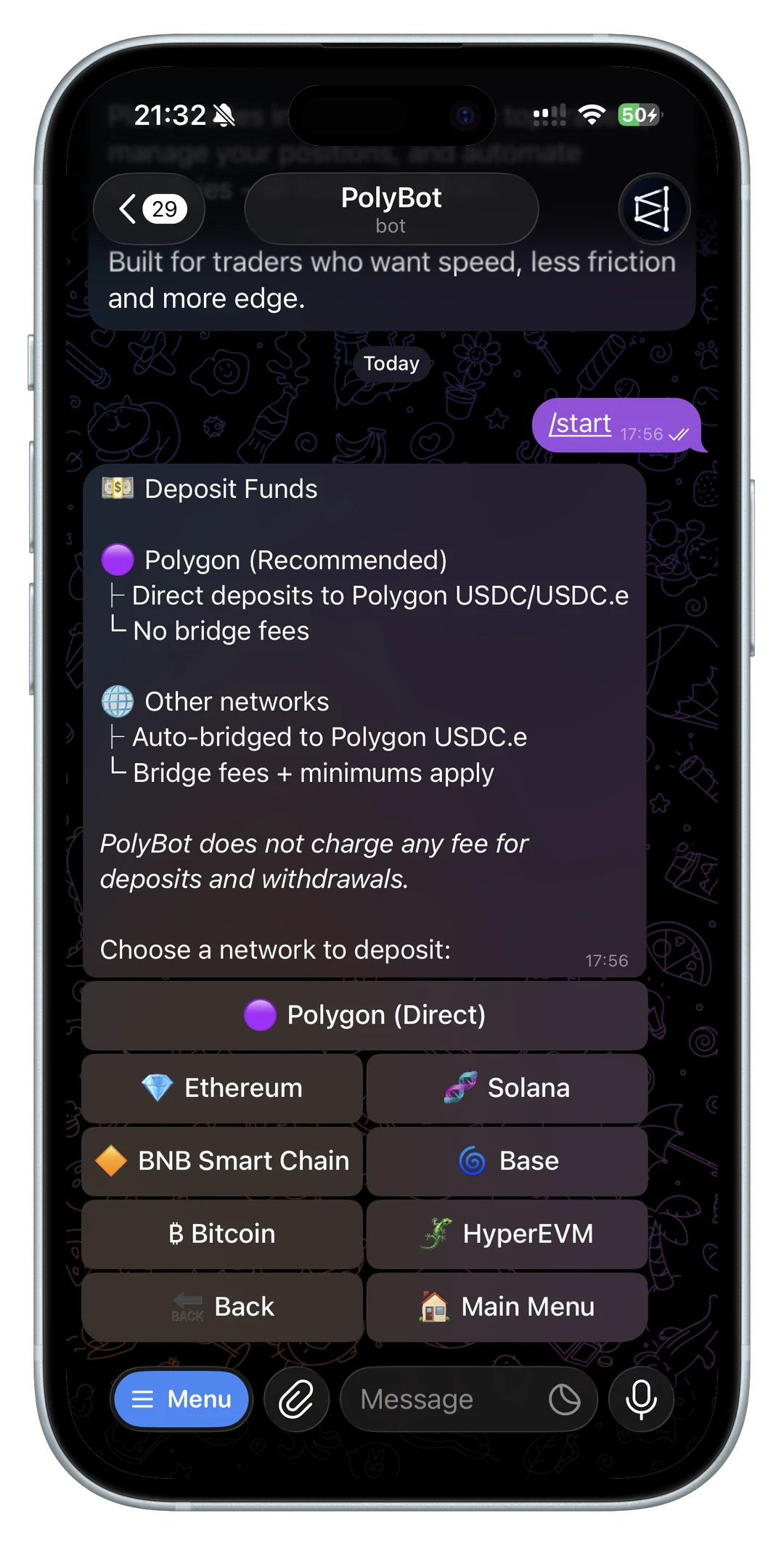
Polymarket Telegram group trading is useful when a market idea starts in a conversation.
Prediction markets often move because people notice the same news, event, or price change at the same time. A Telegram group can surface that signal quickly, but group chat can also create urgency, noise, and weak confirmation. The right group workflow should make markets easier to inspect, not turn every message into a trade signal.
PolyBot's group workflow is designed around discovery and routing. Members can search markets, share market cards, inspect trader cards, and open the bot to trade from a direct-message flow where wallet, order, and risk details can be reviewed.
If you are new to the product, start with the Telegram trading bot for Polymarket guide. If you need command navigation first, read the Polymarket Telegram bot commands guide.
If group signals usually reach you on mobile, read the Polymarket mobile trading bot guide before reacting to every shared market card or forwarded link.
What a group trading bot should do
A Polymarket group bot should help the group find and discuss markets without turning the group into an uncontrolled trading terminal.
The most useful group features are:
- market search from inside the chat
- market cards when someone shares a Polymarket link
- trader cards when someone shares a profile or wallet
- deep links into a controlled DM trading flow
- referral attribution for the group owner or promoter
- clear separation between discussion and execution
That last point matters. Groups are good for discovery. Personal trading decisions should still happen in a flow where each user can review their own wallet, balance, order size, slippage, market side, and risk settings.
Use /polybot to search markets in a group
The core group command is /polybot [query].
For example:
/polybot bitcoin
In a group, that kind of search can help members pull up relevant markets without leaving the conversation. It is useful for live events, breaking news, sports games, crypto moves, election markets, weather markets, and any discussion where someone asks, "Is there a Polymarket for this?"
For election-market discussion, keep the Polymarket politics and election trading bot guide close to the group workflow.
Search results are still only the start. Before trading, check:
- exact market wording
- outcome side
- resolution source
- expiry
- YES and NO prices
- spread
- liquidity
- recent price movement
For command-level navigation, read Polymarket Telegram bot commands.
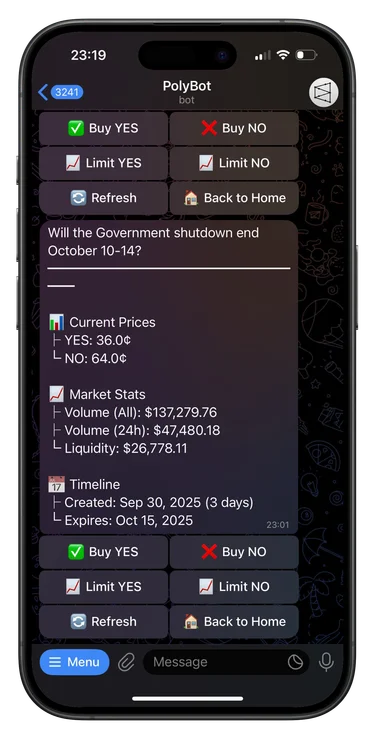
Market cards turn links into context
Market cards are useful because they turn a raw Polymarket link into something the group can read quickly.
A good market card should make it easier to answer:
- what market is being discussed?
- what are the current prices?
- how much liquidity or volume is visible?
- which outcome is being considered?
- is this market worth opening for a closer review?
That does not mean everyone should trade from the card. A card gives context. The user still needs to decide whether the market question is clear, whether the price is acceptable, and whether the trade fits their own bankroll.
If you are deciding between web and Telegram workflows, read Polymarket Telegram bot vs web trading.
Trader cards help groups inspect wallets
Trader cards are useful when someone shares a Polymarket profile or wallet. If the shared artifact is a position profit screenshot instead, use the Polymarket PnL card guide before treating it as proof of repeatable edge.
Instead of discussing a wallet only by reputation, the group can inspect signals like PnL, active markets, portfolio behavior, or copy-trading context. That helps shift the conversation from "this wallet is good" to "what kind of edge does this wallet actually show?"
Before copying from a group discussion, ask:
- does the wallet have enough sample size?
- is performance concentrated in one lucky market?
- does the wallet trade categories you understand?
- are entries still copyable after delay and slippage?
- does your bankroll fit the wallet's typical sizing?
- would strict caps be needed?
Use the Polymarket wallet analyzer before copying a trader. If the wallet came from a large trade or group whale alert, read Polymarket whale alerts and wallet tracking first. Then read how to copy trade on Polymarket from Telegram.
Trading should move to DM
Group chat is a discovery surface. Direct messages are the safer execution surface.
That separation matters because group messages can create pressure. A user should still review the order in their own bot session:
- wallet state
- balance
- market side
- order type
- size
- estimated shares
- slippage
- open orders
- settings
If a market card or trader card opens a trade flow, treat it as the start of review, not the end of review.
For beginner safety, read what to check before your first Polymarket Telegram trade.
Group referrals need clear attribution
Groups can be useful for referral attribution because the person who adds the bot or shares the workflow may introduce new traders.
The important point is clarity. Users should know which official bot they are opening, what the link does, and whether the group is an official community or a third-party group. Referral rewards should not be confused with trading advice.
For the reward mechanics, read Polymarket Telegram bot referral program.
Before opening any group link:
- verify the bot handle
- verify the website
- avoid random support DMs
- never enter a seed phrase
- do not trust copied avatars or lookalike bot names
The official PolyBot links and fake bot safety guide covers those checks.
Good group rules reduce bad trades
A Telegram prediction market group can be useful only if the signal-to-noise ratio stays reasonable.
For a broader signal framework, read the Polymarket trading signals bot guide before using group chat, wallet alerts, or price moves as trade inputs.
Useful group norms include:
- paste market links instead of screenshots
- state the market question, not only the headline
- separate opinion from confirmed news
- call out thin liquidity
- ask whether a limit order is safer than a market order
- avoid pressuring members to trade
- remind users to verify the official bot
Group speed is valuable when it helps users discover markets faster. It is dangerous when it turns uncertainty into momentum.
For price-control workflow, read Polymarket limit orders from Telegram.
When group trading is useful
Group workflows are strongest when discussion improves context.
Examples:
- a sports group discussing live markets
- a crypto group watching BTC or ETH up/down contracts
- a politics group sharing event markets
- a weather group watching storm or temperature markets
- a private research group tracking specific categories
- a creator community sharing markets with followers
In each case, the group helps with discovery. Individual traders still need to handle sizing, risk, and order choice.
For sports groups specifically, read the Polymarket sports trading bot guide before turning live-game discussion into Telegram trades.
For crypto groups watching BTC or ETH up/down contracts, read the Polymarket crypto trading bot guide before turning chat momentum into a trade.
For politics groups, read the Polymarket politics and election trading bot guide before treating campaign discussion as market confirmation.
If you use groups mainly for alerts, read Polymarket Telegram alerts and watchlists.
When group trading is risky
Group trading becomes risky when the group replaces individual review.
Watch for:
- everyone repeating the same trade without checking price
- old market links being reused after conditions changed
- thin markets moving because the group itself is buying
- fake support accounts entering the chat
- screenshots instead of verifiable market links
- users treating referral links as endorsements
- pressure to act before reading market rules
If a group trade fails or fills strangely, check balance, open orders, liquidity, and order type before retrying. The Polymarket order failed guide explains common failure paths.
A simple group workflow
Use this process before trading from a group:
- Someone shares a topic, market, or wallet.
- Use
/polybot [query]or a market card to pull up context. - Read the market question and outcome side.
- Check spread, liquidity, and time to resolution.
- Open the DM flow for personal review.
- Confirm wallet, size, order type, and slippage.
- Use
/portfolio,/orders, or/recentafter trading.
That process keeps the group useful without letting the group make the decision for you.
For a deeper look at /polybot [query], browse modes, and market-card checks, read the Polymarket market search in Telegram guide.
Group trading is best for discovery
The best Polymarket Telegram group workflow is not "everyone copies the chat." It is a structured way to find markets, inspect context, and then move each user's execution into a private flow with wallet and order controls.
Use groups to surface ideas. Use the bot to inspect the market. Use your own risk process before committing capital.
Not investment advice. Prediction markets are risky, and group discussion can amplify both useful signals and bad trades.
Polymarket API Trading Bot Guide: CLOB, API Keys, Orders, and Safer Automation
What to know before building or using a Polymarket API trading bot: CLOB authentication, API keys, signed orders, order types, order-book data, errors, secrets, and safer Telegram automation.
Product Guide / 10 min
Polymarket Auto-Claim and Redeem Winnings in Telegram: Resolved Markets, Payouts, and Balance
How Polymarket auto-claim and manual redemption work in a Telegram bot: resolved markets, winning shares, claim-all, pending redemptions, pUSD balance, notifications, and troubleshooting.
Product Guide / 9 min