Polymarket API Trading Bot Guide: CLOB, API Keys, Orders, and Safer Automation
What to know before building or using a Polymarket API trading bot: CLOB authentication, API keys, signed orders, order types, order-book data, errors, secrets, and safer Telegram automation.

PolyBot Team
Updated June 1, 2026
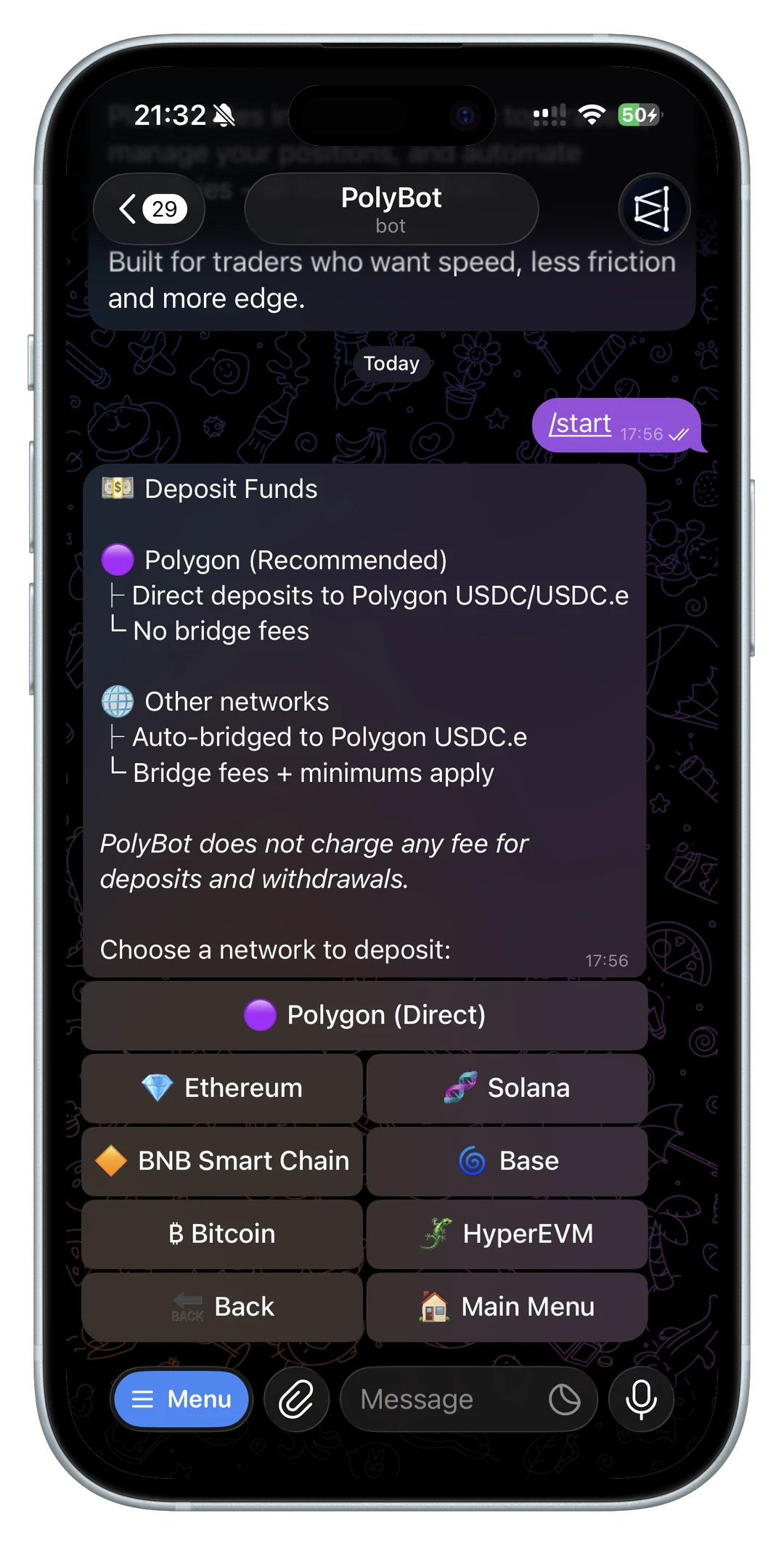
A Polymarket API trading bot sounds like a shortcut: connect to the CLOB API, read prices, submit orders, and let code trade faster than a human.
The real checklist is longer. A trading bot has to authenticate correctly, sign orders safely, protect private keys and API credentials, understand order-book depth, choose the right order type, handle failed orders, avoid stale data, and stop itself when the market conditions no longer match the strategy.
This guide explains what to review before you build, run, or trust a Polymarket API trading bot. It is written for traders comparing self-hosted automation with a managed Telegram workflow, not as implementation code.
If an API bot will use model output or AI-generated signals, read the Polymarket AI trading bot guide before connecting research summaries to live order placement.
For a non-technical comparison of bot workflows, read the prediction market trading bot guide before choosing between Telegram execution, copy trading, automation, and direct API infrastructure.
If you are deciding whether to build or use a bot, read this together with self-hosted Polymarket bot vs Telegram bot, Polymarket API keys and wallet permissions, and the Telegram trading bot guide.
If the bot will quote both sides or chase maker rebates, read the Polymarket maker vs taker guide and Polymarket market making bot guide before building order-placement loops.
If API automation accepts FAK behavior, resting limit orders, or multi-leg execution, read the Polymarket partial fills guide before assuming every submitted order creates the intended exposure.
What the Polymarket CLOB API is for
Polymarket uses a Central Limit Order Book for trading. In practical terms, market prices come from bids and asks, and orders interact with live depth instead of a single fixed quote.
Polymarket's documentation separates public and authenticated access:
- market metadata and many read endpoints can be public
- order books, prices, and spreads can be read without private trading authority
- placing orders, canceling orders, checking balances, and authenticated trading actions require CLOB authentication
- creating user orders still requires order signing
That means a trading bot is not just a data script. Once it can place or cancel orders, it becomes part of the wallet security boundary. For the trader-facing cleanup workflow, read the Polymarket open orders and cancel orders guide.
API keys are not the same as private keys
Polymarket's authentication docs describe two levels:
- L1 authentication uses the wallet private key to prove control and sign EIP-712 messages.
- L2 authentication uses API credentials such as key, secret, and passphrase for CLOB requests.
The important point is that API credentials do not remove signing risk. Even with L2 authentication, order creation still requires the user to sign the order payload.
Treat both layers as sensitive:
- never paste private keys into a random bot
- never commit API secrets
- never expose API secrets in client-side code
- keep signing server-side or in a secure local environment
- rotate credentials if they may have leaked
- separate read-only research tools from trading tools
For a security-first explanation, read the Polymarket API keys and wallet permissions guide.
A trading bot needs market data before orders
Before a bot places an order, it needs to know what it is trading.
Useful inputs include:
- market title and condition
- token ID
- outcome side
- tick size
- minimum order size
- negative-risk flag
- best bid and ask
- spread
- order-book depth
- market status
- expiry and resolution context
If any of those are stale or mismatched, the bot can place the wrong order quickly.
For the price-grid piece of that checklist, read the Polymarket tick size guide before letting automation round custom prices.
For trader-facing review, the market search guide explains why exact wording, liquidity, expiry, and resolution details matter before execution.
Order creation is not just POST and pray
Polymarket's order documentation explains that all orders are expressed as limit orders. Market orders are supported by using a marketable limit price so the order executes immediately against available book depth.
The same documentation lists order behaviors such as:
- GTC: good until cancelled
- GTD: good until date
- FOK: fill or kill
- FAK: fill and kill
That means a bot must decide what should happen if liquidity is smaller than expected.
Key questions:
- Should the order rest or only execute now?
- Should partial fills be accepted?
- What price limit protects the strategy?
- How long can an order remain open?
- What happens if the market moves before the order posts?
- Can the bot cancel stale orders quickly?
- Does the market require negative-risk order handling?
For non-developer order behavior, read the Polymarket order types guide.
The order book is the risk surface
API automation is only as good as its order-book logic.
A bot should not treat a displayed price as enough. It needs to inspect:
- best bid and ask
- spread
- depth at usable prices
- how much size the order would consume
- whether the average fill price still matches the strategy
- whether the book changed since the signal was generated
- whether related legs still have depth
This matters for every strategy, but especially for arbitrage, copy trading, and fast news reaction. If the bot sees a 40 cent ask but only $5 is available there, a larger order may fill much worse or fail.
Use the order book guide and liquidity, spread, and slippage guide as the manual version of the same review.
If your CLOB automation targets crypto up/down markets, read the Polymarket crypto trading bot guide before building trigger-price loops.
Error handling is part of the strategy
Polymarket's error-code documentation covers failures around authentication, order placement, balances, market data, and rate limits. For a human trader, an error is an interruption. For a bot, an error is a branch in the strategy.
A serious bot needs rules for:
- invalid or expired authentication
- insufficient balance or allowance
- tick-size or price precision errors
- market not accepting orders
- post-only orders crossing the book
- FOK or FAK orders not filling as expected
- rate limits
- stale market data
- failed cancellation
- repeated errors on the same market
The safe default after repeated failures is usually pause, not retry forever.
If the goal is a fast manual Telegram workflow rather than custom CLOB infrastructure, read the Polymarket sniper bot guide before building code around every signal.
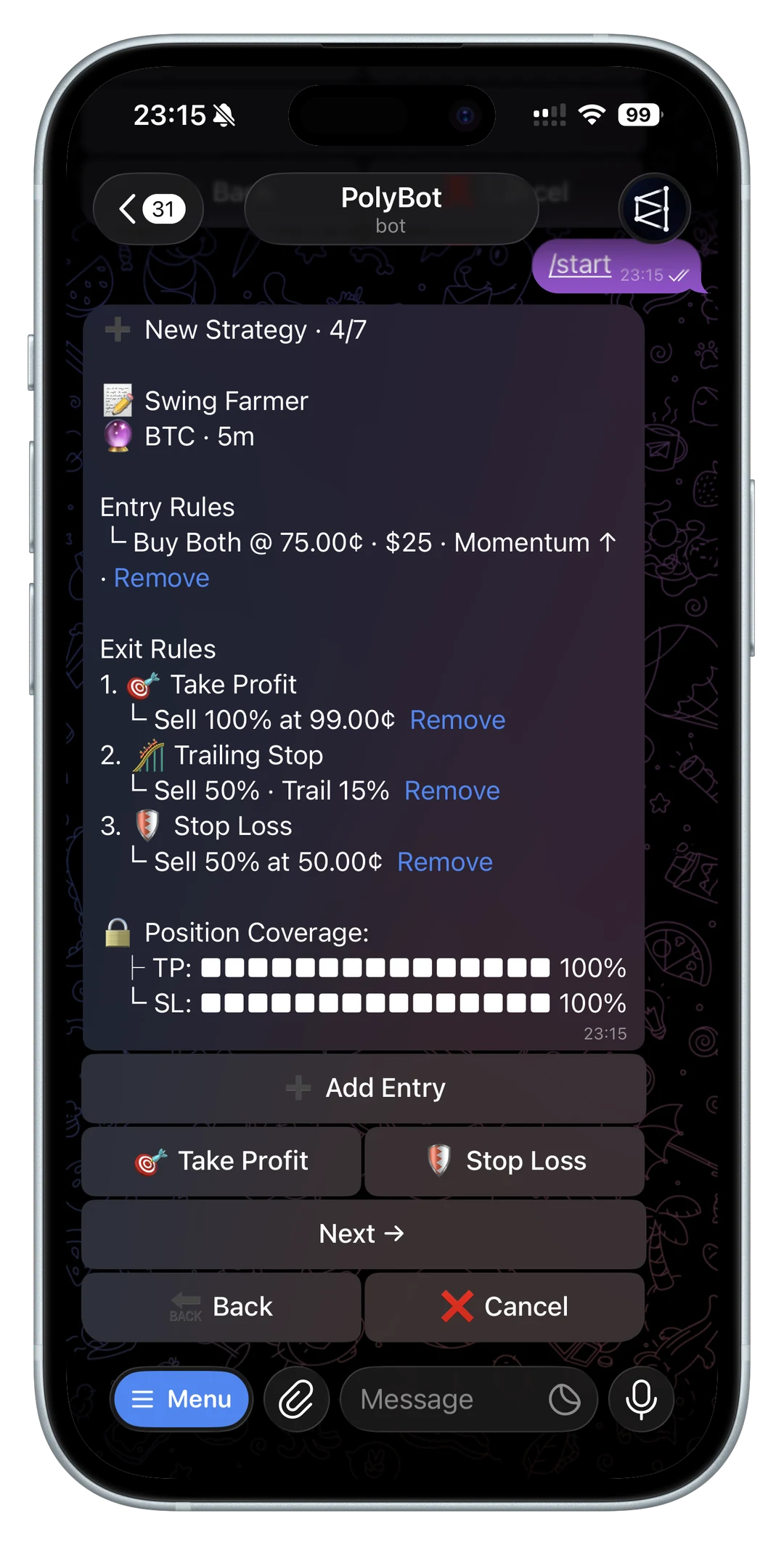
If the goal is managed strategy automation rather than custom infrastructure, read the Polymarket Auto Trader bot guide before implementing entry and exit loops yourself.
For trader-facing examples, read the Polymarket order failed guide.
Negative-risk markets need explicit support
Negative-risk and multi-outcome events are not just normal binary markets with more buttons.
Polymarket's docs note that multi-outcome events can require negative-risk options when orders are submitted programmatically. A bot that ignores event structure can create exposure that does not match the intended basket.
Before a bot trades negative-risk markets, check:
- whether it reads the negative-risk flag
- whether it handles all related outcomes correctly
- whether contract approvals and funder address behavior are understood
- whether partial fills break the basket
- whether exits can be handled across all legs
For trader context, read the negative-risk markets guide and Polymarket arbitrage guide.
Secrets and deployment matter as much as strategy
A profitable-looking strategy can still be unsafe if the deployment is careless.
Avoid:
- private keys in source code
- API secrets in frontend bundles
- credentials in logs
- broad production access for scripts
- no monitoring for failed orders
- no alert when balances change
- no kill switch
- running the bot from a laptop that sleeps
- reusing the same credentials across experiments
At minimum, a self-hosted bot needs secure secret storage, backend-only signing, clear logs without secrets, health checks, alerting, and a manual pause path.
If that sounds like infrastructure work, that is the point. A trading bot is production software that touches funds.
When a Telegram workflow is safer than self-hosting
Building your own API bot can make sense if you have engineering skill, strict operational habits, and a strategy that truly needs custom infrastructure.
For many traders, a managed Telegram workflow is safer because it keeps the core controls close to the trade:
- market cards
- order confirmations
- slippage limits
- copy-trading settings
- daily caps
- stop losses and take profits
- alerts
- portfolio review
- redeem flow
- official support and documentation
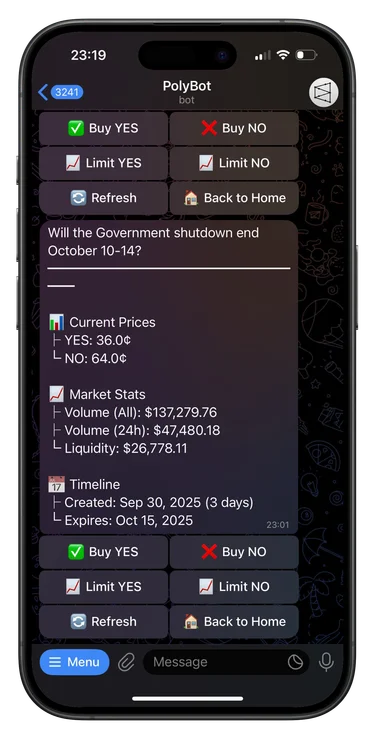
PolyBot is designed around that managed workflow: trade Polymarket from Telegram, analyze wallets, copy selected traders, manage risk, and automate strategies without building CLOB infrastructure yourself.
Start with the Telegram trading bot guide if you want the product workflow rather than an API implementation.
A practical API bot checklist
Before using or building a Polymarket API trading bot, answer:
- What exact markets and token IDs can it trade?
- Does it read market status, tick size, and minimum order size?
- Does it inspect order-book depth before placing orders?
- Does it sign orders without exposing private keys?
- Are API secrets stored outside code and logs?
- What order types does it use?
- What happens on partial fills?
- What happens when an order fails?
- Can it cancel stale orders?
- Does it handle negative-risk markets correctly?
- What stops the bot after repeated bad fills?
- Who gets alerted when balances, orders, or errors change?
If the answer to any of these is vague, keep the bot away from meaningful capital.
Polymarket API bot questions
Can I build a Polymarket trading bot with the API?
Yes, Polymarket provides CLOB documentation and clients for market data, authentication, order creation, cancellation, and related trading workflows. Building one safely still requires secure signing, order-book logic, error handling, and operational controls.
Do Polymarket API keys replace a private key?
No. API credentials authenticate CLOB requests, but order creation still requires signing. Treat both API secrets and private keys as sensitive.
Should I paste Polymarket API keys into a Telegram bot?
No. A managed Telegram trading bot should not ask you to paste raw API secrets into chat. Verify official links, custody model, and documentation before funding any workflow.
Is a self-hosted Polymarket bot safer than a managed Telegram bot?
Not automatically. Self-hosting gives control but also adds responsibility for secrets, uptime, logging, signing, monitoring, and failures. A managed workflow can be safer for traders who do not want to operate trading infrastructure.
What is the main risk with Polymarket API automation?
The main risk is fast execution of wrong assumptions: stale market data, weak depth, wrong order type, leaked credentials, partial fills, failed cancels, or a bot that keeps retrying after the market no longer matches the strategy.
Not investment advice, legal advice, or security advice. Verify current official docs before funding, signing orders, creating API credentials, or running trading automation.
Polymarket Auto-Claim and Redeem Winnings in Telegram: Resolved Markets, Payouts, and Balance
How Polymarket auto-claim and manual redemption work in a Telegram bot: resolved markets, winning shares, claim-all, pending redemptions, pUSD balance, notifications, and troubleshooting.
Product Guide / 9 min
How to Cash Out on Polymarket: Sell Positions, Redeem Winnings, and Withdraw From Telegram
A practical cash-out workflow for Polymarket traders: sell active positions, redeem resolved winners, free reserved balance, check PnL, and withdraw from a Telegram bot safely.
Product Guide / 10 min