How to Cash Out on Polymarket: Sell Positions, Redeem Winnings, and Withdraw From Telegram
A practical cash-out workflow for Polymarket traders: sell active positions, redeem resolved winners, free reserved balance, check PnL, and withdraw from a Telegram bot safely.

PolyBot Team
Updated August 24, 2026
Maintained by the PolyBot product team with AI-assisted editing. The workflow was checked against current PolyBot and Polymarket documentation.
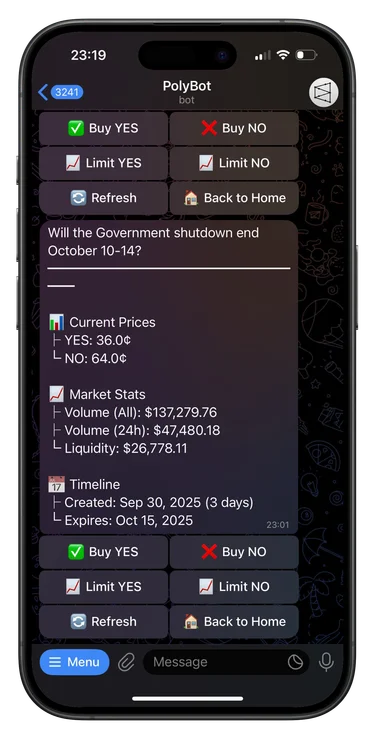
Cashing out on Polymarket is not one button.
A trader may need to sell an active position, redeem a resolved winner, cancel open orders, wait for pending actions, or withdraw available funds to an external wallet. Those steps are related, but they are not interchangeable.
This guide explains the full cash-out path from a Telegram trader's point of view: market sells, limit sells, redeems, auto-claim, reserved balance, PnL review, withdrawal safety, and the checks that prevent a balance question from becoming a support problem.
PolyBot's official Portfolio & Orders Guide describes market sells, limit sells, redeeming winning positions, clearing losing positions, PnL cards, and open orders. If the cash-out story starts with a shared profit card, read the Polymarket PnL card guide before assuming the visible gain is withdrawable. The official Wallet Guide documents /wallet withdrawals to Polygon addresses, selectable withdrawal assets, 2FA prompts, withdrawal limits, and gas sponsorship. The official Auto-Claim Guide explains how winning resolved positions can be redeemed into tradable balance.
If a deposit or bridge transfer never appeared in the available balance, resolve that funding issue before treating it as a cash-out problem.
Polymarket payout, deposits and withdrawals depend on the product
Before following any withdrawal process, identify which Polymarket product holds your current balance. Polymarket's website-versus-app guide says Polymarket.com and the Polymarket US app are separate products and their accounts are not connected.
For international Polymarket.com users trading through PolyBot, cash-out is an on-chain crypto withdrawal from a Polymarket wallet. The current Polymarket withdrawal documentation describes pUSD leaving the wallet for a supported destination chain and token. PolyBot's /wallet flow is narrower: it uses the Polygon route documented in the PolyBot Wallet Guide. Polymarket says it does not charge withdrawal fees, but you should still review the quote and any transaction fees or receiving-platform costs before confirming.
The Polymarket US app uses different payment rails. Its official FAQ lists bank account funding by bank transfer through ACH or debit card in the app. Payment method eligibility requirements, limits, and processing times can differ, so check the live US app instead of applying an international wallet-address workflow to a bank account withdrawal.
The regulatory structure is different too. Polymarket says each US event contract is cleared by Polymarket Clearing, a clearing organization registered with the Commodity Futures Trading Commission. PolyBot is an independent software provider for the international Polymarket workflow; it is not the US app or its clearing organization. This guide therefore keeps the Telegram and Polygon withdrawal path separate from US prediction market trading instructions.
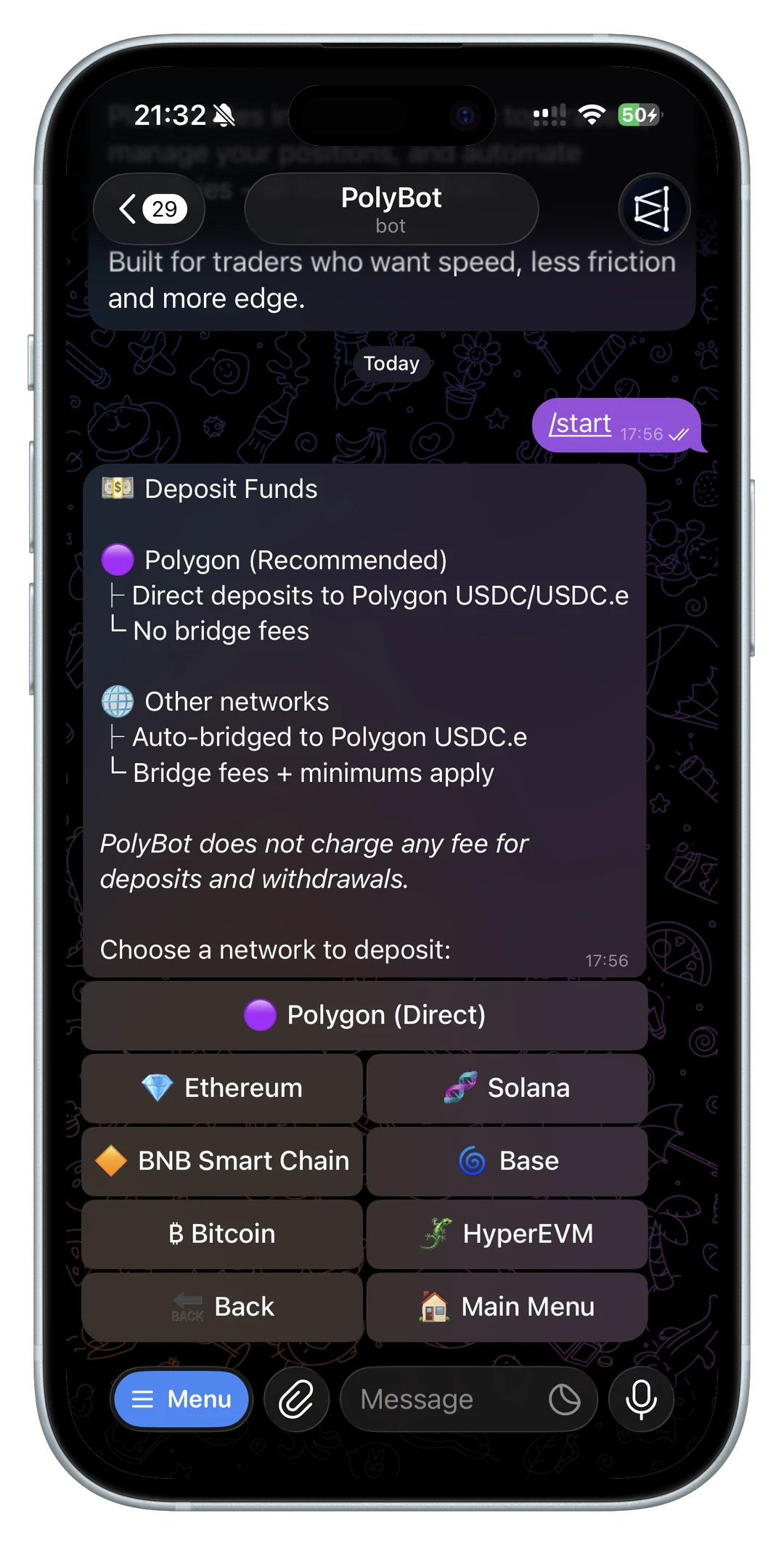
Cash out means three different things in prediction markets
People use "cash out" to mean different actions.
The three most common meanings are:
- Close an active position before the market resolves.
- Claim or redeem winnings after the market resolves.
- Withdraw available funds to an external wallet.
Those actions answer different questions.
Selling asks: can I close the trade now at a price I accept?
Redeeming asks: has the market resolved, did my outcome win, and are winning shares ready to claim?
Withdrawing asks: is the value already available in the wallet balance and am I sending it to the right destination?
The mistake is jumping to withdrawal before checking whether value is still inside open positions, unresolved markets, redeemable winners, or open orders.
Step 1: Check whether the market is still active
Start with the market state.
If the market is still active and tradeable, cashing out usually starts with a sell. You are exiting against current liquidity. The result depends on bid depth, spread, order type, size, and timing.
If the market has resolved, a sell may not be the right action. Winning shares generally need to be redeemed. Losing shares have no payout and may be cleared from the active portfolio view.
Before acting, check:
- market title and outcome
- whether the market is open or resolved
- the side you hold
- current bid and ask if it still trades
- size available near your exit price
- whether any sell orders are already open
- whether the position is redeemable
Step 2: Sell active positions if you want to exit before resolution
An active position in an event contract can usually be reduced through a market sell or limit sell.
A market sell prioritizes speed. It sells into available bids now. That can make sense when risk changed, the market moved against you, or you want to close a copied position before it becomes worse.
A limit sell prioritizes price. It rests at your chosen price and waits for another trader to take it. That can make sense when you have a target exit and do not need immediate liquidity.
Use a market sell when:
- speed matters more than exact price
- there is enough bid depth for your size
- the spread is tight enough
- you want to reduce exposure immediately
- you accept that the fill can be worse than the displayed midpoint
Use a limit sell when:
- you only want to exit at a specific price
- the spread is wide
- a market sell would move through too much depth
- you can wait
- you are scaling out in planned pieces
For the difference between immediate sells, resting limit sells, and partial fills, use the Polymarket order-types guide.
Step 3: Redeem resolved winners instead of selling
After a market resolves, cashing out usually moves from trading to settlement, which is how prediction markets settle around real world events.
If your outcome wins, winning shares become redeemable. Redeeming converts those winning shares into payout value. PolyBot's auto-claim docs describe winning positions being claimed into pUSD tradable balance after markets resolve when auto-claim is enabled.
Use redeem when:
- the market resolved
- your outcome won
- the position is marked redeemable
- auto-claim has not already processed it
- you want the payout returned to tradable balance
Do not confuse redeem with withdrawal. Redeem returns settlement value to the trading balance. Withdrawal sends available funds out to another wallet.
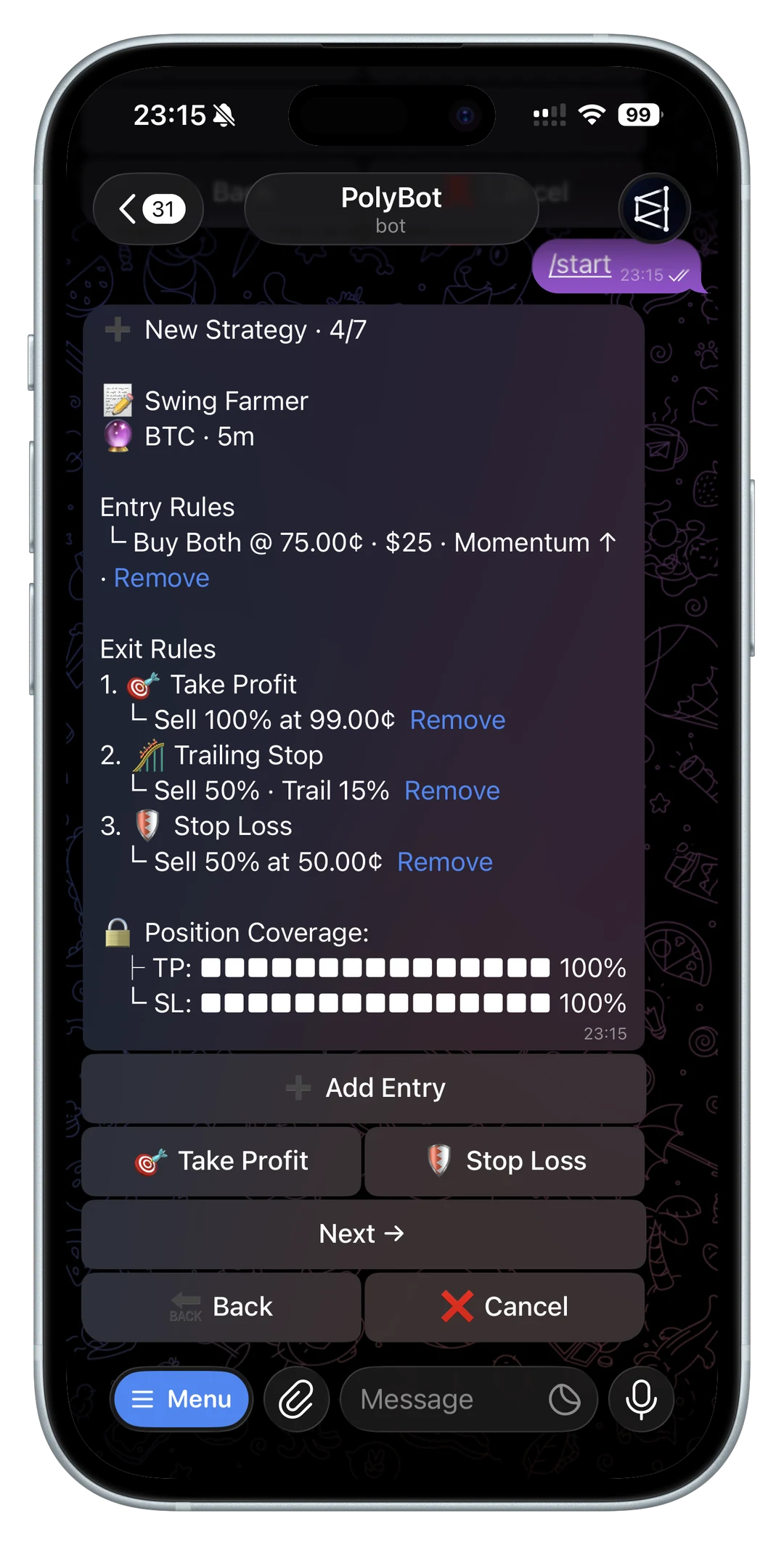
Step 4: Check open orders and reserved balance
A balance can look lower than expected even after a sell or redeem.
Common causes:
- open limit buys reserving funds
- open limit sells reserving shares
- active stop-loss or take-profit rules
- partial fills
- copied trades that used available balance
- redeem or auto-claim still pending
- recent withdrawals or deposits
- wallet screen not refreshed
Before assuming funds are missing, review portfolio, orders, recent activity, and wallet balance together.
Step 5: Review PnL and withdrawal fees before withdrawing
Cash out is not the same as profit.
A trader can withdraw less than expected because the position lost value, sold through a wide spread, partially filled, paid applicable fees, or still has value locked in active orders. A trader can also see a high unrealized PnL that disappears when the exit actually crosses the order book.
Before withdrawing, review:
- original entry price
- exit price or redeem payout
- realized PnL
- remaining open positions
- open orders
- fees, spread, and slippage
- copied-trade differences
- recent redeem and withdrawal activity
Polymarket's fees documentation says Polymarket has taker fees on certain markets, makers are not charged protocol fees, and Polymarket does not charge fees to deposit or withdraw USDC, while intermediaries can charge their own fees. In a Telegram bot workflow, also check product-specific bot fees, transaction fees, spread, slippage, and any receiving-platform costs.
Step 6: Withdraw only after funds are available
Crypto withdrawals are the final wallet action.
PolyBot's wallet docs describe withdrawal from /wallet. The documented flow uses a Polygon destination address, lets the user choose pUSD, USDC, or USDC.e, prompts for 2FA if enabled, supports percentage or custom amounts, and returns a transaction hash after submission.
Before confirming a withdrawal, check:
- you are in the official bot
- the destination is a Polygon address
- the receiving wallet or exchange supports the selected asset on Polygon
- the amount is available and within the limits shown in the bot
- open orders are not reserving the balance
- redeemable winnings are already claimed
- 2FA prompt is inside the official bot flow
- no support account asked for a private key, seed phrase, backup code, or authenticator code
- you will save the transaction hash
Network conditions and the selected destination can affect processing times before the transaction is fully processed.
For sensitive wallet steps, verify the bot handle, support account, and 2FA prompt against the official PolyBot links and safety guide.
Cash-out decision table
Use this table when the next step is unclear.
| Situation | Better next action | Why |
|---|---|---|
| Market is open and you want out now | market sell | fastest way to reduce active exposure |
| Market is open but price matters | limit sell | protects exit price but may not fill |
| Market resolved and your side won | redeem or auto-claim | converts winning shares to balance |
| Market resolved and your side lost | clear or archive | no payout remains |
| Balance seems unavailable | check orders, portfolio, recent activity | funds or shares may be reserved |
| Sell filled only partly | review partial fill and open remainder | account state may be mixed |
| Funds are already available | withdraw from /wallet | wallet action after trading and settlement |
| Unsure about source of balance change | review PnL and trade history | separates trades, redeems, and transfers |
If more than one row applies, handle the earlier account-state issue first. A withdrawal should usually come after selling, redeeming, and open-order review.
Copy traders should cash out by exposure, not emotion
Copy trading can create several small positions across markets and leaders.
Before cashing out copied exposure, ask:
- which leader created the position?
- did my entry match the leader's entry?
- did my exit need to match the leader's exit?
- did the leader sell, hold, or redeem?
- did my copy partially fill?
- would closing all copied positions break a strategy I still want?
- are there open orders or stop rules attached to those copied positions?
A clean copy-trading cash-out workflow starts with portfolio review, not the withdrawal button.
For copied positions, the copy trading guide explains why a follower may have different fills, sizes, or skipped trades than the source wallet.
Mobile cash-out needs extra caution
Many users cash out from a phone because Telegram is mobile-first.
That convenience adds risk:
- copied addresses can be wrong
- fake support DMs can look urgent
- exchange network screens can be confusing
- Telegram notifications can hide context
- small screen layouts can make amounts harder to inspect
- public Wi-Fi or shared devices can increase account risk
For a first withdrawal, use a small test amount. The goal is to prove the destination, network, and asset route before sending a larger balance.
For phone-specific checks, read the Polymarket mobile trading bot guide.
Common cash-out mistakes
Common mistakes include:
- trying to withdraw before selling active positions
- trying to sell after a market already resolved
- forgetting to redeem a winning resolved position
- ignoring open limit orders that reserve funds or shares
- assuming unrealized PnL is the same as withdrawable balance
- using market sell in a thin book without checking bid depth
- cancelling an order and assuming it sold the filled shares
- sending a withdrawal to the wrong network
- trusting a support DM during a withdrawal
- skipping a small test withdrawal
Most cash-out confusion comes from mixing trading actions, settlement actions, and wallet actions. Keep them separate.
Practical cash-out checklist
Before cashing out, answer:
- Is the market still open or already resolved?
- Do I need to sell, redeem, cancel, or withdraw?
- What position size is still open?
- Are any funds or shares reserved by orders?
- Did a previous sell only partially fill?
- Are any winnings redeemable or pending auto-claim?
- Does realized PnL match the trade history?
- Is the destination wallet ready for Polygon deposits?
- Is 2FA enabled before meaningful withdrawal?
- Did I save the withdrawal transaction hash?
- Did I review the relevant fine print for this product and payment route?
The safer sequence is: review portfolio, close or reduce active exposure, redeem resolved winners, cancel stale orders, verify balance, then withdraw.
FAQ
How do I cash out on Polymarket?
First decide what "cash out" means. If the position is active, sell it. If the market resolved and your side won, redeem the winnings. If funds are already available in the Polymarket account wallet balance, withdraw to an external Polygon address.
Is selling the same as withdrawing?
No. Selling closes or reduces an active position. Withdrawing sends available funds out of the wallet. A trader may need to sell or redeem first before funds are withdrawable.
Why is my Polymarket balance not withdrawable?
Funds may still be inside active positions, reserved by open orders, pending redemption, used by copied trades, blocked by verification issues, or waiting on a recent deposit or withdrawal request to be processed. Review portfolio, orders, recent activity, and current balance together.
Do I redeem or sell after a market resolves?
If your outcome won and the position is redeemable, redeeming is usually the settlement action. Selling is for active tradeable markets before final settlement.
Can auto-claim withdraw my money automatically?
No. Auto-claim redeems winning resolved positions into tradable balance. It does not send funds to an external wallet. Withdrawal is a separate wallet action.
What should I check before withdrawing from a Telegram bot?
Verify the official bot, destination network, asset, address, amount, 2FA prompt, available balance, and transaction hash. Never share private keys, seed phrases, backup codes, or authenticator codes with support accounts.
Not investment advice, financial advice, legal advice, tax advice, or security advice. Prediction-market trading and crypto transfers can lose money, and every sell, redeem, or withdrawal should be checked against current official docs and the live bot screen before acting.
Polymarket Cuts Crypto Taker Delay From 250ms to 50ms
Polymarket reduced its crypto-market taker delay from 250ms to 50ms. Here is what changed for fills, trading bots, makers, and copy traders.
Execution / 5 min
Polymarket Copy Trading: How It Works and How to Start From Telegram
Learn how Polymarket copy trading works, how to choose wallets, configure filters, control slippage, size positions, and manage risk from Telegram with PolyBot.
Copy Trading / 13 min