Polymarket Resolution Rules: Payouts, Disputes, Redeems, and What Happens After a Market Ends
A practical guide to Polymarket resolution rules, UMA proposals and disputes, winning-share payouts, redeem timing, market wording, and how Telegram traders should review settled positions.
PolyBot Team
Updated June 1, 2026
A Polymarket market ending is not always the same as money being ready to use.
The event can be over, the likely winner can be obvious, and the price can already look settled. But a trader still needs to know whether the market has formally resolved, whether the winning side is final, whether a dispute is possible or active, and whether winning shares have been redeemed back into the tradable balance.
That distinction matters for trading, PnL, withdrawals, and support questions. If you treat "the game ended" or "the headline happened" as the same thing as final settlement, you can misread a position that is still pending resolution.
Polymarket's official Resolution documentation explains that markets resolve through predefined rules and the UMA Optimistic Oracle. Its Positions & Tokens documentation explains that winning outcome tokens redeem after resolution. The Polymarket Help Center also summarizes the trader-facing rule: markets resolve according to the market's predefined rules, winning shares receive $1 per share, losing shares become worthless, and trading stops after resolution.
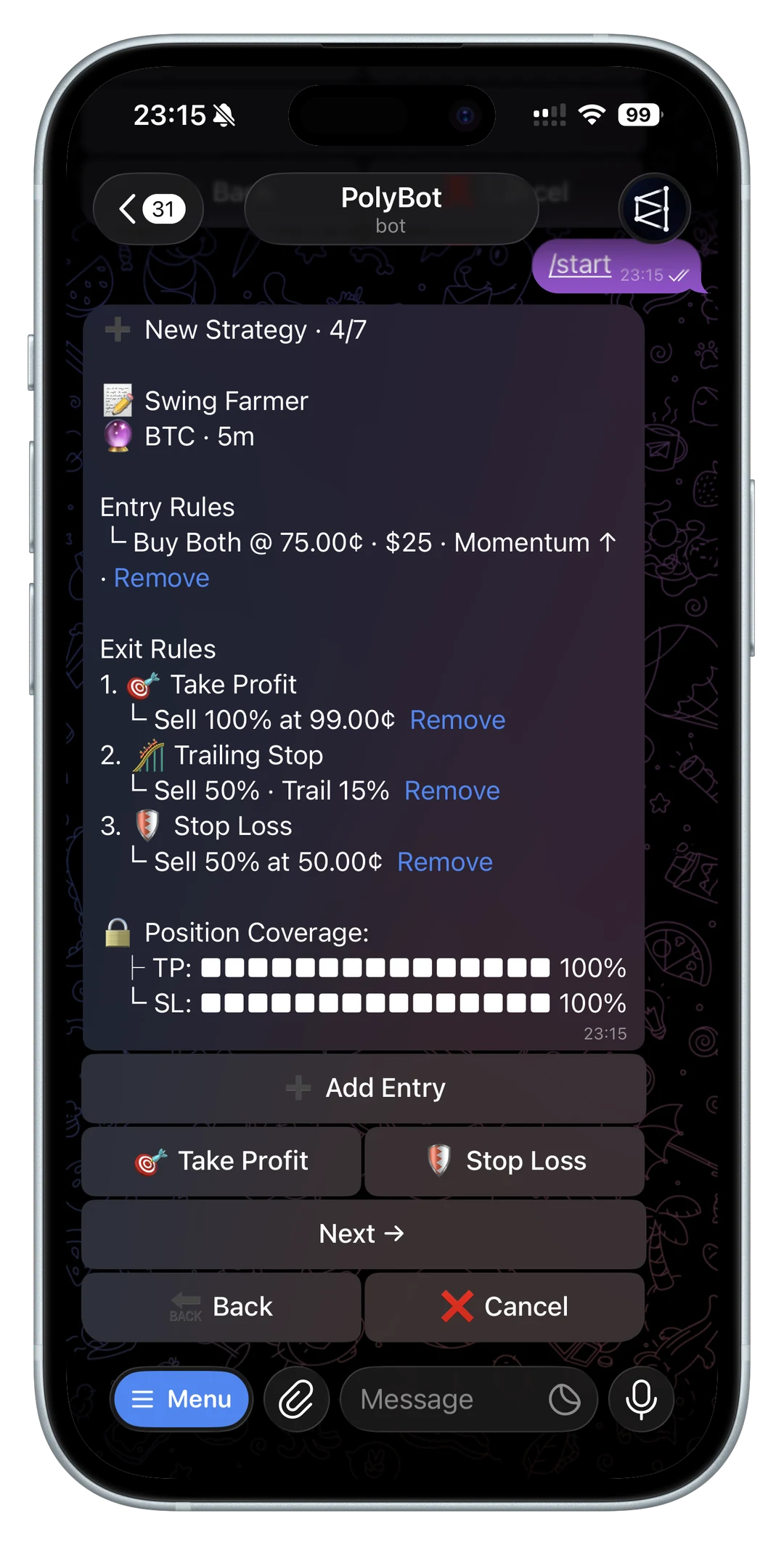
PolyBot's official Auto-Claim Guide explains the Telegram-side workflow: after Polymarket markets resolve, winning positions can be redeemed into pUSD tradable balance, while losing positions can be cleared. The Portfolio & Orders Guide covers manual Redeem, Claim all, and queued redemption states.
This guide explains how to read Polymarket resolution rules before trading and how to think about payouts after the market ends.
Resolution rules are part of the trade
The market title is not enough.
The title tells you the headline question. The resolution rules define how the outcome is judged. On a clean market, those two feel identical. On a close, ambiguous, delayed, or multi-source market, the rules matter more than the headline.
Before trading, check:
- exact market wording
- resolution source
- end date or event deadline
- edge cases
- whether the market depends on official announcements, data feeds, or a specific source
- whether the market is simple binary or part of a multi-outcome event
- whether "Other", cancellation, delay, or unclear wording can matter
Polymarket's docs put it directly: the title describes the question, but the rules define resolution. That is the habit to build before clicking YES or NO.
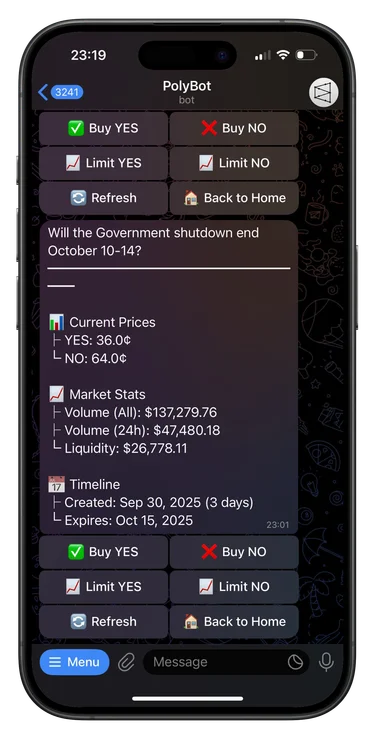
If you find the market through Telegram search, read the Polymarket market search guide before treating a result as actionable.
An obvious outcome is not always final settlement
Traders often say "this market is over" when they mean one of several different states:
- the real-world event happened
- the likely outcome is clear
- the market stopped trading actively
- an outcome was proposed
- a challenge period is running
- a dispute is active
- the market fully resolved
- winning shares are redeemable
- the payout has already been redeemed
Those states are not the same.
A market can look obvious before the official resolution state is final. A market can have an initial proposal and still be within a challenge window. A market can be disputed, delaying final settlement. A winning position can be resolved but not yet redeemed.
For a trader, the safe rule is simple: do not expect payout behavior until the market is actually resolved and the position is redeemable.
How the UMA resolution flow works
Polymarket's current documentation says it uses the UMA Optimistic Oracle for decentralized, permissionless resolution.
At a high level:
- An outcome is proposed.
- The proposer posts a bond.
- A challenge period gives others time to dispute the proposal.
- If there is no dispute, the proposal can be accepted and the market resolves.
- If there is a dispute, the process can require another proposal or escalate to UMA voting.
For normal traders, the most important takeaway is not the proposer mechanics. It is timing and finality.
An undisputed proposal can resolve much faster than a disputed one. A disputed market can take days instead of hours. During that time, a trader should avoid assuming the payout is already spendable.
If you are trying to trade, sell, withdraw, or reconcile PnL around resolution time, check the market state first.
What happens after a market resolves
After final resolution, the winning side determines payout.
In a standard binary market:
- YES wins if the event occurs under the market rules
- NO wins if the event does not occur under the market rules
- winning shares redeem at $1.00 per share
- losing shares have no payout
- trading in that resolved market stops
That does not mean every user sees a balance update instantly. A position may still need a redeem action or an auto-claim workflow. If redemption is queued or pending, wait for the follow-up state before assuming funds are missing.
For the share and price model behind this, read Polymarket odds and prices explained.
Redeem is different from sell
Selling and redeeming are separate exit paths.
Sell before resolution when:
- the market is still tradeable
- there is bid liquidity
- you want to reduce risk or lock in price movement
- the final outcome is still pending
- you prefer an early exit over waiting for resolution
Redeem after resolution when:
- the market has resolved
- your outcome won
- the position is redeemable
- you want the payout returned to tradable balance
If your outcome lost, there is nothing to redeem. The settled losing position may be cleared from an active portfolio view, but no payout returns from losing shares.
For the exit side, read how to sell a Polymarket position. For the settlement side, read the auto-claim and redeem winnings guide.
Why disputes affect payouts
Disputes are not just governance trivia. They affect when a trader should expect the position to become final.
If a proposed outcome is challenged, the market may need more review before settlement. That can mean:
- longer wait before redeemability
- more uncertainty for open PnL
- support questions from users who expected instant payout
- delayed withdrawal planning if funds are tied to resolved winnings
- extra need to read the exact market rules
The correct response is usually patience and verification, not repeated action. If a market is disputed or pending, redeeming may not be available yet. If redemption is already queued, repeatedly trying the same action can make the review harder.
Clarifications and edge cases
Market rules are supposed to be known before trading, but real-world events can be messy.
Polymarket's resolution docs describe clarifications for rare cases where additional context is needed after trading begins. The practical lesson is that ambiguous wording is risk. If you need a clarification to understand your trade, the market may be too unclear for your size.
Be extra careful with markets involving:
- vague words like "launch", "announce", "confirm", or "major"
- sources that may disagree
- delayed official reporting
- multi-outcome structures
- "Other" outcomes
- election certification, appeals, or recount-style edge cases
- markets where the deadline and the event date are not the same
If the market belongs to a multi-outcome structure, read the Polymarket negative-risk markets guide before treating one outcome in isolation.
For election-specific wording, certification, and source checks, read the Polymarket politics and election trading bot guide.
How resolution affects PnL
Resolution turns a price-based estimate into a settlement result.
Before resolution, position value depends on current market price, spread, liquidity, and whether you could actually sell your full size. After resolution, winning shares redeem based on the final outcome, while losing shares have no payout.
That is why a PnL tracker should separate:
- open position value
- unrealized PnL
- realized sell result
- resolved winning position
- redeemable position
- redemption pending
- redeemed payout
- lost or cleared position
If those states are mixed together, a trader can overstate profit or think funds are missing. For the accounting workflow, read the Polymarket PnL tracker guide and the Polymarket trade history guide.
Telegram workflow after resolution
In a Telegram trading workflow, the resolution question usually shows up after the trade:
- Why did my winning market not return to balance?
- Is this position redeemable?
- Did auto-claim already run?
- Is redemption pending?
- Is the market disputed?
- Can I withdraw this value now?
- Why does my portfolio still show a resolved position?
Work in this order:
- Check whether the market has fully resolved.
- Confirm whether your outcome won or lost.
- Open portfolio and check whether the position is redeemable, pending, redeemed, lost, or clearable.
- If auto-claim is enabled, wait for the processing notification.
- If manual action is needed, use Redeem or Claim all from the official portfolio flow.
- Refresh wallet or portfolio after the action completes.
- Review recent activity before assuming balance is wrong.
For the product workflow, use Polymarket portfolio and orders in Telegram.
Withdrawal comes after settlement
A withdrawal is not a resolution tool.
If your value is still in an open position, you may need to sell first. If the market resolved and your side won, you may need to redeem first. If redemption is pending, you may need to wait. Only after value is available in the trading balance does withdrawal become the right question.
That sequence is:
- open position: sell or hold
- resolved winner: redeem or auto-claim
- available balance: withdraw if you want funds outside the bot
For the cash-out path, read the Polymarket Telegram bot withdrawal guide.
Resolution checklist before trading
Before opening a Polymarket position, ask:
- What exact question am I trading?
- Which source decides the outcome?
- What is the end date?
- What edge cases are already described?
- Is the title simpler than the actual rule text?
- What would make YES win?
- What would make NO win?
- Is there an "Other" or multi-outcome complication?
- Is the market close enough to resolution that liquidity could behave differently?
- Would I rather sell before resolution or hold for payout?
- Do I understand what happens if the market is disputed?
If you cannot answer those questions, reduce size or keep researching.
Resolution FAQ
How does Polymarket decide who wins?
Polymarket markets resolve according to their predefined resolution rules. Current Polymarket documentation says outcomes are resolved through the UMA Optimistic Oracle process, where outcomes can be proposed and disputed before final resolution.
What happens to winning shares?
Winning shares become redeemable after final resolution. In a standard binary market, the winning side redeems at $1.00 per share.
What happens to losing shares?
Losing shares have no payout. They may be cleared from the active portfolio view after settlement, but they do not return capital.
Why has my winning market not paid out yet?
Common reasons include: the market is not fully resolved, a dispute is active, redemption has not run yet, auto-claim is disabled, redemption is queued, or the wallet/portfolio view needs refresh.
Can I sell after resolution?
After final resolution, trading for that market stops. The usual action for a winning resolved position is redeem, not sell.
Does auto-claim withdraw my winnings?
No. Auto-claim redeems winning positions into tradable balance. Withdrawal is a separate wallet action.
The bottom line
Resolution is where market wording becomes money.
Before trading, read the rules. Before expecting payout, check the official resolution state. Before withdrawing, confirm the winning shares have been redeemed into available balance. If a market is pending or disputed, treat the delay as part of the risk instead of assuming the balance is wrong.
Not investment advice. Prediction markets are risky, market resolution can be delayed or disputed, and all trading or redemption actions should be checked against current official docs and live product state before relying on them.
Polymarket Odds and Prices Explained: YES/NO Shares, Probability, and Payouts
A practical guide to Polymarket odds: how YES/NO prices map to probability, why bid/ask matters, how shares pay out, what position value means, and how Telegram traders should read market cards.
Trading Guide / 10 min
Polymarket Arbitrage Guide: Related Markets, Negative Risk, Order Books, and Bot Risk
How to evaluate Polymarket arbitrage before trading or automating it: related markets, negative-risk events, order-book depth, fees, slippage, timing, and execution risk.
Trading Guide / 10 min