Polymarket Arbitrage Guide: Related Markets, Negative Risk, Order Books, and Bot Risk
How to evaluate Polymarket arbitrage before trading or automating it: related markets, negative-risk events, order-book depth, fees, slippage, timing, and execution risk.

PolyBot Team
Updated June 1, 2026
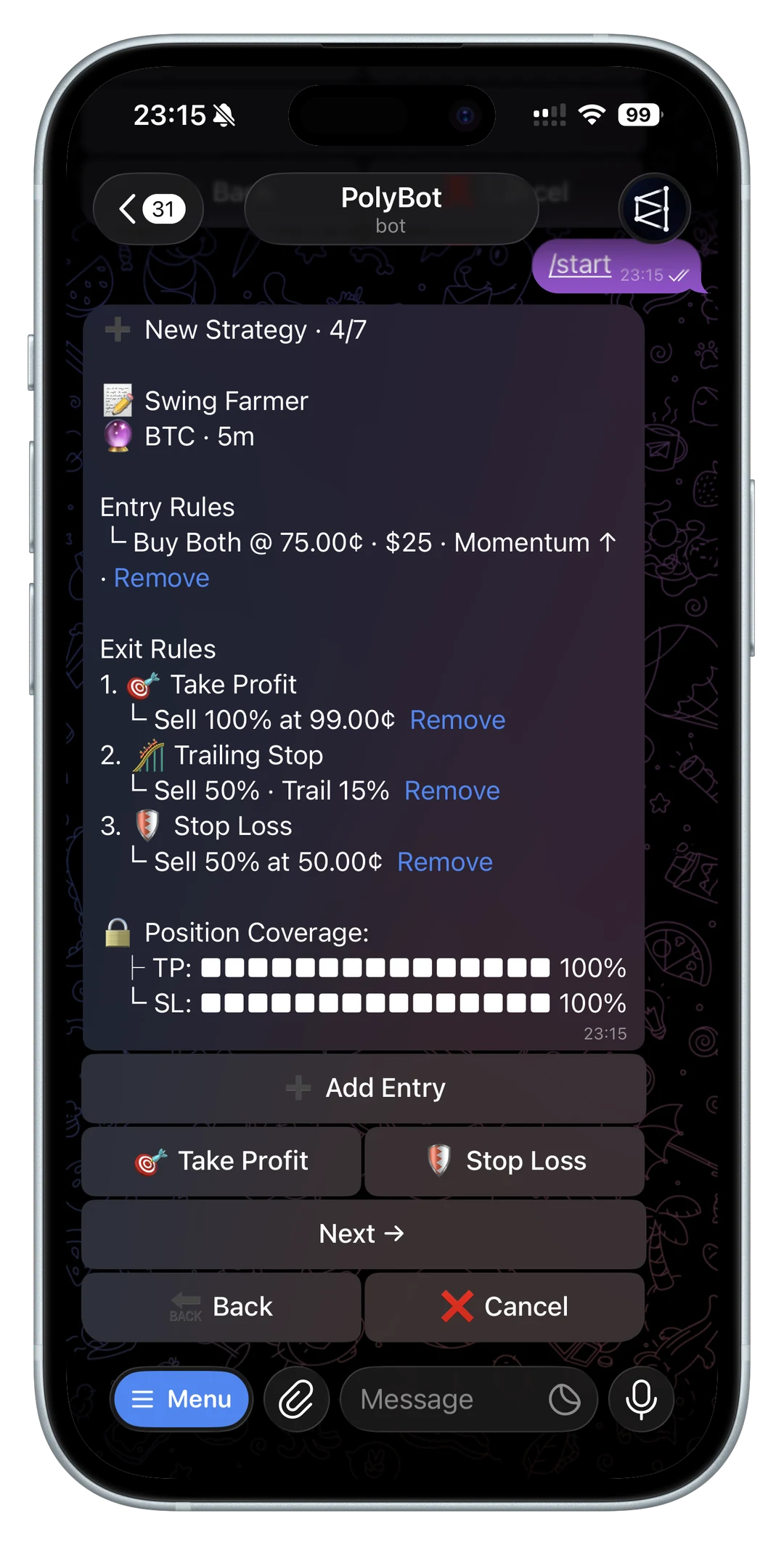
Polymarket arbitrage looks simple in screenshots: two related prices disagree, so a trader buys the cheap side, sells the expensive side, and locks in a clean edge.
In live prediction markets, the hard parts are execution, liquidity, market rules, and timing. A spread can disappear before both legs fill. A related market can resolve under different language. A negative-risk event can have rules that change how the basket behaves. A bot can calculate a theoretical edge and still lose money after slippage, fees, partial fills, or stale data.
This guide explains how to think about Polymarket arbitrage before you trade it manually or automate it from a Telegram workflow.
Use the Polymarket market search guide to find related markets, the order book guide to check depth, and the trading costs guide before treating any spread as real.
If you plan to automate this through the CLOB, read the Polymarket API trading bot guide before handling API keys, signed orders, retries, or partial fills.
If one leg can fill without the other, read the Polymarket partial fills guide before treating an apparent spread as executable.
If the arbitrage setup depends on resting quotes instead of immediate execution, read the Polymarket market making bot guide before quoting both sides.
If one resting leg does not fill, use the Polymarket limit order not filled guide before assuming the apparent edge is still executable.
What arbitrage means in prediction markets
Arbitrage means exploiting a price relationship that appears inconsistent.
In prediction markets, that can happen when:
- two markets describe overlapping outcomes
- one event has multiple related outcomes
- a YES/NO pair is priced inefficiently
- categorical outcomes add up oddly
- a market lags a faster related market
- a trader can hedge exposure across markets
- one venue updates before another venue
The phrase "risk-free" gets used too casually. In practice, an apparent arbitrage is only useful if the whole trade can be executed at the prices, sizes, and rules assumed by the calculation.
The edge is not the number in the spreadsheet. The edge is the filled position after costs.
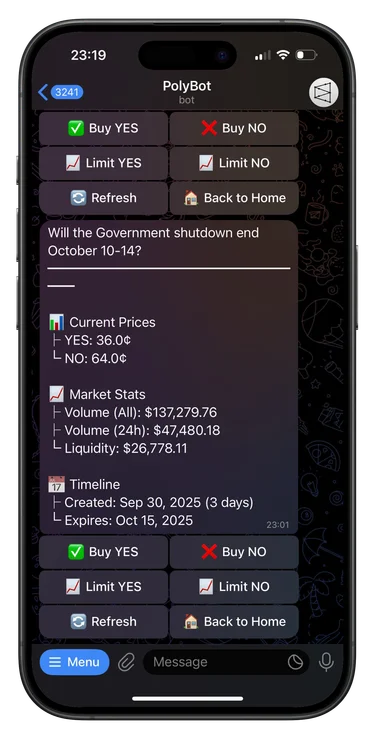
Start with market wording, not price
Before looking at the spread, read the market rules.
Two markets can look related while resolving differently. For example, one may refer to an official announcement, another to a date threshold, another to a specific source, and another to a broader outcome. If those details differ, the prices may not be inconsistent. They may be pricing different risks.
Check:
- exact title and resolution criteria
- outcome wording
- end date
- resolution source
- whether the event can be canceled or extended
- whether related markets use the same threshold
- whether one market has already entered a different information state
If the wording is not equivalent, do not treat the spread as arbitrage.
For resolution mechanics, read the Polymarket resolution rules guide.
Related markets can create false edges
Related markets are not automatically interchangeable.
An apparent edge can appear when:
- one market is broader than another
- one market is about timing and another is about final outcome
- one market resolves on a different source
- liquidity is thin on one side
- the visible price is stale
- the top of book is too small for the intended size
- one leg can fill and the other cannot
The safer approach is to treat related markets as a research signal first. If the prices disagree, ask why. Sometimes the answer is a real dislocation. Often the answer is different wording, different liquidity, or different trader attention.
Use market search in Telegram to find adjacent markets, but slow down before converting a similarity into a trade.
Negative-risk markets need special care
Negative-risk markets are one of the most common places traders look for structured opportunities.
Polymarket's developer documentation describes negative-risk markets as markets where a trader may need to specify negative-risk options when placing orders, and where the complete set of outcomes matters. In normal trader terms, that means the event structure can be different from a simple isolated YES/NO market.
The opportunity is that related outcomes can sometimes create a better basket than buying one outcome alone. The risk is that partial coverage, missing legs, fees, or wrong assumptions can turn a clean-looking setup into uneven exposure.
Before trading a negative-risk setup, check:
- whether the market is actually flagged as negative risk
- whether all relevant outcomes are known
- whether your order flow supports the market type
- how much liquidity exists in each leg
- whether the basket still works after fees and spread
- what happens if only part of the basket fills
- whether you can exit all legs later
For a trader-focused walkthrough, read the negative-risk markets guide.
The order book decides whether the edge exists
A price shown on a market card is not the same as an executable arbitrage.
The order book decides:
- how much size is available at each price
- whether both legs can fill
- how far the price moves after your first order
- whether your second order is still profitable
- whether the spread is real or just a tiny top-of-book quote
- whether a market order will walk through weak depth
Polymarket's order-book documentation describes bid and ask levels, spread, and real-time order-book updates. That is the data an arbitrage trader needs, because a theoretical price mismatch does not matter if the book cannot support the size.
Before placing an arbitrage trade, calculate the edge using executable depth, not just displayed midpoint or last price.
The order book guide explains bids, asks, spread, depth, and fill price from a trader's point of view.
Fees, spread, and slippage can erase the edge
Small arbitrage spreads are fragile.
A setup that looks profitable before execution can fail because of:
- bot fees
- spread
- slippage
- gas or sponsored-gas assumptions
- partial fills
- order cancellation delays
- stale prices
- wide exits
- rewards or rebates not matching assumptions
If the gross edge is 1% and the combined spread/slippage/cost impact is more than 1%, the trade is not an arbitrage. It is a bad fill with a good-looking label.
For cost review, read the Polymarket trading costs guide.
Market orders are dangerous for thin arbitrage
Market orders prioritize execution. Arbitrage often needs price control.
If one leg fills as a market order and pushes the book, the second leg may no longer be profitable. If the second leg fails, you are left with directional exposure, not an arbitrage basket.
Limit orders can protect price but create a different risk: one leg may rest while the other fills, or neither leg may complete before the opportunity disappears.
Useful order questions:
- Do I need both legs filled immediately?
- What is the maximum price that keeps the edge alive?
- What happens if only one leg fills?
- Should this be FAK, FOK, GTC, or GTD?
- Is the size small enough relative to depth?
- How fast can I cancel stale orders?
The Polymarket order types guide explains when market, limit, FOK, FAK, GTC, and GTD orders make sense.
Automation helps only if risk controls are strict
A Polymarket arbitrage bot can scan faster than a human. That does not make it profitable by default.
Automation can help with:
- monitoring many related markets
- comparing live order books
- reacting when a spread appears
- enforcing size limits
- skipping weak depth
- canceling stale orders
- logging fills and failed legs
Automation can also make mistakes faster:
- stale market metadata
- wrong market matching
- latency between legs
- partial fills
- failed cancels
- duplicated triggers
- insufficient balance
- missing negative-risk handling
- no kill switch after repeated losses
If you automate arbitrage, risk controls should come before speed. Every trade should have max size, max slippage, depth checks, stale-data checks, partial-fill handling, and a pause rule.
For fast single-market entries, read the Polymarket sniper bot guide. For arbitrage, speed alone is not enough because every related leg still needs executable depth.
For general strategy automation, read the Polymarket Auto Trader bot guide before applying single-market trigger logic to related-market trades.
For Telegram automation context, read the self-hosted Polymarket bot vs Telegram bot guide and trading strategies for crypto up/down markets.
Copying arbitrage traders is harder than it looks
Some profitable wallets use arbitrage-like or basket-style strategies. Copying them can be difficult.
A leader may:
- enter several related markets together
- use a bankroll large enough to complete every leg
- get filled before the spread disappears
- cancel stale legs quickly
- hedge with positions you do not see as one simple trade
- rely on execution speed
- use order sizes that move the market
If you copy only one leg of a basket, you can end up with risk the leader never intended. If you copy later, the spread may be gone.
Before copying an arbitrage-style wallet, use the wallet lookup guide, the wallet analyzer guide, and the copy trading settings guide.
A practical arbitrage checklist
Before placing or automating a Polymarket arbitrage trade, answer:
- Are the market rules truly equivalent or intentionally related?
- Is the opportunity still present in executable order-book depth?
- Does each leg have enough size at the needed price?
- What is the net edge after fees, spread, and slippage?
- What happens if only one leg fills?
- What order type protects the edge?
- Can stale orders be canceled quickly?
- Does the setup involve negative-risk market mechanics?
- Can the position be exited later without giving back the edge?
- Is the size small enough for the book?
- Is there a kill switch after repeated failed legs?
- Is the trade still worth taking if the best price moves one tick?
If any of those answers are unclear, the trade is not ready for automation.
Polymarket arbitrage questions
Is Polymarket arbitrage risk-free?
Not automatically. Apparent arbitrage can disappear through market-rule differences, weak order-book depth, fees, slippage, partial fills, stale data, or one leg filling without the other.
Can a bot find Polymarket arbitrage faster than a human?
Yes, automation can scan related markets and order books faster. But a faster bot still needs strict depth checks, slippage limits, stale-data checks, partial-fill handling, and cancellation rules.
Are negative-risk markets the same as arbitrage?
No. Negative-risk markets can create structured opportunities, but they also require understanding the event, the outcome set, order support, and what happens if only part of the basket fills.
What is the biggest mistake in Polymarket arbitrage?
The biggest mistake is treating a displayed price gap as executable profit. The order book, market rules, fill size, and costs decide whether the edge is real.
Should I copy a wallet that seems to do arbitrage?
Only after checking whether the strategy is copyable. Many arbitrage-style trades depend on speed, multiple legs, complete baskets, and exact fill prices. Copying one visible trade can create directional risk.
Not investment advice. Arbitrage can lose money when markets, liquidity, execution, or assumptions move against the trade.
Polymarket Odds and Prices Explained: YES/NO Shares, Probability, and Payouts
A practical guide to Polymarket odds: how YES/NO prices map to probability, why bid/ask matters, how shares pay out, what position value means, and how Telegram traders should read market cards.
Trading Guide / 10 min
Polymarket Position Sizing and Risk Management: Bankroll, Limits, Stop Losses, and Exposure
A practical guide to Polymarket position sizing and risk management: bankroll limits, quick-buy amounts, per-market exposure, stop losses, partial exits, slippage, copy trading, and portfolio review.
Trading Guide / 10 min