Self-Hosted Polymarket Bot vs Telegram Bot: Which Workflow Fits?
Compare self-hosted Polymarket bots with Telegram trading bots by engineering effort, ops burden, wallet analysis, copy trading, and risk controls.

PolyBot Team
Updated August 22, 2026
Maintained by the PolyBot product team with AI-assisted editing. The comparison focuses on operating tradeoffs rather than declaring one setup universally best.
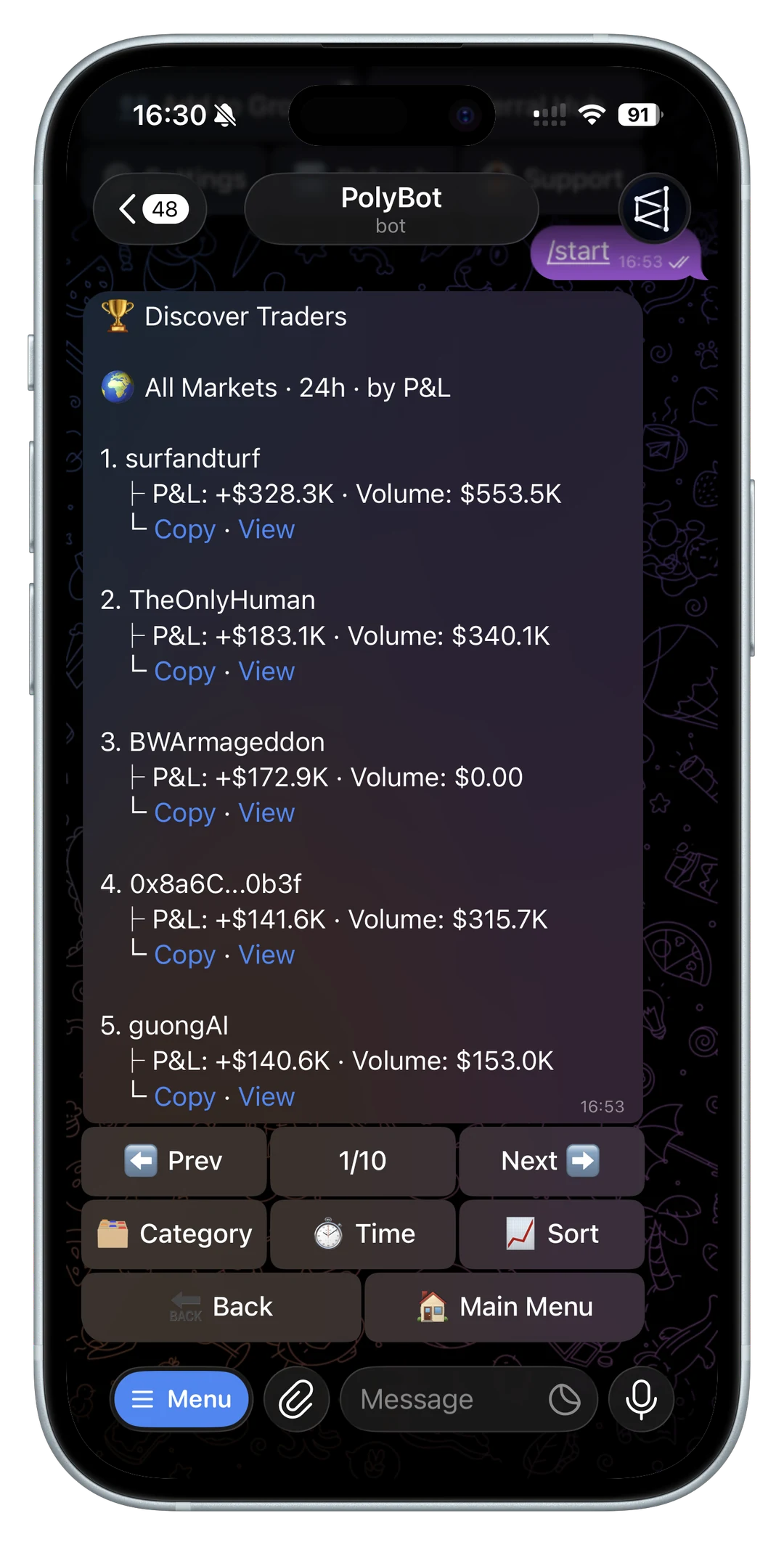
The choice between a self-hosted Polymarket bot and a Telegram trading bot is really a choice between control and operating burden.
Self-hosting can make sense for developers with custom strategies, proprietary data, and the patience to maintain trading infrastructure. A Telegram bot can make more sense for traders who want copy trading, wallet analysis, alerts, order controls, and mobile execution without turning the workflow into a software project.
This guide compares both approaches without assuming one is always better.
If you are still deciding which prediction-market bot workflow fits, start with the prediction market trading bot guide, then use this page for the self-hosted tradeoff.
If custody is the main concern, read the non-custodial Polymarket Telegram bot guide before assuming self-hosting is automatically safer.
The important distinction is not "technical" versus "non-technical." It is whether you want to own the full trading system. A self-hosted bot means you are responsible for credentials, order signing, data quality, uptime, error handling, and risk controls. A Telegram trading bot means you evaluate a managed product workflow and its safety model instead.
What self-hosting gives you
A self-hosted Polymarket bot gives maximum flexibility.
It can be useful when you need:
- custom strategy logic
- proprietary signals or data feeds
- direct API integrations
- custom dashboards
- specialized risk rules
- cross-market research
- complete control over deployment and monitoring
If your edge depends on code that only you can run, self-hosting may be worth the effort.
The Polymarket API trading bot guide covers the developer-facing version of this decision.
Polymarket's current CLOB documentation describes trading as a hybrid-decentralized system with offchain order matching and onchain settlement on Polygon. Orders are signed messages, and direct API users need to understand authentication, signing, order submission, cancellations, and order status. That is powerful, but it is also a real engineering surface.
If you are building directly, start with the official Polymarket CLOB trading docs and order creation docs before trusting sample code from random repos.
What self-hosting requires
The hard part is not sending the first order. It is keeping the system correct under real market conditions.
A serious self-hosted setup needs to handle:
- credentials and signing
- market discovery
- order-book updates
- WebSocket reconnects
- stale data
- partial fills
- failed cancellations
- duplicate order prevention
- slippage controls
- logging and alerts
- deployment monitoring
- incident response
For copy trading, the system also has to avoid duplicated side effects when signals repeat or infrastructure restarts. That is engineering work, not just configuration.
The hidden parts of a self-hosted bot
Most self-hosted bot discussions focus on the strategy. The hidden work is the plumbing around the strategy.
A production-grade bot needs answers for:
- how private keys are stored and rotated
- how API credentials are derived, stored, and revoked
- how order signing is isolated from application logs
- how order books are refreshed
- how stale prices are rejected
- how failed submissions are retried
- how cancellations are reconciled
- how fills are persisted
- how duplicate signals are deduped
- how deployment restarts avoid repeating trades
- how alerts reach the operator when something breaks
The first working order is the easy milestone. The durable milestone is a bot that can handle market movement, API errors, partial fills, and infrastructure restarts without creating exposure you did not intend.
API control also means API responsibility
Direct API control gives flexibility, but it shifts responsibility to you.
Polymarket's CLOB docs describe separate authentication layers: key-based signing to create or derive credentials, then API credentials for trading requests, while order creation still requires signed order payloads. That means a self-hosted bot must treat private keys, API keys, passphrases, and request signatures as sensitive production secrets.
For order types, the same docs distinguish resting limit orders from market-style orders such as FOK and FAK. The Polymarket order types guide explains how those choices affect Telegram traders. That matters because a self-hosted bot must decide what happens when liquidity is missing:
- should the order fill entirely or cancel?
- should it partially fill and cancel the rest?
- should it rest as a limit order?
- should it retry at a new price?
- should it alert a human instead?
Those choices are not implementation details. They define the strategy's real behavior.
What a Telegram bot gives you
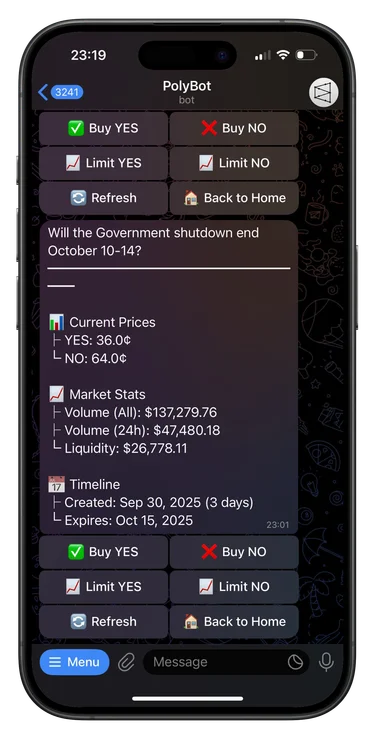
A Telegram trading bot for Polymarket is designed around trader workflow instead of infrastructure ownership.
The useful questions are:
- Can I find and open markets quickly?
- Can I analyze a wallet before copying it?
- Can I place market and limit orders from the same workflow?
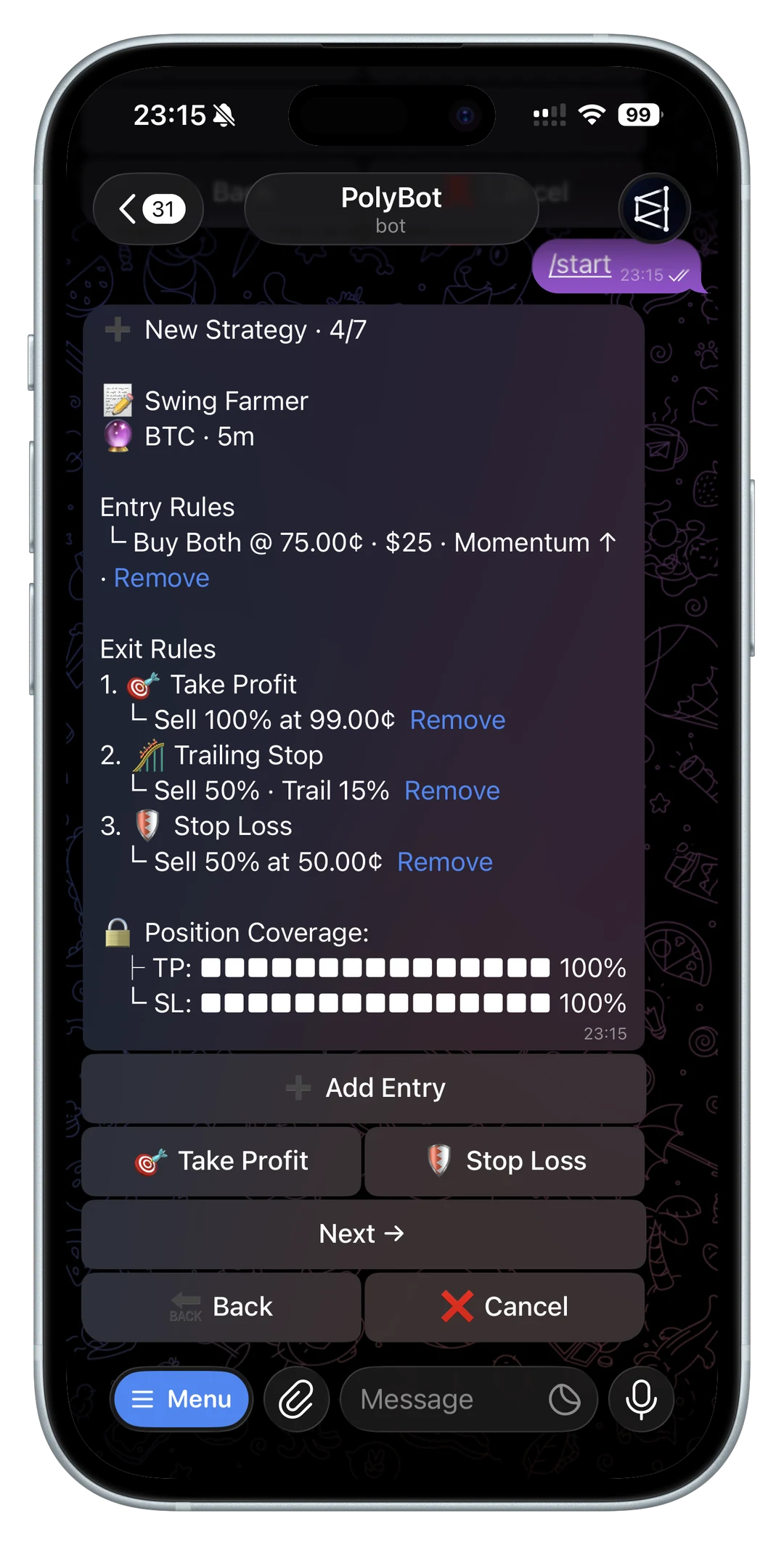
- Can I set stop-loss and take-profit rules?
- Can I monitor alerts and watchlists without switching tools?
- Can I use the product from mobile?
- Can I keep wallet control and risk settings understandable?
PolyBot's public positioning includes copy trading, wallet analysis, automated strategies, market and limit orders, stop-loss and take-profit controls, and Safe wallet control for Polymarket traders.
PolyBot's docs describe a Telegram-native workflow with paste-to-trade, market orders, limit orders, portfolio/order management, copy trading, automation, group support, sponsored gas, and a self-custodial Safe wallet model. The managed workflow does not remove trading risk, but it reduces the amount of infrastructure a trader has to build before using those controls.
For current product mechanics, use the PolyBot docs and the PolyBot trading guide as the source of truth.
Compare by the job, not the label
The better choice depends on the job you need done.
Choose self-hosting when:
- you are comfortable maintaining trading infrastructure
- your strategy is code-first and proprietary
- you need custom data pipelines
- you want to own every implementation detail
- you can monitor failures and bad fills
Choose a Telegram bot when:
- you want faster setup without building infrastructure
- copy trading is part of the workflow
- wallet analysis matters before execution
- alerts and order controls should live near chat
- mobile execution is important
- you want to compare tools by practical trading workflow
Use the comparison hub if you are evaluating PolyBot against other Polymarket trading tools.
Cost is not only subscription cost
Self-hosting can look cheaper because there may be no product subscription. That is an incomplete comparison.
Self-hosting costs include:
- developer time
- server hosting
- monitoring and alerting
- secret management
- incident response
- ongoing API changes
- testing and backtesting
- failed-order investigation
- security review
- opportunity cost when engineering replaces trading research
A Telegram bot may have product fees, but it can reduce setup time and operational burden. The better comparison is total cost of ownership, not only the visible product fee.
For product-cost questions, read Polymarket Telegram bot fees, custody, gas, and safety.
Wallet analysis is a major difference
Many custom bots start from a signal or strategy. Copy trading starts from a wallet.
Before copying a wallet, you need to understand:
- realized PnL
- win rate in context
- category edge
- sizing behavior
- liquidity
- whether the wallet is still copyable
That is why the Polymarket wallet analyzer matters in a Telegram workflow. It helps convert public wallet behavior into a more disciplined copy decision.
For a deeper walkthrough, read the wallet analyzer guide and the copy trading red flags guide.
Execution risk exists in both models
Self-hosting does not remove order-book risk. Telegram execution does not remove order-book risk either.
Both workflows still need to account for:
- liquidity
- spread width
- slippage
- partial fills
- market impact
- stale prices
- fast news
- bad exits
The difference is where the controls live. In a self-hosted bot, you build and maintain them. In a Telegram trading workflow, you evaluate whether the product gives you the controls you need.
Read Polymarket limit orders vs market orders and Polymarket liquidity, spreads, and slippage before judging either approach.
The same rule applies to automation. A self-hosted bot can implement any rule you want, but that also means it can implement a bad rule perfectly. A managed Telegram workflow should be judged by whether it exposes the right controls: max size, slippage, stop-loss, take-profit, filters, pause behavior, and clear order feedback.
Read the Polymarket Auto Trader bot guide, trading strategies for crypto up/down markets, and Polymarket stop-loss, take-profit, and trailing stop if you are comparing automation surfaces.
Security comparison
Security looks different in each model.
With a self-hosted bot, you control the implementation, but you also own:
- private key storage
- server access
- deployment secrets
- dependency updates
- logging hygiene
- API credential rotation
- access control for dashboards and workers
- alerting when an order behaves unexpectedly
With a Telegram bot, you evaluate:
- official links
- custody model
- Telegram account security
- in-bot 2FA
- withdrawal path
- private key export behavior
- automation limits
- support-channel legitimacy
Neither model is automatically safe. The safer model is the one you can actually operate with discipline.
Self-hosting and Telegram can also work together
This is not always an either-or decision.
The important question is where your edge actually lives. If the edge is unique engineering, self-hosting may be central. If the edge is selecting better wallets, reacting faster to markets, and controlling risk, a Telegram workflow may be enough.
Example hybrid setups
A hybrid setup might look like:
- custom research script plus Telegram alerts
- self-hosted wallet scoring plus manual Telegram execution
- custom dashboard plus PolyBot copy-trading controls
- API-based backtesting plus Telegram-based live order review
- private signal generation plus limit-order placement in a managed workflow
This can work well when the custom code produces insight but the trader still wants a simpler execution surface. The risk is fragmentation. If research, alerts, orders, and portfolio state are split across too many tools, you need a clear process for reconciliation.
A practical decision checklist
Before choosing, ask:
- Do I have a strategy that requires custom code?
- Can I maintain infrastructure during live market events?
- Do I need direct API control or just faster execution?
- How will I monitor errors and duplicate orders?
- How will I analyze wallets before copying?
- What risk controls are required before I fund the workflow?
- How much time do I want to spend on ops instead of trading decisions?
- What happens if my bot crashes while orders are open?
- How will I prevent duplicate orders after a restart?
- Where are credentials stored?
- How will I know if fills are worse than expected?
- Who reviews the system when the market is moving quickly?
If the answers point to engineering ownership, self-hosting can be a strong fit. If the answers point to trader workflow, a Telegram bot is usually simpler.
Questions about self-hosted Polymarket bots
Is a self-hosted Polymarket bot better than a Telegram bot?
Only if you need the extra control and can operate it safely. Self-hosting is better for custom strategies, proprietary data, and engineering-heavy workflows. A Telegram bot is usually better for traders who want managed execution, copy trading, alerts, wallet analysis, and mobile workflow without owning infrastructure.
Can a self-hosted bot remove slippage?
No. It can implement slippage controls, order-book checks, and custom routing logic, but it cannot create liquidity that is not available. Thin markets, wide spreads, and fast news still affect fills.
Is self-hosting cheaper?
Not always. It may reduce visible product fees, but it adds engineering, hosting, monitoring, secret management, maintenance, and incident-response costs. For many traders, those costs are higher than expected.
Can I use both?
Yes. Some traders use custom code for research and Telegram for alerts, execution, or portfolio review. If you do this, define which system is the source of truth for positions, open orders, and risk limits.
For recordkeeping across systems, preserve source-wallet events, submitted orders, acknowledgements, fills, and terminal status separately. Do not treat a submitted order or a portfolio snapshot as proof of a completed trade.
Choose the workflow you can safely operate
A self-hosted Polymarket bot gives control, flexibility, and engineering ownership. A Telegram bot gives a managed trading workflow for copy trading, wallet analysis, alerts, order controls, and mobile execution.
The right choice depends on whether you want to build and operate the system yourself or focus on trading decisions inside a product workflow.
Not investment advice. Automation can lose money in either model if strategy, liquidity, sizing, or risk controls are weak.
Best Polymarket Telegram Bot Alternatives
Compare Polymarket Telegram bot alternatives by copy trading, wallet analysis, sniper execution, alerts, automation, custody, fees, and risk.
Comparison / 10 min
Best Polymarket Copy Trading Bot? Use This Checklist Before You Pick One
Compare Polymarket copy trading bots by execution, wallet analysis, copy filters, risk controls, custody, fees, and Telegram workflow before you trust a setup.
Copy Trading / 13 min