Non-Custodial Polymarket Telegram Bot Guide: Safe Wallets, Key Export, 2FA, and Withdrawals
How to evaluate a non-custodial Polymarket Telegram bot workflow: Safe wallet control, signer keys, private key export, 2FA, deposits, withdrawals, API permissions, and scam checks.

PolyBot Team
Updated June 1, 2026
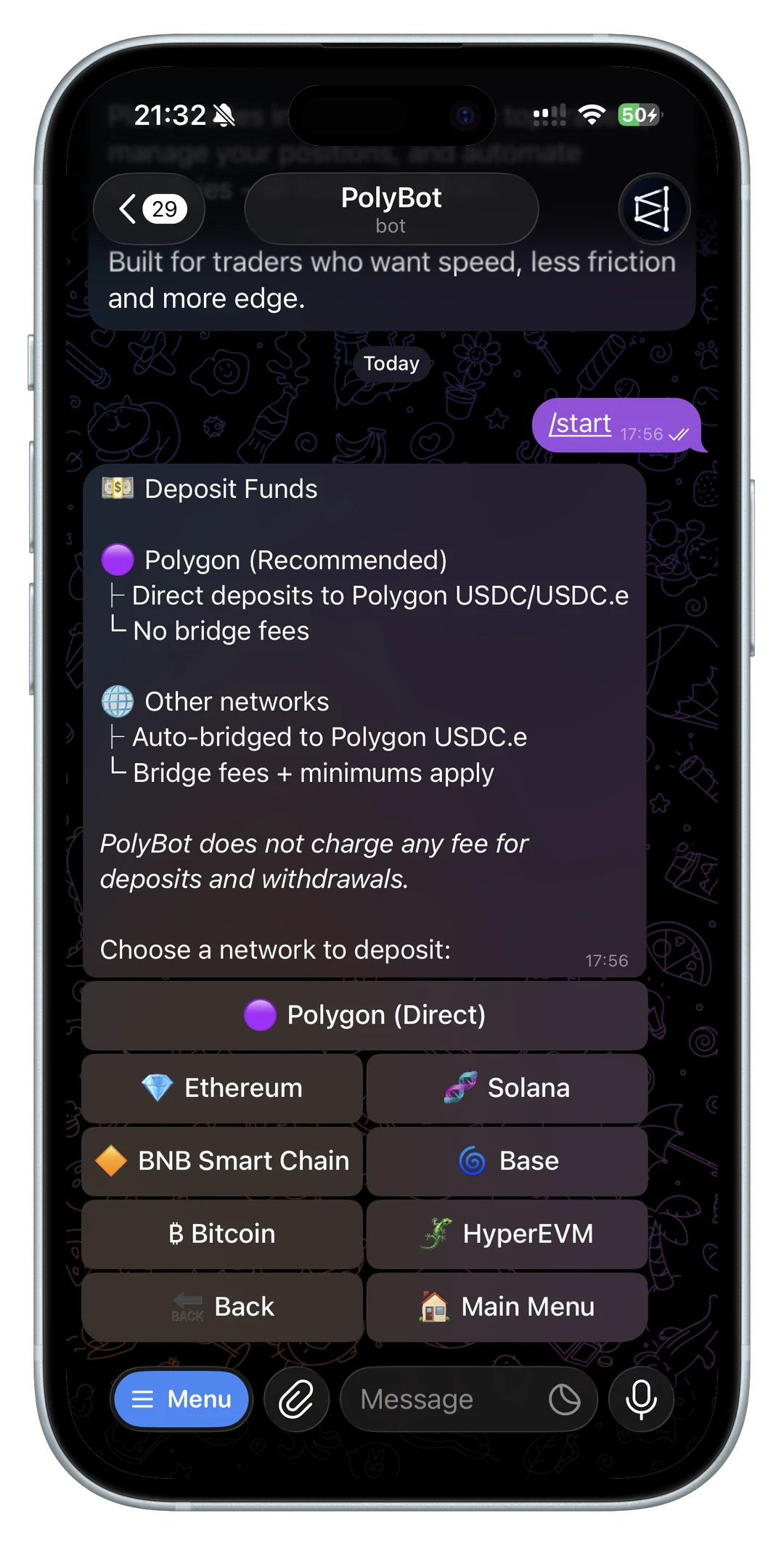
A non-custodial Polymarket Telegram bot should make wallet control easier to understand, not harder.
The phrase "non-custodial" can sound reassuring, but it is only useful when the product explains what the user controls, what the bot can do, how orders are signed, how withdrawals work, how keys can be exported or recovered, and which actions require extra protection.
This guide explains how to evaluate a non-custodial Polymarket Telegram bot workflow: Safe wallet control, signer keys, private key export, 2FA, deposits, withdrawals, API permissions, fake bot risk, and the difference between self-custody and self-hosting.
If you want the broader safety checklist first, read Polymarket Telegram bot fees, custody, gas, and safety. If you are comparing full bot workflows, start with the prediction market trading bot guide.
What non-custodial should mean
In a trading-bot context, non-custodial usually means the user has a path to control the wallet and withdraw funds without asking the product operator to manually release them.
That does not automatically answer every question.
Before funding, ask:
- What wallet is created or connected?
- Who can sign transactions?
- Can the user export or recover signer access?
- Can withdrawals be started from the product without support?
- Which actions require 2FA?
- Does the product ever ask for a seed phrase or private key in chat?
- What happens if Telegram access is lost?
- What happens if the user exports a key and stores it poorly?
Non-custodial is not a magic safety label. It is a set of concrete controls that should be documented and testable.
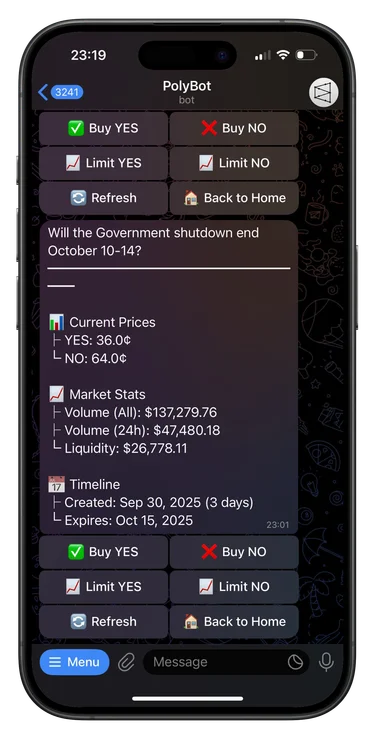
Safe wallet flow versus a random bot wallet
A Safe wallet flow can give the user a clearer wallet boundary than an opaque bot balance. The important thing is not the brand name alone. The important thing is whether the user can understand ownership, signing, export, withdrawals, and recovery.
A good Safe-wallet trading workflow should explain:
- which chain the wallet lives on
- how deposits reach the trading balance
- whether gas is sponsored
- how withdrawals are submitted
- how private key or signer export works
- how 2FA protects sensitive actions
- what support can and cannot do
PolyBot's public site and docs describe Safe wallet control as part of the Telegram trading workflow. That matters because the user should be able to connect the product claim to a real wallet, a real withdrawal path, and a real security process.
For the first funding path, read the Polymarket Telegram bot deposit guide. If funding is delayed or missing, read the Polymarket deposit not showing up guide. For the exit path, read the Polymarket Telegram bot withdrawal guide.
Questions to ask before trusting a custody claim
Do not accept "non-custodial" as a complete answer. Treat it as the start of a checklist.
Useful follow-up questions:
- Is the wallet address visible?
- Is the trading balance separate from the deposit address?
- Which actions can the bot perform automatically?
- Which actions require explicit confirmation?
- Can open orders reserve balance?
- Can copy trading or auto trading spend available balance without another tap?
- Can the user cancel orders from the same interface?
- Can the user withdraw without a support ticket?
- Is private key export documented as a backup action?
- Does the product explain what happens if Telegram access is lost?
These questions matter because real custody is not only about where the wallet exists. It is also about whether the user understands how trading permissions, automation, open orders, withdrawals, and key backup fit together.
If a bot says "you control the wallet" but cannot explain deposits, withdrawals, export, 2FA, or open-order behavior, the custody story is incomplete.
What support should never ask for
A non-custodial support process should not require secrets.
Support may reasonably ask for:
- a public wallet address
- a transaction hash
- a market link
- an order ID
- a screenshot with secrets hidden
- the approximate time of an issue
- the official Telegram username you contacted
Support should not ask for:
- private key
- seed phrase
- authenticator code
- backup code
- Telegram login code
- full browser session token
- remote desktop access to export a key
- a deposit to a new "verification" wallet
This difference is simple but important. Public identifiers help support investigate. Secrets control accounts or funds. A custody-aware product should keep that boundary clear in docs, bot copy, and support workflows.
Private key export is not a support step
Private key export can be part of self-custody. It can also be the fastest way to lose control if handled badly.
The difference is who initiated it and where the key goes.
Legitimate self-custody export looks like:
- the user intentionally opens a documented settings flow
- the product explains that the key controls wallet access
- the key is shown only to the user
- the user stores it offline or in a secure password manager
- the user never sends it to support, admins, group members, or another bot
Unsafe key handling looks like:
- a support account asks for the key
- a bot says the key is needed to activate trading
- a group admin asks for the key to fix a deposit
- a website asks for the key after a failed withdrawal
- a script tells the user to paste the key into an
.envfile without understanding the risk
For credential-specific risks, read Polymarket API keys, wallet permissions, and Telegram bot safety. For fake-link checks, read the official PolyBot links and fake bot safety guide.
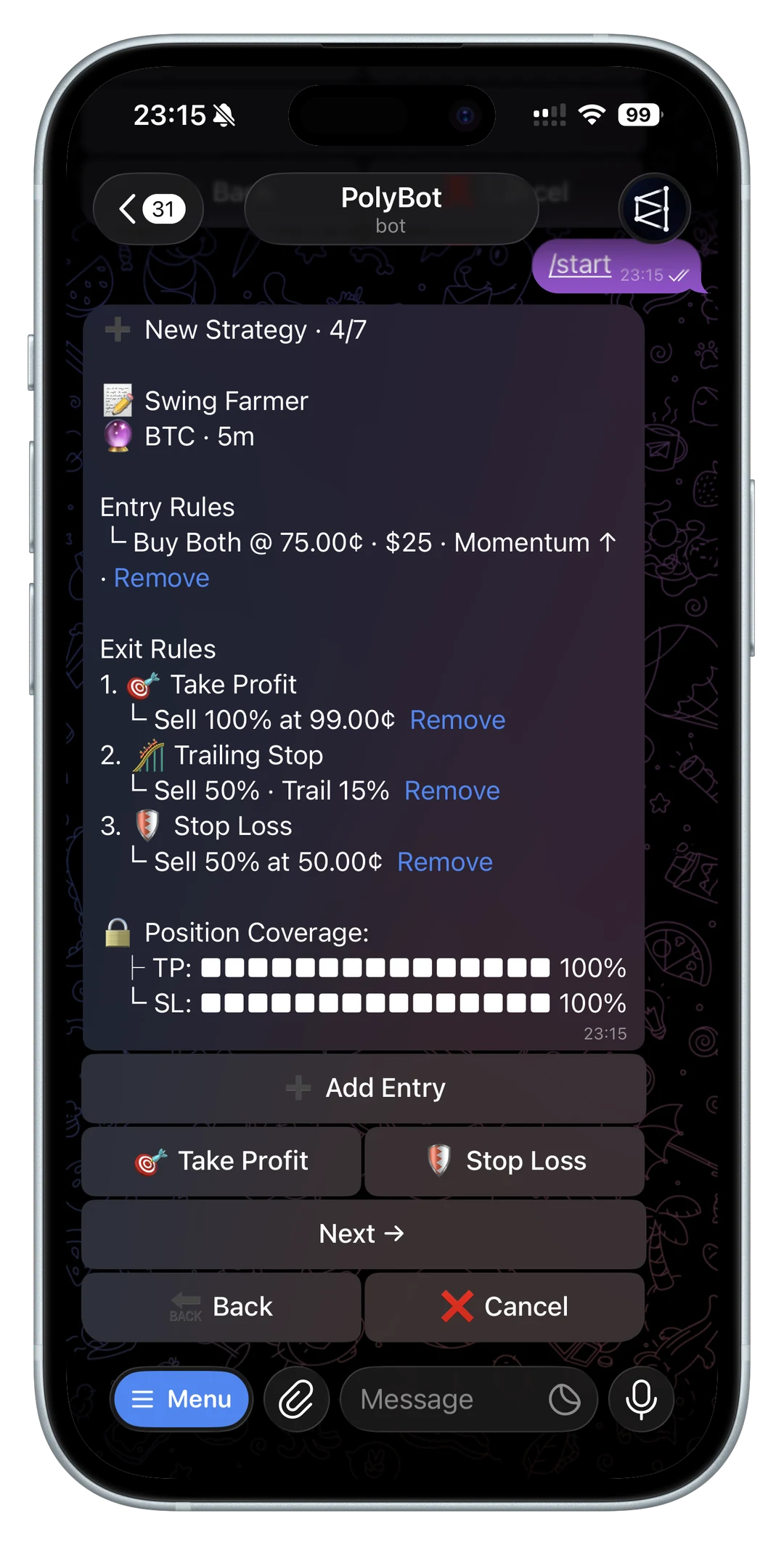
API keys are not the same as wallet control
Some Polymarket bots and scripts talk about API keys, CLOB credentials, wallet permissions, and private keys as if they are interchangeable. They are not.
API credentials can authenticate requests. A private key or signer key can control wallet authority. Order creation and cancellation still need careful signing and permission boundaries.
Before trusting an API-based or self-hosted workflow, check:
- where private keys are stored
- whether API secrets are server-side only
- whether logs can leak secrets
- how orders are signed
- how duplicate orders are prevented
- how failed orders are retried
- how open orders are cancelled
- how the bot stops during bad market conditions
If you are considering direct CLOB automation, read the Polymarket API trading bot guide before treating API access as automatically safer than a managed Telegram workflow.
2FA should protect sensitive wallet actions
Two-factor authentication is not a trading strategy. It is a protection layer around sensitive actions.
For a non-custodial Telegram bot, the most important 2FA boundaries are usually:
- withdrawals
- private key export
- account recovery or disabling security controls
- changing sensitive wallet settings
2FA does not protect against every risk. It does not make a bad trade good. It does not fix a private key that was already shared. It does not stop market losses, liquidity losses, or slippage.
But it can reduce the chance that a stolen Telegram session or rushed mobile action becomes a direct wallet-loss event.
Use the Polymarket Telegram bot 2FA security guide before the wallet holds meaningful value, not after.
Deposits prove the link path; withdrawals prove control
Many users check deposits but ignore withdrawals. That is backwards for custody due diligence.
A deposit confirms that funds can enter the product flow. A withdrawal confirms that the user understands the exit path.
Before depositing, verify:
- official website
- official Telegram handle
- current docs
- deposit network
- deposit address shown inside the product
- supported asset
- whether a small test is appropriate
Before withdrawing, verify:
- available balance
- open orders
- pending positions
- destination address
- network
- 2FA prompt
- transaction hash
- whether the withdrawal screen matches current docs
A non-custodial product should not make withdrawal feel like a support ticket. The user should know how to initiate it, what asset and network are involved, and what to do if a transaction is pending. The Polymarket cash-out guide covers the sell, redeem, and withdraw sequence before that final wallet action, and the Polymarket withdrawal failed guide covers failed or pending exits.
Non-custodial does not remove trading risk
Wallet control and trading risk are separate.
A user can fully control a wallet and still lose money because:
- the market thesis is wrong
- the market resolves against the position
- the spread is wide
- liquidity disappears
- a copied wallet becomes uncopyable
- automation repeats a bad rule
- a market order fills worse than expected
- a stop loss cannot fill cleanly
This is why custody should be paired with trading controls.
For exposure limits, read the Polymarket position sizing guide. For exits, read the stop-loss and take-profit guide. For copy risk, read the copy trading settings guide.
Automation changes the custody review
Manual trading and automated trading use the same wallet, but they create different review needs.
With manual trading, the user confirms each order. With copy trading, auto trading, alerts, presets, and strategy rules, the wallet may be used according to settings created earlier. That can still fit a non-custodial model, but the user has to understand the automation boundaries.
Before enabling automation, check:
- maximum trade size
- daily cap
- per-market cap
- slippage tolerance
- price range filters
- category filters
- pause controls
- open-order cancellation path
- notifications for fills and skips
- what happens when balance is insufficient
A non-custodial wallet does not protect a user from broad automation settings. It only preserves wallet-control rights. The automation settings decide how quickly the wallet can take exposure.
That is why copy trading and strategy automation should be reviewed before increasing balance. Wallet control, 2FA, and private key export are safety basics; sizing, slippage, caps, and pause controls are trading-risk basics.
Non-custodial versus self-hosted
Non-custodial does not mean self-hosted.
A managed Telegram bot can use a user-controlled wallet model. A self-hosted bot can still be dangerous if it stores keys badly, retries orders incorrectly, leaks secrets, or runs without monitoring.
Self-hosting gives more control, but it also makes the trader responsible for:
- deployment security
- secret storage
- signer safety
- API key rotation
- uptime
- monitoring
- duplicate order protection
- partial-fill handling
- incident response
If the real requirement is mobile execution, alerts, copy trading, and a clear withdrawal path, a managed Telegram workflow may be simpler. If the requirement is proprietary strategy logic and custom infrastructure, self-hosting may be worth the operational load.
Read self-hosted Polymarket bot vs Telegram bot before assuming custom infrastructure is safer by default.
Non-custodial checklist before funding
Before funding a non-custodial Polymarket Telegram bot, confirm:
- The bot link came from the official website or docs.
- The wallet model is explained in plain language.
- You know whether the wallet is Safe-based or otherwise user-controlled.
- You know how deposits work.
- You know how withdrawals work.
- You know which actions require 2FA.
- You understand what private key export does.
- No one asked you to paste a private key, seed phrase, Telegram login code, 2FA code, or backup code.
- API keys and private keys are not confused.
- You can pause automation and cancel open orders.
- You can start with a small balance.
- You can recover the official docs later.
If any of those answers are unclear, slow down. A fast trading bot is useful only after custody is understood.
Not investment advice, legal advice, tax advice, or security advice. Prediction markets are risky, eligibility rules vary, and self-custody creates responsibility. Always verify current product docs, official links, wallet actions, and live market conditions before funding or trading.
Can U.S. Users Use a Polymarket Telegram Bot? Eligibility, Restrictions, and Safe Checks
A compliance-focused guide for U.S. users and restricted jurisdictions: PolyBot availability, Polymarket geographic restrictions, VPN risks, official docs, and why bypass advice is unsafe.
Safety / 8 min
Polymarket API Keys, Wallet Permissions, and Telegram Bot Safety
How to think about Polymarket API keys, private keys, wallet permissions, Safe wallet export, 2FA, fake Telegram bots, and support scams before funding a trading bot.
Safety / 9 min