Polymarket Telegram Bot Fees, Custody, Gas, and Safety Checklist
Before using a Polymarket Telegram bot, check fees, custody, gas sponsorship, withdrawal rules, signer access, docs, risk controls, and support.
PolyBot Team
Updated June 1, 2026
A Polymarket Telegram bot can make trading faster, but speed is not the first thing to evaluate. Before you deposit funds or copy a wallet, you should understand fees, custody, gas, withdrawals, and risk controls.
This checklist is for traders comparing Polymarket bots or deciding whether a Telegram workflow is safe enough for their own process.
It is not legal, financial, or security advice. It is a practical due diligence framework.
If a tool asks you to run your own CLOB integration or provide API credentials, read the Polymarket API trading bot guide before funding it.
1. Who controls the wallet?
Custody is the first question.
Ask:
- Is the wallet custodial or user-controlled?
- Can I withdraw funds without asking support?
- Can I export or recover access?
- Is the signer model explained clearly?
- Does the bot ever hold my private key server-side?
- What happens if I lose Telegram access?
If the product cannot explain custody in plain language, slow down.
PolyBot is built around a Safe wallet flow, which is why the site describes Safe wallet control across the Telegram trading bot guide and product pages.
For a deeper custody checklist, read the non-custodial Polymarket Telegram bot guide.
2. What are the trading fees?
Fees change your real performance.
Before trading, look for:
- fee percentage
- whether the fee applies to buys, sells, or both
- minimum trade size
- subscription fees
- deposit fees
- withdrawal fees
- referral fee effects, if any
For copy trading, fees matter even more. A thin-margin wallet may look profitable before fees and worse fills, then become unattractive after real execution costs.
If you are comparing bots, the fee should be easy to find and easy to understand.
For a cost-specific breakdown of protocol taker fees, bot fees, gas sponsorship, spread, and slippage, read the Polymarket trading costs guide. For the execution distinction behind maker rebates, taker fees, and post-only orders, read the Polymarket maker vs taker guide.
For copy-specific costs, check whether the bot explains minimum sizing, copied-trade limits, and any fee behavior before you follow a wallet. For referral-specific fee sharing, read Polymarket Telegram bot referral program.
3. Who pays gas?
Polymarket runs on Polygon infrastructure, and trading workflows can involve approvals, orders, withdrawals, and other transactions.
Questions to ask:
- Do I need POL?
- Is gas sponsored?
- Are withdrawals gas-free?
- Are there fees for cancellations?
- Does the bot explain which network and token it uses?
Gas sponsorship can improve the user experience, but it should still be documented. You should know what asset you are trading, what network you are using, and what costs you may face when moving funds.
4. How do deposits and withdrawals work?
Do not wait until after funding to learn the withdrawal flow.
Check:
- supported deposit networks
- supported assets
- minimum deposit
- conversion behavior, if deposits convert into a trading balance
- withdrawal network
- withdrawal asset
- whether withdrawals require 2FA
- expected timing
- failure or support process
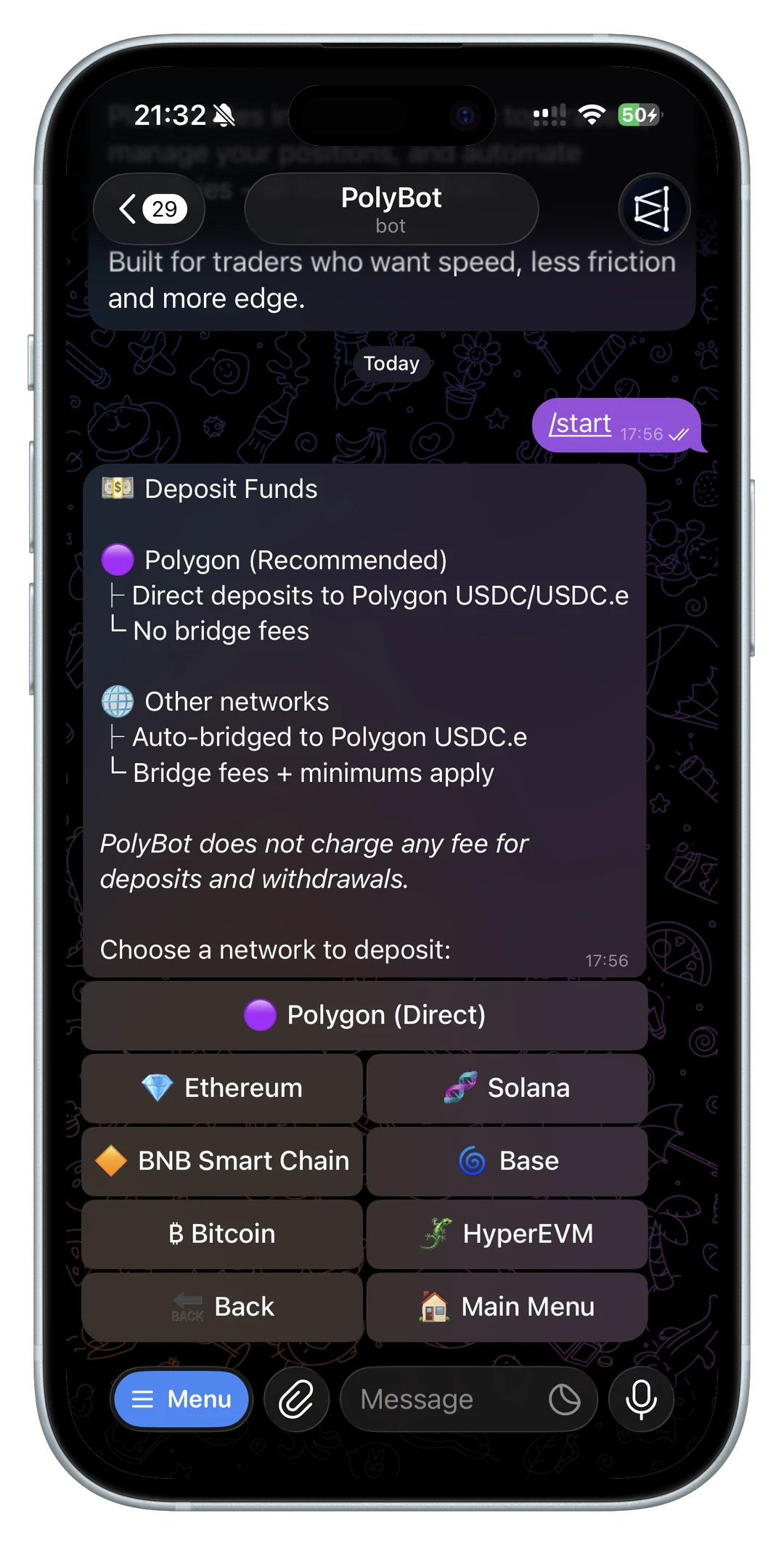
For a Telegram bot, the deposit flow should be especially clear because the interface is compact. Good products make the fund movement easy to verify.
If a balance does not appear after funding, use the Polymarket deposit not showing up troubleshooting guide.
For a dedicated funding walkthrough, read the Polymarket Telegram bot deposit guide before sending funds.
For the exit path, read the Polymarket cash-out guide, Polymarket Telegram bot withdrawal guide, Polymarket withdrawal failed guide, and the Polymarket Telegram bot 2FA security guide.
5. Are copy trading risks explained?
Copy trading is not passive income. It is automated exposure to another wallet's behavior.
Before copying, confirm that the bot supports:
- per-wallet sizing
- slippage limits
- copied trade filters
- daily caps
- per-market caps
- stop or pause controls
- notifications
- visibility into copied fills
Then analyze the wallet itself. The Polymarket wallet analyzer guide explains how to evaluate PnL, win rate, sizing, category edge, and copy risk before turning on automation.
6. Can you stop automation quickly?
Every automated trading workflow needs an exit path.
Look for:
- pause copy trading
- stop individual wallets
- cancel open orders
- update slippage
- lower caps
- withdraw funds
- receive alerts when automation triggers
The easier it is to start automation, the easier it should be to stop it.
7. Are stop-loss and take-profit tools available?
Risk controls do not make prediction market trading safe, but they can make your process more deliberate.
Useful controls include:
- stop-loss rules
- take-profit rules
- trailing stops
- partial exits
- default exit presets
- alerts for large moves
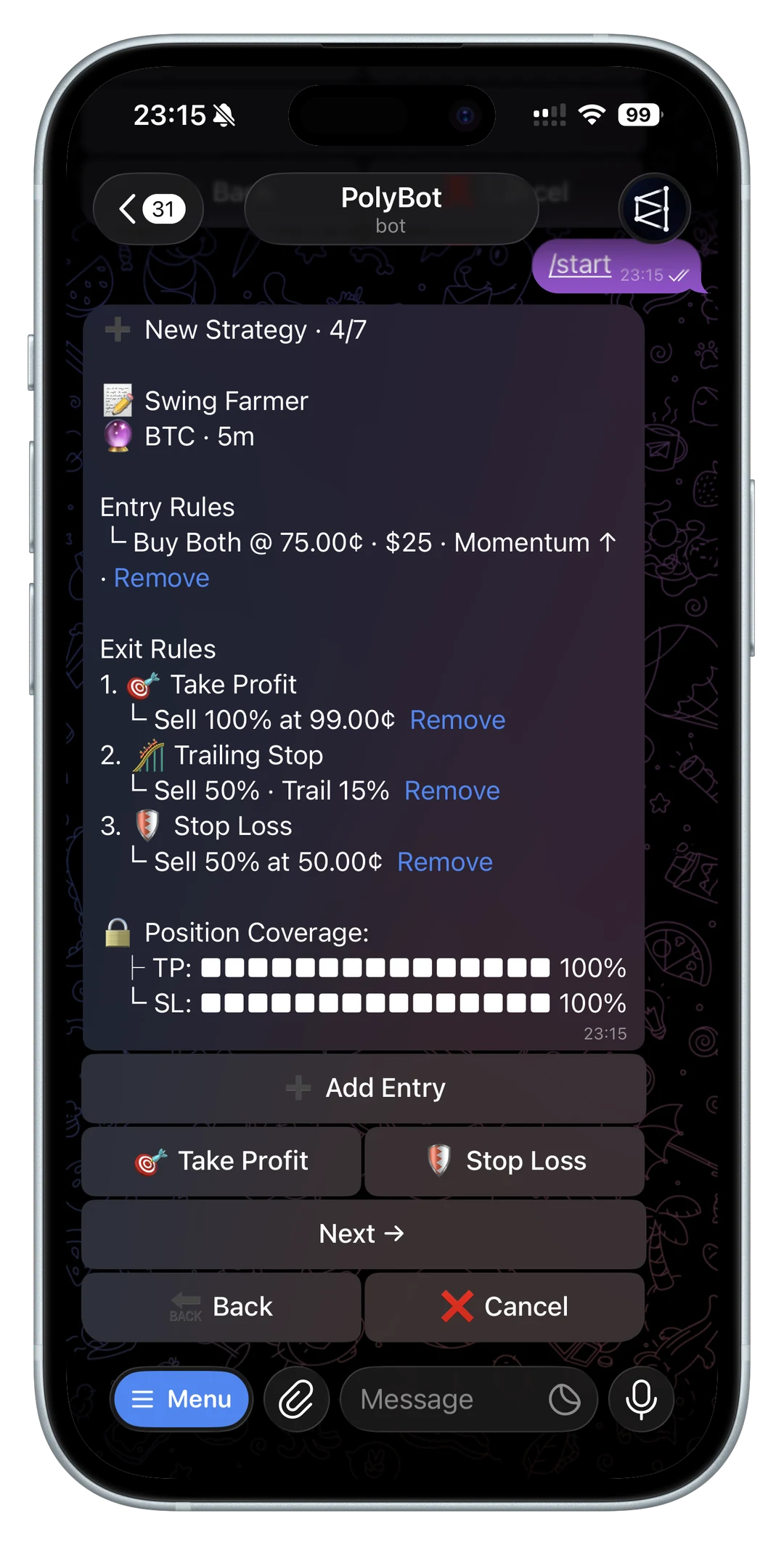
If you are using copy trading or automated strategies, think about exits before entries. PolyBot's strategy workflow supports trigger prices, take-profit rules, stop losses, trailing stops, and entry windows; the crypto up/down strategy guide covers those mechanics. For reusable exit templates, read Polymarket exit presets in Telegram.
8. Is the documentation specific?
Good documentation is a safety feature.
A serious Polymarket Telegram bot should explain:
- how orders are placed
- what order types exist
- how wallets work
- how deposits and withdrawals work
- how manual redeem and auto-claim work
- how copy trading behaves
- how automation behaves
- what fees apply
- what limitations exist
Generic feature lists are not enough. You want mechanics.
The Polymarket Telegram bot settings guide is a useful companion because it ties execution mode, quick buys, slippage, auto-claim, presets, 2FA, and private key export into one review path.
For the redemption workflow specifically, read Polymarket auto-claim and redeem winnings.
9. Is the product honest about limitations?
Be skeptical of claims that imply guaranteed execution, guaranteed profits, or risk-free copy trading.
Useful products explain tradeoffs:
- market orders can fill worse than expected
- stop losses are not guarantees in fast markets
- copied trades can lag the leader
- low liquidity can distort fills
- leader wallets can lose edge
This is especially important in prediction markets because liquidity, timing, and resolution risk vary by market.
10. Does the workflow fit your behavior?
The safest tool is still unsafe if it encourages a process you cannot monitor.
Ask yourself:
- Will I check copied wallets regularly?
- Do I understand the categories being traded?
- Can I afford the position sizes?
- Do I know when to pause?
- Do alerts reach me where I will actually see them?
PolyBot is designed for Telegram-first traders: order flow, wallet analysis, copy trading, strategies, and alerts live close to where many traders already watch markets.
Final checklist
Before using any Polymarket Telegram bot, confirm:
- wallet custody is clear
- fees are transparent
- gas behavior is documented
- deposits and withdrawals are understandable
- copy trading has filters and caps
- automation can be paused
- risk tools exist
- docs explain mechanics
- limitations are stated plainly
Then start small. A faster interface is useful only when the process behind it is disciplined.
Not investment advice, legal advice, or security advice. Verify current fees, custody, and withdrawal rules before funding any trading workflow.
Can U.S. Users Use a Polymarket Telegram Bot? Eligibility, Restrictions, and Safe Checks
A compliance-focused guide for U.S. users and restricted jurisdictions: PolyBot availability, Polymarket geographic restrictions, VPN risks, official docs, and why bypass advice is unsafe.
Safety / 8 min
Polymarket API Keys, Wallet Permissions, and Telegram Bot Safety
How to think about Polymarket API keys, private keys, wallet permissions, Safe wallet export, 2FA, fake Telegram bots, and support scams before funding a trading bot.
Safety / 9 min