Polymarket Telegram Bot Deposit Guide: Fund PolyBot Safely With USDC
How to fund a Polymarket Telegram bot safely: official-link checks, PolyBot wallet deposits, supported networks, pUSD balance, minimums, withdrawals, and troubleshooting.
PolyBot Team
Updated June 1, 2026
Funding is the step where a Polymarket Telegram bot becomes real.
Before that, the workflow is only menus, search, settings, and market review. After funding, mistakes can cost money: a wrong bot link, wrong network, wrong address, misunderstood balance, or rushed withdrawal can turn a simple first trade into a support problem.
This guide explains how to think about deposits in PolyBot, the Telegram trading bot for Polymarket. It covers official-link checks, the /wallet flow, supported networks and assets, the difference between deposit balance and tradable balance, withdrawal basics, and troubleshooting when a deposit is not visible yet. If funds were already sent and the balance is missing, use the Polymarket deposit not showing up guide.
It is not financial, legal, or security advice. Always verify current deposit screens inside the bot and current official docs before sending funds.
If you are funding from a phone, read the Polymarket mobile trading bot guide before trusting copied addresses, forwarded screenshots, or rushed Telegram messages.
If you are testing the full money-in and money-out loop, pair this with the Polymarket cash-out guide before assuming a deposit, sell, redeem, and withdrawal are the same workflow.
Start with official-link verification
Do not start a deposit from a forwarded Telegram message, search-result ad, random support DM, or copied group link.
Use the official route first:
- Website: polybot.trading
- Telegram bot: @TradePolyBot
- Docs: docs.polybot.trading
Then confirm the Telegram username before pressing Start or sending funds.
This step matters because deposit flows are easy to imitate. A fake bot can copy a display name, logo, screenshot, or "support" message. What it should not be able to match cleanly is the full path from official website to official docs to official Telegram handle.
If you have not checked the official link path yet, read official PolyBot links and fake bot safety and the U.S. users and restricted jurisdictions guide before funding anything.
Understand the PolyBot wallet model first
PolyBot's docs describe a self-custodial Polygon Safe wallet flow. In practical terms, you should understand these wallet concepts before depositing:
- your PolyBot wallet is the wallet used for the Telegram trading workflow
- deposits should use the deposit address shown in the PolyBot deposit flow
- the Polymarket profile or trading wallet address shown on a wallet screen may be reference information, not the address to fund
- trading uses the tradable balance shown in the bot
- gas is sponsored for the normal product workflow
- sensitive actions like withdrawals and private key export deserve extra care
The key point is simple: use the deposit address shown for the selected network inside PolyBot. Do not send funds to a random address from a support message, a copied screenshot, or a different wallet field that is not labeled as the deposit address for that network.
For broader custody, gas, fees, and withdrawal checks, read the Polymarket Telegram bot fees and custody checklist.
For the Safe-wallet and self-custody layer behind funding, read the non-custodial Polymarket Telegram bot guide.
For a cost-specific explanation of protocol fees, bot fees, bridge or exchange costs, gas sponsorship, spread, and slippage, read the Polymarket trading costs guide.
How to deposit in PolyBot
The normal funding path starts from the wallet command.
- Open the official bot.
- Run
/walletor open Wallet from the main menu. - Tap Deposit.
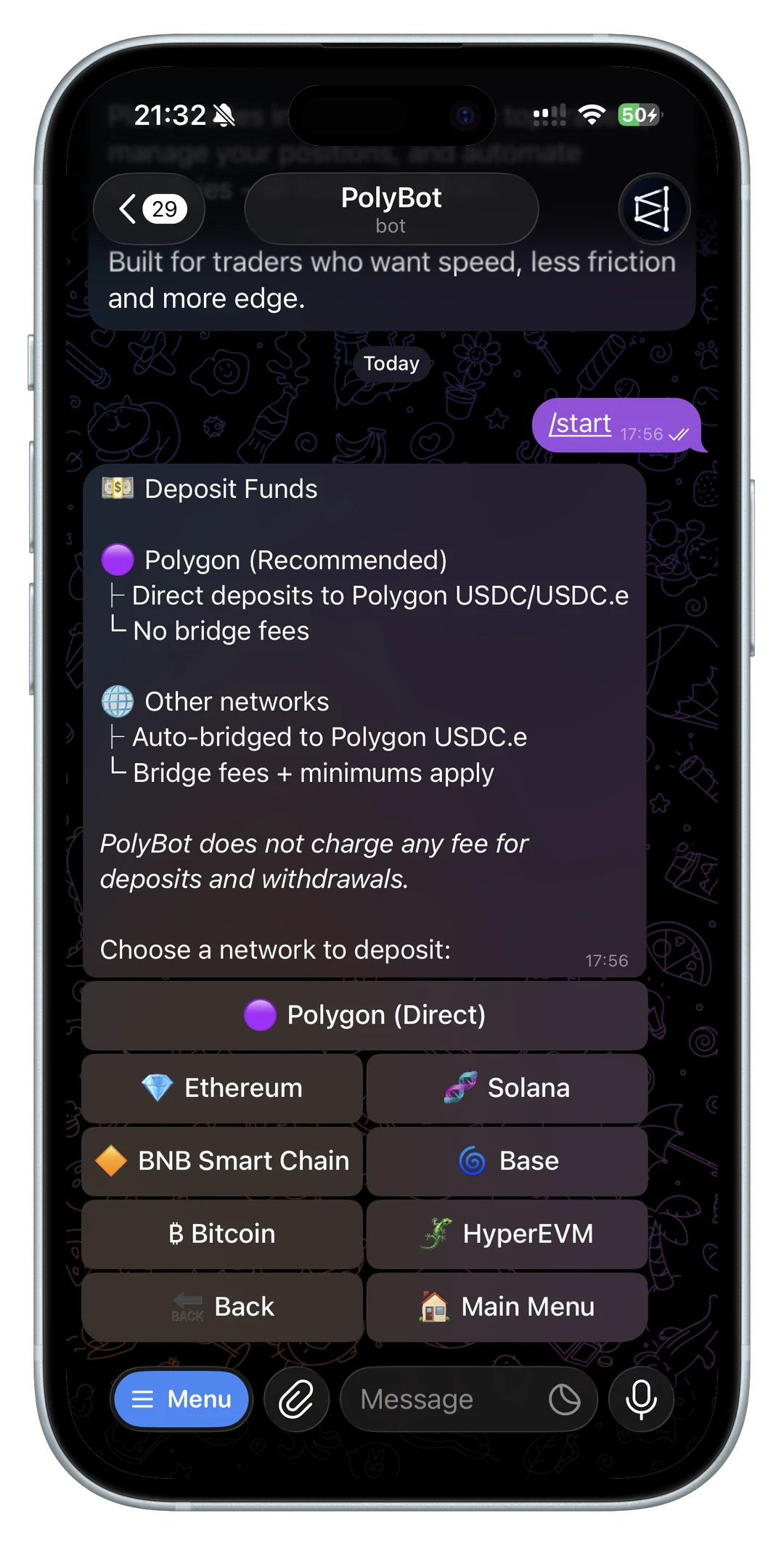
- Choose the network you want to deposit from.
- Copy the address or scan the QR code shown for that network.
- Send a supported asset from your wallet or exchange.
- Return to PolyBot and refresh the wallet after the transaction confirms.
Do not reuse an address from an old screenshot if the bot is showing a fresh deposit screen. Do not switch networks after copying the address unless you go back and copy the correct address for the selected network.
If you are new to command navigation, keep the Polymarket Telegram bot commands guide open while learning /wallet, /portfolio, /orders, /settings, and /recent.
Which network should you use?
PolyBot's wallet docs currently recommend Polygon direct deposits as the fastest and cheapest option. Polygon direct deposits avoid bridge fees and usually confirm faster than cross-chain deposits.
The same docs list these deposit network options:
| Network | Deposit behavior |
|---|---|
| Polygon | Direct deposit, fastest and cheapest in the documented flow |
| Ethereum | Bridges through Polymarket infrastructure |
| Solana | Bridges through Polymarket infrastructure |
| BNB Smart Chain | Bridges through Polymarket infrastructure |
| Base | Bridges through Polymarket infrastructure |
| Bitcoin | Bridges through Polymarket infrastructure |
| HyperEVM | Bridges through Polymarket infrastructure |
The safe habit is to choose the network based on what the current bot screen and docs show, then send only a supported asset for that network.
If you are not sure, Polygon is usually the easiest first deposit path to reason about because it is the direct route in the documented flow.
Supported assets can depend on the network
Do not assume that any stablecoin on any chain is acceptable.
PolyBot's wallet docs list different supported assets by network. Examples include USDC, USDC.e, pUSD, and USDT on Polygon; ETH, USDC, USDT, and WETH on Ethereum; SOL, USDC, and USDT on Solana; and network-specific assets for BNB Smart Chain, Base, Bitcoin, and HyperEVM.
Supported deposited assets may be bridged or swapped into the tradable balance used by PolyBot. That conversion is convenient, but it also means the number you care about after funding is not only "did the transaction leave my wallet?" It is "did the deposit finish processing and appear in the bot's tradable balance?"
Before sending funds, check:
- selected network
- supported asset
- minimum deposit shown in the flow
- exact deposit address
- whether a bridge or swap is expected
- whether processing may take longer than a direct Polygon deposit
If the asset or network is not listed in the current deposit screen, do not send it.
What is pUSD or tradable balance?
Deposit status and trading balance are related, but they are not always the same moment.
PolyBot's docs describe the tradable balance as pUSD funds available for Polymarket trading. Deposited assets can bridge or swap in the background before they become available for orders.
That distinction matters when a deposit appears to be "sent" from your wallet but is not yet ready for trading. The chain transaction may have confirmed while the bridge, swap, or balance refresh is still catching up.
Before placing a trade, verify:
- the deposit transaction succeeded
- the bot wallet balance refreshed
- the tradable balance increased
- no open orders are reserving funds
- copy trading or strategy automation did not use part of the balance
For post-trade balance review, read the Polymarket portfolio and orders guide.
Minimum deposits and timing
Minimums and timing are details to check inside the current deposit flow.
PolyBot's wallet docs recommend at least a small deposit for a smooth experience and say network-specific screens may show asset-level minimums. They also say Polygon direct deposits are typically fastest, while cross-chain deposits can take longer because they rely on bridge processing.
Use this checklist before sending funds:
- Is the amount above the minimum shown for that network and asset?
- Are you sending to the address displayed in the current PolyBot deposit flow?
- Are you using the selected network, not a similarly named one?
- Are you sending a supported asset for that exact network?
- Do you understand whether bridge fees or delays may apply?
- Are you starting with a small test amount before sending more?
Fast funding is useful, but only after the details are correct.
Deposit safety checklist
Before sending funds, pause and run this checklist:
- official domain is
polybot.trading - official bot handle is
@TradePolyBot - deposit starts from
/walletinside the verified bot - no support account has asked for a private key, seed phrase, 2FA code, or manual transfer
- selected network matches the wallet or exchange withdrawal network
- selected asset is supported for that network
- deposit address or QR code comes from the current bot flow
- amount is above the minimum shown in the bot
- first transfer is small enough to test the path
- you know how to refresh and check the tradable balance afterward
This is the highest-leverage safety point in the funding workflow: most deposit problems are not about trading strategy. They are about link verification, network selection, address selection, and balance interpretation.
Deposits versus withdrawals
Depositing funds is not the same as proving the full wallet flow.
Before scaling up, understand withdrawals too:
- withdrawals are started from
/wallet - the destination is a Polygon address in the documented flow
- withdrawal assets can include pUSD, USDC, or USDC.e, depending on the current bot flow
- open limit orders, reserved shares, and pending fees can reduce withdrawable balance
- 2FA can protect withdrawals if enabled
If you plan to keep meaningful funds in any Telegram trading workflow, enable and test the security controls before you need them. The Polymarket Telegram bot 2FA security guide explains why withdrawals and private key export deserve a second factor.
For the withdrawal path itself, read the Polymarket Telegram bot withdrawal guide. If the exit test fails or stays pending, use the Polymarket withdrawal failed guide.
Why a deposit may not show immediately
If a deposit is not visible yet, do not immediately send another one. For the full troubleshooting workflow, use the Polymarket deposit not showing up guide.
Check these causes first:
The transaction is still confirming
A direct Polygon deposit may update quickly, but it still needs confirmations and wallet refresh. Cross-chain deposits can take longer.
The bridge or swap is still processing
Deposits from other networks may bridge or swap before becoming pUSD tradable balance. The source transaction can look complete while the final tradable balance is still pending.
The wrong network was used
Sending the right token on the wrong network can create a recovery problem. Check the sending wallet or exchange history against the network you selected in PolyBot.
The wrong asset was sent
Do not assume every US dollar stablecoin behaves the same. Verify the supported asset list for the selected network.
The wrong address was used
The deposit address shown in the PolyBot deposit flow is the address to use. The wallet screen may show other addresses for reference. Do not fund an address unless the current deposit flow says to use it.
The wallet view needs refresh
After a transaction, refresh the wallet or revisit /wallet. If a bridge or swap just completed, allow a minute and refresh again.
Funds are reserved elsewhere
Open limit orders, copied trades, strategy orders, or pending actions can reduce available balance. Use /portfolio, /orders, and /recent to reconstruct what happened. For cancellation cleanup, read the Polymarket open orders and cancel orders guide.
For error-focused workflow checks, read the Polymarket order failed guide.
A safer first-funding workflow
For a first deposit, use a boring process:
- Open PolyBot from the official website or docs.
- Confirm
@TradePolyBot. - Run
/wallet. - Choose Polygon direct if you want the simplest documented route.
- Copy the deposit address from the current deposit screen.
- Send a small supported amount above the current minimum.
- Wait for confirmation and refresh the wallet.
- Confirm the tradable balance before trading.
- Place only a small manual test trade.
- Review
/portfolio,/orders,/recent, and withdrawal settings.
Only after that should you consider larger deposits, copy trading, automated strategies, stop-loss presets, or faster execution settings.
For the beginner path after funding, read Polymarket Telegram bot for beginners.
Deposit FAQ
What is the easiest way to fund PolyBot?
The documented simplest path is usually Polygon direct through /wallet because PolyBot's docs describe it as the fastest and cheapest deposit route. Still, check the current bot screen before sending funds.
Can I deposit from Ethereum, Solana, Base, Bitcoin, BNB Smart Chain, or HyperEVM?
PolyBot's wallet docs list those networks as supported deposit routes through bridge infrastructure. Network availability, assets, minimums, and timing should be verified in the current deposit flow.
What token do I trade with after depositing?
PolyBot's docs describe trading balance as pUSD funds. Supported deposits may bridge or swap into the tradable balance before they are usable for orders.
Why did my deposit leave my wallet but not appear in trading balance yet?
The transaction may still be confirming, bridge or swap processing may still be underway, or the wallet view may need refresh. Cross-chain deposits can take longer than direct Polygon deposits.
Should I send funds to the Polymarket profile address shown in the wallet screen?
Use the deposit address shown in the PolyBot deposit flow for the selected network. PolyBot's wallet docs specifically warn not to fund the Polymarket profile or trading wallet address shown for reference.
Should I test withdrawals before using larger size?
Yes, especially if you are new. Deposits prove only one direction of the wallet flow. A small withdrawal test helps you understand destination address entry, available balance, 2FA, and timing.
Keep funding boring
Deposits should not be exciting. The best deposit workflow is slow, verified, and repeatable: official link, correct bot handle, correct network, supported asset, current deposit address, small first transfer, refreshed tradable balance, and clear withdrawal path.
Once funding is boring, the rest of the product can do its job: market review, orders, copy trading, alerts, automation, and portfolio management.
Not investment advice. Prediction markets are risky, crypto transfers can be irreversible, and deposit details should always be verified against the current official PolyBot docs and in-bot screens before sending funds.
Polymarket Deposit Not Showing Up? Telegram Bot Funding Troubleshooting Guide
What to check when a Polymarket Telegram bot deposit does not show up: wrong network, bridge delays, unsupported assets, deposit addresses, pUSD tradable balance, and wallet refresh.
Product Guide / 10 min
Polymarket Telegram Bot Withdrawal Guide: Cash Out From PolyBot Safely
How withdrawals work in a Polymarket Telegram bot: pUSD balance, Polygon destination addresses, 2FA, minimums, open orders, failed withdrawals, and safety checks.
Product Guide / 9 min