Polymarket Deposit Not Showing Up? Telegram Bot Funding Troubleshooting Guide
What to check when a Polymarket Telegram bot deposit does not show up: wrong network, bridge delays, unsupported assets, deposit addresses, pUSD tradable balance, and wallet refresh.
PolyBot Team
Updated June 1, 2026
A deposit that does not show up immediately is stressful, but it is not always lost.
In a Polymarket Telegram bot workflow, the source wallet transaction, bridge or swap processing, bot wallet balance, and tradable balance can update at different times. A transaction can look complete in the sending wallet while the final pUSD balance is still waiting on confirmation, conversion, bridge processing, or a wallet refresh.
This guide explains what to check when a Polymarket deposit is not visible yet: official bot verification, network and asset selection, deposit address mistakes, bridge delays, pUSD tradable balance, minimums, recent activity, and when to stop sending more funds.
PolyBot's official Wallet Guide describes /wallet deposits, supported networks and assets, deposit address safety, Polygon direct deposits, cross-chain deposits, pUSD tradable balance, refresh behavior, and withdrawals. PolyBot's What Is PolyBot page also explains that deposits from supported networks convert to pUSD tradable balance for trading.
If you are still preparing the first transfer, read the Polymarket Telegram bot deposit guide. If you already need the full money-out path, read the Polymarket cash-out guide.
Do not send a second deposit first
The first rule is simple: do not immediately send another transfer to "test" the same path.
Pause and gather facts:
- exact sending wallet or exchange
- transaction hash or withdrawal ID
- source network
- token sent
- amount sent
- destination address
- time sent
- network selected in PolyBot
- current
/walletbalance - whether a bridge or swap is expected
Sending again before you understand the first transfer can turn one problem into two. It can also make support and accounting harder because there are now multiple transactions, possible bridge states, and balance updates to reconcile.
Start with official bot verification
Before troubleshooting money movement, verify that you used the real product path.
Use the official route:
- Website: polybot.trading
- Telegram bot: @TradePolyBot
- Docs: docs.polybot.trading
If the deposit started from a forwarded Telegram message, search ad, support DM, random group link, or copied screenshot, slow down. Fake bot and fake support flows often target deposits because the user is already ready to move funds.
For link checks, read official PolyBot links and fake bot safety. For custody and wallet-control context, read the non-custodial Polymarket Telegram bot guide.
Confirm the network selected in the bot
A deposit can fail or delay if the sending network does not match the network selected in the bot.
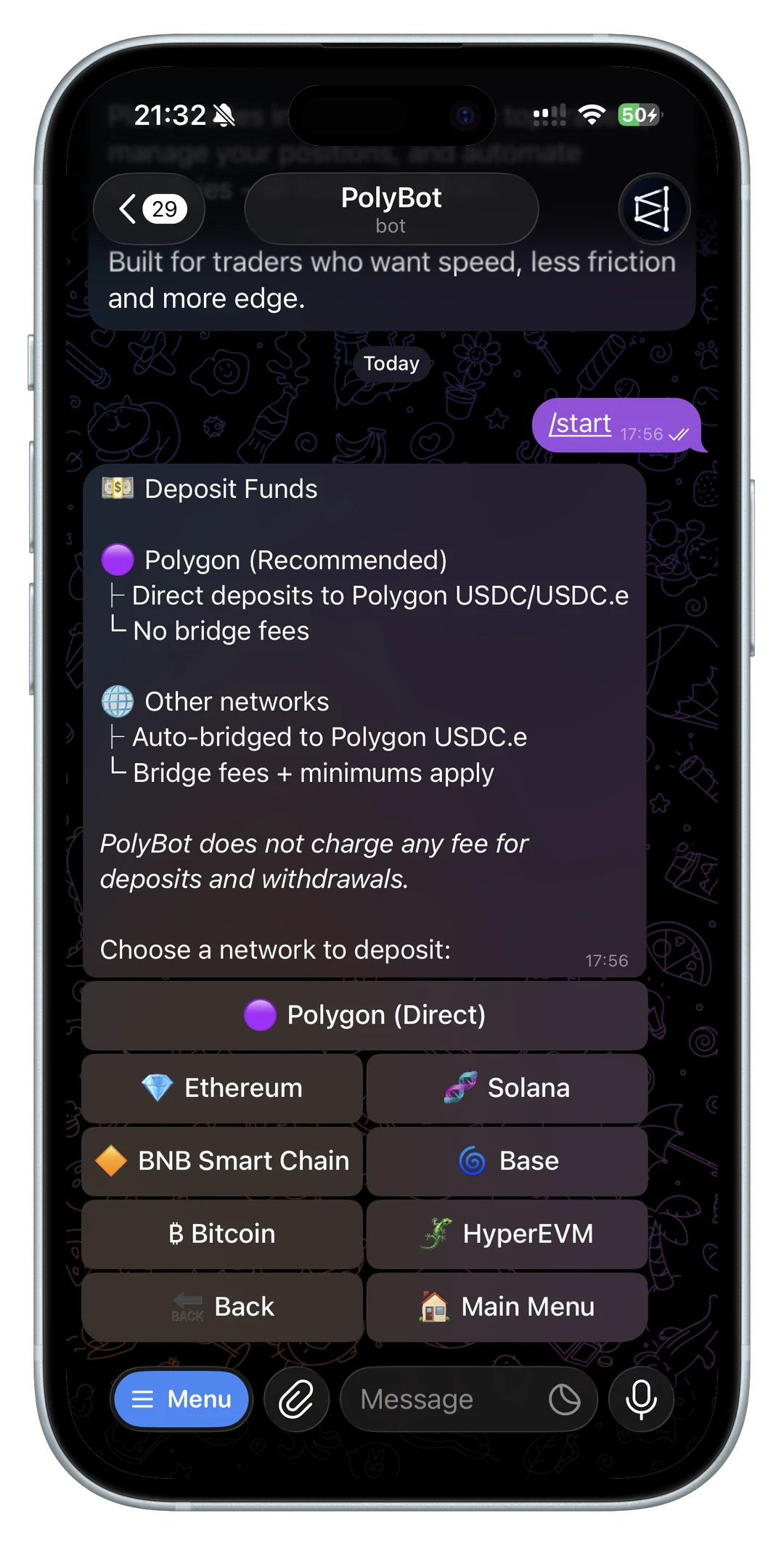
PolyBot's wallet docs list multiple deposit routes:
| Network | Deposit behavior |
|---|---|
| Polygon | Direct deposit, usually fastest and cheapest |
| Ethereum | Bridges through Polymarket infrastructure |
| Solana | Bridges through Polymarket infrastructure |
| BNB Smart Chain | Bridges through Polymarket infrastructure |
| Base | Bridges through Polymarket infrastructure |
| Bitcoin | Bridges through Polymarket infrastructure |
| HyperEVM | Bridges through Polymarket infrastructure |
The address format alone is not enough. Some wallets and exchanges show similar-looking addresses across EVM networks, while the actual network route matters.
Check the sending wallet or exchange history and compare it with the network selected in the PolyBot deposit screen. If they do not match, stop and collect evidence before sending more.
Confirm the asset is supported on that network
Do not assume every token with the same symbol is supported.
PolyBot's wallet docs list supported assets by network. For example, Polygon includes USDC, USDC.e, pUSD, and USDT. Ethereum includes ETH, USDC, USDT, and WETH. Other networks have their own supported assets.
Before treating a deposit as missing, check:
- token symbol
- token contract or exchange withdrawal asset
- selected network
- minimum amount shown in the bot
- whether the asset should bridge or swap into pUSD
- whether the asset is listed in the current deposit flow
If the token is not supported on the selected network, the issue is not a normal refresh delay. Treat it as a possible recovery or support case and avoid further transfers.
Confirm the deposit address came from the deposit flow
PolyBot's wallet docs warn users to fund the deposit address shown in the PolyBot deposit flow, not the Polymarket profile or trading wallet address shown for reference.
That distinction matters.
The safe address checklist is:
- address copied from
/wallet-> Deposit - network selected before copying
- address copied from the current bot screen, not an old screenshot
- no support account supplied the address manually
- QR code or address matches the selected network flow
- destination address in the transaction history matches what the bot showed
If the destination address came from anywhere else, do not assume the bot can detect it automatically.
Understand pUSD tradable balance timing
The number that matters for trading is not always the same as the source-chain transaction status.
PolyBot's wallet docs describe pUSD as the tradable balance used for Polymarket trading. Supported deposited assets can be bridged or swapped to pUSD where needed. The docs also say bridges and swaps can run in the background and that users should refresh after completion.
That creates a normal sequence:
- Source wallet or exchange submits transfer.
- Source network confirms the transaction.
- Bridge or swap processing may run if the deposit is not direct Polygon pUSD.
- PolyBot detects the completed funding path.
- Tradable balance refreshes.
If you are depositing from Polygon direct, the path is usually simpler. If you are depositing from another network, the bridge or swap step can make the source transaction look complete before the bot balance is ready.
Refresh the wallet before assuming failure
After the transaction confirms, refresh the wallet view.
Use:
- Main Menu -> Refresh
/wallet- reopening the Wallet screen
- waiting a minute after a bridge or swap completes, then refreshing again
Avoid reading an old Telegram message as the current balance. Wallet state can change after the message was generated.
For command navigation, read the Polymarket Telegram bot commands guide.
Check minimums, bridge fees, and exchange withdrawals
A small deposit can be confusing if fees or minimums apply.
PolyBot's wallet docs describe a general minimum deposit and network-specific deposit screens that may show asset-level minimums. Cross-chain deposits can also involve bridge fees handled by the bridge infrastructure. Sending from an exchange can add another layer: the exchange may show a withdrawal as complete while the network or bridge path still needs time.
Before escalating, check:
- deposit amount versus minimum shown in PolyBot
- exchange withdrawal fee
- bridge or swap cost
- whether the received amount may be lower than the sent amount
- whether the transfer is below any asset-level minimum
- whether the source platform has a pending or completed status
For the cost side, read the Polymarket trading costs guide.
Check whether funds were already used or reserved
Sometimes the deposit did show up, but the available balance changed quickly.
Possible causes:
- a manual trade was placed
- copy trading used part of the balance
- an auto-trader or strategy order ran
- a limit order reserved funds
- a failed-looking order partially filled
- a withdrawal or wallet action was submitted
Use /portfolio, /orders, and /recent to reconstruct account state before assuming the deposit failed. For reserved balance, read the Polymarket open orders and cancel orders guide. For partial execution, read the Polymarket partial fills guide.
Deposit troubleshooting table
Use this table to classify the problem.
| Symptom | Likely area to check | Better next action |
|---|---|---|
| Transaction still pending in source wallet | source network or exchange | wait for confirmation |
| Transaction confirmed but no bot balance | bridge, swap, or refresh | refresh /wallet, wait, then recheck |
| Wrong network used | network mismatch | stop sending, collect transaction details |
| Unsupported token sent | asset mismatch | collect token and transaction details |
| Sent to profile or trading wallet address | address mismatch | compare destination with deposit-flow address |
| Balance appeared then changed | orders, copy trading, or recent actions | check /portfolio, /orders, /recent |
| Amount lower than expected | fees, bridge, or minimums | compare sent amount with received route |
| Support DM asks for key or code | scam risk | stop and verify official links |
The goal is not to guess. The goal is to identify which layer changed: source transaction, bridge or swap, bot wallet refresh, tradable balance, or later account activity.
What to collect before asking support
If the deposit still does not appear after basic checks, prepare the facts.
Useful details:
- transaction hash
- source wallet or exchange
- source network
- token sent
- amount sent
- destination address
- PolyBot network selected
- time sent
- screenshots of the current
/walletdeposit screen, with sensitive info redacted - current wallet balance screen
- whether you refreshed after confirmation
- whether any trades, copied trades, or open orders happened afterward
Do not send private keys, seed phrases, 2FA codes, backup codes, or full account credentials. A legitimate support process should not need them.
Prevent the next missing-deposit scare
For the next deposit, use a slower process:
- Open PolyBot from the official website or docs.
- Confirm
@TradePolyBot. - Open
/wallet. - Choose Polygon direct if you want the simplest documented route.
- Copy the deposit address from the current deposit screen.
- Send a small amount above the current minimum.
- Save the transaction hash.
- Wait for confirmation.
- Refresh
/wallet. - Confirm pUSD tradable balance before trading.
After the first clean deposit, keep the same discipline for larger deposits. The cost of a slow checklist is lower than the cost of a wrong network or address.
FAQ
Why is my Polymarket deposit not showing up?
The transaction may still be confirming, bridge or swap processing may still be running, the wallet view may need refresh, the wrong network or asset may have been used, or funds may already be reserved by orders or later activity.
How long should a PolyBot deposit take?
PolyBot's docs describe Polygon direct deposits as the fastest route, while cross-chain deposits can take longer because they use bridge infrastructure. Timing depends on the network, asset, bridge, and wallet refresh.
What should I do first if my deposit is missing?
Do not send another deposit. Verify the official bot, collect the transaction hash, confirm the network, asset, amount, and destination address, then refresh /wallet.
Can a deposit be confirmed on-chain but not tradable yet?
Yes. Supported assets may still need bridge or swap processing before they become pUSD tradable balance. The source transaction can confirm before the final trading balance updates.
Should I fund the Polymarket profile address shown in the wallet screen?
Use the deposit address shown in the PolyBot deposit flow for the selected network. PolyBot's wallet docs warn not to fund the Polymarket profile or trading wallet address shown for reference.
What information should I never send to support?
Never send private keys, seed phrases, 2FA codes, backup codes, or full account credentials. For deposit troubleshooting, use transaction details, network, token, amount, destination address, and current wallet status instead.
Not investment advice, financial advice, legal advice, tax advice, or security advice. Crypto transfers can be irreversible, bridge routes can take time, and every deposit should be verified against the current official docs and live bot screen before sending funds.
Polymarket Telegram Bot Deposit Guide: Fund PolyBot Safely With USDC
How to fund a Polymarket Telegram bot safely: official-link checks, PolyBot wallet deposits, supported networks, pUSD balance, minimums, withdrawals, and troubleshooting.
Product Guide / 10 min
Polymarket API Trading Bot Guide: CLOB, API Keys, Orders, and Safer Automation
What to know before building or using a Polymarket API trading bot: CLOB authentication, API keys, signed orders, order types, order-book data, errors, secrets, and safer Telegram automation.
Product Guide / 10 min