Polymarket API Keys, Wallet Permissions, and Telegram Bot Safety
How to think about Polymarket API keys, private keys, wallet permissions, Safe wallet export, 2FA, fake Telegram bots, and support scams before funding a trading bot.

PolyBot Team
Updated June 1, 2026
Polymarket API keys, wallet permissions, and private keys are not interchangeable.
That distinction matters when you use a Telegram trading bot. Telegram can make order flow faster, but it also creates a high-risk environment for fake bots, copied support accounts, rushed funding instructions, and credential scams.
This guide explains the safety model to understand before funding a Polymarket Telegram bot or connecting any wallet workflow: what API keys are for, what a private key controls, why 2FA matters, what a Safe wallet changes, and which requests should immediately stop the process.
For the dedicated custody and Safe-wallet checklist, read the non-custodial Polymarket Telegram bot guide.
If a bot asks you to trust AI-generated trade decisions, pair this with the Polymarket AI trading bot guide so model output does not blur credential, wallet, or order-signing boundaries.
It is not legal, financial, or security advice. It is a practical checklist for avoiding obvious credential and wallet-permission mistakes.
Start with the key distinction
There are three different things users often mix together:
- private key or signer key
- API credentials
- product session or Telegram account access
A private key controls wallet authority. API credentials authenticate requests to a trading API. A Telegram account controls the chat surface where the product runs.
If someone compromises any one of those layers, the risk is different. If someone compromises more than one, the risk increases quickly.
What Polymarket API keys do
Polymarket's CLOB authentication docs describe a two-level model.
L1 authentication uses a wallet private key to prove ownership and sign requests. L2 authentication uses API credentials such as an API key, secret, and passphrase to authenticate CLOB requests like querying balances, checking open orders, cancelling orders, or posting signed orders. For user-level order cleanup, read the Polymarket open orders and cancel orders guide.
The important safety point is that API credentials are not "just a login." They are trading infrastructure credentials. They should not be pasted into a random Telegram bot, copied into a support DM, committed to code, or exposed in client-side scripts.
If you are not building your own bot, you should rarely need to touch raw Polymarket API credentials yourself.
What a private key controls
A private key or signer key is more sensitive than an API key.
Anyone with the private key can act as the wallet owner. That can mean moving funds, signing orders, deriving credentials, or taking control outside the normal product flow.
PolyBot's wallet docs describe a self-custodial Safe wallet model on Polygon, with key export available from settings. That export path is a user-initiated backup action. It is not something support should ask you to paste into chat.
Treat these as immediate red flags:
- "paste your private key to activate the bot"
- "send your seed phrase for recovery"
- "support needs your key to fix a withdrawal"
- "export your key and send it here"
- "add this key to a script and run it"
- "disable 2FA so support can help"
Do not continue that flow.
What PolyBot 2FA protects
PolyBot's 2FA docs describe 2FA as protecting sensitive actions such as withdrawals and private key export.
That is a useful boundary. Trading, browsing, and deposits are not the same as sending funds out of the wallet or exposing the signer key.
Before a wallet holds meaningful value, enable 2FA and store backup codes securely offline. A Telegram account alone should not be the only protection around withdrawal or key-export actions.
For setup details, read the Polymarket Telegram bot 2FA guide.
API keys versus Telegram bots
A managed Telegram bot should not require you to paste raw API secrets into chat.
If you are evaluating a product, ask:
- does the product explain its wallet model?
- does it require private key entry, or does it create a wallet flow?
- does it ask for Polymarket API credentials?
- does it explain what permissions it needs?
- can funds be withdrawn without support?
- does it support 2FA for sensitive actions?
- does it document private key export clearly?
If a bot cannot explain these points in plain language, do not fund it.
For product-selection context, read how to choose a Telegram trading bot for Polymarket.
Wallet permissions to review before funding
Wallet permissions are the practical side of custody.
Before depositing into any bot, understand:
- which wallet receives funds
- what asset becomes tradable balance
- which network is used
- whether gas is sponsored
- how withdrawals work
- whether 2FA protects withdrawals
- whether private key export exists
- whether the bot ever asks for a seed phrase or raw key
- what happens if Telegram access is lost
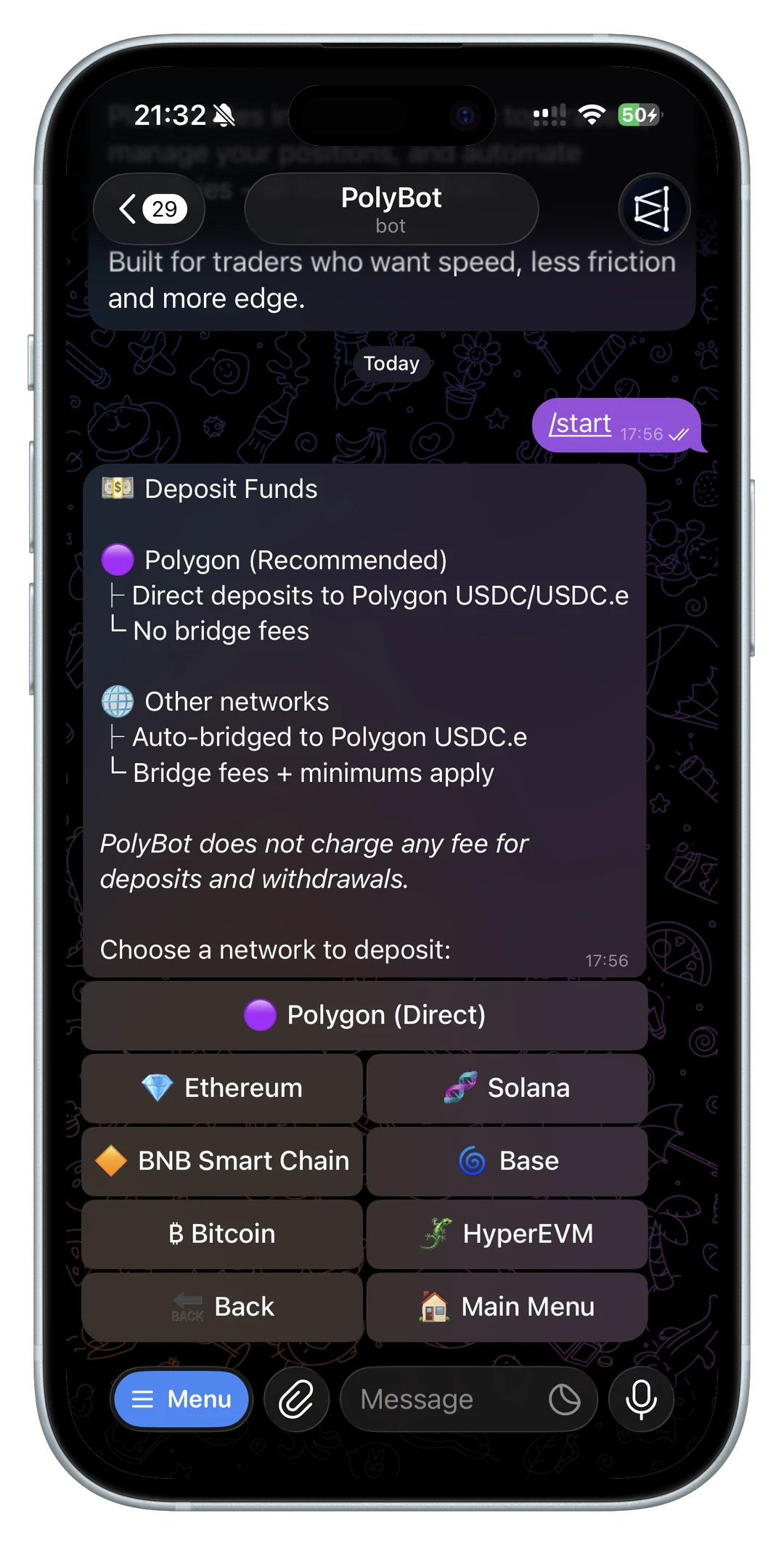
PolyBot's wallet docs currently describe a Safe wallet on Polygon, pUSD tradable balance, deposit addresses by network, withdrawal from /wallet, and private key export from settings.
For the funding side, read the Polymarket Telegram bot deposit guide and Polymarket deposit not showing up guide. For the exit side, read the Polymarket Telegram bot withdrawal guide and Polymarket withdrawal failed guide.
Fake bot and fake support patterns
Telegram impersonation usually relies on urgency.
Common patterns include:
- a copied bot name or avatar
- a support account DMing first
- a "verification wallet" transfer request
- a claim that your funds will be frozen
- a fake recovery bot link
- a request for backup codes or authenticator codes
- a request to export and share a key
- a shortened link to a copied website
The safest response is to stop, open the official website manually, check the exact bot handle, and compare the flow against official docs.
For official link verification, read Is TradePolyBot official?.
Self-hosted bots need stricter credential discipline
If you build your own Polymarket bot, credential risk moves onto you.
Polymarket's API docs say private keys should be kept in secure environments and API secrets should not be exposed in client-side code. That means a self-hosted bot should use proper secret storage, backend-only signing, deployment separation, logging discipline, and least-privilege operational access.
If you are considering programmatic trading, read the Polymarket API trading bot guide before creating credentials or signing orders.
If the programmatic tool promises maker rebates or liquidity rewards, read the Polymarket market making bot guide before sharing credentials.
Do not run a public repo, shared script, or browser extension with wallet keys unless you understand exactly where the key is stored and where it is sent.
For the broader build-versus-managed comparison, read self-hosted Polymarket bot vs Telegram bot.
Security checklist before funding
Before sending funds to any Polymarket Telegram bot, confirm:
- the official domain and Telegram handle
- the product docs explain custody
- the wallet address comes from the documented wallet flow
- no one asked for a seed phrase
- no one asked for a private key in chat
- no one asked for API credentials in chat
- 2FA is available for withdrawals and key export
- backup codes are stored offline
- withdrawal path is documented
- eligibility restrictions are understood
- a small test deposit and withdrawal are possible
If any of those checks fail, stop before funding.
What to do if you shared a credential
If you shared a private key, API secret, seed phrase, Telegram login code, 2FA code, or backup code, treat it as compromised.
Do not debate whether the person seemed trustworthy. Assume the secret can be used.
Practical next steps:
- stop interacting with the suspicious account
- preserve screenshots and links
- check official support paths
- review active Telegram sessions
- review wallet activity and recent trades
- move funds only through a trusted, official, verified flow
- rotate or revoke credentials where possible
- generate fresh credentials for self-hosted tools
- enable or reset 2FA if appropriate
If funds are already at risk, speed matters, but guessing from a fake support DM makes the situation worse.
FAQ
Are Polymarket API keys the same as a private key?
No. API credentials authenticate certain CLOB requests. A private key controls wallet authority and is used for signing. Treat both as sensitive, but do not confuse their roles.
Should I paste API keys into a Telegram bot?
No. A managed Telegram trading workflow should not ask you to paste raw API secrets into chat. If a product asks for credentials, verify exactly why and where they are stored before funding anything.
Does PolyBot require private key entry to trade?
PolyBot's docs describe a self-custodial Safe wallet flow and private key export from settings. Private key export is a backup action, not a support request.
What does 2FA protect in PolyBot?
PolyBot's docs describe 2FA as protecting withdrawals and private key export. Enable it before the wallet holds meaningful value.
Is a private key export ever legitimate?
It can be legitimate when you intentionally export your own signer key for self-custody backup. It is not legitimate for a support account, stranger, group admin, or random bot to ask you to paste that key.
Keep credentials boring
The safest credential workflow is boring: official links, documented wallet flow, no secrets in chat, 2FA enabled, backup codes stored offline, small funding tests, and clear withdrawal path.
For copied wallets, the Polymarket copy trading settings guide covers the controls that limit what automation can do after setup: sizing mode, slippage, daily cap, price range, category filters, and skip reasons.
Fast execution is useful only after custody and credentials are understood. If a bot cannot explain wallet permissions clearly, do not let it near funds.
Not investment advice, legal advice, or security advice. Verify current official docs before funding, exporting keys, generating API credentials, or using any trading automation.
Can U.S. Users Use a Polymarket Telegram Bot? Eligibility, Restrictions, and Safe Checks
A compliance-focused guide for U.S. users and restricted jurisdictions: PolyBot availability, Polymarket geographic restrictions, VPN risks, official docs, and why bypass advice is unsafe.
Safety / 8 min
Non-Custodial Polymarket Telegram Bot Guide: Safe Wallets, Key Export, 2FA, and Withdrawals
How to evaluate a non-custodial Polymarket Telegram bot workflow: Safe wallet control, signer keys, private key export, 2FA, deposits, withdrawals, API permissions, and scam checks.
Safety / 12 min