Polymarket AI Trading Bot Guide: Signals, Wallet Analysis, Automation, and Risk Controls
How to evaluate a Polymarket AI trading bot workflow: market discovery, news summaries, wallet analysis, signals, automated rules, API safety, order-book checks, and risk controls.

PolyBot Team
Updated June 1, 2026
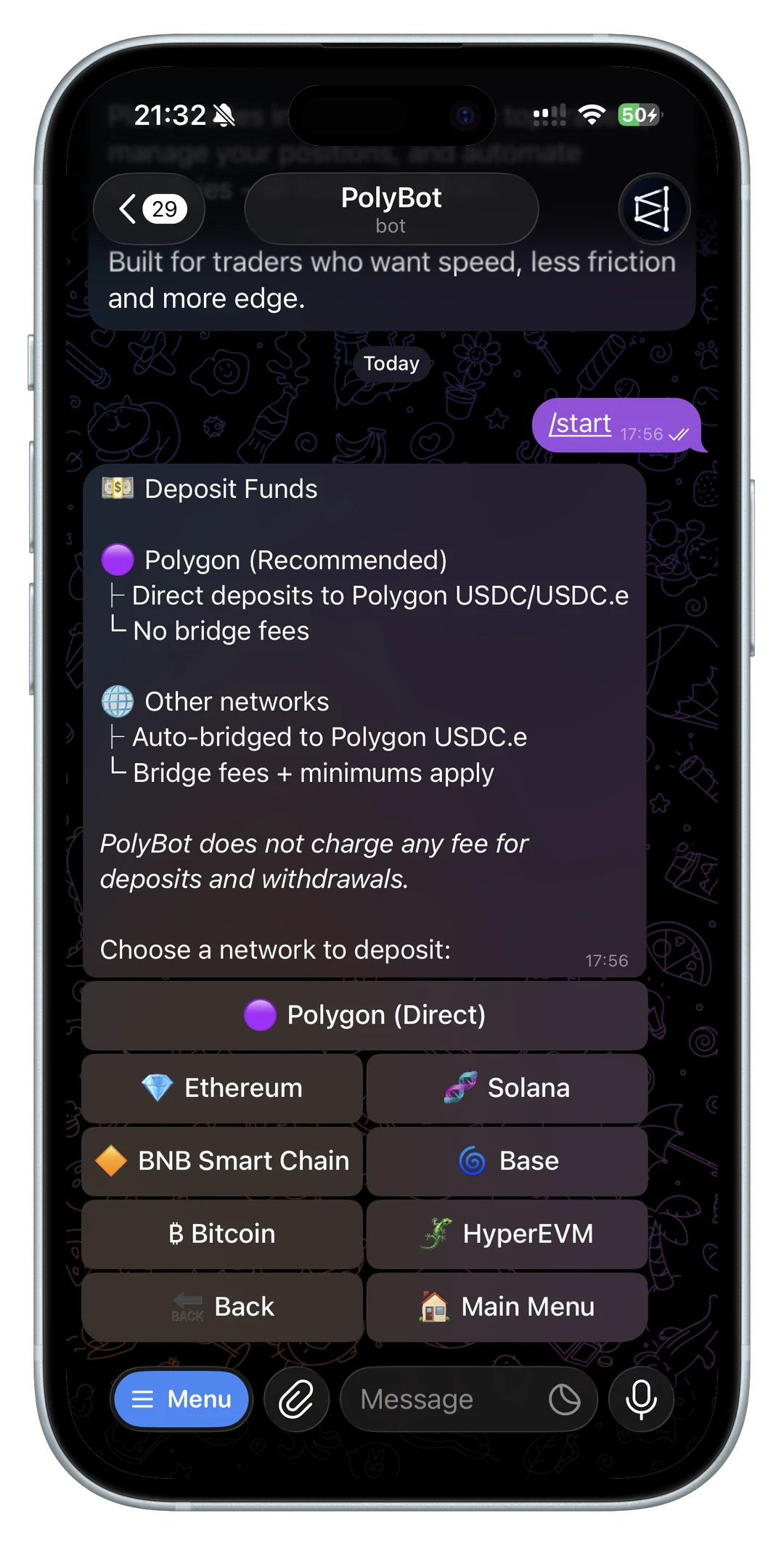
A Polymarket AI trading bot is only useful when it improves the workflow around a trade.
It should not be treated as a magic signal generator.
Prediction markets are hard because the final trade depends on wording, resolution rules, liquidity, spread, timing, wallet behavior, order type, and sizing. AI can help summarize information, classify signals, rank markets for review, explain wallet behavior, or turn a messy alert into a checklist. But the order still needs explicit controls: price, size, slippage, liquidity, exposure, exit plan, and a clear reason to stop.
This guide explains how to evaluate AI-assisted Polymarket trading from Telegram: where AI can help, where it should not be trusted, how to connect AI output to market scanners, wallet analysis, signals, automated rules, API bots, order-book checks, and risk controls.
If you want the broader bot framework first, read the prediction market trading bot guide. If you want rule-based execution, use the Polymarket auto trader bot guide. If you are building direct infrastructure, read the Polymarket API trading bot guide before connecting any model to order placement.
AI is research support, not a trade authority
The first rule is simple: do not let a model place trades from vague language.
Weak AI trading instructions sound like:
- "Buy likely winners."
- "Trade trending markets."
- "Follow smart money."
- "Enter if sentiment is bullish."
- "Use news to predict the outcome."
- "Increase size when confidence is high."
Those instructions are not trading rules. They are prompts.
Strong workflows separate model output from execution rules. AI can say why a market deserves review. It should not decide the final order without checks that a deterministic system can verify.
Before an order, the workflow still needs:
- exact market
- outcome side
- maximum acceptable price
- maximum size
- liquidity and spread check
- slippage limit
- order type
- stop or exit plan
- reason to skip
- reason to pause the strategy
If the AI cannot produce or support those fields, it should stay in the research layer.
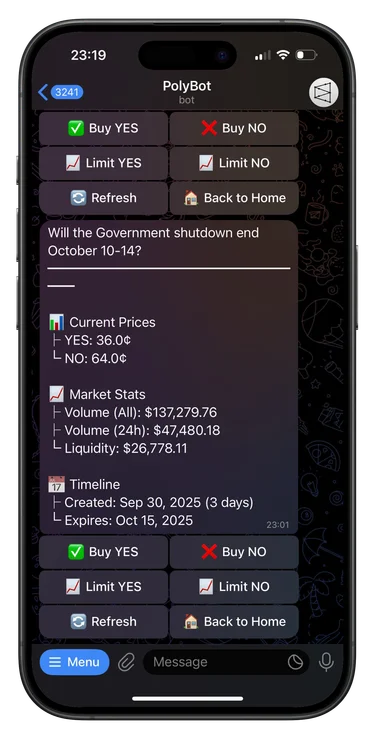
What AI can actually help with
AI can help with parts of the trading process that are text-heavy, noisy, or comparative.
Useful AI roles include:
- summarizing long market descriptions
- extracting deadlines and resolution details
- comparing related markets
- classifying news by relevance
- grouping alerts by topic
- turning wallet activity into a review checklist
- explaining why a copied trade skipped
- drafting risk notes before changing size
- ranking markets for human review
- summarizing post-trade mistakes
Those are valuable because they reduce friction. They do not remove the need for live market checks.
An AI summary can miss a clause. A news classifier can mistake rumor for confirmation. A wallet explanation can overfit a small sample. A "high confidence" output can still point to a market with a wide spread.
The right question is not "Can AI predict Polymarket?" The better question is "Can AI help me review faster without hiding the checks that protect the account?"
Market discovery: AI plus scanner, not AI alone
AI can help prioritize markets from a scanner, but it should not replace scanner evidence.
A market scanner can show:
- active markets
- trending markets
- volume changes
- price changes
- large trades
- category movement
- market age
- liquidity clues
AI can then help group those results into topics or explain why a market might be worth reading. That can save time when many markets are moving.
But scanner output still needs hard checks:
- Is the market open?
- Is the wording clear?
- Is the current price already stale?
- Is the spread acceptable?
- Is there visible depth for the planned size?
- Are related markets pricing the event differently?
- Is the category inside the trader's edge?
Use the Polymarket market scanner bot guide for the discovery layer and the Polymarket order book guide for the execution layer. AI can help sort the queue. It should not hide the bid, ask, spread, or depth.
News analysis: summarize, then verify
AI can be helpful around news-driven markets because news is messy.
It can summarize articles, extract names, compare timelines, identify affected markets, and flag unresolved claims. That is useful when a headline hits and several Polymarket markets might react.
But news trading is exactly where AI can be dangerous.
Before trading from an AI news summary, confirm:
- source quality
- whether the event actually happened
- whether the market resolves on that event
- whether the market source differs from the news source
- whether the deadline matters
- whether the price already moved
- whether liquidity disappeared after the alert
Do not let a model turn a headline into a market order. It may summarize the story correctly and still choose the wrong market.
Use the Polymarket news trading bot guide to separate source verification, market wording, liquidity, and order timing. Use the Polymarket resolution rules guide whenever the market wording is the real edge.
Wallet analysis: AI can explain patterns, not prove edge
AI can help summarize wallet behavior after the data is collected.
For example, it can explain:
- category concentration
- trade frequency
- average position size
- whether large trades behave differently from small trades
- whether wins are recent or old
- whether entries look like news reactions
- whether the wallet tends to exit or hold to resolution
- whether the wallet may require basket-style copying
That explanation can make wallet analysis easier to understand.
It does not prove the wallet has edge.
Raw wallet data still matters: PnL, realized versus unrealized profit, market count, volume, timing, average entry, liquidity, and drawdown. A model can make a weak sample sound coherent. It can also miss that a profitable wallet is impossible to copy because the edge depends on speed, size, or several related positions.
Use the Polymarket wallet analyzer guide, the best Polymarket traders to copy guide, and the copy trading bankroll guide before turning AI wallet summaries into copied exposure.
Signals: AI should rank alerts, not chase them
AI can help triage a noisy signal feed.
It can group price alerts, whale alerts, copied-wallet notifications, news links, and volume changes into a shorter list of markets worth reviewing. It can also explain why a signal is market-related, wallet-related, operational, or just noise.
That can be useful when alerts are frequent.
But the model should not treat every interesting signal as a trade. A signal can be real and still too late. A wallet can trade a market and still be wrong for your size. A price move can happen for a reason that is already fully priced.
For every AI-ranked signal, check:
- what changed
- why it changed
- whether the current price still matters
- whether the spread widened
- whether there is enough depth
- whether the signal fits your strategy
- whether the next action is watchlist, alert, limit order, market order, copy adjustment, or no trade
Use the Polymarket trading signals bot guide and the Polymarket notification bot guide to keep signal triage separate from execution.
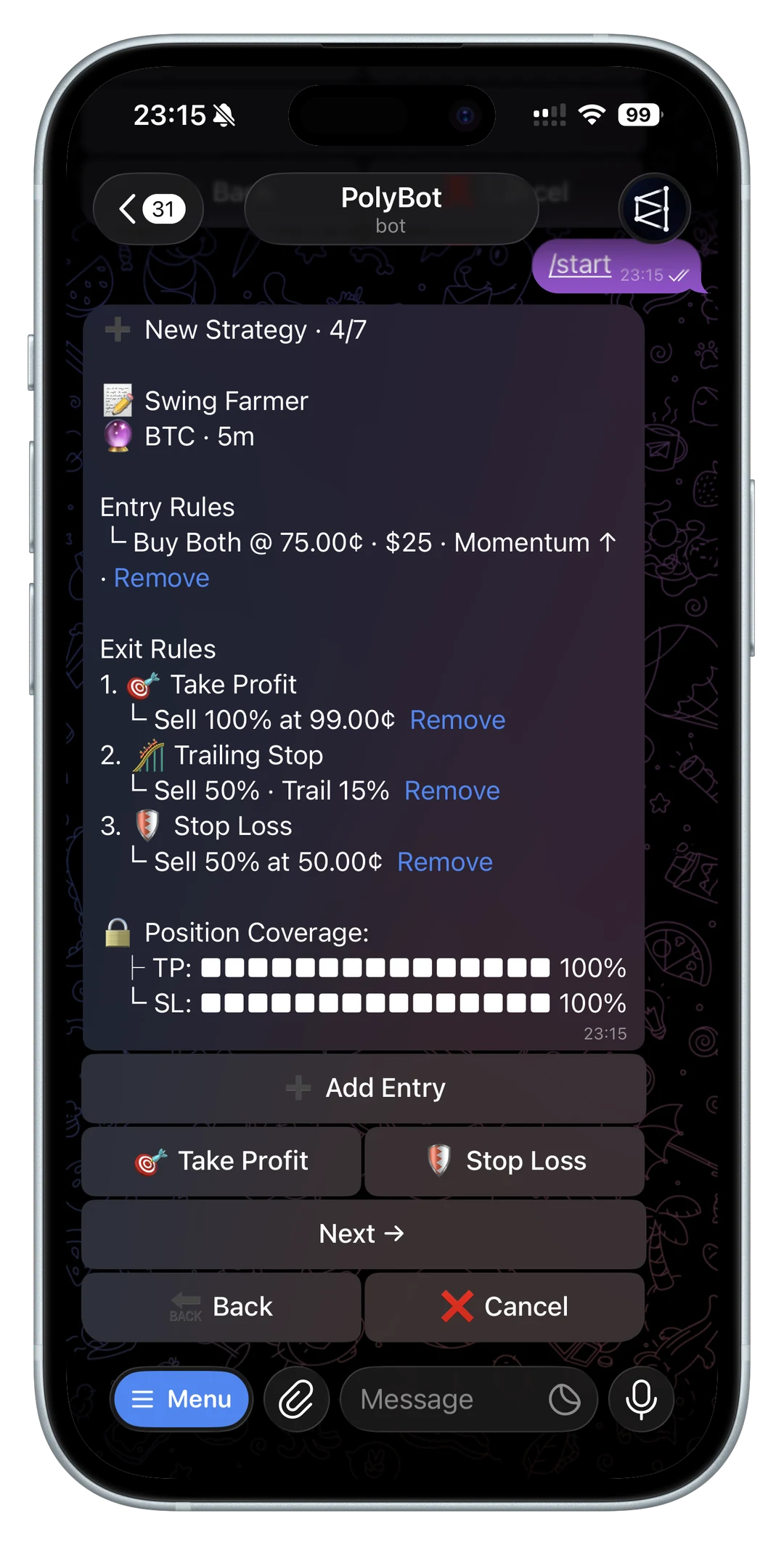
AI plus automation needs strict rules
The safest AI-assisted automation pattern is not "AI decides, bot trades."
It is:
- AI summarizes or classifies information.
- A rule-based workflow checks whether the setup qualifies.
- The bot applies size, price, liquidity, and risk limits.
- The trader can review, pause, or cap the strategy.
That keeps the model out of the final control loop.
For example, AI might classify a market as related to a known category, but the automated rule should still require:
- category allowlist
- market age or expiry range
- maximum spread
- minimum depth
- max price
- max trade size
- max daily exposure
- stop-loss or exit logic
- pause condition after failed orders or abnormal slippage
The Polymarket auto trader bot guide covers the rule-based version of this workflow. AI can help describe the setup. The automation should still be explicit enough to audit.
API and self-hosted AI bots have extra risk
An AI bot connected directly to an API is higher risk than an AI assistant that only summarizes.
Once a system can place or cancel orders, it needs production-grade controls:
- credential storage
- order signing boundaries
- stale-data checks
- nonce and duplicate-order handling
- rate-limit handling
- partial-fill handling
- cancellation logic
- monitoring
- logging
- kill switch
- post-trade reconciliation
AI does not remove any of that. In many cases, it adds another failure mode: the model may produce a plausible but invalid instruction.
Before building or trusting an AI-connected API bot, read the Polymarket API trading bot guide, self-hosted Polymarket bot vs Telegram bot, and Polymarket API keys and wallet permissions.
If the team cannot explain how the model output becomes a bounded order, do not fund it with meaningful size.
Order-book checks should be deterministic
AI should not decide whether liquidity is "good enough" from vibes.
Liquidity checks need numbers.
Before an AI-assisted trade, confirm:
- best bid
- best ask
- spread
- visible depth near the intended price
- expected fill price
- maximum accepted slippage
- whether the order crosses too much spread
- whether the order might partially fill
- whether the market moved since the signal
These checks should be deterministic, logged, and visible to the trader.
This is where many AI bot claims break down. A model may identify a good thesis, but the fill can still be bad. In prediction markets, a few cents of price drift can change the expected value of the trade.
Use Polymarket liquidity, spread, and slippage, Polymarket trading costs, and the Polymarket order failed guide before treating a model-generated idea as executable.
Risk controls matter more with AI
AI can make a workflow feel confident even when the evidence is weak.
That is why AI-assisted trading needs stricter risk controls, not looser ones.
Use:
- fixed max trade size
- max per market
- max per category
- max daily exposure
- max number of open AI-assisted positions
- slippage limits
- price ranges
- stop or exit rules
- pause after repeated failed orders
- pause after abnormal fill drift
- manual review for larger size
The goal is to prevent one convincing explanation from becoming too much exposure.
Read the Polymarket position sizing and risk management guide, Polymarket stop loss and take profit guide, and Polymarket scale-in and scale-out guide before increasing size on AI-assisted strategies.
A practical Telegram AI workflow
A safer Polymarket AI workflow from Telegram can look like this:
- Scanner or alert finds markets and wallet activity.
- AI groups related markets, summarizes news, or explains wallet behavior.
- The trader opens the market card or wallet review.
- The workflow checks wording, source, bid, ask, spread, depth, and expiry.
- The trader chooses watchlist, alert, limit order, market order, copy setup, or no trade.
- Any automation uses explicit rules, not open-ended AI instructions.
- Notifications report fills, skips, failures, and exposure changes.
- Portfolio review checks whether the AI-assisted idea actually worked.
That workflow uses AI where it helps: reducing information load.
It keeps final trading authority in rules and review.
Polymarket AI trading bot checklist
Before trusting a Polymarket AI trading bot, confirm:
- The bot explains whether AI is used for research, signals, or execution.
- Model output is separated from order placement.
- Every order has explicit market, side, price, size, and order type.
- Liquidity, spread, and depth are checked before execution.
- Position size is capped before the model produces a recommendation.
- News summaries link back to source verification and market wording.
- Wallet summaries use real PnL, timing, size, and liquidity evidence.
- Copy-trading actions have slippage, caps, filters, and pause controls.
- API credentials and private keys are protected.
- Failed orders, partial fills, skips, and stale signals are logged.
- The trader can disable the model or pause automation quickly.
- The bot does not claim AI removes market, liquidity, or resolution risk.
If the workflow cannot explain these controls, treat the AI label as marketing, not a safety feature.
Common questions about Polymarket AI trading bots
Can AI predict Polymarket outcomes?
AI can help summarize information and organize evidence, but it cannot guarantee prediction-market outcomes. Markets depend on resolution wording, new information, liquidity, and price. Treat AI as research support, not proof.
Should an AI bot place Polymarket orders automatically?
Only if the final order is constrained by explicit rules for market, side, price, size, slippage, liquidity, exposure, and pause conditions. Open-ended model output should not place live orders by itself.
Is an AI trading bot better than copy trading?
They solve different problems. AI can help analyze information or rank markets. Copy trading follows wallet behavior. Both need risk controls, wallet analysis, slippage limits, and review.
Can AI help analyze Polymarket wallets?
Yes, AI can summarize wallet patterns after the data is collected. It still needs real wallet metrics: PnL quality, trade count, timing, sizing, category edge, drawdown, liquidity, and whether the behavior is copyable.
What is the safest way to use AI with a Telegram trading bot?
Use AI for summaries, triage, explanations, and checklists. Keep order placement rule-based, capped, visible, and easy to pause.
AI should make review faster, not judgment weaker
The best Polymarket AI trading bot workflow does not replace the trader's process.
It compresses research, organizes alerts, explains wallet behavior, and helps route attention. Then explicit trading rules decide whether a trade can happen at the current price, size, liquidity, and risk level.
That separation is the key. AI can help you see more. It should not make you ignore the checks that determine whether the trade is actually worth taking.
Not investment advice, legal advice, tax advice, or security advice. Prediction markets are risky, AI output can be wrong, and automated trading can lose money. Always verify market wording, current liquidity, wallet safety, and official product behavior before funding or trading.
Polymarket Auto Trader Bot Guide: Automated Strategies, Triggers, Exits, Alerts, and Risk Controls
How to evaluate a Polymarket auto trader bot workflow: automated strategies, trigger prices, momentum entries, take profit, stop loss, trailing stops, slippage, alerts, sizing, and pause rules.
Automation / 11 min
Polymarket API Trading Bot Guide: CLOB, API Keys, Orders, and Safer Automation
What to know before building or using a Polymarket API trading bot: CLOB authentication, API keys, signed orders, order types, order-book data, errors, secrets, and safer Telegram automation.
Product Guide / 10 min