Best Polymarket Traders to Copy: How to Find Wallets With Real Edge
How to find and evaluate the best Polymarket traders to copy: leaderboard filters, wallet PnL, win rate, sizing behavior, category edge, liquidity, copyability, and risk controls.

PolyBot Team
Updated June 1, 2026
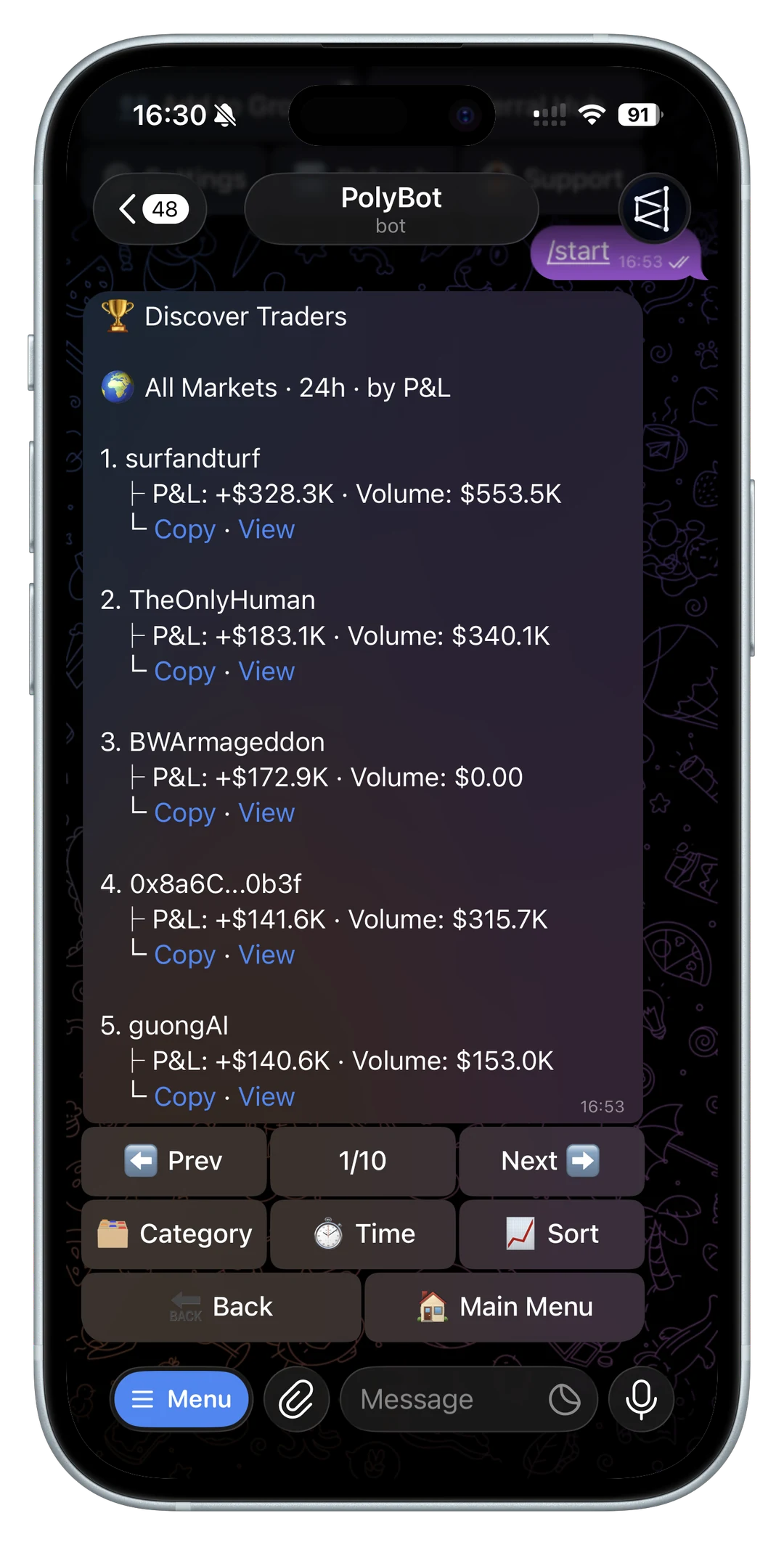
The best Polymarket trader to copy is not always the trader with the biggest visible profit. It is the trader whose edge is still active, understandable, liquid enough to follow, and compatible with your own bankroll.
That distinction matters because copy trading turns another wallet's decisions into your own exposure. A leaderboard can help you find candidates, but it cannot tell you whether a trader's entries are still copyable after slippage, whether the wallet only won once, or whether the sizing would be dangerous for a smaller account.
PolyBot's official Copy Trading Guide describes several ways to find traders: leaderboard discovery, direct wallet address entry, and group trader cards. This guide focuses on the step before you subscribe: how to decide whether a top trader is actually worth copying.
Use the Polymarket wallet analyzer to review a candidate wallet, then use the copy trading settings guide to turn that research into sizing, filters, slippage, and risk limits.
If you only have an address, profile link, or shared trader card, start with the Polymarket wallet lookup guide before deciding whether the wallet belongs on your shortlist.
If a candidate seems to win through related-market spreads, use the Polymarket arbitrage guide to decide whether the strategy can be copied without breaking the basket.
Start with a shortlist, not a hero wallet
Do not look for one perfect trader. Build a shortlist of wallets that deserve deeper review.
A useful shortlist can come from:
- Polymarket leaderboards or trader rankings
- wallets repeatedly appearing in profitable market niches
- large-trade or whale alerts
- traders shared in Telegram groups
- wallets found through profile links or public activity
- historical wallets you already watched during live events
At this stage, you are not deciding who to copy. You are deciding who is worth analyzing.
The first filter should be simple:
- enough recent activity to judge behavior
- more than one winning market
- clear market categories or repeatable themes
- trade sizes that your bankroll can reasonably follow
- entries that appear liquid enough for followers
- no obvious pattern of one lucky outlier carrying the account
If a wallet only looks good because of a single resolved market, put it in the watch list, not the copy list.
Leaderboard rank is a lead, not proof
A Polymarket leaderboard is useful because it surfaces traders with visible results. It is not enough by itself.
For a deeper breakdown of ranking metrics, categories, and time windows, read the Polymarket leaderboard guide.
Leaderboard position can be distorted by:
- one outsized win
- a very large bankroll
- unresolved positions marked at changing prices
- category-specific events that may not repeat
- old performance from a trader who is no longer active
- strategies that worked only because the wallet was early
A top-ranked wallet can still be a weak copy target if the edge is stale, the trades are too large, or the profit came from a market that has already resolved.
Before copying a ranked trader, ask:
- What markets created the PnL?
- Was the result realized or still open?
- Is the wallet still trading?
- Does the trader repeat the same kind of edge?
- Would a follower have been able to enter near the same prices?
- Did the wallet size up intelligently or just get lucky once?
For the performance side of that review, read the Polymarket PnL tracker guide.
If the trader is being promoted with a profit screenshot, read the Polymarket PnL card guide before turning a single green card into a copy-trading decision.
If the trader often uses resting entries or exits, read the Polymarket limit order not filled guide before assuming a follower can match the same limit prices.
Separate PnL from copyability
High PnL means the wallet made money. Copyability asks whether you can follow the wallet in a way that preserves enough of the edge.
Those are different questions.
A trader may be profitable but hard to copy if:
- they trade thin markets where the first order consumes the best price
- they react to breaking news before followers can enter
- they use a much larger bankroll than you
- they build full baskets that require copying every leg
- they scale in and out quickly
- they exit manually before followers understand the reason
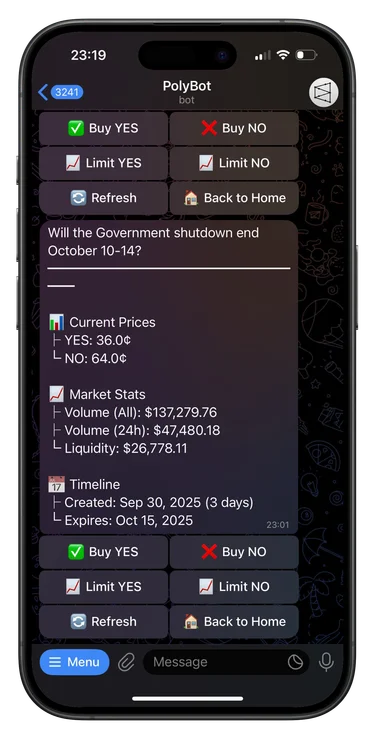
If a wallet buys YES at 38 cents and followers fill at 48 cents, they are no longer holding the same trade. The source wallet might still have a good expected value while the copied entry is weak.
That is why trader selection should always include liquidity, spread, and execution review. The liquidity, spread, and slippage guide explains how price quality changes when an order hits the book.
Look for category edge
Many strong Polymarket traders are not universally strong. They win in a category they understand and perform worse elsewhere.
Examples:
- a politics specialist who reads polling and campaign news well
- a sports trader with deep league knowledge
- a crypto up/down trader focused on short-window price movement
- a weather trader who understands forecast model changes
- a geopolitics trader who reacts quickly to primary-source updates
If the wallet's edge is category-specific, copying every trade can dilute the result. Category filters exist for this reason. They help you copy the part of the wallet that has evidence, not the whole personality of the account.
For politics specialists, read the Polymarket politics and election trading bot guide before copying election or campaign-news wallets.
For crypto specialists, read the Polymarket crypto trading bot guide before copying short-window BTC, ETH, or SOL wallets.
When reviewing a wallet, split performance by category:
- Where did the profits come from?
- Where did the losses come from?
- Does volume match the profitable categories?
- Are recent trades still in the same niche?
- Would you understand the markets well enough to monitor exits?
If the trader is strong in one category and random everywhere else, your copy setup should usually be narrow.
For sports specialists, read the Polymarket sports trading bot guide before copying live-game wallets or league-specific traders.
Study sizing before you copy
Sizing is one of the strongest signals a trader leaves behind.
A useful trader does not only pick winners. They often size better on stronger ideas, reduce exposure on weaker ideas, and avoid letting one bad market ruin the account.
Study whether the wallet:
- uses consistent position sizes
- sizes up only when conviction appears higher
- doubles down after losses
- spreads small bets across many unrelated markets
- places tiny test trades before larger entries
- exits partial positions instead of all-or-nothing
For copying, the question is not "What did they spend?" The question is "What should I spend if I follow this behavior?"
A six-figure wallet may buy $2,000 without taking excessive portfolio risk. That does not make $2,000 a sensible copied size for a smaller trader. Use the position sizing and risk management guide before increasing copy amounts.
Check activity freshness
Old edge can look clean in a chart and still be useless today.
Before copying a wallet, check whether the trader is still active in the same way:
- Did they trade in the last few days or weeks?
- Are they still entering the categories where they won before?
- Has their trade size changed?
- Are they taking more long shots than before?
- Did their recent PnL deteriorate?
- Are they still exiting positions with discipline?
Do not copy a wallet only because it used to be good. Copy trading should follow current behavior, not a screenshot of old performance.
If the wallet has gone quiet, keep it on a watchlist. If it returns with the same pattern, analyze the new activity before turning on automation.
Identify the trader's edge type
The best copy settings depend on why the trader wins.
Expertise edge
The trader understands a subject better than the market. This is common in politics, sports, weather, and niche news categories.
Copying this type usually means:
- use category filters
- avoid unrelated trades
- keep size moderate until the edge repeats
- monitor whether the trader stays in their domain
Strategy edge
The trader follows a repeatable setup. That may involve basket trades, recurring price dislocations, order-book behavior, or structured event coverage.
Copying this type usually means:
- understand whether the full basket must be copied
- keep slippage strict if margins are thin
- make sure your bankroll can cover all required legs
- review skipped trades carefully
Information edge
The trader reacts faster than most of the market.
Copying this type usually means:
- execution speed matters
- slippage needs careful limits
- the wallet may be hard to follow in thin markets
- missed or late entries may be better than bad entries
The smart money copy trading playbook goes deeper on these edge types.
Use wallet analysis before subscription settings
A good copy setup starts with wallet analysis, not with a subscription toggle.
Before subscribing to a trader, review:
- realized and unrealized PnL
- win rate in context
- category concentration
- average entry price
- typical trade size
- largest drawdowns
- active positions
- recent activity
- liquidity around normal entries
- whether sells are important to the strategy
PolyBot's Polymarket wallet analyzer is built for this workflow. Paste a wallet, profile URL, or username, then review the trader's edge profile, category mix, sizing distribution, win rate, PnL behavior, and suggested copy setup.
For a metric-by-metric explanation, read the Polymarket wallet analyzer guide.
Convert the trader review into copy rules
After a wallet passes analysis, decide how narrow the copy setup should be.
Examples:
- Category specialist: copy only the categories where the trader has edge.
- High-conviction trader: ignore tiny leader trades and copy larger entries at smaller proportional size.
- Thin-market trader: use stricter slippage or avoid copying.
- Full-basket strategy: reduce size enough to copy the whole structure.
- Fast-news wallet: keep execution fast, but skip if price drift is too large.
- High-volume trader: set a daily cap before the first copied trade.
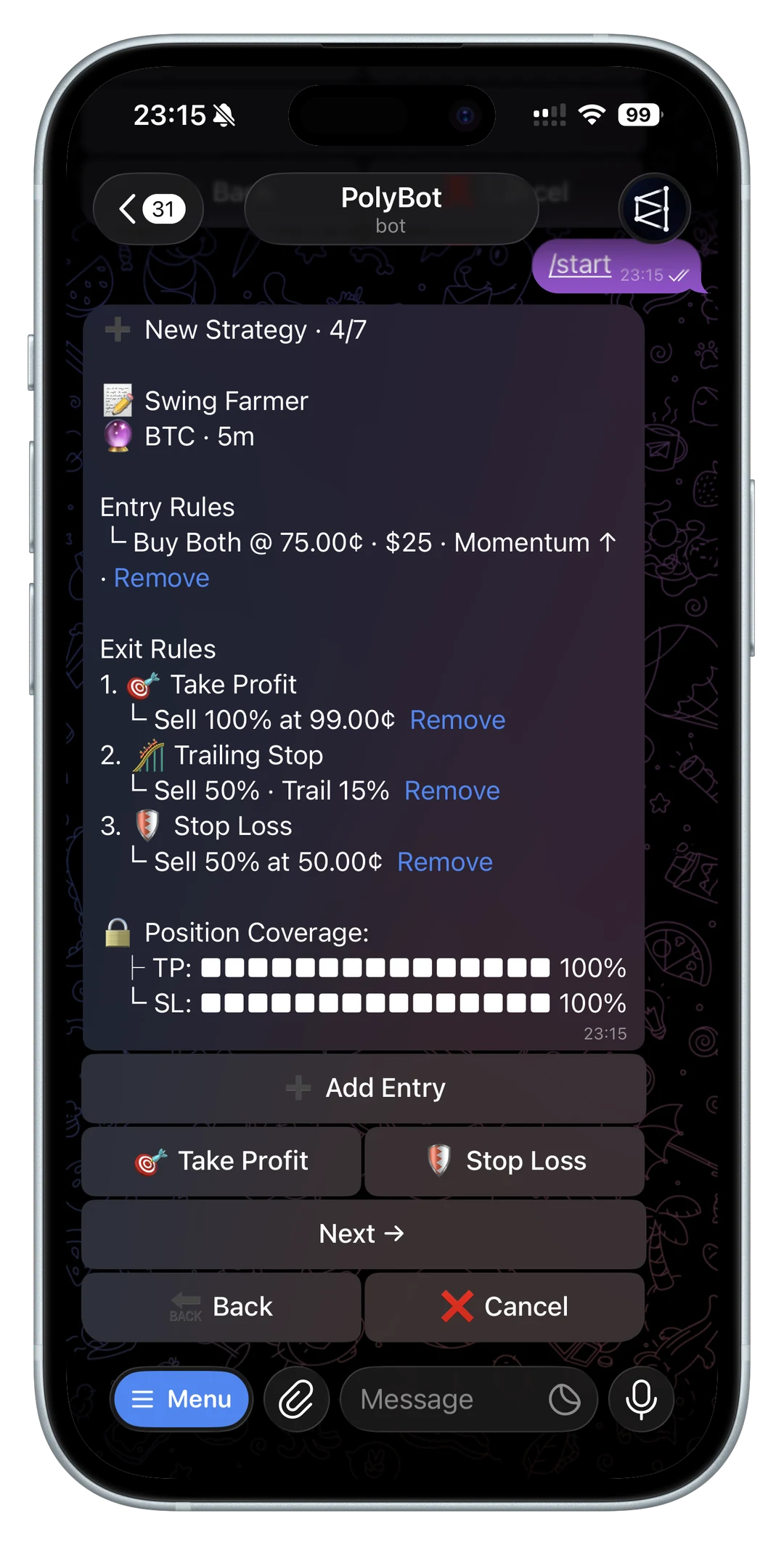
PolyBot's copy trading controls support this kind of translation: fixed or proportional sizing, daily caps, price ranges, slippage tolerance, trade size limits, per-outcome limits, category filters, stop losses, take profits, and trailing stops.
If a trader scales in and out quickly, use the Polymarket scale-in and scale-out guide before assuming every add or partial exit is copyable.
The goal is not to copy every action. The goal is to copy the part of the trader's behavior that has evidence and fits your risk budget.
When not to copy a top trader
Sometimes the best decision is to watch instead of copy.
Avoid copying when:
- the profit comes from one market
- the wallet has no recent activity
- trades are too illiquid for followers
- the strategy requires a bankroll much larger than yours
- you cannot explain why the trader wins
- the trader's recent behavior changed
- the edge depends on being first after breaking news
- you would have to use unlimited slippage to get fills
- you cannot tolerate the drawdown pattern
If you cannot explain the source of the edge, you are not copying a strategy. You are copying an outcome.
A practical workflow for finding traders to copy
Use this sequence:
- Build a shortlist from leaderboards, alerts, groups, and known wallets.
- Remove wallets with stale or one-market performance.
- Analyze each remaining wallet's PnL, category mix, sizing, and liquidity.
- Decide the edge type: expertise, strategy, information, or sizing.
- Estimate whether your bankroll can copy the behavior.
- Choose fixed or proportional sizing.
- Add category, price, size, slippage, and daily-cap filters.
- Start small.
- Review copied fills against the source wallet.
- Pause or reduce size if copied results diverge from the leader.
For the end-to-end setup after this selection step, read how to copy trade on Polymarket from Telegram.
Questions about copying top Polymarket traders
Who is the best Polymarket trader to copy?
There is no universal best trader to copy. The best candidate is a wallet with recent, repeatable, understandable, and copyable edge that fits your bankroll, categories, liquidity tolerance, and risk limits.
Is a top Polymarket leaderboard wallet safe to copy?
Not automatically. A leaderboard wallet can be profitable because of one large win, old performance, or size advantages that followers cannot replicate. Analyze the wallet before subscribing.
Should I copy every trade from a profitable wallet?
Usually no. Many profitable wallets have a specific category, price range, size band, or strategy where they perform best. Filters help isolate the behavior worth copying.
How small should I start when copying a trader?
Start with a size small enough that several losing copied trades would not change your overall bankroll plan. Use daily caps and per-trade limits before raising exposure.
What should I review after copying starts?
Compare copied fills with source-wallet fills, skipped trades, slippage, category results, realized PnL, unrealized exposure, and whether the trader's behavior still matches the original analysis.
If the follower result is mostly skipped trades, read the Polymarket copy trading skipped trades guide before deciding whether the trader is bad or your settings are too strict.
Not investment advice. Public wallet history can be incomplete, stale, noisy, or hard to copy. Prediction-market trading and copy trading can lose money.
Polymarket Copy Trading: How It Works and How to Start From Telegram
Learn how Polymarket copy trading works, how to choose wallets, configure filters, control slippage, size positions, and manage risk from Telegram with PolyBot.
Copy Trading / 13 min
Polymarket Copy Trading Bankroll and Drawdown Guide
How to size a Polymarket copy trading setup around bankroll, drawdown, liquidity, daily caps, per-trade limits, follower gap, and when to scale or pause a copied wallet.
Copy Trading / 12 min