Polymarket Scale-In and Scale-Out Guide: Laddered Entries, Partial Exits, Limit Orders, and Risk
How to scale into and out of Polymarket positions from Telegram: laddered entries, partial exits, limit orders, alerts, liquidity checks, stop losses, take profits, and risk controls.

PolyBot Team
Updated June 1, 2026
Scaling into and out of Polymarket positions is useful only when it reduces risk and improves decision quality.
The weak version of scaling is simple averaging down: buy more because the price moved against you and hope the market comes back. The stronger version is a planned workflow: define maximum exposure, split entries by price or confirmation, use limit orders when price matters, take partial exits when the trade moves in your favor, and keep every step visible in portfolio and orders.
Prediction markets make scaling more complicated than normal chart-only trading. Market wording, resolution rules, expiry, liquidity, bid-ask spread, and available depth all matter. A second buy can improve an average entry price, but it can also double exposure in a thin market. A partial exit can reduce risk, but it can also leave too much capital in a market with poor liquidity.
This guide explains how to scale into and out of Polymarket positions from Telegram: laddered entries, partial exits, limit orders, alerts, copy-trading constraints, automated strategy entries, stop-loss and take-profit rules, and the risk checks that should happen before adding or reducing size.
If you want the broader sizing framework first, read the Polymarket position sizing and risk management guide. If you already know the entry price levels, pair this with the Polymarket limit orders guide and the Polymarket liquidity, spread, and slippage guide.
If a laddered entry or partial exit fills smaller than planned, use the Polymarket partial fills guide to decide whether the remaining size should rest, cancel, or be resized. For stale ladder cleanup, read the Polymarket open orders and cancel orders guide.
Scaling is a plan, not a reaction
Scaling should answer a simple question:
How much exposure do I want if the full plan plays out?
That number should be defined before the first order.
A planned scale-in might look like:
- buy a small starter position after initial review
- add only if the price reaches a better level
- add only if the market wording and source still support the thesis
- stop adding after a fixed maximum exposure
- use a limit order instead of chasing
A planned scale-out might look like:
- sell part of the position at the first target
- sell another part if liquidity remains strong
- leave a smaller runner if the thesis can continue
- protect the remainder with a stop loss or trailing stop
- cancel stale exits when the market changes
That is different from reacting to every price move.
Why scaling is risky in prediction markets
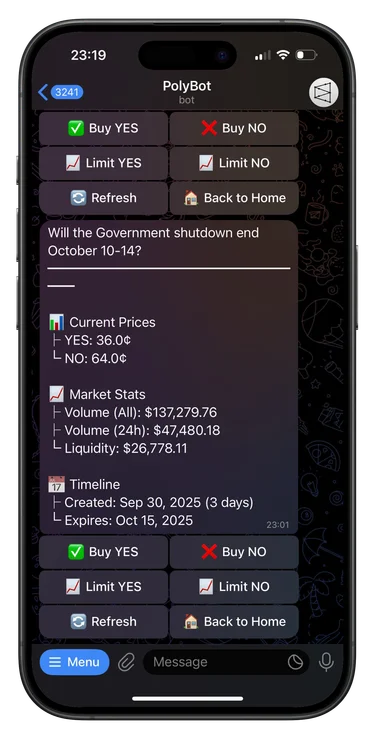
Prediction markets have constraints that make scaling easy to misuse.
Before adding size, check:
- exact market wording
- outcome side
- resolution source
- time remaining
- current bid and ask
- spread
- depth at the next price level
- existing open orders
- existing copied or automated exposure
- maximum loss if all entries fill
The key mistake is thinking only about average entry price.
Example: a trader buys YES at 55 cents, then buys more at 48 cents. The average looks better. But if the market is thin, the second buy may consume poor liquidity, increase drawdown, and make the exit harder. A better average price is not useful if the total position is now too large to sell cleanly.
For the order-book side of that problem, read the Polymarket order book guide.
Start with maximum exposure
The safest scaling workflow starts with the maximum position, not the first order.
Before placing the starter entry, decide:
- maximum dollars for the market
- maximum shares for the outcome
- maximum category exposure
- maximum daily loss
- how many entries are allowed
- whether copy trading or strategies may add more
- when the plan is invalidated
Then split the total size into pieces.
For example:
- 25% starter after market review
- 25% if price reaches a better level
- 25% after source confirmation
- 25% only if liquidity remains deep enough
The exact percentages matter less than the constraint. The full plan should fit your bankroll if every entry fills.
For broader bankroll rules, read the Polymarket copy trading bankroll and drawdown guide.
Laddered entries should use price and evidence
A laddered entry means the trader plans several possible buys instead of one full-size entry.
Good ladder rules can be based on:
- a target price
- a tighter spread
- a liquidity threshold
- source confirmation
- a market moving back to a planned level
- a time window
- related markets confirming the thesis
Weak ladder rules sound like:
- buy more every time it drops
- double size after a loss
- keep averaging down until it turns
- add because the first trade is red
- add because a group chat is confident
If the next entry does not have a reason beyond "the position is losing," skip it.
For alerts around planned price levels, use the Polymarket Telegram alerts and watchlists guide. For news-driven levels, use the Polymarket news trading bot guide.
Limit orders are the cleanest ladder tool
A limit order lets the trader define the price before the market reaches it.
That matters for scaling because each ladder level should have a price rule.
Use limit orders when:
- you want to add only at a specific price
- the spread is currently too wide
- the market is active but not tradeable now
- you would rather miss than overpay
- your size would move the book
- you want the order visible in the orders workflow
Avoid using a market order just because a planned ladder level is near. If the price moved quickly, the executable ask may be worse than the alert or midpoint suggests.
For order mechanics, read Polymarket order types: FOK, FAK, GTC, and GTD.
Partial exits reduce position risk
Scaling out means selling a position in pieces instead of all at once.
Partial exits can help when:
- the position moved in your favor
- the order book is thin for a full exit
- you want to recover part of the stake
- the thesis is still valid but less attractive
- the market is close to resolution
- you are copying a volatile wallet
- you want to leave a smaller position for upside
The tradeoff is that partial exits can become too complicated. If you cannot explain what each remaining share is doing, the plan may need simplification.
For the sell workflow, read how to sell a Polymarket position from Telegram. For portfolio review, use the Polymarket portfolio and orders guide.
Take profit and trailing stops can scale out automatically
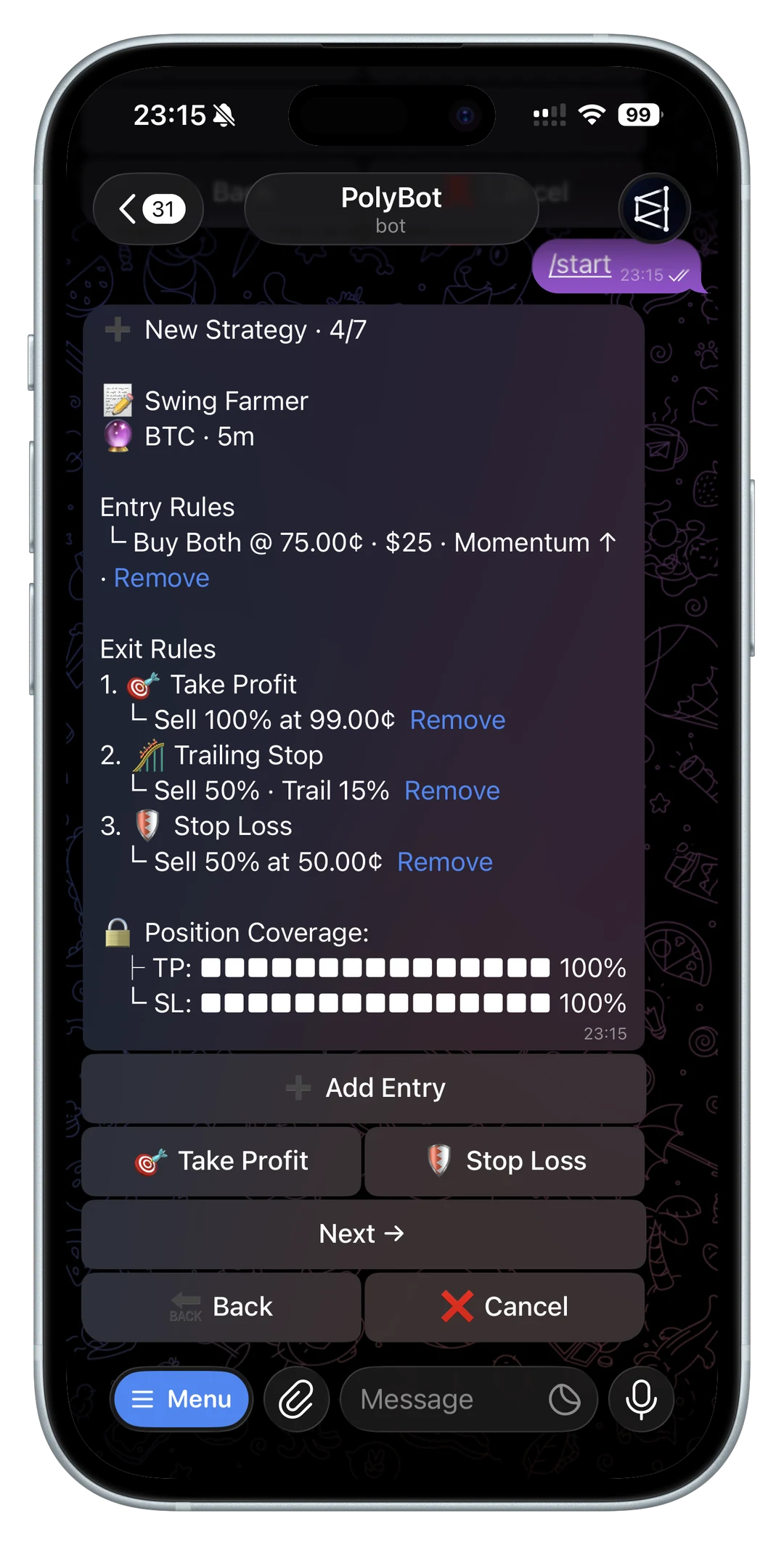
Take-profit rules and trailing stops can help turn a scale-out plan into reusable logic.
Common scale-out patterns include:
- sell 50% at the first profit target
- sell another 25% at a second target
- protect the rest with a trailing stop
- close the full position if a downside stop triggers
This can be useful when a position moves while you are away from Telegram. It can also create stale rules if the market context changes.
Before using exit rules, check:
- which outcome side the rule applies to
- how much of the position it controls
- whether it overlaps an existing limit sell
- whether liquidity can support the exit
- whether the rule still matches the thesis
For exit-rule mechanics, read the Polymarket stop-loss and take-profit guide.
Scaling and copy trading need extra limits
Copy trading can scale a position without the trader manually clicking.
That can happen when:
- a copied wallet adds to the same outcome
- several copied wallets trade the same market
- a copied wallet exits partially
- the trader also adds manually
- an alert or strategy adds exposure on top of copied exposure
Before copying a wallet that scales in and out, check:
- whether entries happen at copyable prices
- whether the wallet averages down aggressively
- whether exits are partial or all at once
- whether the wallet trades related markets together
- whether your daily caps stop overexposure
- whether per-outcome limits are active
For copy controls, use Polymarket copy trading settings. For selecting wallets, read the best Polymarket traders to copy guide.
Strategy entries can scale too
Automated strategies can create ladder-like behavior if multiple entry rules are active.
That can be useful when the strategy is narrow and well-defined. It is risky when several rules can fire in the same market without a total cap.
Before using automated scale-ins, define:
- maximum entries per market
- maximum total exposure
- cooldown after a closed trade
- minimum price movement before re-entry
- entry window
- exit plan
- slippage tolerance
- pause rule after repeated skips or losses
For automated rules, read the Polymarket Auto Trader bot guide and trading strategies for crypto up/down markets.
Scaling after volume or news alerts
Volume alerts, trending markets, and breaking news can tempt traders to add too quickly.
Before adding after an alert, ask:
- Did the market already move?
- Did the spread widen?
- Is the source verified?
- Is this still the right market?
- Did liquidity improve or disappear?
- Does the added size fit the original maximum exposure?
- Would a limit order be safer than immediate execution?
The alert can justify review. It does not automatically justify more size.
For alert-driven workflows, use the Polymarket volume alerts bot guide and the Polymarket trading signals bot guide.
Scaling checklist
Before scaling into or out of a Polymarket position, answer:
- What is the full maximum exposure?
- How many entries are allowed?
- What price or evidence justifies the next entry?
- Is the current bid and ask still acceptable?
- Can the order book support the next size?
- Does the market wording still match the thesis?
- Are copy trading or strategies already adding exposure?
- Which orders or exit rules are active?
- What partial exit plan applies if the trade moves in your favor?
- What stop or invalidation plan applies if it moves against you?
If those answers are not clear, use a watchlist or alert instead of another order.
Common mistakes
Avoid these patterns:
- averaging down without a maximum size
- adding because the first trade is red
- using the same ladder on every market
- ignoring open orders before adding
- forgetting copied exposure
- using market orders in wide spreads
- scaling into markets close to ambiguous resolution
- leaving old exit rules active after the thesis changes
- treating a lower average price as proof of better risk
Scaling should make the position easier to manage, not harder to understand.
FAQ
What does it mean to scale into a Polymarket position?
Scaling in means building a position in pieces instead of buying the full amount at once. A good scale-in plan defines maximum exposure, entry levels, liquidity checks, and invalidation rules before the first order.
Is averaging down on Polymarket safe?
No strategy is automatically safe. Averaging down can improve the average entry price, but it also increases exposure and can make exits harder in thin markets. Use a maximum size and order-book checks before adding.
How do I scale out of a Polymarket position?
Scaling out means selling part of a position while leaving some exposure open. Traders can use market sells, limit sells, take-profit rules, or trailing stops, depending on liquidity and the plan.
Are ladder orders better than market orders?
Laddered limit orders can be better when price discipline matters. Market orders can fit when speed matters and the book is deep, but they can be expensive in wide or moving spreads.
Bottom line
Scaling is useful when it makes risk explicit.
The right workflow is not "buy more because price dropped." It is maximum exposure first, planned entries second, order-book checks third, and clear partial exits after that.
For the broader risk stack, read the Polymarket position sizing guide, limit orders guide, stop-loss and take-profit guide, and portfolio and orders guide.
Polymarket Stop Loss and Take Profit in Telegram: Exit Rules, Presets, and Trailing Stops
How Polymarket stop-loss, take-profit, trailing-stop, and exit preset workflows should work in a Telegram bot: triggers, partial exits, liquidity risk, copy trading, and stale-order review.
Risk Management / 10 min
Polymarket Copy Trading: How It Works and How to Start From Telegram
Learn how Polymarket copy trading works, how to choose wallets, configure filters, control slippage, size positions, and manage risk from Telegram with PolyBot.
Copy Trading / 13 min