Polymarket Volume Alerts Bot Guide: Trending Markets, Price Moves, Liquidity, and Risk
How to use Polymarket volume alerts and trending-market signals from Telegram: market discovery, price-change alerts, liquidity checks, watchlists, limit orders, and risk controls.

PolyBot Team
Updated June 1, 2026
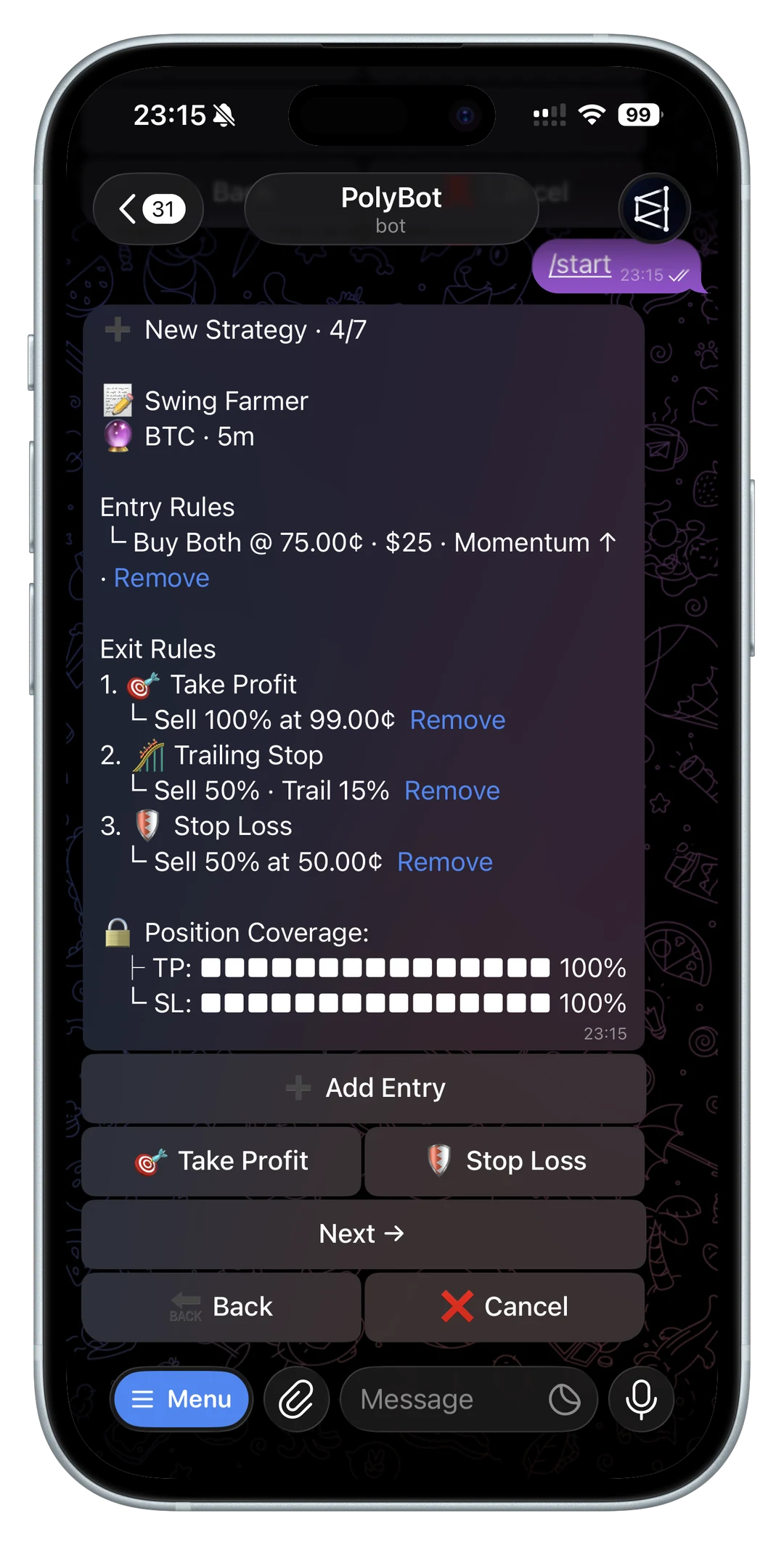
A Polymarket volume alerts bot is useful when it helps you notice where attention is moving without making every busy market look like a trade.
Volume, trending lists, price-change alerts, and market-mover notifications are discovery tools. They can tell you that a market is active, a topic is heating up, a new story is moving prices, or a large group of traders is paying attention. They cannot tell you whether the current price is still good, whether the book has enough depth, or whether the market wording matches the reason for the move.
This guide explains how to use Polymarket volume alerts and trending-market signals from Telegram: what volume can and cannot show, how trending markets differ from high-volume markets, when price-change alerts are useful, how to check liquidity after a move, and when to use a watchlist, limit order, market order, or no trade.
If volume alerts are one part of a wider Telegram update system, use the Polymarket notification bot guide to keep market notifications separate from wallet, copy-trading, order, and portfolio notifications.
If the volume move should become a target-price review instead of an immediate entry, use the Polymarket price alerts bot guide to set thresholds and avoid chasing.
If you want the broader discovery stack first, read the Polymarket market scanner bot guide. If the move starts from news, pair this with the Polymarket news trading bot guide. If the alert is only one signal among many, use the Polymarket trading signals bot guide.
Volume is attention, not edge
Volume tells you that trading happened. It does not tell you who has the better side now.
A high-volume market can be useful because it may have:
- more recent price discovery
- tighter spreads
- more visible liquidity
- more traders updating the book
- more public discussion
- easier exits than a dead market
But volume can also mean the easy move already happened.
A crowded market can be overreacting to the same headline. A big move can attract traders who are late. A market can have strong historical volume while the current best bid and ask are thin. A large trade can make volume look healthy while removing the best liquidity from the side you wanted.
Use volume as a filter for attention. Do not use it as proof of value.
For the execution layer behind that difference, read Polymarket liquidity, spread, and slippage and the Polymarket order book guide.
Trending markets are different from high-volume markets
High volume tells you a market has traded a lot.
Trending tells you activity is increasing.
Those are not the same signal.
A high-volume market may be stable, mature, and liquid. A trending market may be newer, more volatile, or reacting to a fresh event. Trending is often more useful for discovery because it shows where attention is shifting. It is also more dangerous because fast attention can move before you finish review.
Before acting on a trending market, ask:
- Why is it trending?
- Did the price already move?
- Is the trend driven by real news or social momentum?
- Did liquidity improve with the attention?
- Did the spread widen?
- Is there enough depth for my size?
- Is this the market that best expresses the event?
- Would an alert or limit order be better than buying now?
If the answer is unclear, slow down. The trend may be a research prompt, not an entry.
What a volume alert should include
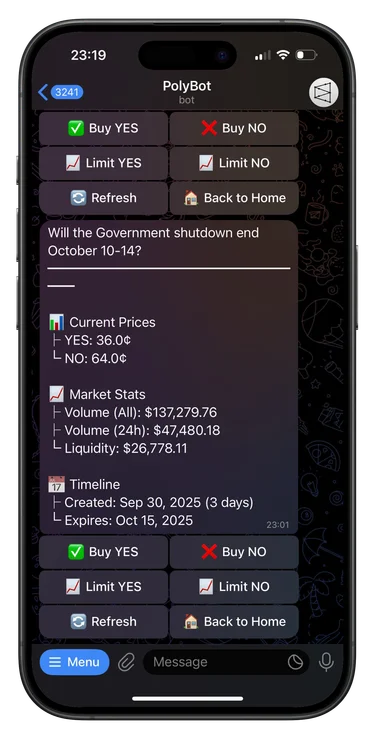
A useful volume or market-mover alert should give enough context for review.
At minimum, it should help you inspect:
- market title
- outcome side
- current YES and NO prices
- volume or activity change
- price change
- bid and ask
- spread
- visible depth
- expiry
- link to open the market card
The alert should not only say "market is hot." A hot market with a wide spread can be a bad trade. A hot market with unclear wording can be the wrong contract. A hot market after a large move can be too late.
For watchlists and alert discipline, read the Polymarket Telegram alerts and watchlists guide.
Price-change alerts are attention signals
A price-change alert says a market moved enough to deserve attention.
That can be useful around:
- breaking news
- live sports
- election updates
- crypto up/down markets
- court rulings
- group-driven market links
- whale trades
- low-liquidity markets that suddenly wake up
But price-change alerts are noisy if the threshold is too sensitive.
Before trading after a price-change alert, check:
- what caused the move
- whether the cause is verified
- whether the move continued after the alert
- whether the current price still has edge
- whether the spread widened
- whether the order book can support your size
- whether the market rules match the apparent reason
If price-change alerts keep firing without action, raise thresholds, narrow categories, or move those markets to a watchlist.
Volume alerts versus whale alerts
Volume alerts and whale alerts answer different questions.
A volume alert says a market is active.
A whale alert says a large wallet or large trade appeared.
The overlap matters, but the review is different. A volume spike can come from many smaller traders. A whale alert can come from one wallet that moved the book. In both cases, the next step is not automatic execution.
After a whale-driven move, ask:
- Did the whale trade before the price moved?
- Did the trade consume the best liquidity?
- Is the wallet usually strong in this category?
- Is the wallet hedged in another market?
- Is your entry still close enough to the original trade?
- Would copying this behavior survive slippage?
For that path, use the Polymarket whale alerts and wallet tracker guide and the Polymarket wallet analyzer.
Search before trading a trending topic
Sometimes the alert points to a topic, not a clean trade.
For example:
- a team injury report
- a candidate poll
- a crypto liquidation move
- a court ruling
- a celebrity or company announcement
- a live game update
Before acting, search for related markets and compare wording. The most active market may not be the cleanest expression of the idea. Another market may have better liquidity, clearer rules, or a more direct relationship to the event.
Use search when:
- you only have a topic
- several related markets exist
- the first market has a wide spread
- you need to compare expiry dates
- you are not sure which outcome the news affects
For this workflow, read the Polymarket market search in Telegram guide.
Check the book after the alert
The order book decides whether a volume alert is tradeable.
After a market starts moving, liquidity can change in several ways:
- makers add depth because the market is active
- makers pull orders because the event is uncertain
- the best ask moves away from the displayed price
- the best bid disappears after sellers hit it
- the spread widens while traders wait for confirmation
- large traders consume the first levels of the book
That means a visible market price can become stale quickly.
Before placing an order, check:
- best bid
- best ask
- spread
- depth at your intended size
- whether the midpoint is misleading
- whether a market order would cross too much spread
- whether a limit order can express your target price
If the book does not support the trade, the correct action may be a watchlist entry or a limit order.
If the next action is to add only part of the planned size, use the Polymarket scale-in and scale-out guide before turning a volume alert into a larger position.
Use watchlists for markets that are active but not ready
Many volume alerts should become watchlist entries.
Use a watchlist when:
- the market is interesting but the price is wrong
- liquidity is too thin now
- the spread is too wide
- the market needs source confirmation
- you want to compare related markets later
- you own a position and want to monitor exits
- you want a price target instead of an immediate order
A watchlist turns attention into structure. It lets the trader revisit the market when price, liquidity, or information improves.
For alert setup, use Polymarket Telegram alerts and watchlists.
Limit orders protect against chasing
If a market moves because of volume or attention, a limit order is often safer than a market order.
Use a limit order when:
- the current ask is too high
- the best bid moved away
- the spread widened after the alert
- you only want the trade at a specific level
- your order size would move the book
- you would rather miss than overpay
A market order can fit when speed matters, the book is deep, the spread is acceptable, and the trade has already been reviewed. But a market order after a noisy alert is how traders pay for urgency.
For price-control details, read Polymarket limit orders from Telegram.
Category filters reduce noise
Volume alerts are easier to use when they stay inside categories you understand.
Sports, politics, crypto, finance, culture, and event markets behave differently. A trader who understands crypto up/down windows may not understand election certification rules. A trader who follows sports injury news may not understand related-market pricing.
Use category filters when:
- too many alerts are firing
- most alerts are outside your edge
- one category has better liquidity for your size
- you only want live sports
- you only want crypto up/down markets
- you only want politics or election markets
Then use category-specific checks:
- Polymarket sports trading bot guide
- Polymarket politics and election trading bot guide
- Polymarket crypto trading bot guide
When fast execution makes sense
Fast Telegram execution can be useful after a volume or trending alert when the plan already exists.
Speed fits when:
- the market is already known
- the acceptable price is already defined
- the source of the move is clear
- the order book supports the size
- the spread is acceptable
- the trader knows whether to use market or limit
- the exit or review plan is already set
Speed does not fit when the alert is the first time you have seen the market.
If volume alerts feed fast entries, use the Polymarket sniper bot guide so speed remains a controlled last step, not the whole strategy.
Mobile volume alerts need extra discipline
Volume and price-change alerts often reach traders on a phone.
That is useful because the market card, watchlist, order controls, and portfolio can be close to the notification. It is risky because mobile trading can compress review into one rushed tap.
On mobile, slow down for:
- exact market wording
- outcome side
- bid and ask
- spread
- depth
- order size
- whether the alert is stale
- whether a limit order is safer
For phone-first workflows, read the Polymarket mobile trading bot guide.
Risk controls for volume-driven trading
Volume-driven trading needs strict defaults because attention can create urgency.
Useful controls include:
- maximum order size
- maximum position size
- category caps
- daily loss limit
- slippage tolerance
- minimum liquidity threshold
- minimum spread requirement
- no-trade rule after unverified news
- limit-order preference for wide spreads
- post-trade review of fills
If an alert makes you want to increase size because "everyone is trading it," reduce size instead.
For sizing and drawdown rules, read the Polymarket position sizing and risk management guide.
A practical volume-alert workflow
A disciplined workflow looks like this:
- Volume, trending, or price-change alert fires.
- Open the market card.
- Identify what changed.
- Check market wording and expiry.
- Check bid, ask, spread, and depth.
- Compare the current price with the reason for the move.
- Search related markets if the topic is broad.
- Choose watchlist, price alert, limit order, market order, or no trade.
- Review the fill or open order afterward.
This keeps volume alerts in the right place: discovery first, execution second.
Volume alerts checklist
Before trading from a Polymarket volume alert, answer:
- Why did this market become active?
- Is this high volume, trending activity, or a price-change alert?
- Did the price already move?
- Is the market wording clear?
- Is the source of the move verified?
- What are the current bid and ask?
- How wide is the spread?
- How much depth exists for my size?
- Would a limit order be safer?
- Should this be a watchlist item instead?
- What is my maximum loss if I am wrong?
If the alert only creates urgency, skip it.
FAQ
What is a Polymarket volume alerts bot?
A Polymarket volume alerts bot is a Telegram workflow that helps traders notice active or fast-moving markets, then review market wording, price, liquidity, and order controls before trading. It is a discovery tool, not an automatic trade instruction.
Are trending Polymarket markets good trades?
Not automatically. Trending markets can reveal attention, but they can also mean the price already moved, the spread widened, or traders are chasing the same side. Check the order book before acting.
What is the difference between volume alerts and price-change alerts?
Volume alerts focus on trading activity. Price-change alerts focus on movement in the market price. Both can be useful, but both need liquidity, source, wording, and risk checks before execution.
Should I use market orders after a volume alert?
Only when the spread is acceptable, depth supports your size, and speed matters more than exact price. In many volume-driven moves, a limit order or watchlist entry is safer than chasing.
Bottom line
Polymarket volume alerts are useful when they help you find active markets and then slow down in the right places.
The right workflow is not "market is trending, buy now." It is alert to review, review to order-book check, order-book check to watchlist, limit order, market order, or no trade.
For the broader discovery and execution map, read the Polymarket market scanner bot guide, Polymarket trading signals bot guide, and prediction market trading bot guide.
Polymarket Market Scanner Bot Guide: Find Markets, Alerts, Liquidity, Wallet Signals, and Risk
How to evaluate a Polymarket market scanner bot workflow: search, trending markets, volume, price alerts, whale alerts, wallet signals, liquidity, order books, and risk controls.
Telegram Trading / 12 min
Polymarket Market Search in Telegram: Find Markets, Check Liquidity, and Trade Safely
How to use Polymarket market search inside Telegram: /search, /polybot group search, volume, trending, category, live, up/down markets, liquidity checks, paste-to-trade, and safe order review.
Telegram Trading / 11 min