How to Sell a Polymarket Position: Market Sells, Limit Sells, Stop Losses, and Redeems
A practical guide to closing Polymarket positions from Telegram: market sells, limit sells, partial exits, stop losses, take profits, open orders, liquidity, PnL, redeeming winners, and withdrawals.

PolyBot Team
Updated June 1, 2026
Selling a Polymarket position is not the same as withdrawing money.
A sell closes or reduces exposure while the market is still tradeable. A redeem converts winning resolved shares back into tradable balance after the market resolves. A withdrawal sends available funds out of the wallet. Traders often mix these steps together, which creates confusion about PnL, balance, and whether a position is actually closed.
PolyBot's official Trading Guide documents selling at market from /portfolio, limit sells from portfolio, and order management. The official Portfolio & Orders Guide explains market sells, limit sells, stop losses, redeeming winners, PnL cards, and open orders. If you plan to share the position result after selling, use the Polymarket PnL card guide. Polymarket's order documentation adds the underlying order-type context: market-style execution consumes available liquidity immediately, while GTC limit orders can rest on the book until filled or cancelled.
This guide explains how to think about selling a Polymarket position before you tap the button.
If you are deciding what needs an exit from a broader account view, start with the Polymarket portfolio tracker bot guide to connect positions, PnL, open orders, alerts, and redeems.
If the exit needs immediate execution, use the Polymarket market orders from Telegram guide before choosing a market sell over a limit sell.
Start with the exit question
Before selling, ask what problem the exit is meant to solve.
Common exit questions:
- Do I need to close now at the best available price?
- Do I want to sell only if the market reaches my target?
- Do I want to reduce risk but keep some upside?
- Do I need downside protection while offline?
- Did the market already resolve, meaning I should redeem instead of sell?
- Is my balance unavailable because shares are open, orders are reserved, or winnings are pending?
Different answers lead to different tools. A market sell, limit sell, stop loss, take-profit rule, redeem action, and withdrawal are not interchangeable.
If the position is hard to exit because it was too large for the market, use the Polymarket position sizing guide before repeating that setup.
Market sell is the fastest exit
A market sell is the direct way to reduce or close an active position.
In PolyBot, the documented flow is:
- Open
/portfolioor Portfolio from the main menu. - Select the position.
- Choose Sell.
- Pick 25%, 50%, 75%, 100%, or enter custom shares.
- Confirm the sell.
The goal is speed. You are trying to sell into available bids now.
That speed has a cost: the final price depends on current liquidity. If the order book is thin, a market sell may fill worse than the last displayed price. If you are selling a larger position, the first shares may fill near the visible bid while later shares fill lower.
Use market sell when:
- you need to reduce risk quickly
- the market is liquid enough for your size
- waiting for a target price is less important than exiting
- a copied position no longer fits your plan
- you want a partial exit without leaving a resting order
Do not treat market sell as guaranteed price control. It is an execution tool, not a price promise.
Check liquidity before selling
The sell price depends on bids.
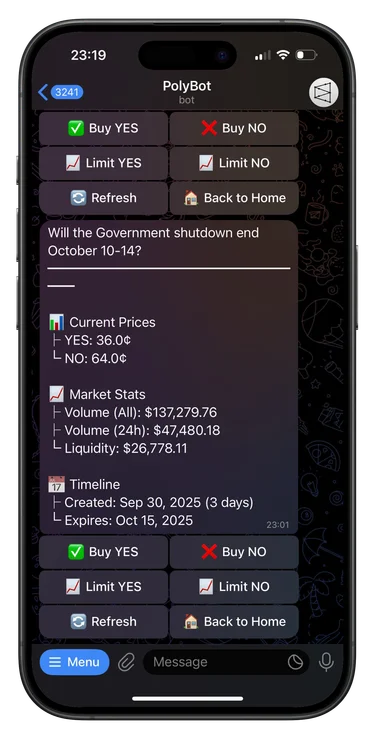
If YES is shown around 60 cents but there are only a few shares bid near 59 or 60 cents, a larger sell can move down the book. A market sell consumes the available bids until your sell size is filled or the order type stops.
Before selling, check:
- current bid and ask
- spread width
- depth near the current bid
- your position size
- whether your sell would move the visible market
- whether a partial sell would be cleaner
- whether a limit sell would protect price better
For a deeper explanation, use the Polymarket liquidity, spread, and slippage guide.
For the bid-side mechanics that decide what a market sell can actually receive, read the Polymarket order book guide.
Partial sells reduce all-or-nothing decisions
You do not always need to sell the whole position.
Partial sells can help you:
- lock in some profit
- reduce an oversized position
- free some balance while keeping upside
- lower emotional pressure after a sharp move
- test exit liquidity before closing fully
- make a copied trade fit your own risk limit
The common mistake is thinking only in 0% or 100%. If the position grew too large or the thesis weakened but did not fully break, selling 25% or 50% may be more useful than forcing a full decision.
Partial sells still need liquidity review. A small partial sell can be clean in a market where a full exit would move price too much.
If the price, share count, and payout math are unclear, read Polymarket odds and prices explained before deciding how much to sell.
Limit sell is price control
A limit sell says: sell only at this price or better.
PolyBot's docs describe limit sells from the portfolio. You choose the position, enter a limit price in cents, enter shares, and confirm the GTC order. The order can remain open until it fills or is cancelled.
Use a limit sell when:
- you have a target exit price
- you do not need to exit immediately
- the spread is wide
- a market sell would accept too much slippage
- you want the market to come to your price
- you are scaling out in planned chunks
The tradeoff is fill uncertainty. A limit sell may not fill. It may partially fill. It may stay open after your thesis changes. That is why open-order review matters after placing it.
For the broader limit-order mechanics, read the Polymarket limit orders guide.
Stop loss and take profit are exit rules
A stop loss is not the same thing as a limit sell.
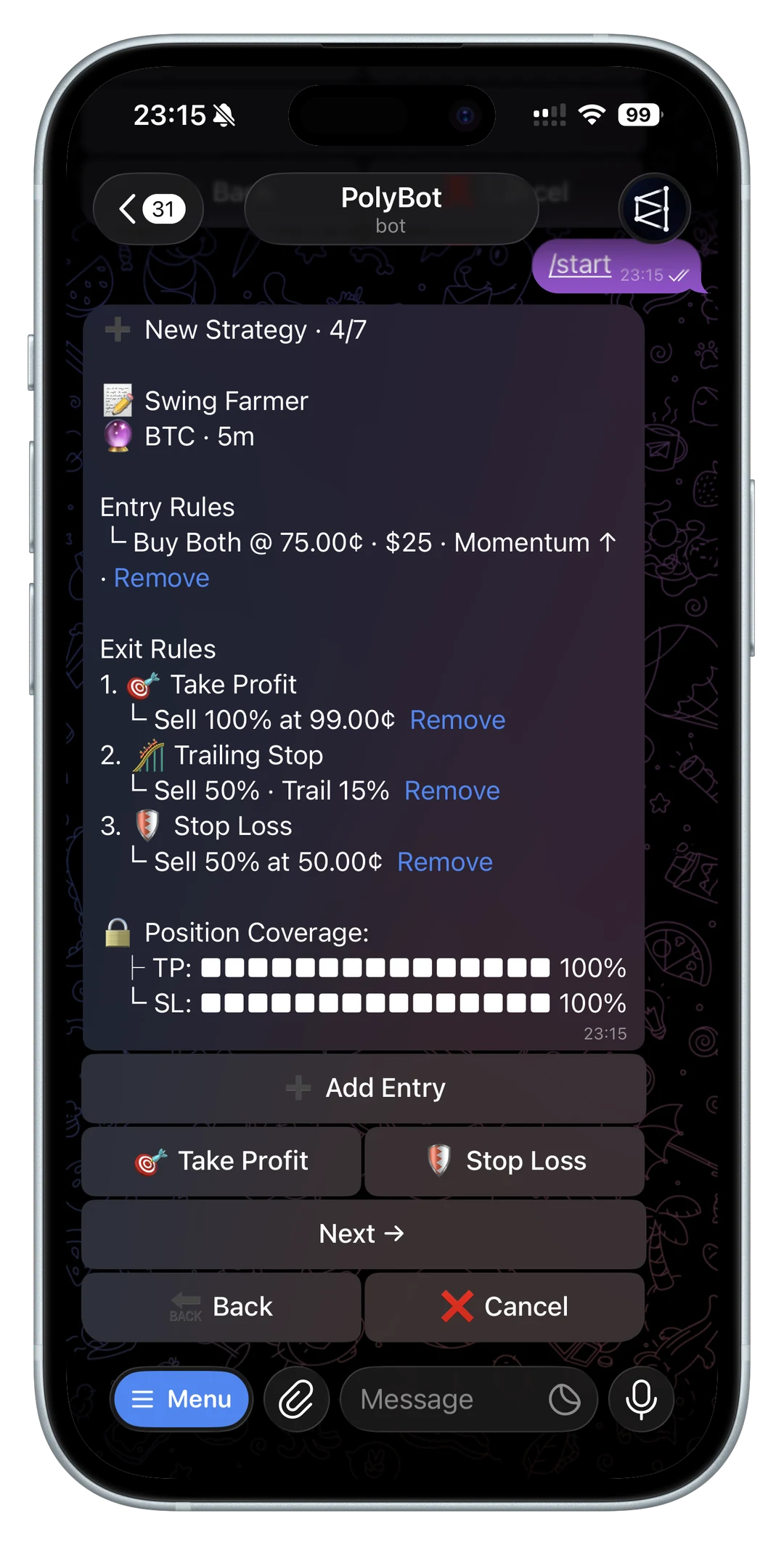
A limit sell waits for a target price. A stop loss attempts to reduce downside when the market moves against you. A take-profit rule is a planned upside exit. A trailing stop follows a favorable move and then exits after a reversal.
If you are selling in pieces rather than closing all at once, use the Polymarket scale-in and scale-out guide to keep partial exits tied to the original position size and risk plan.
These tools answer different questions:
- Market sell: close now.
- Limit sell: sell only if I can get my price.
- Stop loss: try to exit if my risk level breaks.
- Take profit: sell when my upside target is reached.
- Trailing stop: protect part of a winner after it reverses.
PolyBot's portfolio docs describe stop losses as downside protection for positions you cannot monitor. They matter most when you are offline, copying wallets, or running automated strategies.
For the full exit-rule framework, read the Polymarket stop-loss and take-profit guide.
Review open orders before selling again
If a sell does not behave the way you expected, check open orders.
Shares can be reserved by:
- open limit sells
- active stop-loss rules
- strategy exits
- partially filled orders
- stale orders that were never cancelled
PolyBot's orders hub shows open limit-order count, active stop-loss count, fill progress, market, outcome, side, price, size, and cancellation controls. If a position says you cannot sell, reserved shares may be part of the reason.
Before placing another exit, check /orders, refresh, and cancel stale orders if they no longer match the plan.
For a dedicated cancellation checklist, use the Polymarket open orders and cancel orders guide.
If the issue is that a limit sell is still waiting, use the Polymarket limit order not filled guide to check bid depth, queue position, partial fills, and stale-order risk before selling again.
Redeem is not a sell
After a market resolves, selling may no longer be the right action.
If your outcome wins, you generally redeem winning shares so the payout returns to tradable balance. If your outcome loses, there is no payout; the losing position may be cleared from the active view.
Use redeem when:
- the market has resolved
- your outcome won
- the position is redeemable
- you want the payout back in tradable balance
- auto-claim has not already handled it
Use sell when:
- the market is still open
- there is bid liquidity
- you want to close before final resolution
- the position can still trade
The auto-claim and redeem winnings guide explains manual redeem, Claim all, pending redemption, and auto-claim. If the market state itself is unclear, read the Polymarket resolution rules guide before choosing sell or redeem.
Selling affects PnL differently than redeeming
PnL is easy to misread during exits.
If you sell before resolution, your realized result depends on the exit price, size, fees, and any spread/slippage. If you hold a winning position through resolution, redemption turns winning shares into payout value. If you partially sell, part of the position becomes realized while the rest remains open.
Track:
- average entry price
- shares sold
- sell price
- remaining shares
- open-position current value
- realized PnL
- redeemable winnings
- open orders still reserving shares
For the accounting side, read the Polymarket PnL tracker guide and the trade history guide.
Copy trading exits need special care
A copied position may not close the same way as the leader's position.
Your copied result can differ because:
- you entered later
- your fill price was worse
- your size was smaller or capped
- slippage filters skipped some entries
- the leader partially exited
- you used your own stop-loss or take-profit rule
- the market moved before your follower order executed
When selling copied positions, decide whether you are following the leader's exit or managing your own risk. If the leader is still holding but your bankroll or thesis has changed, it can still make sense to reduce exposure. If the leader exits but your order book is thin, blindly selling the full copied size can produce worse fill quality.
The copy trading settings guide explains how filters, caps, and side controls affect copied entries and exits.
Selling is not withdrawing
After selling, proceeds return to the trading balance. They do not automatically leave the wallet.
The full path is:
- Sell or redeem to make value available in the trading balance.
- Check open orders and active positions that may reserve funds.
- Use the wallet withdrawal flow if you want funds sent to an external address.
If your goal is to cash out, read the Polymarket cash-out guide and the Polymarket Telegram bot withdrawal guide. Withdrawal has its own network, address, asset, 2FA, and confirmation checks.
A selling checklist
Before confirming a Polymarket sell, check:
- Is the market still tradeable, or has it resolved?
- Am I trying to close now or set a target?
- How many shares am I selling?
- Is a partial sell enough?
- What bid liquidity is available?
- How wide is the spread?
- Could a limit sell avoid bad slippage?
- Are any shares reserved by existing orders or stop-loss rules?
- Will the exit create realized PnL, leave unrealized exposure, or trigger a redeem workflow later?
- Do I need a withdrawal after the sell, or only trading balance?
That checklist is slower than panic selling. It is also how you avoid confusing exit execution with balance accounting.
Troubleshooting: why can't I sell?
Common reasons:
- the market has resolved
- the position is too small for the chosen sell type
- shares are reserved by an open limit order
- a stop-loss or strategy exit already controls part of the position
- liquidity is too thin for the desired size
- the order would violate price, tick-size, or minimum-size rules
- the portfolio view needs refresh
- the order was partially filled or already cancelled
If the issue is an execution failure, read the Polymarket order failed guide. If the issue is order type, read the Polymarket order types guide.
The bottom line
Selling a Polymarket position is an exit decision, not a generic cash-out button.
Use market sell when speed matters. Use limit sell when price matters. Use stop-loss and take-profit rules when you need planned exits. Use redeem after a winning market resolves. Use withdrawal only after value is available and you actually want to move funds out.
Not investment advice. Prediction markets are risky, liquidity can change quickly, and any sell, redeem, or withdrawal action should be verified against current official docs and the live bot screen before trading.
Polymarket Market Orders From Telegram: Fast Buys, Sells, Slippage, and Risk
How to use Polymarket market orders from Telegram: market buys, market sells, bid-ask spread, slippage, FAK/FOK behavior, partial fills, failed orders, and safer review.
Execution / 11 min
Why Did My Polymarket Limit Order Not Fill? Price, Liquidity, and Open Order Fixes
A practical guide for Polymarket traders whose limit order is still open, partially filled, stale, rejected, or not matching from Telegram.
Execution / 9 min