Polymarket PnL Card Guide: Share Profit and Loss From Telegram Without Misreading the Trade
How to use Polymarket PnL cards from a Telegram bot: what a profit card can show, what it cannot prove, and how to pair shareable screenshots with portfolio, PnL, orders, and trade history checks.

PolyBot Team
Updated June 1, 2026
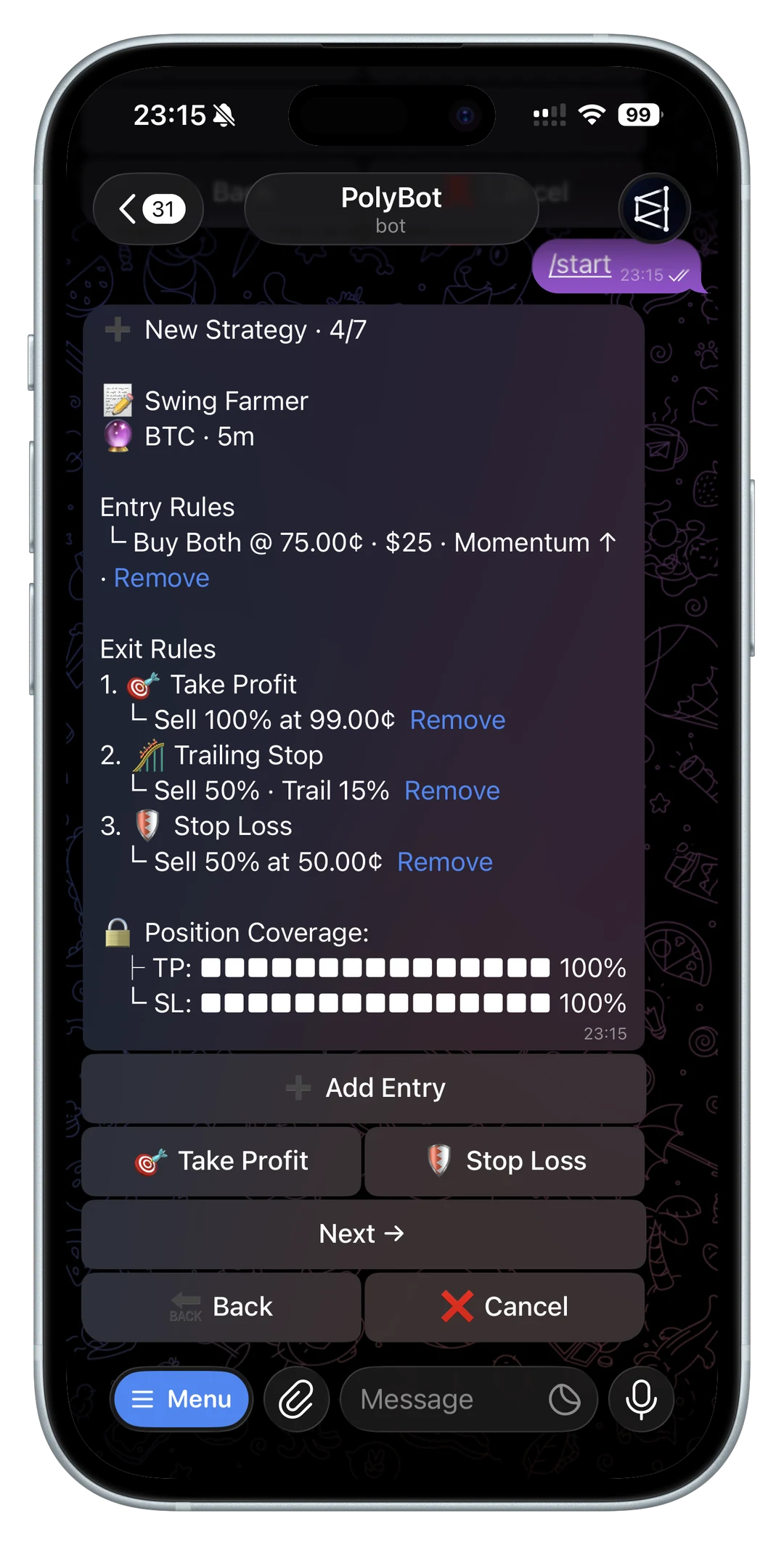
A Polymarket PnL card is useful when it turns a position into a clear, shareable snapshot.
It is not useful when traders treat the card as proof that a strategy works, proof that a wallet is worth copying, or proof that the displayed number is already realized profit. A profit card can communicate a trade quickly inside Telegram, but it still needs context: position size, entry price, current price, liquidity, whether the gain is realized or unrealized, and whether the market has actually resolved.
PolyBot's official Portfolio & Orders Guide documents PnL cards as shareable images for positions. The same guide explains that portfolio PnL is based on current price, average price, and shares, and that this is unrealized for open positions. PolyBot's What Is PolyBot overview also lists portfolio, sells, stop loss, redeems, and PnL cards as part of the trading workflow.
This guide explains how to use Polymarket PnL cards from Telegram without overreading the screenshot.
If you need the full profit calculation first, read the Polymarket PnL tracker guide. If you need the broader account view, read the Polymarket portfolio tracker bot guide. If the card came from a position you may sell, read how to sell a Polymarket position before treating the displayed value as exitable.
What a Polymarket PnL card is
A PnL card is a visual summary of a position's profit or loss.
In a Telegram trading workflow, the card is useful because it can be generated where the trade is already being discussed. A trader can review a position, produce a card, and share the result in a group or community without assembling a manual screenshot from multiple pages.
The card can help communicate:
- market or position context
- profit or loss direction
- percentage or dollar-style performance
- current position outcome
- a trade result worth discussing
- a position that needs follow-up review
That does not make the card a complete accounting record. It is a summary layer, not the ledger.
What a PnL card cannot prove
A Polymarket profit card can look convincing while leaving out important details.
Before relying on a card, ask what it does not show:
- Was the PnL realized or unrealized?
- Was the position still open?
- Was there enough liquidity to exit at the displayed value?
- Did the trader scale in or out?
- Were there partial fills?
- Did fees, spread, or slippage change the true result?
- Was this one winner offset by other losses?
- Was the market resolved, redeemable, or still disputed?
- Was the card generated before or after a major price move?
A card is strongest as a conversation artifact. It is weaker as evidence of repeatable edge.
For a structured recordkeeping workflow, use the Polymarket trade history and CSV guide alongside any shared card.
Realized and unrealized PnL matter
The most important distinction is realized versus unrealized.
Unrealized PnL is the value of an open position based on current market pricing. It can change quickly.
Realized PnL is closer to what happened after selling, redeeming, or otherwise closing exposure. Even then, it should be reviewed with the actual fills, size, fees, and redemption state.
PolyBot's portfolio docs define PnL for open positions as the difference between current price and average price, multiplied by shares. That makes a PnL card for an open position a current snapshot, not a promise that the same amount can be captured later.
If a card shows a large gain, the next question is simple: can the trader actually sell the position at a similar value? The answer depends on bid depth, spread, order size, and market state.
For those mechanics, read the Polymarket order book guide and the liquidity, spread, and slippage guide.
Use PnL cards after portfolio review
Generate the card after checking the position, not before.
A practical Telegram workflow is:
- Open
/portfolio. - Choose the position.
- Check outcome side, shares, average price, and current price.
- Check whether the position is open, won, lost, or awaiting action.
- Review any open orders, stop losses, or strategy exits tied to the same market.
- Decide whether the card is for sharing, personal notes, or group discussion.
If the position needs action, handle the action before treating the card as final. That might mean selling, placing a limit sell, redeeming a winning position, cancelling a stale order, or simply refreshing prices.
For the full position workflow, read the Polymarket portfolio and orders guide.
When a PnL card is useful
PnL cards are useful when the audience understands the limits of the snapshot.
Good uses include:
- sharing a resolved position with a community
- showing a trade result in a private group
- documenting a position before a post-trade review
- comparing a copied trade against the leader's result
- showing that a market moved as expected
- turning portfolio review into a cleaner visual note
The card is especially helpful when the alternative is a messy screenshot with private wallet details, unrelated balances, or too much interface noise.
In groups, a card can help people discuss a trade without forcing everyone to open the same market manually. PolyBot's official Group Guide describes Telegram group market cards and trader cards as context surfaces, while actual trading routes into DM. The same principle applies to PnL cards: share context, then review privately before taking action.
For group-specific safety and routing, read the Polymarket Telegram group trading guide.
When a PnL card is risky
PnL cards become risky when they create social proof without enough context.
Common failure modes:
- copying a wallet because one card looks good
- increasing size because a group keeps posting winners
- ignoring losing positions because only wins get shared
- assuming a percentage gain means a large dollar gain
- treating unrealized PnL as settled profit
- failing to notice that liquidity was too thin to exit
- sharing sensitive account context by mistake
The biggest problem is selection bias. People naturally share strong winners more often than boring holds, small losses, or failed entries. A feed full of green cards can make a strategy look better than its actual distribution.
Before copying a trader from a card, use the Polymarket wallet analyzer guide and the best Polymarket traders to copy guide.
PnL cards and copy trading
Copy trading adds another layer of interpretation.
A source wallet may produce a strong PnL card, but a follower may not reproduce that result. The follower can enter later, pay a worse spread, use different size, miss some trades, skip due to settings, or exit differently.
When reviewing a copied-trade card, separate:
- leader wallet entry price
- follower entry price
- follower size
- skipped or partially filled trades
- slippage between source and follower
- current liquidity
- whether the leader's result was realized
- whether the follower can exit cleanly
This matters because a copied wallet can be genuinely profitable while still being hard to copy at your size or delay.
For copy controls, read how to copy trade on Polymarket from Telegram and the Polymarket copy trading settings guide. For risk sizing, read the copy trading bankroll and drawdown guide.
PnL cards and resolved markets
Resolved markets need a different reading than open markets.
If a market has resolved and the position won, the trader may need to redeem before the winnings become usable balance. If the position lost, the active view may need cleanup. If redemption is pending, the account may show a winning position but not yet show the final usable funds.
A PnL card from a resolved market should be paired with:
- market resolution status
- winning outcome side
- redeem status
- whether Claim all or auto-claim is enabled
- whether the result appears in activity history
- whether the balance has refreshed
For the settlement workflow, read the Polymarket auto-claim and redeem winnings guide and the resolution rules guide.
What to check before sharing a PnL card
Use this checklist before sharing a profit or loss card:
| Check | Why it matters |
|---|---|
| Market title and outcome | Avoid sharing the wrong side or wrong market |
| Open or resolved status | Changes whether PnL is still moving |
| Realized or unrealized | Separates actual exit results from current value |
| Position size | Percentage gains can hide small dollar exposure |
| Entry and current price | Shows whether the move is meaningful |
| Liquidity and spread | Shows whether the value can be exited |
| Open orders | May reserve shares or balance |
| Redeem state | Determines whether winnings are usable |
| Private details | Avoid leaking sensitive account context |
The goal is not to make every card complicated. The goal is to avoid letting a clean image hide the trade state.
How PolyBot fits the workflow
PolyBot is built around a Telegram-native trading loop: discover markets, trade, manage the portfolio, sell, protect positions, redeem, and share context without leaving Telegram.
PnL cards fit near the end of that loop. They are useful after a trader understands the position. They are less useful as the starting point for a new trade.
Use the card to communicate. Use the portfolio, order, wallet, and history views to decide.
For command navigation, read the Polymarket Telegram bot commands guide. For phone-first trading, read the Polymarket mobile trading bot guide.
FAQ
What is a Polymarket PnL card?
A Polymarket PnL card is a shareable visual summary of a position's profit or loss. In PolyBot, PnL cards are generated from the portfolio workflow and are useful for sharing position context in groups or communities.
Does a PnL card show realized profit?
Not always. A card can reflect an open position's current value. For open positions, PnL can be unrealized and may change before selling or market resolution.
Can I use PnL cards to choose wallets to copy?
Use them only as a starting signal. A single card does not prove repeatable edge, liquidity, sample size, risk control, or copyability. Review the wallet's broader history before copying.
Why can a PnL card look profitable while my balance is unchanged?
The value may still be in an open position, a resolved position waiting for redeem, an open order, or a pending wallet action. Check portfolio, orders, activity, and redeem status before assuming a balance issue.
Are PnL cards safe to share?
They can be, but review the image and surrounding message before sharing. Avoid exposing private wallet details, account identifiers, 2FA information, support links, or unrelated balances.
Should I trust PnL screenshots in Telegram groups?
Treat them as context, not proof. Ask whether the PnL is realized, whether losses are also shown, whether the position was liquid enough to exit, and whether the wallet has repeatable performance.
Not investment advice, financial advice, tax advice, or security advice. Prediction-market PnL can change quickly, and every card should be checked against the live position, order book, portfolio state, and current official docs.
Polymarket PnL Tracker Guide: Realized, Unrealized, Positions, and Redeems
How to read Polymarket PnL correctly: realized PnL, unrealized PnL, total PnL, open positions, resolved winnings, redeem status, copied wallets, and Telegram portfolio review.
Wallet Analysis / 10 min
Polymarket Leaderboard Guide: PnL, Volume, Wallet Rankings, and Copy Trading Risk
How to read a Polymarket leaderboard before copy trading: PnL, volume, time windows, category rankings, wallet activity, liquidity, and when top traders are not copyable.
Wallet Analysis / 10 min