Why Did My Polymarket Limit Order Not Fill? Price, Liquidity, and Open Order Fixes
A practical guide for Polymarket traders whose limit order is still open, partially filled, stale, rejected, or not matching from Telegram.

PolyBot Team
Updated June 1, 2026
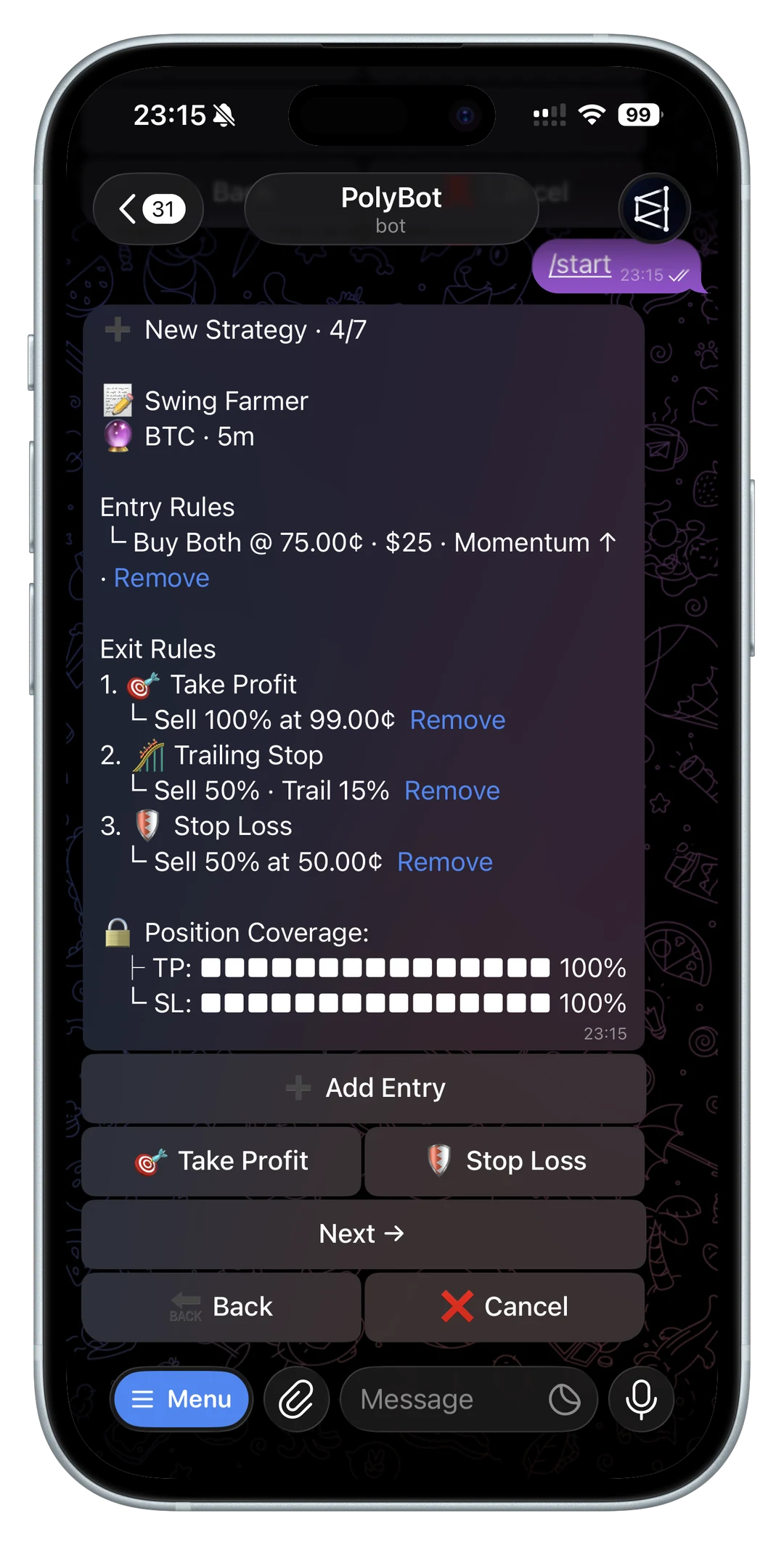
A Polymarket limit order can be valid and still not fill.
That is the whole point of a limit order: it protects your price instead of forcing immediate execution. The tradeoff is that your order may rest on the book, fill only partly, become stale, or wait until another trader is willing to match your price and size.
This guide explains why a Polymarket limit order may not fill, how to diagnose the cause from Telegram, and when to cancel, edit, replace, or leave the order alone.
PolyBot's official Trading Guide documents the Telegram flow for market buys, market sells, limit buys, limit sells, and order management. Its Portfolio & Orders Guide shows where open orders, active stop-loss count, cancellation controls, positions, and PnL fit into the review loop.
If you are still learning the basic order flow, start with the Polymarket limit orders from Telegram guide. If the order is already open, use the Polymarket open orders and cancel orders guide with this checklist. If the issue is a rejection rather than a resting order, use the Polymarket order failed error codes guide.
Quick answer
Your Polymarket limit order usually did not fill because the market has not traded at your price with enough matching size.
The common causes are:
- your buy price is below the current ask
- your sell price is above the current bid
- there is not enough size at the matching price
- the order is behind other resting orders at the same price
- only part of the requested size matched
- the market moved after you placed the order
- the order price does not match the market's tick size
- your available balance or shares are reserved elsewhere
- the order type or post-only setting prevents immediate matching
- the market is paused, not ready, near resolution, or too thin to trade cleanly
Do not retry blindly. First decide whether the order is resting, partially filled, rejected, or stale.
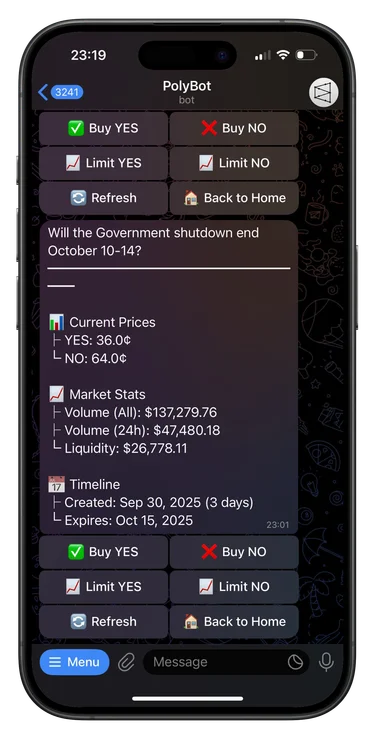
Limit orders protect price, not fill speed
Polymarket's official orders overview explains that GTC and GTD are limit order types that rest on the book at a specified price. FOK and FAK are market-style order types that execute immediately against resting liquidity.
That distinction is the first thing to check.
If you placed a normal limit buy, you are saying: buy only at this price or better. If nobody is selling enough shares at that price, the order waits.
If you placed a normal limit sell, you are saying: sell only at this price or better. If nobody is buying enough shares at that price, the order waits.
This is not a failed order. It is the expected behavior of a price-controlled order.
Use a limit order when price matters more than immediacy. Use a market-style order when immediate execution matters more than the risk of a worse fill. For that tradeoff, read the Polymarket market orders from Telegram guide and the Polymarket slippage tolerance guide.
Check the bid, ask, and spread
The order book tells you whether your price is currently matchable.
Polymarket's official orderbook documentation describes bids, asks, tick size, minimum order size, midpoint, spread, and orderbook depth. For a trader, the key fields are simple:
| Field | What it means | Why your limit order may not fill |
|---|---|---|
| Best bid | Highest visible buy price | A sell above this price may wait |
| Best ask | Lowest visible sell price | A buy below this price may wait |
| Spread | Gap between bid and ask | Wide spreads make passive orders wait longer |
| Depth | Size available at each price | Large orders may only fill partly |
| Tick size | Valid price increment | Invalid precision can reject the order |
| Minimum order size | Smallest accepted order size | Tiny orders or copied slices may fail |
If the best ask is 58c and your limit buy is 55c, your order is not currently marketable. It can still fill later, but only if sellers move down or another trader crosses into your bid.
If the best bid is 42c and your limit sell is 48c, your order is waiting for buyers to move up or for another trader to take your sell.
For a deeper explanation of these fields, read the Polymarket order book guide.
A limit order can be behind other orders
Even if the market touches your price, your order may not fill immediately.
There may be other resting orders at the same price ahead of yours. If only part of the available demand or supply trades through that level, earlier orders can fill first while yours remains open.
That is especially common around popular prices like 50c, 60c, or 75c. Many traders may cluster there because those prices feel psychologically clean. Your order can be valid, visible, and still waiting in the queue.
In Telegram, this is why "price reached my limit" is not always enough evidence. You also need to know how much size traded at that level and whether your order actually matched.
Partial fills are not the same as no fill
Sometimes the order did work, but only partly.
Example:
- you place a limit buy for $200 at 40c
- only $70 worth of matching sell liquidity appears
- $70 fills
- the remaining $130 stays open
The account now has both a real position and an open remainder. Cancelling the open remainder does not undo the filled shares. Replacing the order can create more exposure if you forget the partial fill.
This matters even more for exits. A limit sell can sell some shares and leave the rest open. If you assume the position is fully closed, you may keep unwanted exposure into a fast-moving event.
Use the Polymarket partial fills guide before retrying, cancelling, or changing size.
Tick size can make the price invalid
Some "not filled" cases are not resting orders. They are rejected orders.
Polymarket's orders overview documents market tick sizes and explains that order prices must conform to the market's minimum price increment. A market with a 0.01 tick uses prices like 0.41, 0.42, and 0.43. A finer tick can allow more decimal places. A coarser tick allows fewer.
If a custom price is invalid for the market, the order can fail instead of resting.
If the error points to price precision, read the Polymarket tick size guide before replacing the order or widening slippage.
Check this when:
- you typed the price manually
- the bot allowed cents plus decimals
- you copied a price from another screen
- the market has unusual precision
- a bot or strategy generated the price
If the order failed with a tick-size message, fix the price precision first. Do not widen the order just to make it submit.
Available balance can be reserved by other orders
Another confusing case: the price is fine, but available balance is not.
Polymarket's orders overview describes open-order validity checks around balances and allowances. It also explains that order placement is limited by available balance after existing open orders are considered.
In trader terms, an open buy can reserve funds. An open sell can reserve shares. That means the account may look funded, but a new order cannot use balance or shares already tied to resting orders.
Before retrying a limit order, check:
- open buy orders in the same market
- open sell orders in the same market
- ladder orders at nearby prices
- partially filled orders with remainders
- copy-trading orders that reserved balance
- active stop or take-profit rules that may interact with the position
For the account-level workflow, use the Polymarket portfolio and orders guide.
The order may be stale
A stale order is an order that still exists after the original reason for it is gone.
Limit orders become stale when:
- breaking news changes the market
- liquidity moves away from your price
- your thesis changes
- a copied trader exits while your order remains
- the market nears resolution
- you already entered or exited another way
- a partial fill created a smaller leftover order
- a ladder level is no longer part of the plan
Stale orders are dangerous because they can fill later when you are no longer watching. The fill may be technically correct but strategically wrong.
If the reason for the order is gone, cancel it. If the reason still exists but the market moved, replace it deliberately. If the order is part of a ladder or market-making setup, review the whole plan before cancelling only one level.
Why copied limit orders may not match the leader
Copy trading adds another reason a limit order may not fill.
The leader's trade and the follower's trade do not necessarily hit the same liquidity at the same time. The leader may fill first, moving the book before the follower order arrives. The follower may also use a different size, slippage setting, max trade cap, minimum order size, or price limit.
Common copy-trading causes:
- the leader consumed the available liquidity
- the follower order arrived after the book moved
- the follower's order size was too small
- the follower's max price was too strict
- the copied trade was skipped by settings
- the follower's open orders reserved balance
- the market was too thin for both accounts
If this happens often, do not only increase slippage. Review the copied trader's average size, market type, holding period, and liquidity profile. The best Polymarket traders to copy guide explains why a trader can be profitable but still hard to copy.
Troubleshooting checklist
Use this sequence before retrying:
- Confirm whether the order is open, partially filled, rejected, or cancelled.
- Compare your limit price with the current bid and ask.
- Check the available size at your price and nearby prices.
- Look for partial fills before changing the remaining order.
- Verify that the price matches the market tick size.
- Check whether open orders reserve balance or shares.
- Confirm whether the market is still accepting normal orders.
- Decide whether the original reason for the order still exists.
- Cancel stale orders before placing replacement orders.
- Record the exact error message if the order was rejected.
The important discipline is to separate four states: waiting, partially filled, rejected, and stale. Each state needs a different action.
When to cancel, edit, or wait
| Situation | Better action | Why |
|---|---|---|
| Price still matches your thesis but has not traded | Wait or leave the order | This is normal limit-order behavior |
| Market moved away and your thesis changed | Cancel | The old order can create unwanted exposure |
| Order partly filled | Review position and remainder | Filled shares are real; only the remainder is open |
| Price precision is invalid | Correct tick-size precision | A bad price will not become valid by waiting |
| Balance is reserved | Cancel or adjust other orders | New orders need available funds or shares |
| You need immediate execution | Use a market-style order carefully | Speed trades off against fill quality |
| Copy trade keeps missing | Review copy settings and liquidity | The leader's fill may not be reproducible |
FAQ
Why did my Polymarket limit buy not fill?
Most likely, your buy price is below the current ask or there is not enough sell liquidity at your price. A limit buy protects your maximum price; it does not guarantee that another trader will sell to you there.
Why did my Polymarket limit sell not fill?
Your sell price may be above the current bid, or there may not be enough buy demand at that price. Check the bid side, the size available, and whether your position or shares are reserved by another order.
Can a limit order fill only partly?
Yes. If only part of the requested size matches, the filled portion becomes a real trade and the remainder can stay open depending on the order type. Always check partial fills before replacing the order.
Does a limit order expire?
It depends on the order type. Polymarket documents GTC orders that rest until filled or cancelled and GTD orders that remain active until a specified expiration time unless filled or cancelled first.
Is an open order the same as a position?
No. An open order is an instruction that can still fill. A position is shares you already hold. A partially filled order can create both a position and an open remainder.
Should I cancel an order that has not filled?
Cancel it when the reason for the order is gone. Leave it only when the price, market state, size, and timing still match the plan.
Bottom line
A Polymarket limit order not filling is usually not a bug. It is usually the result of price, liquidity, queue position, partial fills, tick size, reserved balance, or stale order logic.
The fix is not always to retry. The fix is to classify the order state, read the book, check open orders, and choose the next action deliberately.
For Telegram traders, the clean workflow is: place the limit order, know where to review it, check partial fills, cancel stale orders, and only replace the order when the plan still makes sense.
Not investment advice, financial advice, legal advice, or security advice. Prediction-market trading is risky, liquidity can move quickly, and every order should be checked against the live market, current docs, and your own risk limits before execution.
Polymarket Open Orders and Cancel Orders in Telegram: Limit Orders, Balance, and Risk
How to manage Polymarket open orders from Telegram: cancel stale limit orders, review reserved balance, partial fills, stop rules, failed orders, and portfolio risk.
Execution / 11 min
Polymarket Tick Size Guide: Price Precision, Rejected Orders, and Telegram Fixes
How Polymarket tick size works, why invalid price precision rejects orders, how to read tick size from the order book, and how Telegram traders should fix custom prices.
Execution / 9 min