Polymarket Tick Size Guide: Price Precision, Rejected Orders, and Telegram Fixes
How Polymarket tick size works, why invalid price precision rejects orders, how to read tick size from the order book, and how Telegram traders should fix custom prices.

PolyBot Team
Updated June 1, 2026
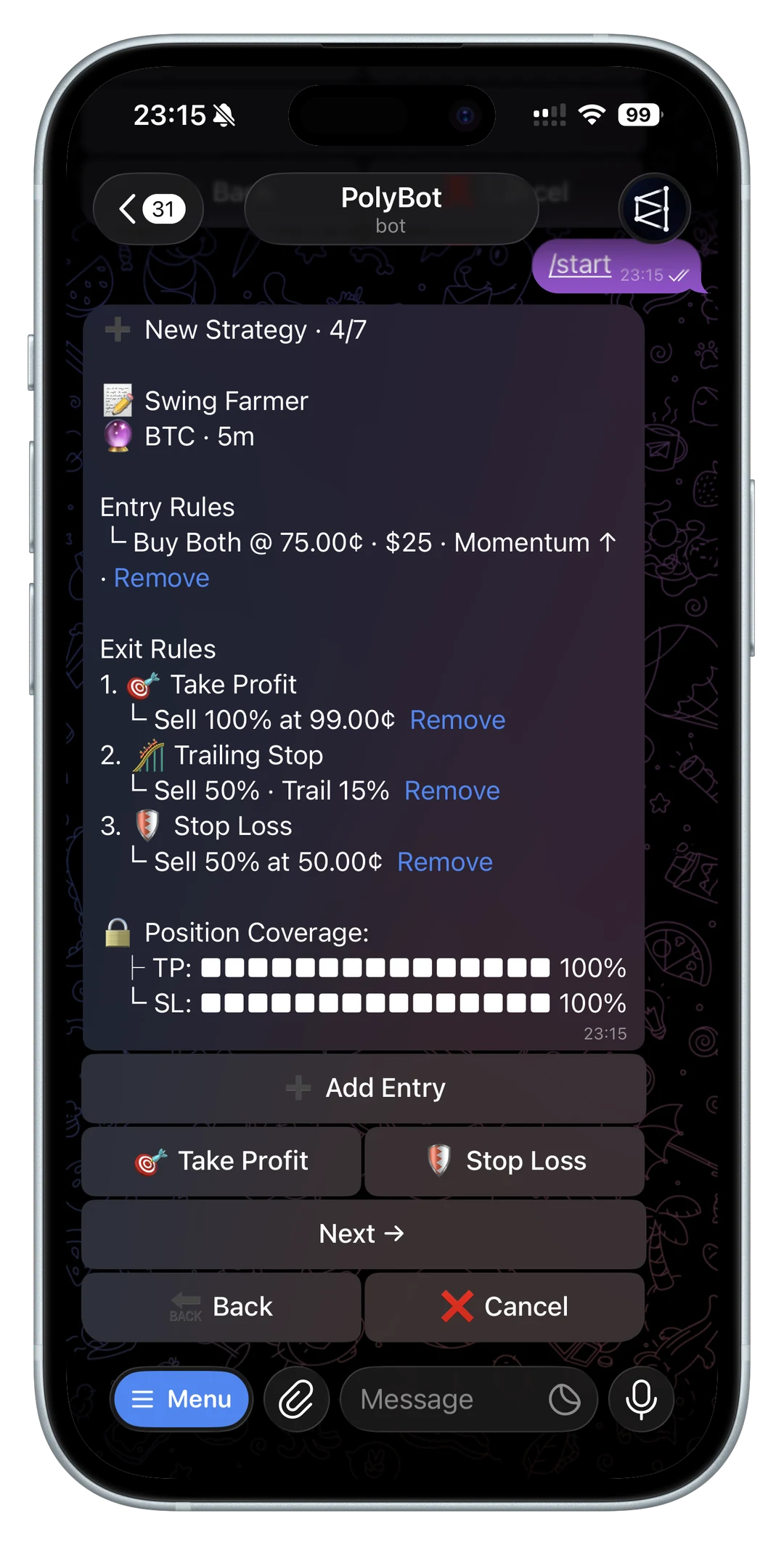
Polymarket tick size is the price increment a market accepts.
That sounds small until an order gets rejected. A trader may enter a price that looks reasonable, but if it does not match the market's tick size, the order cannot be submitted cleanly. In Telegram trading, this usually appears as a price precision problem, an invalid price, or an order failure that needs the exact market increment.
This guide explains tick size in trader terms: what it is, why it changes price precision, where it appears in official Polymarket docs, how it affects limit orders, copy trading, API bots, and what to do when a price is rejected.
PolyBot's official Trading Guide documents Telegram order flows for market buys, market sells, limit buys, limit sells, and order management. This page focuses on the price-validity layer underneath those flows.
If the rejected order was part of a broader failure, read the Polymarket order failed error codes guide. If the order is valid but still open, read the Polymarket limit order not filled guide. If you need bid, ask, spread, and depth first, use the Polymarket order book guide.
Quick answer
Tick size is the smallest allowed price increment for a market.
If a market uses a 0.01 tick size, prices like 0.42 and 0.43 are valid. A price like 0.421 is too precise for that market. If a market uses a 0.001 tick size, a price like 0.421 can be valid.
The practical rule:
- check the market's current tick size
- round prices to valid increments
- do not assume every market uses the same precision
- do not retry a rejected price without fixing precision
- expect API bots and copy-trading systems to re-check tick size before placing orders
Tick size is not slippage. It is not spread. It is not your edge. It is the price grid the market accepts.
What tick size means
Polymarket's official create order documentation says order prices must conform to the market's tick size. The same page gives examples for common tick sizes:
| Tick size | Price precision | Example valid prices |
|---|---|---|
0.1 | 1 decimal | 0.1, 0.2, 0.5 |
0.01 | 2 decimals | 0.01, 0.50, 0.99 |
0.001 | 3 decimals | 0.001, 0.500, 0.999 |
0.0001 | 4 decimals | 0.0001, 0.5000, 0.9999 |
In trader language, tick size decides the valid price ladder.
If the market accepts one-cent steps, you can quote 42c or 43c. You cannot quote 42.1c. If the market accepts finer steps, that extra decimal may be allowed.
The price can be economically reasonable and still invalid. The matching system needs the price to fit the market's increment.
Why tick-size errors happen
Tick-size errors usually happen when a user or bot creates a custom price instead of using a prebuilt button.
Common causes:
- typing a custom limit price with too many decimals
- copying a price from a chart, API response, or spreadsheet
- calculating a midpoint between bid and ask
- applying a percentage adjustment to another trader's fill
- using a strategy formula that creates fractional cents
- reusing an old market's tick size on a new market
- missing a tick-size change after a market moves near the edges
The fix is not to guess another price. The fix is to read the current tick size and round to a valid increment.
Where to find tick size
Polymarket exposes tick size in several places.
The official orderbook documentation shows tick_size as part of the order book response, next to bids, asks, minimum order size, negative-risk status, and the book hash.
The official get tick size endpoint returns the minimum tick size for a token ID. That is useful for API bots, execution tools, and systems that need to validate prices before order creation.
The order docs also say the market object can expose minimum_tick_size. In other words, there is no reason for automation to hardcode one global precision across all markets.
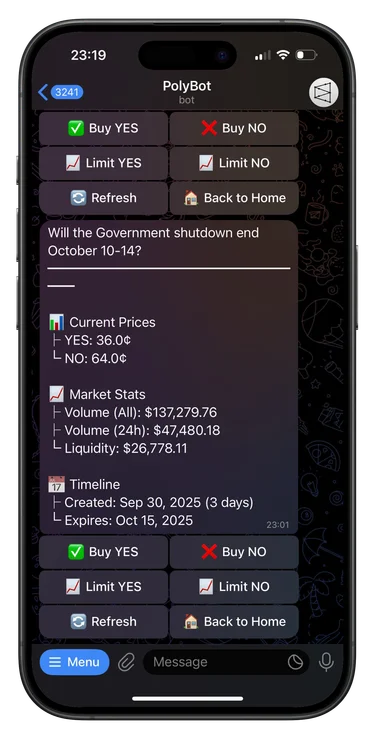
In a Telegram workflow, the user should not have to inspect raw API fields. The bot should format valid price controls and prevent invalid custom prices where possible. But when an order fails, knowing the tick-size concept helps you understand the fix.
Tick size is different from spread
Spread is the gap between the best bid and best ask.
Tick size is the grid the price must land on.
Example:
- best bid:
0.48 - best ask:
0.52 - spread:
0.04 - tick size:
0.01
In that market, 0.49, 0.50, and 0.51 may be valid prices because they fit the one-cent grid. Whether they fill is a separate question. They may rest on the book, partially fill, or never match.
Now imagine a strategy calculates a midpoint price of 0.505. That may look mathematically precise, but if the tick size is 0.01, it is invalid. The trader has to choose a valid price such as 0.50 or 0.51.
For fill quality after the price is valid, read the Polymarket liquidity, spread, and slippage guide.
Tick size is different from slippage tolerance
Slippage tolerance decides how much worse than expected an immediate trade is allowed to execute.
Tick size decides whether the price is valid at all.
If your price breaks the tick-size rule, widening slippage does not solve the precision problem. You still need a valid price increment.
This matters for Telegram traders because the wrong reaction can make the trade worse. A rejected custom limit price should not automatically become a loose market order. First fix the price precision. Then decide whether the trade should be a limit order, market order, or no order.
For the market-order side of that choice, read the Polymarket market orders from Telegram guide and the Polymarket slippage tolerance guide.
How tick size affects limit orders
Limit orders are where most tick-size mistakes show up.
When you place a limit buy, the price is the maximum you are willing to pay. When you place a limit sell, the price is the minimum you are willing to accept. Both prices need to land on the market's valid tick grid.
For manual Telegram trading, this affects:
- custom limit buy prices
- custom limit sell prices
- ladder entries
- scale-out prices
- stop or take-profit levels that create limit-style orders
- copied follower orders that adjust the leader's price
- maker-style quotes
If a limit order is rejected for tick size, do not assume the order was too expensive, too cheap, or too slow. It may simply be invalid precision.
For the full order-management workflow, use the Polymarket limit orders guide and the Polymarket open orders and cancel orders guide.
Tick size can change
The order book docs describe a tick_size_change event in the market WebSocket stream. They also warn that continuing to use an old tick size after a change can cause rejected orders.
That matters for bots more than casual manual traders, but the trader-level implication is simple: do not treat tick size as permanent.
If a market moves into a different price region or the feed reports a tick-size update, an automation system should refresh its valid price increment before placing more orders.
For fast strategies, this is not a cosmetic detail. A bot that calculates good prices but submits invalid precision can miss entries, fail exits, and create confusing Telegram alerts.
What the error message means
Polymarket's official error code documentation includes an order-processing error for prices that break the minimum tick-size rule. It also lists related errors for size below the market minimum, crossed-book post-only orders, balance or allowance problems, FOK/FAK liquidity problems, and market readiness.
That is why the exact error text matters.
"Order failed" is not enough. Save:
- market title
- outcome side
- buy or sell
- entered price
- entered size
- order type
- timestamp
- exact error message
If the message points to tick size, fix precision. If it points to minimum size, adjust size. If it points to balance or allowance, review wallet state. If it points to FOK/FAK liquidity, review the book.
Copy trading and tick size
Copy trading can create tick-size problems if the follower's order is calculated from another wallet's trade.
A leader may fill at a price that is valid in the original context. A follower system may then apply slippage limits, price caps, or adjustment logic. If that calculation creates an invalid decimal, the follower order needs rounding before submission.
This is one reason copied trades can skip or fail even when the leader traded successfully. The follower's actual order has its own size, timing, price limit, balance state, and market precision.
If copied trades skip often, read the Polymarket copy trading skipped trades guide before loosening every setting. If the copy fills but only partly, use the Polymarket partial fills guide.
API bots should validate before submitting
API bots should not discover tick-size errors only after an order fails.
A practical bot should:
- fetch the market or order book
- read current tick size
- calculate the intended price
- round or snap to a valid increment
- verify the rounded price still matches the strategy
- place the order only if the strategy still makes sense
- refresh tick size when market data updates indicate a change
The important part is step 5. Rounding can change the economics.
If a strategy wants to buy at 0.421 and the market only accepts 0.42 or 0.43, those are not identical choices. Rounding down may miss. Rounding up may overpay. The bot should decide deliberately.
For builder-level execution context, read the Polymarket API trading bot guide.
Practical checklist
Before retrying a price-precision failure:
- Confirm the order failed instead of simply resting open.
- Read the exact error message.
- Check the market's current tick size.
- Check whether the market is standard or negative-risk.
- Round the price to a valid increment.
- Recalculate whether the trade still has enough edge.
- Check spread and depth after the corrected price.
- Review size, balance, and allowance separately.
- Submit only if the corrected order still matches the plan.
- Save the corrected price and result for later review.
Do not solve every rejected order by changing multiple settings at once. If the only issue is tick size, fix tick size and keep the rest of the plan stable.
FAQ
What is tick size on Polymarket?
Tick size is the minimum price increment a market accepts. It controls whether a submitted price has valid precision.
Why was my Polymarket price rejected?
One common reason is that the price does not conform to the market's tick size. The price may have too many decimals for that market's accepted increment.
Is tick size the same as minimum order size?
No. Tick size controls price increments. Minimum order size controls how small the order can be. Both can cause rejections, but they are different checks.
Is tick size the same as spread?
No. Spread is the gap between the best bid and best ask. Tick size is the valid price grid for orders.
Can tick size change?
Yes. Polymarket's order book docs describe tick-size change events. Bots should refresh tick size instead of assuming one value forever.
Should I round up or round down?
It depends on the trade. For a buy, rounding up may improve fill chance but can overpay. For a sell, rounding down may improve fill chance but can accept less. The corrected price still has to match the strategy.
Bottom line
Tick size is small, but it is not optional.
If a Polymarket order fails because of price precision, the fix is to use the market's valid price increment, not to blindly widen slippage or retry a random price. For Telegram traders, that means treating tick-size errors as execution information: read the market, correct the price, and only resubmit if the trade still makes sense.
Not investment advice, financial advice, legal advice, or security advice. Prediction-market trading is risky, and every order should be checked against the live market, current docs, and your own risk limits before execution.
Why Did My Polymarket Limit Order Not Fill? Price, Liquidity, and Open Order Fixes
A practical guide for Polymarket traders whose limit order is still open, partially filled, stale, rejected, or not matching from Telegram.
Execution / 9 min
How to Sell a Polymarket Position: Market Sells, Limit Sells, Stop Losses, and Redeems
A practical guide to closing Polymarket positions from Telegram: market sells, limit sells, partial exits, stop losses, take profits, open orders, liquidity, PnL, redeeming winners, and withdrawals.
Execution / 10 min