Polymarket Slippage Tolerance Guide: Market Orders, Copy Trading, and Risk
How to set Polymarket slippage tolerance for Telegram market orders, copy trading, alerts, limit orders, partial fills, failed orders, and risk review.

PolyBot Team
Updated June 1, 2026
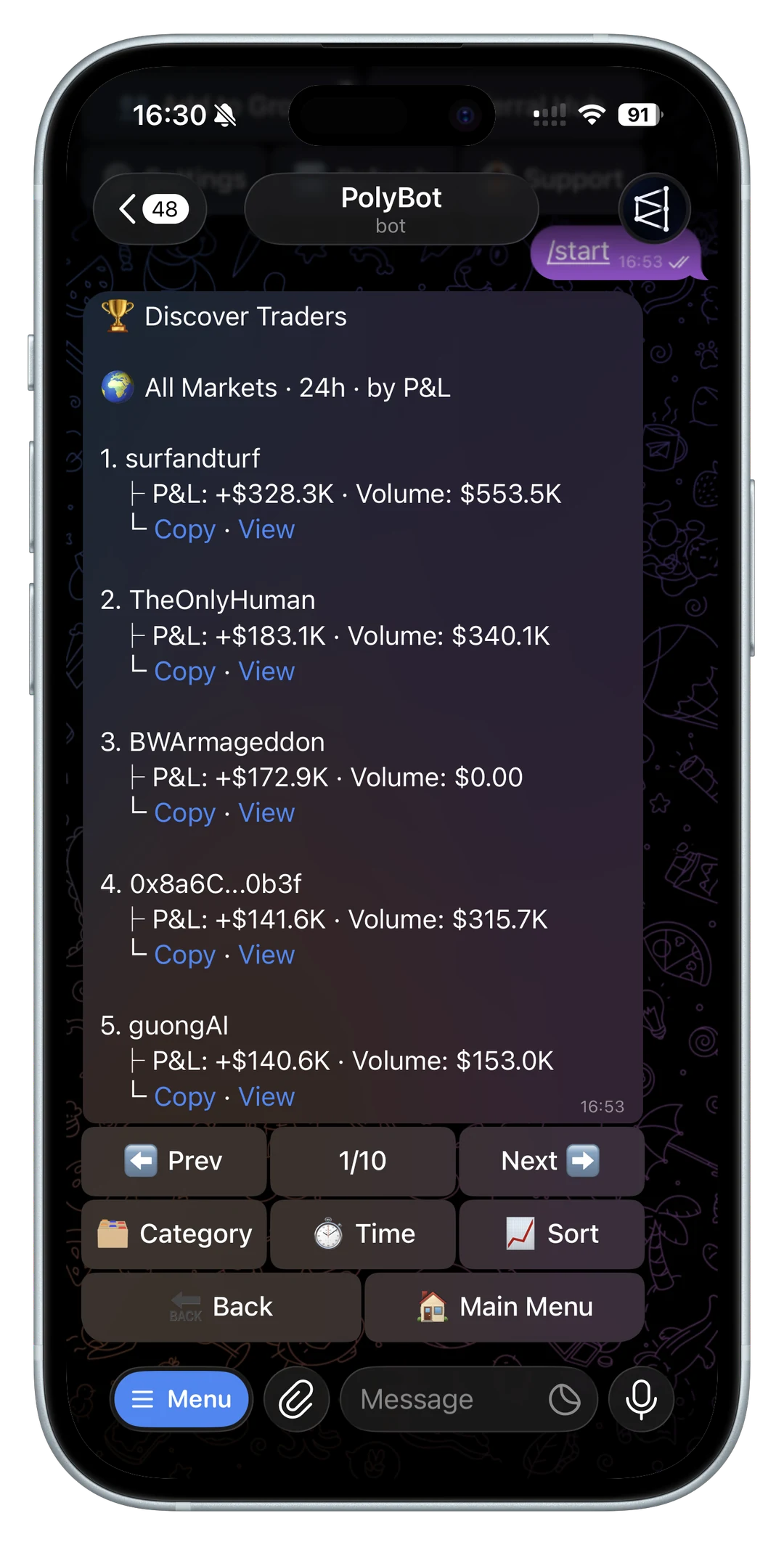
Slippage tolerance is the line between price discipline and fill reliability.
Set it too tight and good trades may skip because the market moved by a few cents. Set it too loose and the bot can enter a position at a price that no longer matches the original idea. In Polymarket trading, that difference matters because a few cents can change the entire expected value of a binary market trade.
This guide explains how to think about Polymarket slippage tolerance for Telegram market orders, copied trades, alerts, order-book depth, limit orders, partial fills, failed orders, PnL review, and portfolio risk.
If you need the broader execution vocabulary first, read the Polymarket liquidity, spread, and slippage guide. If your immediate action is a fast buy or sell, pair this with the Polymarket market orders from Telegram guide. If you want price control instead of immediate execution, use the Polymarket limit orders guide. If the question is maker versus taker execution, use the Polymarket maker vs taker guide.
If your limit order is still resting and you are tempted to replace it with looser execution, read the Polymarket limit order not filled guide before turning a price-control problem into a slippage problem.
If the price was rejected before the order could rest, use the Polymarket tick size guide because slippage tolerance does not fix invalid price precision.
What slippage tolerance means
Slippage is the gap between the price you expected and the price you actually received.
Slippage tolerance is the maximum gap you are willing to accept before the trade should skip, fail, partially fill, or require a different order type.
The expected price depends on the workflow:
- for a manual market buy, it may be the price shown on the market card
- for a manual market sell, it may be the visible bid or expected exit price
- for a copied trade, it may be the leader wallet's fill price
- for a price alert, it may be the alert trigger price
- for a scanner idea, it may be the price shown when the market was surfaced
- for a news reaction, it may be the price before the order book repriced
Slippage tolerance is not a magic shield. It cannot create liquidity. It cannot stop a market from moving. It only decides whether the execution engine should accept a worse price or refuse the trade.
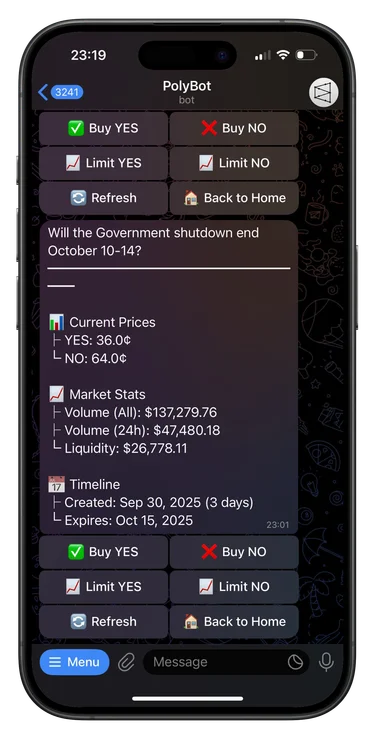
Why slippage tolerance matters on Polymarket
Prediction market prices are bounded between 0 and 100 cents. That makes small price differences more important than they may look.
If you planned to buy YES at 40 cents and the fill happens at 45 cents, the trade is not just 5 cents worse. Your upside to a correct resolution moved from 60 cents per share to 55 cents per share. Your downside also grew because you paid more for the same binary payout.
That is why slippage tolerance should come from the trade idea, not from a default number.
Ask:
- How much edge do I think this trade has?
- Is the edge large enough to survive a worse fill?
- Is the market moving because of real information or temporary noise?
- Is the order size small enough for visible depth?
- Would I rather skip than chase?
- Would a limit order express the trade better?
If a trade only has a small expected edge, loose slippage can erase it. If the market is repricing after confirmed news, very tight slippage can miss the trade entirely.
For price and probability context, read Polymarket odds and prices explained.
Slippage tolerance is different from spread
Spread and slippage are related, but they are not the same thing.
The bid-ask spread is visible before the trade. It is the gap between the best bid and best ask.
Slippage is what happens between your expected price and your actual fill after the order interacts with the book.
A wide spread warns you that immediate execution may already be expensive. Slippage tolerance controls how much worse than expected the trade is allowed to become.
Example:
- best bid: 47 cents
- best ask: 52 cents
- displayed midpoint: about 49.5 cents
- market buy expectation: closer to 52 cents, not 49.5 cents
- deeper asks: 53, 54, and 56 cents
If your buy size consumes the 52 cent ask and keeps filling into 54 cents, the spread was the first cost and slippage was the additional price drift from size, timing, or depth.
For the full book-reading workflow, read the Polymarket order book guide.
Market orders and slippage tolerance
Market orders prioritize immediate execution.
That does not mean they should accept any price. Polymarket's market-order documentation describes market-style orders as immediate execution against resting liquidity, with FOK and FAK behavior, and the price field acting as a worst-price limit for slippage protection.
Trader translation:
- FOK means fill the whole order immediately or cancel it.
- FAK means fill what is available immediately and cancel the rest.
- The protection limit decides how far the order is allowed to reach.
- A skipped or failed order can be better than a bad fill.
Use tighter slippage for market orders when:
- the spread is already wide
- visible depth is thin
- your size may walk the book
- the market is stale or low volume
- the thesis has only a few cents of expected edge
- you would not want the position at a materially worse price
Use looser slippage only when:
- the market is moving fast for a confirmed reason
- missing the trade is worse than paying some extra spread
- your size is small relative to depth
- you have already decided the worse price is still acceptable
- the trade is part of a larger plan with defined exit rules
For the full order-type explanation, read Polymarket order types: FOK, FAK, GTC, and GTD.
Copy trading slippage tolerance
Copy trading has a special slippage problem: your reference price is usually the leader's fill, not the market midpoint.
If the leader buys YES at 41 cents and your copied order fills at 48 cents, you did not copy the same trade. You copied a later, worse version of it.
That is why slippage tolerance is one of the most important copy-trading settings.
Tight copy-trading slippage is useful when:
- the leader trades thin markets
- the leader's edge depends on early entry
- the leader buys around breaking news
- the leader trades small, fast-moving positions
- you are testing a wallet and want clean data
- you care more about fill quality than copy count
Loose copy-trading slippage is only reasonable when:
- the leader's edge is large enough to survive worse entries
- the market has deep liquidity
- skipped trades are clearly worse than worse fills
- copied fills remain close to leader fills in review
- daily caps and size limits already protect exposure
Do not judge a copy setup only by how many trades it mirrors. A lower fill rate with better price quality can be stronger than a high fill rate with bad entries.
For the full setup loop, read the Polymarket copy trading settings guide. If copied trades are skipping, use the Polymarket copy trading skipped trades guide before loosening every filter.
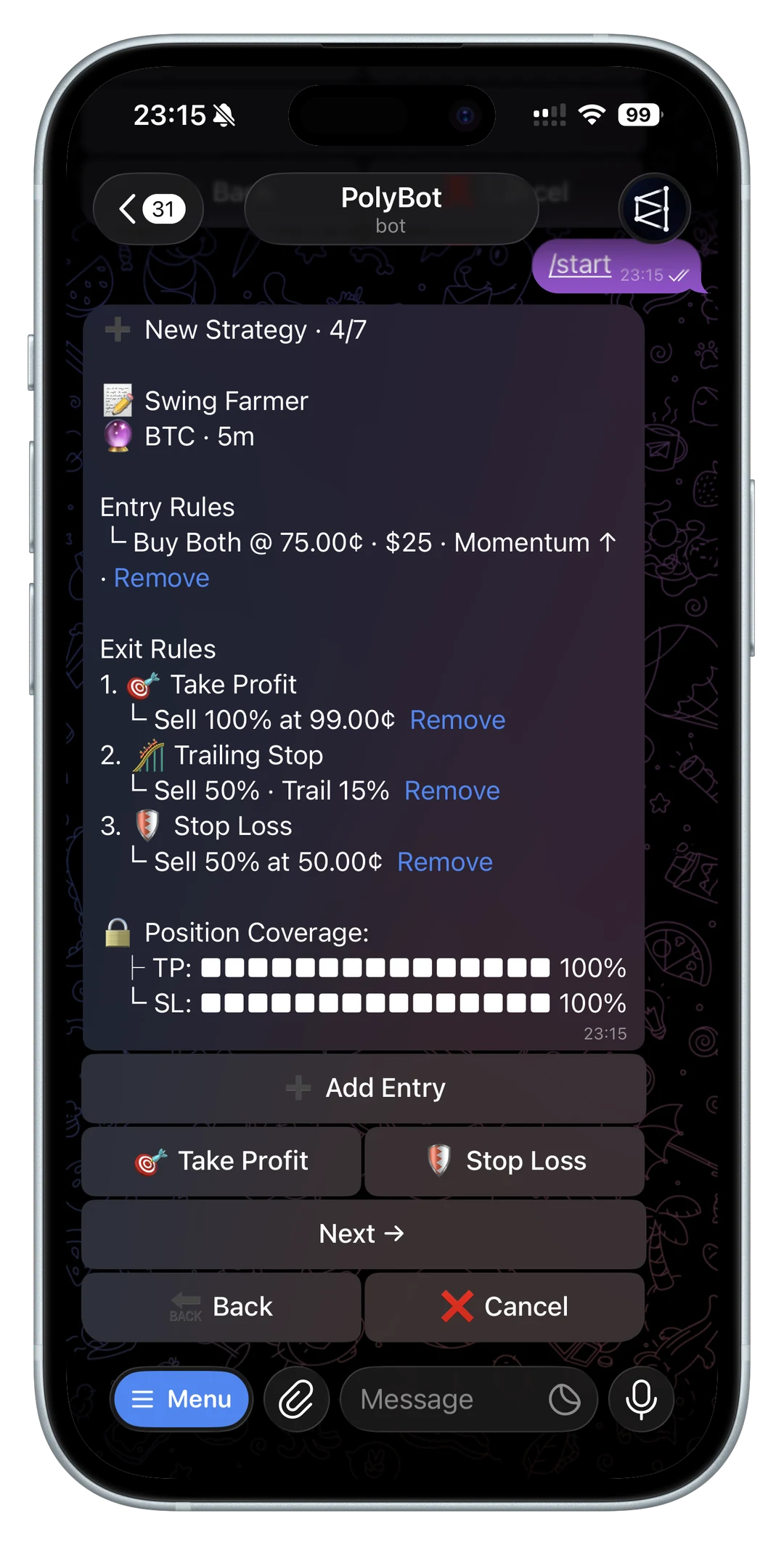
Slippage tolerance and limit orders
Limit orders are the main alternative to loose slippage.
If you know the maximum price you want to pay, a limit buy expresses that directly. If you know the minimum price you will accept to exit, a limit sell expresses that directly.
Use a limit order instead of wider slippage when:
- you want price control more than immediate entry
- the spread is wide
- the market is thin
- you are reacting to an alert but do not want to chase
- the trade idea is valid only at a specific price
- you can tolerate not filling immediately
The tradeoff is fill certainty. A strict limit order may sit open, partially fill, or never fill. That can be the right outcome if the alternative is accepting a price that breaks the trade.
For open-order review, read the Polymarket portfolio orders guide.
Partial fills and failed orders are feedback
A partial fill is not automatically bad. A failed order is not automatically bad either.
Both can mean the market did not have enough liquidity at prices you were willing to accept.
Review partial fills by asking:
- Did the filled size still justify the trade?
- Did the remaining amount cancel or stay open?
- Did the average fill price stay inside the plan?
- Did the order stop because slippage protection worked?
- Should future orders be smaller?
- Should this market use limit orders instead?
Review failed or skipped orders by asking:
- Was there no matching liquidity?
- Did price move beyond tolerance?
- Was the order too large for current depth?
- Did the market enter a delayed, paused, resolved, or invalid state?
- Did balance, allowance, size, tick, or order-type rules block it?
For deeper troubleshooting, use the Polymarket partial fills guide and the Polymarket failed order error codes guide.
Settings should match the workflow
There is no universal slippage tolerance for every Polymarket workflow.
Different workflows need different defaults:
| Workflow | Slippage posture | Why |
|---|---|---|
| Small manual trade in a liquid market | moderate | execution matters, but depth is usually available |
| Large manual trade | strict | size can walk the book |
| Copy trading a fast wallet | strict at first | you need to learn whether fills stay close |
| Breaking news reaction | situational | confirmed news may justify speed, rumors do not |
| Thin long-shot market | strict | a few cents can change expected value sharply |
| Limit-order strategy | no need to widen | the limit price already controls execution |
| Testing a new leader | strict | clean data matters more than fill count |
Use /settings and trade-confirmation habits together. A default can help, but the right answer still depends on market depth, order size, and whether the trade needs speed or price discipline.
For Telegram configuration context, read the Polymarket Telegram bot settings guide and the Polymarket Telegram bot commands guide.
Alerts, scanners, and news need a second check
Alerts and scanners are discovery tools. They should not make slippage decisions by themselves.
A price alert can fire at 45 cents, but the executable ask may already be 50 cents by the time you open the market. A volume alert can show activity, but the book may still be thin for your size. A news alert can point to a real catalyst, but the best entries may be gone before confirmation.
Before converting an alert into a market order, check:
- current best bid and ask
- spread
- depth near your expected price
- whether the alert price is still available
- whether the move is confirmed or speculative
- whether a limit order would avoid chasing
- whether the slippage setting matches the urgency
Use the Polymarket price alerts bot guide, Polymarket market scanner bot guide, and Polymarket news trading bot guide to keep discovery separate from execution.
Review slippage in PnL, not only at entry
Slippage tolerance should be reviewed after trades close, not only before entry.
A copied setup may look active but perform poorly because the follower consistently buys worse than the leader. A manual workflow may have good market ideas but weak results because entries cross too much spread. A fast alert workflow may create excitement but lose edge through late fills.
Track:
- expected entry price
- actual average entry price
- leader fill versus copied fill
- alert trigger price versus fill price
- exit price
- realized PnL
- unrealized PnL on open positions
- skipped trades and skip reasons
- partial fills
- failed orders
If the same workflow repeatedly fills worse than expected, tighten slippage, reduce size, use limit orders, or avoid that market type.
For review, use the Polymarket PnL tracker guide, Polymarket portfolio tracker bot guide, and Polymarket trade history CSV guide.
Practical slippage tolerance checklist
Before widening slippage, answer:
- What is my expected price?
- What is the current best bid or ask?
- How wide is the spread?
- How much depth exists at usable prices?
- Will my size walk through multiple levels?
- Is the market moving because of confirmed information?
- Would I still want the trade at the worst allowed price?
- Would a limit order express the idea better?
- Am I copying the same trade or a worse delayed version?
- If the order skips, is that a problem or useful protection?
After the trade, review:
- Was the fill inside the plan?
- Was the average price close to the expected price?
- Did the order partially fill?
- Did the copied fill stay close to the leader fill?
- Did slippage explain the PnL difference?
- Should future size be smaller?
- Should this workflow use stricter tolerance?
- Should this market type be alert-only?
The best slippage tolerance is not the number that fills the most trades. It is the number that preserves the reason for entering the trade.
FAQ
What is Polymarket slippage tolerance?
Polymarket slippage tolerance is the maximum price drift you are willing to accept between the expected price and the actual fill. In a Telegram workflow, it helps decide whether a market order or copied trade should fill, skip, partially fill, or fail instead of accepting a worse price.
What slippage tolerance should I use on Polymarket?
There is no universal number. Use tighter tolerance for thin markets, large orders, copy trading, and small-edge trades. Use looser tolerance only when the market is liquid, the size is small, and the trade still makes sense at the worst allowed price.
Is tight slippage always better?
No. Tight slippage protects price quality but can skip more trades. That is useful when bad fills are worse than missed fills. It can be too strict when a market is moving quickly and the trade still has edge at a slightly worse price.
Does slippage tolerance remove slippage?
No. It only limits how much slippage the order is allowed to accept. It cannot create liquidity, narrow the spread, or stop other traders from consuming the book first.
Should I loosen slippage if copied trades skip?
Only after reviewing why they skipped. If the copied fill would have been much worse than the leader fill, the skip may be good protection. If the market is liquid and skipped trades would still have edge, a modest adjustment may make sense.
When should I use a limit order instead of wider slippage?
Use a limit order when the trade is only attractive at a specific price, the spread is wide, the market is thin, or you would rather miss the trade than chase it. Wider slippage fits better when immediate execution is more important and the worst allowed price is still acceptable.
Polymarket Liquidity, Spread, and Slippage in Telegram Trading
Learn how Polymarket liquidity, bid-ask spread, slippage, market orders, limit orders, partial fills, and failed FAK/FOK orders affect Telegram trading and copy trading.
Execution / 11 min
Polymarket Market Orders From Telegram: Fast Buys, Sells, Slippage, and Risk
How to use Polymarket market orders from Telegram: market buys, market sells, bid-ask spread, slippage, FAK/FOK behavior, partial fills, failed orders, and safer review.
Execution / 11 min