Polymarket Negative-Risk Markets in Telegram: Multi-Outcome Trading Guide
Learn how Polymarket negative-risk markets work, why multi-outcome events need extra review, and how to trade them from Telegram without confusing outcomes, orders, or approvals.

PolyBot Team
Updated June 1, 2026
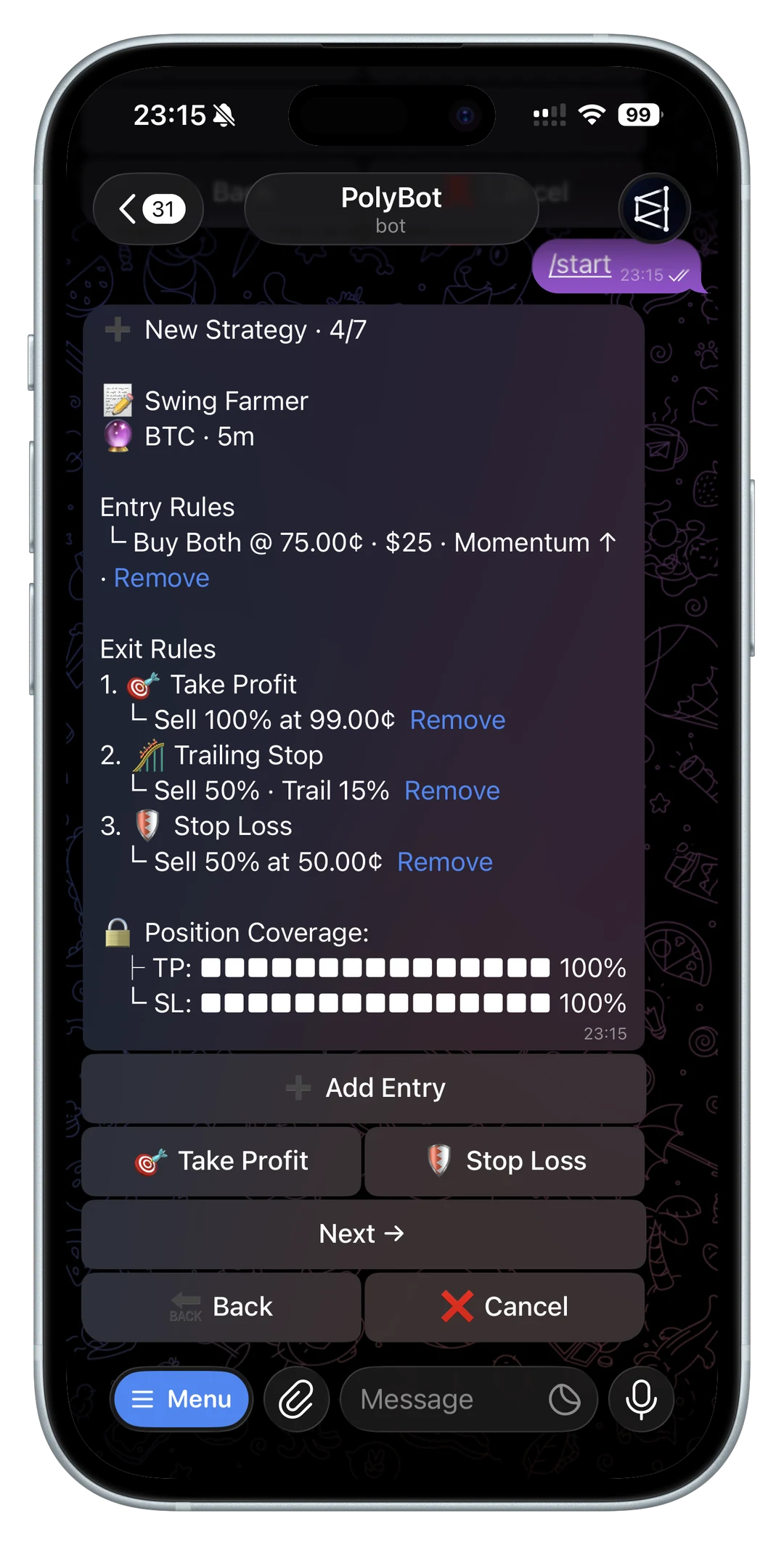
Negative-risk markets are one of the most important Polymarket concepts to understand before trading multi-outcome events.
A simple binary market asks one question with two sides: YES or NO. A negative-risk event can involve several related outcomes where only one outcome can win. That changes how positions relate to each other, how approvals may work, and how carefully traders should read each outcome before placing an order.
PolyBot's official Trading Guide says PolyBot supports standard and negative-risk markets, including categorical market flows and contract approvals for older wallets. Polymarket's official Negative Risk Markets documentation explains the underlying mechanism for multi-outcome events. This guide turns those mechanics into a trader checklist for Telegram workflows.
If you are evaluating structured price differences across related outcomes, read the Polymarket arbitrage guide before treating a negative-risk basket as a simple free edge.
What negative risk means on Polymarket
Negative risk is a mechanism for multi-outcome events where only one outcome can win.
In a standard set of independent binary markets, buying NO on one outcome does not automatically create exposure to every other outcome. In a negative-risk event, the outcomes are connected through a conversion mechanism. Polymarket's docs explain that a NO share in one market can be converted into YES shares in every other market in the same event through the Neg Risk Adapter.
Trader translation: the event is not just a pile of unrelated binary markets. The outcomes are part of one structure.
If the basic YES/NO price and payout model is still unclear, start with Polymarket odds and prices explained before trading multi-outcome events.
That structure can make trading more capital-efficient, but it also makes review more important. You need to understand which outcome you are trading, what happens if that outcome loses, and how the market fits into the larger event.
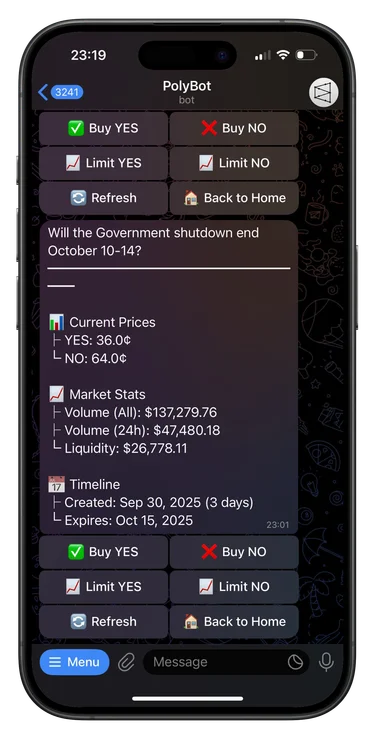
Why multi-outcome events need slower review
Multi-outcome events are easier to misread than simple YES/NO markets.
Examples include:
- election winner markets
- award winner markets
- tournament winner markets
- candidate or nominee markets
- categorical events where many possible outcomes compete
For the politics workflow behind those examples, read the Polymarket politics and election trading bot guide.
The risk is not only picking the wrong side. It is picking the wrong outcome in the right event.
Before trading, confirm:
- event title
- exact outcome name
- whether the market is binary or part of a multi-outcome event
- whether other outcomes in the same event affect your thesis
- current price for the outcome you selected
- liquidity and spread for that specific outcome
- time to resolution
- what happens if an unlisted or "Other" outcome wins
Telegram can make the workflow faster, but it should not make this review disappear.
Negative risk is not a strategy by itself
Negative risk describes market structure. It is not a trading edge.
A negative-risk event can still be:
- mispriced
- illiquid
- crowded
- close to resolution
- hard to hedge
- easy to misunderstand
The structure may allow more efficient exposure across outcomes, but the trader still needs a thesis. Do not buy an outcome only because the event is negative-risk. Buy only if the price, liquidity, event structure, and resolution rules still make sense.
For the settlement and dispute side of those rules, read the Polymarket resolution rules guide.
For the order-book side, read the Polymarket liquidity, spreads, and slippage guide.
How negative-risk markets show up in Telegram
In a Telegram trading workflow, the most important job is making the outcome clear.
PolyBot's trading docs describe paste-to-trade for Polymarket links. For categorical markets, the bot lists outcomes with trade links back into the bot and a view link to Polymarket. That matters because the user should choose the specific outcome deliberately instead of treating the whole event like one YES/NO market.
When a negative-risk or categorical market opens in Telegram, slow down enough to check:
- which event you opened
- which outcome button or link you selected
- whether the displayed price belongs to that outcome
- whether you are buying, selling, or placing a limit order
- whether the market card was refreshed recently
- whether the event has related outcomes worth comparing
For discovery, use the Polymarket market search in Telegram guide before treating a result as actionable.
Market orders versus limit orders in negative-risk events
Order type still matters.
A market-style order prioritizes immediate execution against available liquidity. A limit order prioritizes price. In negative-risk events, that choice can be even more important because liquidity may vary across outcomes in the same event.
One outcome may have tight spreads and active trading. Another may be thin, stale, or mostly ignored. A market order on the wrong outcome can be much worse than the same order on a liquid binary market.
Use market-style orders only when:
- the outcome is definitely the one you want
- the spread is acceptable
- enough size is available
- immediate execution matters
- the current price still fits your thesis
Use limit orders when:
- the spread is wide
- you want a specific entry
- the event is active but the outcome is thin
- you are waiting for a better price
- the market is moving too quickly to trust a quick market buy
For price-control workflow, read Polymarket order types and Polymarket limit orders from Telegram.
Approvals and wallet behavior
Negative-risk markets may use different contracts from standard markets.
Polymarket's order documentation says multi-outcome events use the Neg Risk CTF Exchange and require the negative-risk option when orders are submitted programmatically. PolyBot's docs say current wallets are pre-approved for required contracts and older wallets may auto-approve on demand, which can produce a brief retry prompt.
Trader translation: if a negative-risk trade asks you to retry after a brief approval or wallet setup step, do not panic and do not blindly keep changing price or size. First classify the issue.
Check:
- did the bot say approvals or wallet setup are finishing?
- is this an older wallet?
- did the order actually fail, or is the setup step still completing?
- is the market still open after the retry?
- did the price or spread change while waiting?
For broader error handling, use the Polymarket order failed guide.
Augmented negative risk and "Other" outcomes
Some negative-risk events can change as new named outcomes emerge.
Polymarket's docs describe augmented negative risk as a structure where named outcomes, placeholder outcomes, and an explicit "Other" outcome can exist. They also warn that placeholder outcomes should be ignored until named, and that "Other" can narrow as placeholders are clarified.
For a trader, this means "Other" is not always a simple catch-all you can casually buy.
Before trading "Other" or a newly clarified outcome, ask:
- what is currently included in "Other"?
- could a placeholder be clarified later?
- has the event page changed since you first saw it?
- does the Polymarket UI display the outcome clearly?
- do you understand what resolves to this outcome?
If you cannot explain the outcome in plain language, skip the trade or keep researching.
Copy trading and multi-outcome exposure
Copy trading can make negative-risk events harder to monitor.
A leader wallet may trade several outcomes in the same event. If you copy only one leg, copy every leg at different prices, or miss one trade because of liquidity, your exposure may not match the leader's actual setup.
Before copying a wallet that trades multi-outcome events, check:
- does the leader trade entire event structures or single outcomes?
- do they hedge across outcomes?
- do they average into the same outcome repeatedly?
- do they exit one outcome while entering another?
- can your bankroll copy the full structure?
- do your per-market and per-outcome caps prevent overexposure?
Use the copy trading settings guide and the copy trading bankroll guide before copying wallets that specialize in complex events.
Portfolio review after negative-risk trades
Post-trade review matters because multi-outcome events can create more positions to track.
After trading, check:
- which event the position belongs to
- which outcome side you hold
- average entry price
- current price
- unrealized PnL
- open limit orders on related outcomes
- whether resolved outcomes need redemption
- whether you have exposure to multiple outcomes in the same event
The Polymarket portfolio and orders guide explains how positions, open orders, sells, PnL, and resolved markets fit into one review workflow.
Common mistakes in negative-risk markets
Avoid these patterns:
- treating every multi-outcome event like a simple binary market
- buying an outcome without comparing related outcomes
- ignoring "Other" definitions
- chasing a market order in a thin outcome
- leaving old limit orders open after event news changes
- assuming a copied wallet's full event exposure was copied cleanly
- retrying an approval-related message without refreshing price
- forgetting that liquidity can differ across outcomes in the same event
Most mistakes come from moving too fast. A Telegram workflow can still be disciplined if the confirmation screen forces you to read the outcome and price before execution.
Negative-risk trading checklist
Before trading a negative-risk or multi-outcome market from Telegram, confirm:
- The exact event and outcome.
- Whether only one outcome can win.
- Current price for the selected outcome.
- Spread and available liquidity.
- Whether a market order or limit order fits.
- Whether "Other" or placeholders matter.
- Whether older wallet approvals are still finishing.
- Whether related outcomes affect your thesis.
- Whether copy settings could overexpose you to one event.
- How you will review the position after the trade.
If any item is unclear, slow down. The best execution workflow is the one that helps you avoid confident mistakes.
FAQ
What is a Polymarket negative-risk market?
It is a multi-outcome event structure where only one outcome can win and positions across outcomes can be related through a conversion mechanism. It is designed for capital-efficient trading in events with several possible winners.
Is a negative-risk market safer?
Not automatically. Negative risk is a market structure, not a safety guarantee. Prices, liquidity, spread, resolution rules, and trader behavior still matter.
Can I trade negative-risk markets from Telegram?
PolyBot's trading docs say it supports standard and negative-risk markets. The practical requirement is to review the event and outcome carefully before confirming any order.
Why did my negative-risk order ask me to retry?
PolyBot's docs say older wallets may need an on-demand approval flow for required contracts. If that happens, refresh and recheck price, spread, and outcome before retrying.
Should beginners trade multi-outcome markets?
Beginners should understand simple binary markets first. Multi-outcome markets can be traded, but they require extra review of event structure, outcome wording, liquidity, and related positions.
Slow down on the outcome, not the workflow
Negative-risk markets are not something to fear, but they are something to understand.
Telegram can make finding and trading them faster. Your job is to make sure speed does not hide the event structure. Read the outcome, compare related markets, check liquidity, and choose the order type intentionally.
Not investment advice. Prediction markets are risky, and multi-outcome events can be misunderstood even when the interface is fast.
How to Sell a Polymarket Position: Market Sells, Limit Sells, Stop Losses, and Redeems
A practical guide to closing Polymarket positions from Telegram: market sells, limit sells, partial exits, stop losses, take profits, open orders, liquidity, PnL, redeeming winners, and withdrawals.
Execution / 10 min
Why Did My Polymarket Limit Order Not Fill? Price, Liquidity, and Open Order Fixes
A practical guide for Polymarket traders whose limit order is still open, partially filled, stale, rejected, or not matching from Telegram.
Execution / 9 min